


Why do so many Australian professionals suffer from persistent lower back ache despite investing in high-end ergonomic chairs? With musculoskeletal disorders costing the Australian economy an estimated $55.1 billion annually, the physical health of your team isn't just a comfort issue; it's a productivity one. The reality is that even the best seating can't fix a workstation where your feet don't reach the floor, leading to significant pressure on your thighs and poor spinal alignment. Understanding the nuances of ergonomic footrest benefits and placement is the critical bridge between a standard desk height and your unique physical requirements.
You've likely felt that creeping fatigue after hours of sitting, or perhaps you're struggling to help shorter staff members find a comfortable position at an adjustable desk. It's a common frustration in offices across the country, from Sydney boardrooms to Melbourne home offices. We'll show you exactly how to eliminate this discomfort while ensuring your workplace remains compliant with the latest Australian WHS recommendations. This professional guide provides a clear roadmap for selecting the right hardware and positioning it for maximum physical relief. You'll learn the technical specifications to look for and the precise alignment strategies needed to support your lower back and legs throughout the workday.
Key Takeaways
- Learn why standard 720mm Australian desks often require a footrest to achieve proper spinal alignment for shorter staff members.
- Understand the essential ergonomic footrest benefits and placement strategies to maximise lower back support and reduce leg fatigue.
- Discover how to improve venous return and blood circulation by maintaining correct hip and knee angles throughout the day.
- Get a practical step-by-step guide on adjusting your workstation, starting with your chair height relative to the desk surface.
- Compare industrial-grade materials and surface textures to ensure your selection meets the demands of high-traffic commercial environments.
Understanding the Role of Ergonomic Footrests in the Australian Workplace
An ergonomic footrest isn't just a comfort accessory; it's a functional tool designed to provide lower limb stability and ensure correct spinal alignment. While many people associate the concept with a traditional Footstool used in a lounge room, the professional version is a piece of precision hardware. Its primary role is to bridge the gap between a user's feet and the floor when their chair has been raised to the correct height for their desk. This adjustment is vital for maintaining a neutral posture, where the spine is supported and the body isn't straining to reach the workstation.
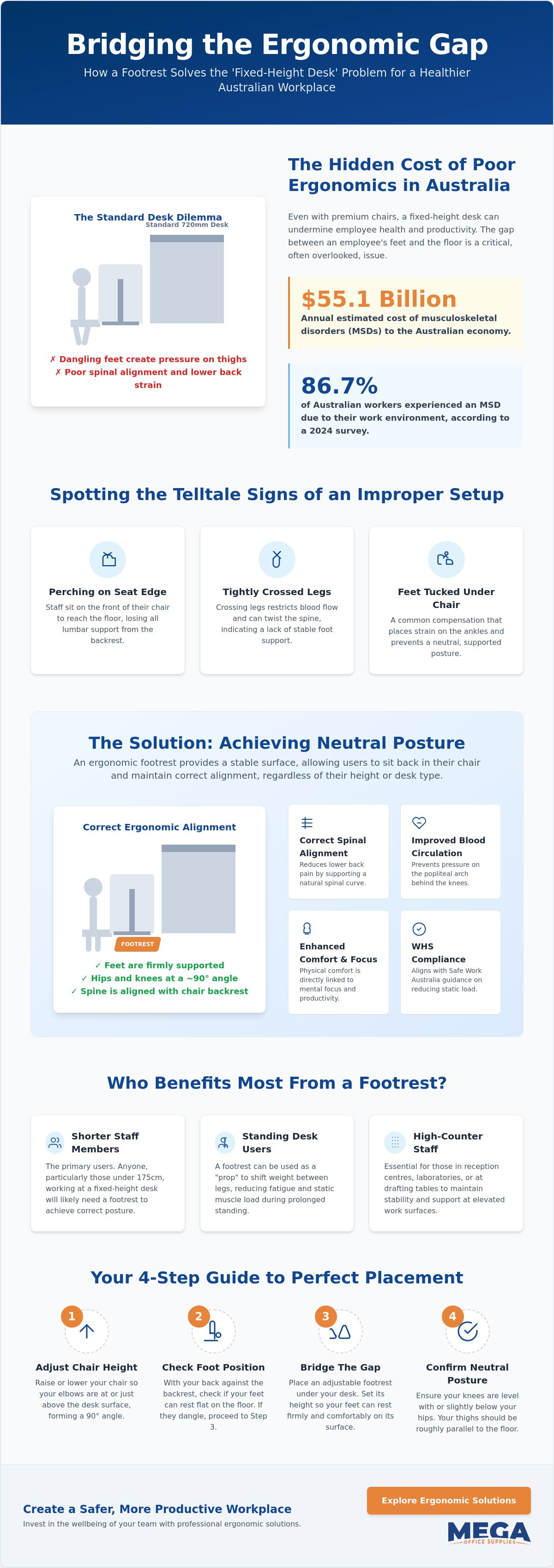
In many Australian offices, the "Fixed Desk Height" problem is a major hurdle for workplace ergonomics. Most standard desks are manufactured to a fixed height of approximately 720mm, a measurement based on the biometrics of the average male. For shorter staff members, this height is often too tall. If they lower their ergonomic office chairs to reach the floor, their elbows end up below the desk surface, causing shoulder strain. If they raise the chair to type comfortably, their feet dangle. This lack of support creates significant pressure on the thighs and lower back.
To better understand this concept, watch this helpful video:
When feet aren't firmly planted, you'll notice tell-tale signs of poor ergonomic setup. Staff members might perch on the very edge of their seat to reach the floor, losing all the support of the chair's backrest. Others might cross their legs tightly or tuck their feet under the chair's five-star base. These compensations are clear indicators that the workstation requires a better understanding of ergonomic footrest benefits and placement to prevent long-term musculoskeletal issues.
The Science of Lower Limb Stability
Proper foot support is essential for protecting the popliteal arch, which is the sensitive area behind your knees. When feet dangle, the front edge of the seat pan exerts constant pressure on this area, potentially restricting blood flow and causing "pins and needles." By using a footrest, you facilitate a slight posterior pelvic tilt, which helps the lower back rest naturally against the chair. This setup aligns with Safe Work Australia's guidance on managing hazardous manual tasks by reducing static loading on the body.
Who Benefits Most from an Under-Desk Footrest?
While anyone can use one, certain users find them indispensable. Individuals under 175cm tall working at fixed-height desks are the primary group, as they're most likely to experience the "dangling feet" syndrome. Secondary users include those at standing desks who use a footrest as a "prop" to shift their weight and reduce fatigue. Staff in high-counter environments, such as reception centres or laboratories, also rely on these tools to maintain stability while working at elevated surfaces.
Key Health and Productivity Benefits of Proper Foot Support
Investing in workplace ergonomics is a strategic decision that directly impacts the bottom line. With musculoskeletal disorders (MSDs) costing the Australian economy an estimated $55.1 billion annually, the physical health of staff is a primary concern for any well run organisation. A 2024 survey by the Australian Chiropractors Association found that 86.7% of Australian workers experienced an MSD due to their work environment. Integrating a professional grade footrest into your workstation is a proven method to mitigate these risks. By understanding the ergonomic footrest benefits and placement, you can effectively standardise comfort across your team, regardless of individual height differences.
Physical comfort is inextricably linked to mental focus. When a staff member is distracted by a dull ache in their lower back or a heavy sensation in their legs, their cognitive output drops. This is particularly evident during the notorious afternoon slump. Providing stable foot support facilitates a 90-degree angle at the hips and knees, which stabilises the torso and allows for sustained concentration. It's a simple adjustment that transforms a sedentary role from a physical endurance test into a productive professional experience.
Circulation and Varicose Vein Prevention
Prolonged sitting in climate-controlled Australian offices often leads to poor venous return. When feet dangle or rest unevenly, the front edge of the chair pan creates a "hammock effect," where the seat material presses into the underside of the thighs. This pressure restricts blood flow and increases the risk of varicose veins. A rocking footrest encourages subtle, frequent movement of the ankles. This rhythmic motion acts as a "second heart" for the legs, pumping blood back toward the torso and reducing the swelling often reported by sedentary workers. Following Safe Work Australia's health and safety guidelines regarding varied posture is essential for maintaining long-term vascular health.
Alleviating Lower Back and Sciatic Pressure
Providing firm foot support allows the pelvis to tilt correctly so that the natural lumbar curve of the spine meets the chair's backrest for full support. Without this foundation, users inevitably slump forward, which overstretches the ligaments in the lower back and compresses the spinal discs. This poor positioning is a leading cause of sciatic nerve discomfort, as the pressure travels from the base of the spine down through the legs. Proper placement ensures the weight of the legs is distributed through the feet rather than being pulled by gravity from the lower vertebrae. If you are looking to upgrade your team's setup, exploring our range of ergonomic workplace accessories can help you find a durable solution that fits your specific office layout.
How to Choose the Right Footrest for Your Specific Environment
Selecting the right ergonomic equipment is a matter of matching technical specifications to the physical demands of your specific workplace. While the general ergonomic footrest benefits and placement strategies remain consistent, the hardware itself must withstand the environment. In a high-traffic commercial setting, durability is paramount. Heavy-duty metal construction is the industry standard for longevity, whereas high-impact plastic models offer a lightweight, cost-effective solution for standard administrative tasks.
Floor compatibility is a frequently overlooked technical detail. A footrest that slides on office carpet or warehouse concrete becomes a significant safety hazard and fails to provide the stable foundation required for spinal support. Professional grade units feature rubberised, non-marking feet that grip the surface. This stability ensures the unit stays exactly where it's placed, maintaining the user's neutral posture throughout the shift.
Features to Compare: Tilt, Height, and Surface
According to WorkSafe Victoria's ergonomic workstation guidance, a proper footrest should be large enough to support both feet and have a non-slip surface. Understanding these ergonomic footrest benefits and placement variables is the key to selecting a unit that won't end up unused under a desk. Consider these features during your procurement process:
- Tilt and Height: Foot-controlled tilt mechanisms allow for rapid adjustments without the user needing to bend down, which is essential for maintaining a rhythmic workflow.
- Surface Texture: Massaging nubs provide tactile feedback for those working in socks or soft-soled shoes, while flat anti-slip surfaces are mandatory for those wearing professional footwear or work boots.
- Platform Width: A wide platform allows for a broader range of movement, enabling users to shift their weight and engage in active sitting.
Selecting for the Sector: Schools, Warehouses, and Offices
Australian schools require hardware that can endure the rigours of the classroom. For growing adolescents, height-adjustable models are vital to accommodate rapid physical changes. In warehouse and industrial environments, heavy-duty metal options are the only logical choice to withstand the weight of staff wearing steel-capped work boots. For professional corporate environments, selecting sleek, low-profile designs ensures the hardware complements high-quality ergonomic office chairs while providing the necessary lower limb support. By prioritising these specific requirements, you can ensure that your investment in workplace health yields long-term results for your entire organisation.
Step-by-Step Guide to Correct Footrest Placement and Setup
Achieving a professional workstation setup requires a logical, tiered sequence. Many users make the mistake of placing the hardware first, which often results in a disjointed posture that fails to address the root cause of discomfort. To fully realise the ergonomic footrest benefits and placement advantages, you must follow a structured process that prioritises the relationship between your body and the desk surface. This methodical approach ensures that your spine remains in a neutral position throughout the workday.
Follow these five steps to standardise your workstation alignment:
- Step 1: Adjust your chair height so your elbows are level with the desk surface. Your forearms should be parallel to the floor when typing.
- Step 2: Measure the gap between your feet and the floor. If your heels do not rest firmly, you require a footrest to bridge this distance.
- Step 3: Position the footrest directly under the desk. It must be perfectly aligned with the centre of your chair to prevent hip twisting.
- Step 4: Adjust the angle of the platform to match the natural flex of your ankles. A tilt of approximately 10 to 15 degrees is standard for most professional roles.
- Step 5: Test the "90-90-90" rule. Your ankles, knees, and hips should all maintain 90-degree angles to ensure optimal blood flow and spinal support.
The Chair-First Rule of Ergonomic Alignment
Chair adjustment is the anchor for your entire workstation. You must never adjust the footrest before your chair height is locked in relative to the desk. This sequence ensures your arms are positioned correctly to prevent shoulder strain and repetitive strain injuries. If you need assistance with your initial seat settings, refer to our complete guide to ergonomic office chairs for seat depth and lumbar tips. Footrests effectively solve the "tall chair" problem created by high Australian desks, allowing you to raise your seat for typing while keeping your lower limbs fully supported.
Placement in Varied Australian Work Environments
Different sectors present unique challenges for hardware positioning. In reception areas, staff often deal with limited legroom and high counters, requiring a low-profile footrest that provides stability without obstructing movement. Home office users must ensure their footrest is compatible with standing desk mats to prevent the unit from sliding during transitions. In classrooms, standardising footrest use at fixed-height computer carrels helps students of different heights maintain focus. To complete your workstation setup, view our full range of professional footrests and ergonomic accessories today.
Integrating Footrests into Your Complete Ergonomic Station
A professional workstation functions as a single, cohesive system where every component supports the user's biometrics. While the chair and desk receive the most attention, the footrest is the essential final link in this chain. It ensures that the ergonomic settings you have painstakingly dialled in remain effective throughout a full shift. By standardising ergonomic footrest benefits and placement as part of your facility's baseline, you eliminate the physical variances that lead to workplace fatigue and long-term musculoskeletal strain.
Beyond providing a static platform, modern footrests facilitate "Active Sitting." This concept involves making frequent, micro-adjustments to your posture to prevent sedentary fatigue. A footrest with a dynamic tilt mechanism allows the user to flex their ankles and shift their weight without breaking their concentration. This subtle movement keeps the lower limbs engaged and prevents the stiffness often associated with prolonged administrative tasks.
Longevity depends on regular maintenance. In high-traffic commercial environments, check the adjustment mechanisms every quarter to ensure the tilt tension remains firm. Clean the non-slip surfaces using professional grade cleaning chemicals to maintain the grip required for safety. Procurement officers should treat these units as a standard component of any office furniture fit-out rather than an optional extra requested only after an injury occurs.
The Synergy of Footrests and Sit-Stand Desks
Footrests are remarkably effective when paired with standing desks. When you are upright, using a footrest as a "foot prop" allows you to adopt the "Captain Morgan" pose, where one foot is slightly elevated. This position shifts your pelvic tilt and immediately alleviates pressure on the lumbar spine. Transitioning between sitting and standing is more efficient when an adjustable footrest is already in position to support the "90-90-90" rule during seated intervals. We recommend rocking footrests for standing desk users to encourage micro-movements that reduce static loading on the legs.
Next Steps for Workplace Procurement
Conducting a basic ergonomic audit is the first step toward departmental health. Identify staff members who are currently perching or whose feet do not reach the floor comfortably after their chair height is set. For larger organisations and public sector departments, we provide streamlined procurement options to simplify the rollout. We accept Australian Government purchase orders for all workplace upgrades. If you require a comprehensive solution for your facility, please contact us to discuss bulk ergonomic footrest benefits and placement requirements for your specific sector.
Maximising Workplace Health and Professional Efficiency
Achieving a truly ergonomic environment requires more than just a high quality chair; it demands a foundation that supports your body's natural alignment. By mastering ergonomic footrest benefits and placement, you can effectively eliminate the physical strain caused by standard desk heights and improve lower limb circulation. Whether you are outfitting a corporate office, a school computer lab, or a warehouse workstation, the correct foot support is the final piece of the productivity puzzle.
Mega Office Supplies has been family owned and operated since 2008. We maintain a commitment to stability and reliability, offering national delivery for all office and facility supplies. Taking these practical steps to improve your workstation today will ensure your team remains focused and healthy for years to come.
Browse our full range of professional ergonomic footrests and secure a more comfortable future for your organisation today.
Frequently Asked Questions
Do I really need a footrest if my feet touch the floor?
You don't necessarily require a footrest if your feet are flat on the floor, provided your chair is already at the correct height for your desk. However, if you have lowered your seat simply to reach the ground, your elbows will likely sit below the desk surface, causing shoulder strain. In this scenario, it is better to raise the chair to the correct typing height and use a footrest to bridge the gap to the floor.
How high should my ergonomic footrest be set?
Set the height so that your knees are level with or slightly higher than your hips. This adjustment ensures that the weight of your legs is supported by the platform rather than pulling on your lower back. Most professional models offer multiple height increments, allowing you to match the exact measurement between your heels and the floor once your chair is locked into its optimal working position.
Can I use a footrest with a standing desk?
You can and should use a footrest with a standing desk to facilitate a "foot prop" position. Elevating one foot onto the platform while standing helps rotate the pelvis and immediately reduces static load on the lumbar spine. This weight shifting is a practical way to manage fatigue, allowing you to remain upright for longer periods without experiencing the typical lower back ache associated with stationary standing.
What is the best angle for an adjustable footrest?
The optimal angle for an adjustable footrest is generally between 10 and 15 degrees. This slight tilt follows the natural resting position of the human foot and prevents the shins from straining during long periods of use. Many high quality units feature a free floating tilt mechanism, which allows you to change the angle slightly throughout the day to keep your ankle joints mobile and reduce stiffness.
Are rocking footrests better than fixed ones for circulation?
Rocking footrests are superior for circulation because they encourage frequent, subtle movement of the ankle joints. This motion engages the calf muscles, which assist in pumping blood back toward the heart and reducing the risk of swelling. For staff in sedentary roles, this constant micro-movement is a key component of effective ergonomic footrest benefits and placement, helping to prevent the "heavy leg" sensation often felt by the end of the day.
How do I know if my footrest is in the right position?
You will know it is correctly positioned when your lower back remains in firm contact with your chair's lumbar support while your feet are flat on the platform. If you find yourself sliding forward or perching on the edge of the seat, the footrest is likely too far away. Ensure the unit is centred with your monitor and keyboard to avoid any subconscious twisting of your hips or spine during the workday.
What footwear is best to use with an ergonomic footrest?
Flat, supportive shoes are the best choice for maintaining a stable and comfortable position on an ergonomic platform. High heels or very thick soles can interfere with the intended angles of the unit and may lead to ankle instability over time. If your workplace allows for soft footwear or socks, choose a footrest with a textured or rubberised surface to ensure your feet don't slide off the platform during use.
Will a footrest help with my lower back pain at work?
A footrest can significantly reduce lower back pain by providing a stable foundation that allows the pelvis to sit in a neutral position. When your feet are properly supported, the weight of your legs is no longer pulling on your lower vertebrae, which helps alleviate the disc compression that causes workday aches. This alignment is a fundamental part of ergonomic footrest benefits and placement, ensuring your spine is supported by your chair's backrest as intended.

Article by
Mega Office Supplies Team
The Mega Office Supplies Team provides practical guidance for Australian businesses, schools, government organisations, healthcare providers, hospitality venues, warehouses and home offices. Based in Tweed Heads South, Mega Office Supplies is an Australian business, family owned and operated since 2008, offering office stationery, workplace furniture, technology products, labels, printers, cleaning and janitorial supplies, safety products, art materials, education resources and everyday business essentials from trusted brands.
General Information
This article is provided as general information only to help customers compare and choose office, workplace, school, cleaning, technology, furniture, safety and business supplies. Product details, specifications, compatibility, availability, pricing and suitability may vary. Always check the individual product page, manufacturer information, workplace requirements and relevant safety guidance before purchasing or using a product.


