




You've spent weeks preparing for a high-stakes exam or a complex financial audit, only to realise your smartphone is strictly prohibited at the door or your app-based keypad lacks the tactile response needed for rapid data entry. We agree that while digital devices are everywhere, they often fall short in high-security environments or during accounting sessions where every keystroke counts. This guide will help you identify the ideal calculator for your specific professional or educational requirements through an expert comparison of features, trusted brands, and strict compliance standards.
We'll examine why physical hardware remains the gold standard for Australian schools and offices, covering everything from VCE-approved CAS models to heavy-duty desktop units. Our team knows that a reliable set of buttons is far more dependable than a glass screen that decides to run out of juice at the worst moment.
Key Takeaways
- Understand why physical buttons help minimise entry errors, especially when your fingers are moving faster than a smartphone processor can handle.
- Learn to compare critical features such as digit capacity and 'roll-over' keyboard technology to ensure your hardware keeps pace with high-volume workloads.
- Identify the ideal calculator for your professional setting by matching specific hardware capabilities to your daily bookkeeping or financial analysis tasks.
- Discover how to choose a reliable device for various Australian work environments to ensure your hardware provides the precision required for daily operations.
Essential calculator types for professional and educational use
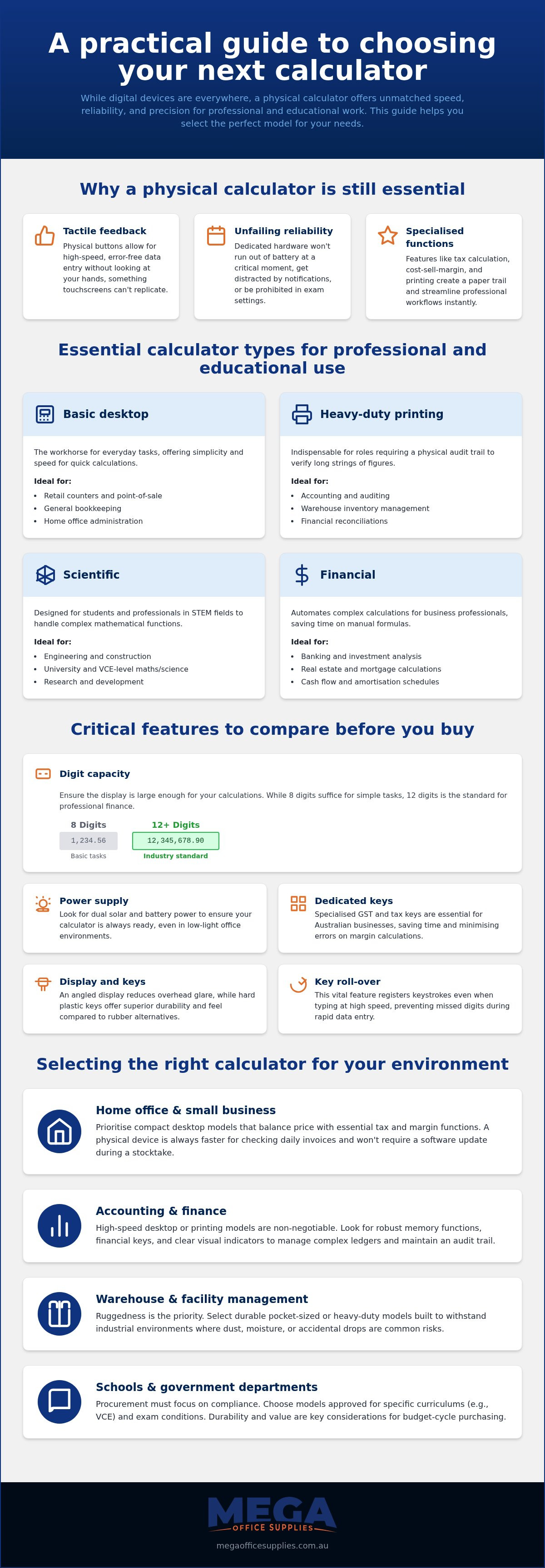
Choosing a physical device over a smartphone app isn't just about avoiding distractions; it's about operational precision. Physical keyboards provide tactile feedback that touchscreens simply cannot match. This allows for high-speed data entry without the need to look at your hands. Dedicated processors ensure that your calculator responds instantly, eliminating the input lag often found in mobile software during intensive sessions.
To better understand how these tools fit into a professional workflow, watch this helpful video:
For retail counters and general bookkeeping, a basic desktop model offers the simplicity needed for fast-paced environments. Conversely, heavy-duty printing models are indispensable in warehouse inventory management and accounting. They provide a physical audit trail on paper tape, which is critical for verifying long strings of figures during reconciliations or inventory checks. This reliable physical record has remained a professional staple throughout the history of calculators.
Distinguishing between scientific and financial models
Scientific models are the standard for engineering and STEM students, handling complex trigonometric and logarithmic functions with manual precision. Financial models serve a different purpose, automating calculations for interest rates, amortisation, and cash flow analysis without the need for manual formulas. If you're sourcing equipment for a classroom or university course, browse our range of educational supplies to find curriculum-compliant hardware that meets strict exam standards.
Critical features to compare before making a purchase
Selecting a professional calculator requires looking beyond basic arithmetic. For large-scale commercial calculations, digit capacity is the first technical hurdle. An 8-digit display might suffice for minor retail tasks, but 12-digit models are the industry standard for bookkeeping and corporate financial reporting. We recommend prioritising hardware with dedicated GST and tax keys. These specialised functions allow Australian businesses to calculate margins and tax obligations instantly, removing the manual steps where errors often creep in.
Keyboard ergonomics are equally vital for high-volume data entry. Look for key roll-over features, which allow the device to register a second keypress before the first is fully released. This prevents missed digits during high-speed numerical entry. You can explore our range of professional office technology supplies to find a model that fits your specific workflow.
Power supply and display considerations
Office reliability depends on a dual power source. Combining solar panels with a battery backup ensures the device never fails during a critical meeting or EOFY reconciliation. For the display, standard LCDs are common, but angled or adjustable screens are superior for reducing glare from overhead office lighting. We also suggest selecting models with hard plastic keys. Unlike rubber alternatives, plastic keys don't perish or become mushy over time, ensuring your hardware remains a dependable workplace asset for years to come.
Selecting the right calculator for your specific environment
Every workspace has unique computational demands. For home offices and small businesses, we suggest prioritising compact desktop models that balance price with essential tax functions. While you might use the Fair Work Ombudsman's Pay and Conditions Tool for payroll compliance, a physical device is faster for checking daily invoices. A reliable set of buttons won't ask for a software update in the middle of a busy stocktake.
In the accounting and finance sectors, high-speed desktop models are non-negotiable. These units require robust memory functions and clear visual indicators to manage complex ledgers. For those in warehouse or facility management, ruggedness is the priority. Select pocket-sized models built to withstand industrial environments where dust or accidental drops are common risks.
Procurement for schools and government departments
Educational and government buyers operate within strict compliance frameworks. It's vital to verify that scientific or graphing models meet specific state curriculum requirements, such as the NESA list for the NSW HSC or VCAA approvals for the VCE in Victoria. For instance, the Casio fx-8200 AU II is a key compliant model for 2026 examinations.
We've streamlined the ordering process to support these sectors. We accept official Australian Government purchase orders and provide direct support for bulk quoting. Educational bodies can access volume pricing through our local team, ensuring your organisation stays within budget while equipping students with the correct calculator technology.
Equipping your workplace for numerical precision
Selecting the right hardware is about more than just basic sums; it's about ensuring your team has the tools to maintain accuracy under pressure. Dedicated tactile buttons and specialised GST functions provide a level of reliability that software alone cannot match. Whether you're managing warehouse inventory or preparing students for state exams, the correct calculator serves as a foundation for error-free data entry. It's much harder to accidentally delete a budget when you're using physical keys instead of a greasy touchscreen.
As a family owned and operated business since 2008, we understand the logistical needs of local businesses and government departments. We offer national delivery supported by real people who can assist with bulk quotes and technical specifications.
browse our full range of professional calculators
Our team is ready to help you find a durable solution that keeps your operations running efficiently every day of the year.
Frequently asked questions
What is the difference between a scientific and a financial calculator?
Scientific models focus on complex mathematics used in engineering and STEM fields, providing dedicated keys for trigonometric and logarithmic functions. Financial models are specialised for business sectors, automating the calculation of interest rates, amortisation, and cash flow analysis. While you can perform basic arithmetic on both, the financial calculator is designed to eliminate manual formula entry for investment and banking professionals.
Which calculators are approved for australian high school exams?
Approved models vary by state curriculum requirements, so you must check the specific NESA (NSW) or VCAA (Victoria) lists before purchasing. For 2026 exams, the Casio fx-8200 AU II is a newly approved model for the HSC. In Victoria, Computer Algebra System (CAS) models like the TI-Nspire are often required for senior mathematics, though they are prohibited in other states.
Should i choose a solar-powered or battery-operated calculator?
Choosing a dual-power model that combines solar panels with a battery backup is the most reliable option for any workplace. Solar power handles daily operation under standard office lighting, while the battery ensures the device doesn't cut out during low-light conditions or critical meetings. This redundancy prevents the frustration of a dead screen during a high-stakes stocktake or a final exam.
Why are printing calculators still used in professional accounting?
Why are printing calculators still used in professional accounting?

Article by
Mega Office Supplies Team
The Mega Office Supplies Team provides practical buying guides and workplace advice for Australian businesses, schools, government organisations, healthcare providers, hospitality venues, warehouses and home offices. Family owned and operated since 2008 and based in Tweed Heads South on the Gold Coast–Tweed border, Mega Office Supplies helps Australian workplaces choose the right office supplies, furniture, technology, cleaning, safety and education products — backed by genuine local service from real people.
General Information
This article is provided as general information only to help customers compare and choose office, workplace, school, cleaning, technology, furniture, safety and business supplies. Product details, specifications, compatibility, availability, pricing and suitability may vary. Always check the individual product page, manufacturer information, workplace requirements and relevant safety guidance before purchasing or using a product.


