


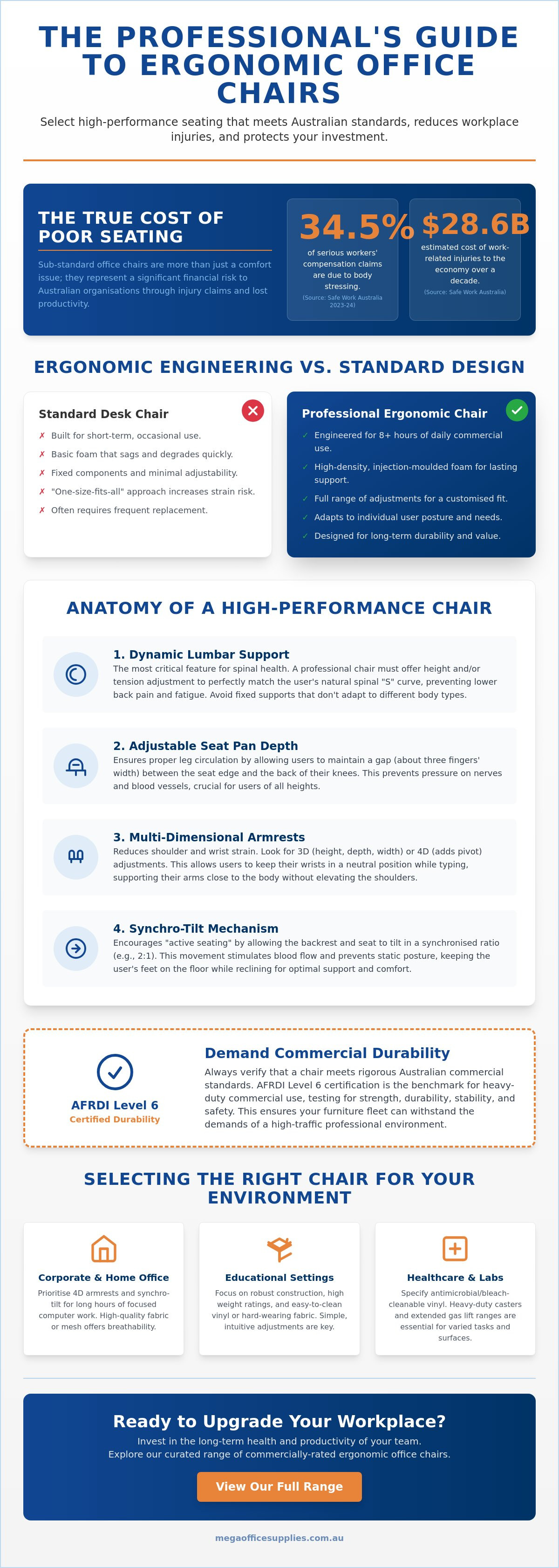
Did you know that body stressing accounts for 34.5% of all serious workers' compensation claims in Australia? Most procurement officers and business owners understand that a sub-standard seat leads to fatigue, but the financial impact of replacing broken, low-quality furniture every twelve months is often overlooked. Finding the right ergonomic office chair requires moving beyond marketing jargon and focusing on verified commercial durability.
Ensuring this durability often starts at the manufacturing stage, where procurement partners like bo-asia.com oversee quality control for companies sourcing products from across Asia.
We agree that deciphering technical specifications like synchro-tilt or gas lift ratings can feel overwhelming when you're managing a busy workplace. This guide provides the technical clarity you need to select high-performance seating that meets Australian standards, including the rigorous AFRDI Level 6 certification. You'll learn how to evaluate seat depth, lumbar tension, and material breathability to reduce workplace injuries and protect your investment. We will examine the essential criteria for various environments, from high-traffic government departments to focused home office setups, ensuring your furniture assets remain compliant and durable for years to come.
Key Takeaways
- Learn to evaluate user-centric engineering requirements to move beyond generic designs and address specific staff posture needs.
- Master the technical differences between fixed and dynamic lumbar support to provide superior spinal alignment for long-term comfort.
- Use ergonomic office chair weight capacity ratings and AFRDI benchmarks to ensure your fleet meets rigorous Australian commercial durability standards.
- Customise your procurement strategy by selecting specific finishes and adjustment ranges tailored for corporate, educational, or healthcare settings.
- Implement a structured maintenance routine for mechanical fixings and upholstery to extend the lifespan of your professional furniture assets.
Understanding the Role of Ergonomics in Workplace Productivity
Ergonomics is often reduced to a simple marketing term, but for professional procurement, it represents a precise engineering standard. A true ergonomic office chair is designed to adapt to the individual user rather than forcing the body to conform to a rigid structure. In high-intensity Australian workplaces, where staff spend eight or more hours seated, the mechanical integrity of furniture directly impacts the bottom line. Poor posture isn't just a comfort issue; it's a significant financial risk.
According to Safe Work Australia data from 2023-24, body stressing accounted for 34.5% of serious workers' compensation claims. The development of ergonomic chairs has evolved to mitigate these risks by facilitating active seating and neutral spinal alignment. When a chair lacks these adjustments, it leads to increased absenteeism and reduced staff focus. With work-related injuries costing the Australian economy an estimated $28.6 billion over a ten-year period, the importance of compliant furniture is clear.
To better understand how these features work in practice, watch this helpful video:
Ergonomic Chair vs. Standard Desk Chair
A standard desk chair is usually built for short-term use with basic materials. In contrast, professional-grade furniture features high-density injection-moulded foam and reinforced frames that resist sagging over time. The myth that "one size fits all" is particularly dangerous in commercial environments where multiple users might share a single workstation. For a deeper look at these distinctions, read our professional comparison of office chairs vs. desk chairs for Australian workplaces.
The Impact on Long-Term Musculoskeletal Health
Adjustable features are essential to minimise the risk of Repetitive Strain Injury (RSI). For example, an adjustable seat pan depth ensures that users of different heights can maintain proper leg circulation without putting pressure on the back of the knees. Supporting the natural "S" curve of the spine prevents the flattening of the lumbar region, which is a primary cause of lower back pain. By investing in an ergonomic office chair that offers dynamic support, organisations can proactively manage the musculoskeletal health of their workforce while maintaining high output levels.
In addition to ergonomic seating, maintaining musculoskeletal health often requires specialised daily living tools; if you are looking for assistive equipment in the Queensland area, you can visit Mobility and You to explore their comprehensive range of mobility solutions.
To further support a healthy lifestyle, many professionals engage in combat sports to improve core stability and offset the effects of long-term sitting; Australian-owned The Fight Club provides the high-quality gear needed to stay active and fit.
Key Features and Mechanisms for Superior Support
Selecting a high-performance ergonomic office chair requires a granular understanding of the hardware involved. It isn't just about the aesthetic appeal; it's about the mechanical response to the user's movements. Every component, from the lumbar system to the gas lift, must be engineered for durability and precision. When reviewing these components, referencing a technical checklist on how to select an ergonomic chair can help procurement officers standardise their requirements across an entire organisation.
Lumbar support is the most critical feature for spinal health. Fixed lumbar support is often insufficient for diverse workforces because it cannot be tailored to different heights. Height-adjustable or dynamic tension systems are the professional choice, allowing the user to align the support exactly with the lower curve of their spine. Similarly, gas lifts must offer a range that accommodates both the user's height and the desk surface. While standard Australian desks sit at 720mm, the rise of sit-stand workstations requires chairs with extended travel ranges to maintain ergonomic alignment at various heights.
Armrest adjustability is another area where technical specifications vary. In professional settings, we categorise these by their degrees of freedom. 1D adjusts height; 2D adds width; 3D includes depth; and 4D allows for pivot. This level of customisation ensures that the user's wrists remain in a neutral position, reducing the risk of strain during long typing sessions. You can compare these technical specifications side-by-side by viewing our full range of office furniture.
Mechanical Adjustments: Synchro vs. Independent Tilt
The tilt mechanism dictates how the chair moves as you recline. Synchro-tilt is the commercial standard for most offices. It tilts the backrest and seat at a fixed ratio, usually 2:1, which keeps the feet flat on the floor while opening the hip angle for better circulation. Independent tilt allows for separate adjustment of the back and seat. This is often preferred for task-specific roles, such as data entry, where a slight forward tilt can reduce pressure on the lower back. Tension control is vital here; the mechanism must be adjustable to support different body weights without being too stiff or too loose.
Material Selection and Breathability
Material choice is a practical consideration for the Australian climate. Mesh backs provide superior airflow, which is essential in non-climate-controlled environments or regions with high humidity. For upholstered options, look for Martindale rub test ratings to gauge durability. A rating of 50,000 or higher indicates suitability for heavy commercial use. In government and school settings, safety is the priority, making fire-retardant foam and commercial-grade fabrics a mandatory requirement for any new furniture asset.
Evaluating Commercial Standards and Durability
Selecting an ergonomic office chair for a professional environment requires looking beyond surface-level aesthetics to verify the structural integrity of the asset. In Australia, commercial-grade furniture is defined by its ability to withstand high-intensity use without mechanical failure. For procurement officers, the most reliable way to ensure a chair is fit for purpose is to check for independent certification and specific load ratings. These benchmarks provide the security and peace of mind necessary when managing large-scale furniture assets.
AFRDI certification serves as the primary benchmark for quality in the Australian market. Administered by the Australasian Furnishing Research and Development Institute, the "Blue Tick" signifies that a product has passed rigorous testing for strength, durability, and stability. While many retail chairs might claim to be ergonomic, only those that meet the AS/NZS 4438:1997 standard provide a documented guarantee of performance. This level of verification is essential for minimising the risk of equipment failure and subsequent workplace injuries.
AFRDI Testing and Australian Compliance
Understanding the different AFRDI levels is vital for matching furniture to its intended environment. Level 4 is suitable for general office use, while Level 5 is designed for heavy office environments. However, Level 6 is the gold standard for Australian workplaces. It indicates that the chair is suitable for severe commercial use, including 24-hour shift work or high-traffic areas. Because of these stringent requirements, schools and government departments typically mandate Level 6 certification for all new seating. You can find compliant options tailored for these environments in our range of educational supplies.
Load Ratings and Structural Integrity
Load ratings are a direct indicator of a chair's structural limits. A standard ergonomic office chair usually carries a rating of 120kg, which is sufficient for most users in a typical eight-hour shift. For environments requiring higher durability, heavy-duty models offer ratings of 150kg or more. These chairs often feature reinforced gas lifts and upgraded bases to handle the increased stress. When evaluating the base, a 5-star design is mandatory for stability. While reinforced nylon is common, polished aluminium bases offer superior longevity and resistance to scuffing in high-volume settings.
The choice of castors also impacts durability. Hard castors are designed for carpeted areas, providing the necessary friction for controlled movement. Soft castors are essential for hard floors like timber or tiles to prevent surface damage and minimise noise. Finally, look at the warranty period as a final indicator of commercial-grade quality. A professional furniture asset should carry a warranty of five to ten years; anything less often suggests the components aren't built for the rigours of a modern Australian workplace.
Selecting the Right Chair for Your Specific Environment
Operational requirements vary significantly across different Australian sectors. A seating solution that excels in a corporate boardroom will likely fail in a high-traffic healthcare reception or a secondary school classroom. Procurement officers must match the mechanical specifications of an ergonomic office chair to the specific physical demands of the workspace. To source premium ergonomic solutions while staying within budget, you can learn more about Smart Buy Office Furniture and their inventory of high-quality preowned furniture. This ensures both user safety and the long-term viability of the furniture asset.
In corporate environments, multi-user adjustability is the priority. With the continued prevalence of hot-desking, a chair must be easily reset to accommodate different body types quickly. Aesthetics also play a role here, as furniture often reflects the organisation's professional branding; for premium executive spaces, sourcing designer pieces from Attica House can further enhance this professional image. Conversely, educational settings demand extreme durability and ease of cleaning. Classroom and staffroom chairs face constant movement and potential spills, making high-density polypropylene or wipeable commercial fabrics more practical than delicate mesh.
Home offices require a balance between professional-grade support and residential scale. As of 2024, over 40% of employed Australians worked from home, a trend that remains steady in 2026. These users need the same level of adjustability found in a commercial suite but often have less floor space. Selecting a model with a compact 5-star base ensures that professional ergonomics don't overwhelm a domestic environment, and you can learn more about Australian Made Vision to find high-quality lenses that support your eyes during these long remote work sessions.
The Holistic Ergonomic Workstation
Seating is only one component of a healthy workspace. To complete the ergonomic circuit, even a high-performance chair should be paired with a standing desk. This combination allows staff to alternate between sitting and standing, which reduces the duration of static loading on the spine. You can further optimise the setup by using footrests to maintain proper hip angles and monitor arms to ensure the screen is at eye level. For smaller desktop additions, browse our range of office supplies to find organisers that keep the primary reach zone clear of clutter.
Specialised Seating for Diverse AU Workplaces
Certain roles require hardware that deviates from standard desk height. Drafting stools are essential for high-bench environments such as laboratories, warehouses, and retail service counters. These feature extended gas lifts and adjustable foot rings to provide stable support at elevated heights. For 24/7 control rooms, heavy-duty task chairs with reinforced frames are mandatory to handle continuous use. In healthcare settings, selecting upholstery with antimicrobial properties is a critical hygiene requirement for reception and consultation areas.
Ready to upgrade your workspace? View our full range of commercial ergonomic furniture to find the right fit for your organisation.
Procurement and Maintenance for Long-Term Value
Procuring a high-performance ergonomic office chair is a strategic capital investment that requires a lifecycle management plan. For procurement officers and facility managers, the focus must shift from the initial transaction to the total cost of ownership. Maintaining a fleet of furniture assets involves more than just reactive repairs; it requires a structured approach to standardisation and preventative care. This ensures that every workstation remains compliant with Australian safety standards while protecting the organisation's financial outlay.
Leveraging the cumulative decades of combined industry experience held by the Mega Office Supplies team allows businesses to streamline their furniture acquisition. We understand the logistical flow required for national distribution and the importance of manual precision in furniture assembly. By choosing a partner with established regional expertise, administrators can secure the stability and reliability needed for high-volume demands without the friction often associated with global supply chains.
For organisations that require a more direct connection to their manufacturing hubs, you can learn more about Buying Office Asia to discover how they manage on-the-ground procurement and quality control.
Bulk Procurement and Standardisation
Standardising on specific chair models across an entire organisation reduces maintenance complexity significantly. When a national office fit-out utilises uniform seating fleets, facility managers can manage spare parts, such as castors and gas lifts, more efficiently. It also ensures that staff moving between different regional offices encounter familiar adjustment mechanisms, reducing the need for repeated ergonomic training. For broader insights into managing large-scale workplace requirements, read our professional procurement guide for 2027.
Maintenance and Asset Longevity
Routine inspections are essential for extending the functional life of commercial furniture. Gas lift performance should be evaluated annually to ensure the mechanism maintains its set height under load. Castors require periodic cleaning to remove debris, such as carpet fibres or dust, which can seize the bearings and lead to floor scoring. Upholstery maintenance is equally vital for preserving a professional atmosphere. Mesh backs should be vacuumed regularly to prevent particulate build-up, while upholstered seats require spot-cleaning with appropriate commercial chemicals to maintain their fire-retardant properties. Knowing when to replace a component versus the entire chair is key to maximizing the value of your office furniture assets.
Our commitment to financial transparency and logistical prowess makes us a dependable partner for your next workplace upgrade. Whether you are coordinating a single department refresh or a national roll-out, our team provides the technical knowledge and volume capacity to ensure a successful result. Contact our local support line to discuss your specific commercial requirements and secure a rapid quote for your organisation.
Optimising Your Workplace for Long-Term Performance
Selecting the right seating is a strategic decision that impacts both employee health and operational budgets. By prioritising AFRDI-certified models and understanding specific mechanical requirements like synchro-tilt and dynamic lumbar support, you ensure your furniture assets remain durable and compliant. A high-performance ergonomic office chair acts as a cornerstone for productivity, especially when integrated into a wider workstation strategy involving standing desks and monitor arms.
Mega Office Supplies brings decades of combined industry experience to every procurement request, providing the logistical prowess needed for national delivery across Australia. Our range of AFRDI-certified commercial seating is designed to withstand the rigours of high-intensity environments, from government departments to busy classrooms. Standardising your fleet with these proven models minimises maintenance complexity and ensures a consistent standard of support for all staff members.
Browse our range of professional ergonomic office chairs to secure reliable, high-quality solutions for your organisation. We look forward to helping you build a safer and more efficient workplace.
Frequently Asked Questions
What is the difference between an ergonomic chair and a task chair?
An ergonomic chair provides multi-point adjustability for long-duration seating, while a task chair is designed for short-term use at a workstation. Task chairs often lack the complex lumbar and seat pan depth controls found in a professional ergonomic office chair. Task chairs are suitable for reception areas or short data entry bursts. Professional ergonomic models are the standard for staff spending over four hours at a desk.
Why is AFRDI Level 6 certification important for Australian businesses?
AFRDI Level 6 certification is the highest Australian benchmark for strength, durability, and stability in commercial seating. It confirms the chair is suitable for severe commercial use, including 24-hour shift work. This certification gives procurement officers peace of mind that the furniture asset meets rigorous safety standards. Many government and education tenders specifically require Level 6 to minimise the risk of workplace injuries and premature equipment failure.
How often should a commercial ergonomic chair be replaced?
A high-quality commercial chair should be replaced every 7 to 10 years depending on the intensity of use. You should monitor the gas lift performance and foam density for signs of degradation. If the seat no longer returns to its original shape or the height cylinder begins to "sink" during the day, the mechanical integrity is compromised. Routine maintenance can extend this lifespan, but structural wear eventually necessitates a full replacement.
Can I use an ergonomic office chair on a carpeted floor?
You can use these chairs on carpeted floors, but you must ensure the castors are appropriate for the surface. Hard castors are designed specifically for carpet to provide enough glide without snagging the fibres. For high-pile carpets, using a chair mat is recommended to protect the flooring and reduce user fatigue. Using soft castors on carpet can lead to premature wheel failure and difficult movement during the workday.
What is a synchro-tilt mechanism and do I need it?
Synchro-tilt is a mechanism where the backrest and seat pan recline simultaneously at a fixed ratio, typically 2:1. This allows you to lean back while keeping your feet flat on the floor and maintaining proper circulation in your legs. It is a vital feature for anyone spending long hours in an ergonomic office chair. This mechanism supports dynamic movement, which is essential for reducing spinal pressure and muscle fatigue during the day.
What weight capacity should I look for in a heavy-duty office chair?
For heavy-duty requirements, you should look for a weight capacity rating of 150kg or higher. Standard commercial chairs are typically rated for 120kg, which suits the majority of users in a standard office setting. Heavy-duty models feature reinforced gas lifts and 5-star bases to handle the additional stress. Always verify the manufacturer's load rating to ensure the chair meets the specific physical demands of your workplace environment.
How do I adjust my chair to the correct height for my desk?
Adjust your seat height so that your feet are planted firmly on the floor with your knees at a 90-degree angle. Your forearms should be parallel to the floor and rest comfortably on the desk or armrests without your shoulders hunching. If your desk is too high for this position, you should use a footrest to support your legs while keeping your upper body aligned with the workstation.
Are mesh chairs better than fabric chairs for Australian offices?
Mesh chairs are often superior for Australian offices due to their breathability and airflow in warmer climates. They prevent heat build-up against the user's back, which is a common issue with traditional upholstered chairs. However, fabric chairs offer higher foam density and more cushioning, which some users prefer for maximum comfort in climate-controlled environments. Both materials are durable, provided they have high Martindale rub test ratings for commercial use.
Article by
Mega Office Supplies Team
The Mega Office Supplies Team provides practical guidance for Australian businesses, schools, government organisations, healthcare providers, hospitality venues, warehouses and home offices. Based in Tweed Heads South, Mega Office Supplies is a family-owned and operated Australian business offering office stationery, workplace furniture, technology products, labels, printers, cleaning and janitorial supplies, safety products, art materials, education resources and everyday business essentials from trusted brands.
General Information
This article is provided as general information only to help customers compare and choose office, workplace, school, cleaning, technology, furniture, safety and business supplies. Product details, specifications, compatibility, availability, pricing and suitability may vary. Always check the individual product page, manufacturer information, workplace requirements and relevant safety guidance before purchasing or using a product.


