

Have you ever reached for a heavy industry catalogue only to have the entire row of plastic holders collapse like a house of cards? It's a common frustration in busy Australian workplaces, where a cluttered desk isn't just an eyesore but a genuine drain on your team's daily productivity. We understand that finding a specific record in a loose stack of papers often feels like an archaeological dig you didn't have time to schedule.
This guide will show you how to select a durable magazine holder that actually stands up to high-volume use while streamlining your archival systems. We will examine the essential features that differentiate professional-grade storage from flimsy alternatives, ensuring your new organisational tools fit your existing shelving perfectly. From material durability to standardised filing layouts, you'll gain the technical knowledge needed to clear the clutter for good.
Key Takeaways
- Identify why a quality magazine holder acts as an essential "active storage" bridge between messy desk surfaces and permanent archival systems.
- Learn to match materials to your specific environment, such as choosing wipeable polypropylene for healthcare or durable metal mesh for corporate reception areas.
- Understand the benefits of standardising your office stationery to maintain organisational consistency and simplify high-volume procurement across different departments.
- Discover how to use official Australian Government purchase orders to streamline the acquisition of essential supplies for schools and agencies.
Solving the desk sprawl: categorising with professional magazine holders
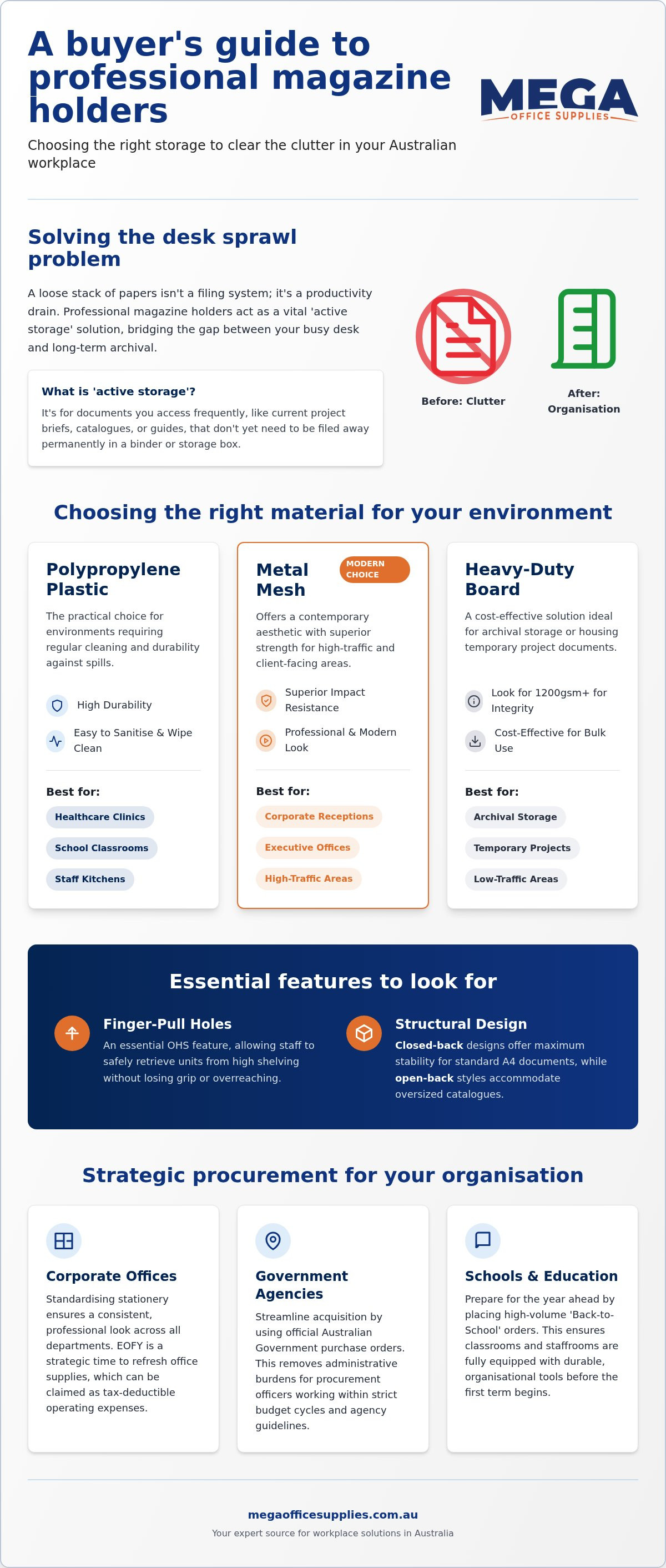
A stack of loose papers isn't a filing system; it's a geological formation that eventually develops its own ecosystem. To maintain professional principles of office management, we must categorise documentation based on handling frequency. A professional magazine holder serves as a critical 'active storage' solution. It bridges the gap between your primary desk surface and permanent filing cabinets. This hardware is ideal for documents you access weekly, such as current project briefs, technical catalogues, or industry journals, which don't yet require the permanence of a binder.
These units provide immediate benefits across various Australian sectors. In school staffrooms, they keep curriculum guides and lesson plans accessible for quick retrieval. Medical reception areas use them to organise patient information leaflets and forms; government archives find them useful for temporary records awaiting final classification. They naturally complement lever arch files by allowing quick drop-in access. This removes the administrative friction of hole-punching every single document that lands on your desk.
Active vs archival document management
We recommend using your magazine holder for the 'active' phase of document lifecycles. Keep your current project folders and frequently referenced manuals upright and visible to minimise visual clutter. It keeps the workflow moving. This approach ensures your workspace remains organised without burying essential information in a drawer. Once the 'active' phase concludes or a specific project is finalised, transition those documents into permanent storage boxes. This disciplined rotation keeps your immediate work area clear and functional for the next task.
Durability and design: choosing between plastic, mesh, and heavy-duty board
Selecting the right magazine holder depends entirely on your specific workplace environment. For healthcare settings or staff kitchens, polypropylene plastic is the logical choice. These units are non-porous and withstand regular sanitisation with cleaning chemicals without degrading or losing their colour. In contrast, corporate reception areas often benefit from metal mesh or solid steel designs. These provide a modern aesthetic while offering the superior impact resistance needed for high-traffic zones where aesthetics and longevity must coexist.
Heavy-duty board options remain a cost-effective choice for archival storage or temporary project housing. To avoid the frustration of collapsing sides under the weight of heavy catalogues, we recommend looking for a minimum of 1200gsm for structural integrity. Regardless of the material you choose, ensure your holders include integrated finger-pull holes. This feature is essential for OHS compliance. It allows staff to retrieve documents safely from high shelving without overreaching or losing their grip on the unit.
Material comparison for high-traffic environments
When evaluating impact resistance in busy school environments, brands like Marbig and Rexel offer robust plastic designs that survive daily handling. You should also consider the physical 'footprint' of the unit. Closed-back designs provide maximum stability for standard A4 documents, while open-back holders accommodate oversized catalogues or legal-sized papers. We suggest reviewing our full range of filing and storage solutions to compare specific brand specifications and dimensions.
Standardising your stationery supplies Australia wide ensures aesthetic consistency across multiple branch locations. When every department uses the same professional magazine holder, it avoids your workspace looking like a mismatched collection of garage sale finds. For public sector organisations, we facilitate a streamlined acquisition process by accepting Australian Government official purchase orders. This removes the administrative burden for procurement officers working within strict agency guidelines.
Timing your orders with national cycles is a practical way to manage budgets effectively. We often assist schools with high-volume 'Back-to-School' orders to ensure classrooms are equipped before the first term begins. For the corporate sector, EOFY represents a strategic time for an office refresh. Investing in durable magazine holder units during this period allows businesses to claim these as tax-deductible operating supplies. Our team, based on the Gold Coast/Tweed border, provides direct local support to resolve any logistical issues quickly without relying on offshore call centres.
Compliance and national procurement cycles
Opening a business account allows your organisation to access tiered pricing and a simplified reordering interface. We recommend selecting established brands such as Marbig, Rexel, or Durable. These manufacturers ensure long-term SKU availability. This means you won't find your chosen storage system discontinued six months later when you need to expand your filing capacity. This focus on longevity is central to our goal of providing consistent solutions for every Australian workplace.
Streamlining your workplace organisation
Choosing the right magazine holder is a practical investment in your team's daily productivity. By matching material durability to your specific environment, you ensure that active documentation remains accessible without contributing to desk sprawl. We've seen how standardising your storage solutions creates a consistent, professional atmosphere while simplifying the procurement process for both corporate and government sectors. Our team brings over 17 years of industry experience to help you manage these logistical requirements with ease.
Our specialists provide genuine local support from our Gold Coast/Tweed border base on weekdays between 8–6 AEST. You can also take advantage of free delivery on orders over $149 to keep your supply costs manageable.
Browse our full range of professional magazine holders and filing solutions
We look forward to helping you establish a more efficient and organised workspace today.
Frequently asked questions
What is the difference between a magazine file and a magazine holder?
In the Australian stationery sector, these terms are often used interchangeably to describe vertical organisers. A magazine holder generally refers to the hardware used to keep documents upright on a shelf or desk. While some manufacturers use the term 'magazine file' to describe fully enclosed designs, both serve as effective 'active storage' tools to prevent desk sprawl and protect loose paperwork from damage.
Are cardboard magazine holders durable enough for school use?
Heavy-duty board is a cost-effective option for archival storage, but we recommend plastic or metal for high-traffic school environments. If you select board, ensure it meets a minimum of 1200gsm to prevent the sides from bowing under the weight of textbooks. For classroom areas where students frequently access materials, polypropylene plastic offers superior impact resistance and a much longer service life.
Can I use magazine holders for A4 documents and catalogues?
Yes, these units are specifically sized to accommodate A4 paper, brochures, and technical catalogues. If you regularly handle oversized documents or thick industry journals, choosing an open-back magazine holder is the most practical move. This specific design allows for extra depth and height that closed units cannot provide; it keeps your project briefs organised without the administrative burden of hole-punching every page.
Does Mega Office Supplies accept government purchase orders for stationery?
We certainly do. We accept official Australian Government purchase orders from all federal, state, and local agencies to simplify procurement for departments working within strict budget cycles. You can submit your documentation through our portal or contact our local support team for assistance with high-volume accounts. Our specialists understand the specific logistical requirements and compliance standards of public sector organisations.
Article by
Mega Office Supplies Team
The Mega Office Supplies Team provides practical buying guides and workplace advice for Australian businesses, schools, government organisations, healthcare providers, hospitality venues, warehouses and home offices. Family owned and operated since 2008 and based in Tweed Heads South on the Gold Coast–Tweed border, Mega Office Supplies helps Australian workplaces choose the right office supplies, furniture, technology, cleaning, safety and education products — backed by genuine local service from real people.
General Information
This article is provided as general information only to help customers compare and choose office, workplace, school, cleaning, technology, furniture, safety and business supplies. Product details, specifications, compatibility, availability, pricing and suitability may vary. Always check the individual product page, manufacturer information, workplace requirements and relevant safety guidance before purchasing or using a product.


