


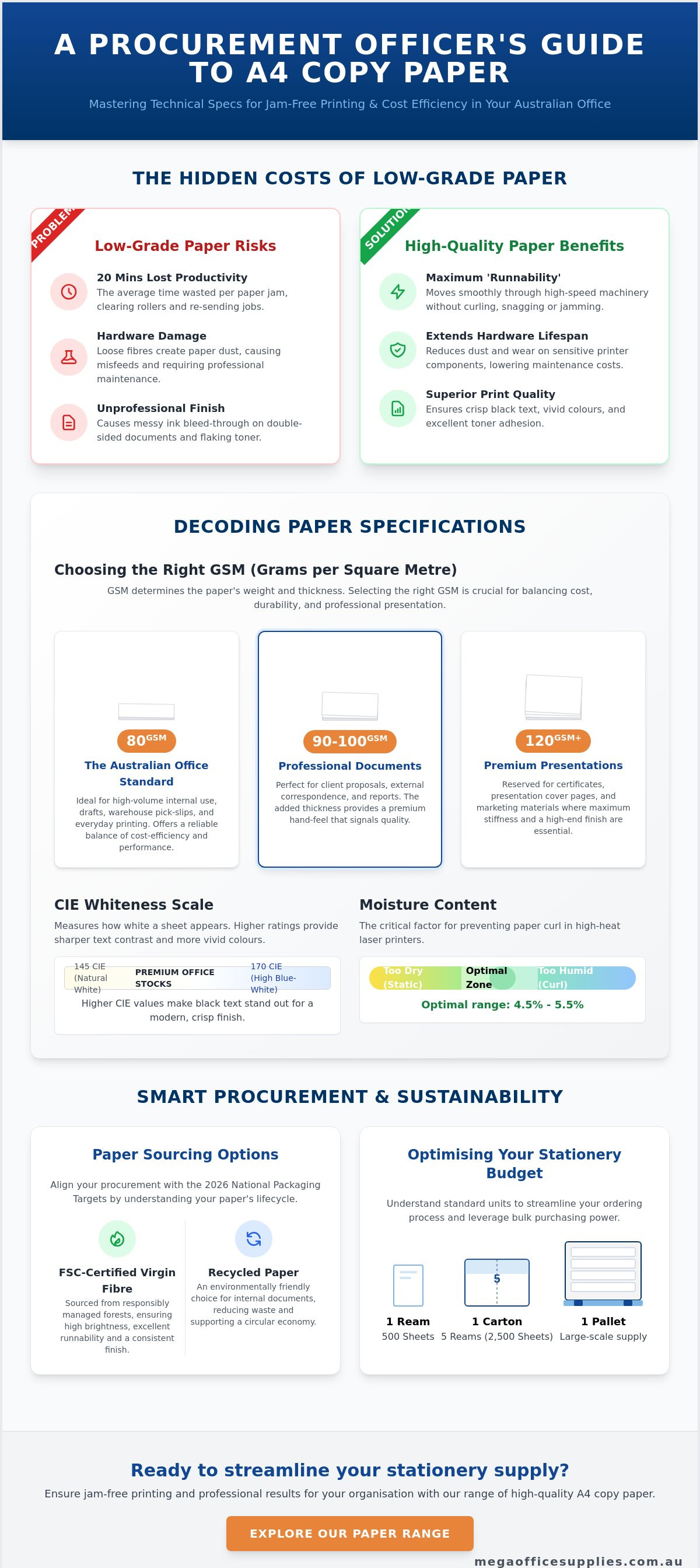
A single paper jam can cost an Australian office up to 20 minutes of lost productivity when you factor in the time spent clearing the rollers, re-sending the job, and managing the resulting queue at the printer. Most procurement officers and school administrators view A4 copy paper as a simple commodity, yet choosing the wrong ream often leads to messy ink bleed-through on double-sided documents and frequent hardware downtime. It's a hidden drain on resources that many businesses accept as inevitable, but it doesn't have to be.
We understand that reliability is the cornerstone of an efficient workplace. By mastering the technical specifications of your paper, from gsm weight to moisture content, you can ensure jam-free printing and professional-grade results for your organisation. This guide provides the practical expertise you need to navigate the 2026 National Packaging Targets and understand the differences between FSC and PEFC certifications. You'll learn how to select the right reams for your specific hardware, ensuring every document looks crisp while establishing a cost-effective bulk procurement strategy that supports your bottom line.
Key Takeaways
- Identify why 80gsm is the preferred weight for standard Australian office documentation and how CIE whiteness affects the professional finish of your printed materials.
- Navigate the 2026 sustainability landscape by understanding the practical differences between FSC-certified virgin fibre and recycled A4 copy paper.
- Match your paper selection to specific hardware requirements to prevent ink smudging and minimise the risk of static-related jams in high-heat laser printers.
- Optimise your stationery budget by comparing ream, carton, and pallet-level purchasing to suit the volume demands of different departments and sites.
Understanding A4 Copy Paper: More Than Just a White Sheet
A4 copy paper remains the essential medium for Australian business documentation, providing a physical record that digital files can't always replace. While many workplaces have shifted toward paperless systems, the requirement for printed contracts, educational handouts, and medical records ensures that high-quality paper stays at the centre of daily operations. The dimensions of these sheets are governed by the ISO 216 standard for paper sizes, which defines A4 as exactly 210mm by 297mm. This consistency allows for universal compatibility across all modern office hardware, from desktop inkjet printers to heavy-duty multifunction centres.
Professional procurement relies on specific units of measure to manage inventory effectively. A single ream contains 500 sheets, while a standard carton consists of five reams, totalling 2500 sheets. For large-scale organisations like schools or government departments, sourcing reliable office supplies involves understanding these units for logistical planning and storage. Beyond the quantity, the most important technical attribute for any procurement officer is runnability. This term describes the paper's ability to move through high-speed machinery without curling, snagging, or causing a jam.
The Anatomy of a Ream
Every ream of A4 copy paper is encased in a moisture-proof wrapper, which isn't just for branding. This protective layer maintains the paper's internal moisture balance, preventing the sheets from absorbing humidity which leads to waving or curling in the printer tray. While multipurpose paper is suitable for general internal drafts, specialist stocks are engineered for specific technologies. Laser-specific paper is designed to withstand the intense heat of fuser rollers, whereas inkjet stocks feature surfaces optimised for rapid ink absorption. Reliable manufacturers serving the Australian market, such as Australian Paper, have established a long-standing reputation for consistent sheet dimensions and surface smoothness.
Why Quality Paper Reduces Operational Costs
Choosing low-grade paper often leads to hidden expenses that far outweigh the initial savings. Budget-tier paper often has loose surface fibres that shed during the printing process, creating paper dust that accumulates on sensitive optical sensors and rubber pickup rollers. Over time, this buildup causes misfeeds and requires professional maintenance to resolve. High-quality paper also ensures better toner adhesion; it prevents the black text from flaking off the page after it leaves the machine. Runnability is the primary metric for reducing office downtime and extending the lifespan of your printing hardware.
Technical Specifications: GSM, Whiteness, and Opacity
Understanding the technical profile of A4 copy paper allows procurement officers to match the right product to specific workplace tasks. The most common metric you'll encounter is GSM, which stands for Grams per Square Metre. In Australia, 80gsm has become the universal standard for high-volume office use because it offers a reliable balance between durability and cost-efficiency. Lower weights might save money initially, but they often lack the structural integrity required for high-speed feeders. Conversely, moisture content plays a critical role in machine performance. If the internal moisture level deviates from the 4.5% to 5.5% range, the paper is likely to curl when exposed to the high-heat fuser units found in modern laser printers.
Choosing the Right GSM for the Task
Selecting the appropriate weight depends on the document's intended life cycle and audience. While 80gsm is the heavy-duty choice for internal memos and high-volume drafts, other weights serve distinct purposes:
- 80gsm: The standard for daily internal documentation, staff kitchens, and warehouse pick-slips.
- 90gsm - 100gsm: These weights are ideal for client proposals and external correspondence. The added thickness provides a professional hand-feel that signals quality to the recipient.
- 120gsm+: Reserved for professional presentations, certificates, and cover pages where maximum stiffness and a premium finish are required.
Whiteness vs. Brightness: What Should You Look For?
The CIE whiteness scale measures how white a sheet appears to the human eye, typically ranging from 145 to 170 for premium office stocks. A higher CIE rating results in sharper contrast, making black text stand out and colours appear more vivid. While high-blue-white shades look modern, a more natural white is often easier on the eyes for long-form reading. When evaluating brightness in your office, use this quick checklist:
- Check the sheet under standard LED or fluorescent office lighting to ensure it doesn't appear grey.
- Compare the paper against a vivid colour print to check for wash out.
- Verify the CIE rating on the packaging; anything below 140 may look dull in professional reception areas.
Current data on Australian paper industry sustainability shows that local manufacturers prioritising these specs also maintain rigorous environmental standards. Choosing a high-CIE paper from a reputable source ensures your documents maintain their professional appeal over time.
Opacity is the final piece of the technical puzzle. It measures how much light passes through the sheet. High opacity is critical for double-sided (duplex) printing to prevent show-through, where text from the reverse side interferes with readability. If your organisation frequently prints multi-page reports to save on volume, ensuring an opacity rating of at least 90% is essential. When you're managing a large fleet of machines, matching your A4 copy paper to your specific toner and ink cartridges will help maintain document clarity and prevent smudging on high-opacity stocks.
Sustainability in the Australian Paper Industry
Australian businesses are increasingly aligning their procurement strategies with corporate social responsibility (CSR) goals. When sourcing A4 copy paper, the choice between recycled and virgin fibre involves more than just price; it requires a clear understanding of environmental certifications. The two primary schemes in Australia are the Forest Stewardship Council (FSC) and the Programme for the Endorsement of Forest Certification (PEFC). Notably, the revised Forest Stewardship Standard for Australia is undergoing its final public consultation until June 29, 2026, which will further refine how local forests are managed. For large organisations with an annual turnover exceeding $5 million, mandatory data reporting to the Australian Packaging Covenant Organisation (APCO) starts in 2026, making the selection of certified paper even more critical for compliance.
Recycled Paper vs. Virgin Fibre
Many procurement officers assume that 100% recycled paper is always the superior environmental choice. However, modern sustainable virgin fibre paper often provides better runnability in high-speed office equipment. Low-grade recycled stocks can sometimes struggle with dust accumulation or curling, which are major causes of machine downtime. In the Australian market, "closed-loop" recycling, where office waste is collected and returned as new reams, is a growing trend. This process ensures that the ISO 216 international standard for paper sizes is maintained through every cycle, providing a reliable product that reduces waste without sacrificing the structural integrity of the sheet.
Australian Standards and Certifications
The PEFC-endorsed Responsible Wood scheme is a cornerstone of the local industry, with its next periodic review scheduled for December 1, 2026. This review covers the Australian Standards for Forest Management (AS 4708) and Chain of Custody (AS 4707). Beyond the trees themselves, ISO 14001 certification indicates that a paper mill manages its broader environmental impact, including water usage and energy efficiency. Choosing certified paper ensures the longevity of regional forestry resources and supports local jobs in the office supplies sector. Recognising these eco-logos on ream wrappers allows school administrators and business owners to make informed, responsible decisions.
The trend toward carbon neutrality is another significant factor for modern workplaces. Local brands like Reflex have pioneered carbon-neutral manufacturing processes that offset emissions from cradle to grave. By 2026, the National Packaging Targets will be enforceable, requiring 100% of packaging to be reusable, recyclable, or compostable. This shift is driving Australian paper mills to innovate their wrapper designs to meet these strict new benchmarks. Mega Office Supplies acts as a dependable partner in this transition, providing access to a broad range of certified stocks that help businesses meet their environmental obligations while maintaining high printing standards.
Matching Paper to Your Office Equipment
Matching your A4 copy paper to the specific technology in your workplace prevents hardware fatigue and ensures consistent output quality. Laser printers and high-speed multifunction devices (MFDs) operate by attracting toner powder to the sheet via an electrostatic charge, which is then fused at temperatures that can exceed 200 degrees Celsius. This process requires paper with high heat resistance and precise moisture control to prevent warping as it passes through the fuser unit. Conversely, inkjet technology relies on liquid ink droplets. If the paper surface is too porous, the ink will 'feather' or bleed along the fibres, resulting in blurry text and smudged images that look unprofessional in a client-facing environment.
Storage is just as critical as the paper's initial quality. Reams should always be stored flat in a cool, dry place and kept off warehouse or stockroom floors to avoid moisture wicking. Storing paper near heat sources like radiators or in direct sunlight will dry out the sheets, causing them to become brittle and prone to static buildup. This static is a leading cause of double-feeding, where multiple sheets are pulled into the machine simultaneously, resulting in immediate jams and potential damage to the internal rollers.
Laser vs. Inkjet Performance
Laser machines are demanding. They require a exceptionally smooth surface to ensure the toner powder transfers precisely before the heat bond occurs. Inkjet-optimised paper, however, features a specialised coating designed to 'lock' liquid ink on the surface for rapid drying. While many Australian offices utilise multipurpose paper for mixed fleets, it's a compromise. Multipurpose stocks are engineered with a balanced absorption rate and heat resistance, making them a dependable choice for general internal documentation across both printer types. For high-volume MFDs in busy school staffrooms or government departments, using a dedicated laser stock can significantly extend the time between professional service calls.
Preventing Jams and Maintenance Issues
Loading your paper trays correctly is a simple way to minimise machine downtime. Before placing a new ream into the tray, use the 'fanning' technique: grip the stack firmly and flex it to allow air between the sheets. This breaks any static bond created during the packaging process. You should also avoid mixing different brands or weights of A4 copy paper in a single tray. Because different manufacturers use varying friction coefficients and coatings, mixing stocks often leads to feed errors and misaligned prints. If you notice persistent streaks or 'ghosting' on your documents, it's often a sign that your paper choice is shedding excessive dust or failing to bond with the toner. View our range of high-performance toner and ink cartridges to find the perfect hardware match for your office stocks.
Bulk Procurement: Streamlining Your Stationery Supply
For large organisations like hospitals, government departments, and multi-campus schools, procurement is a matter of logistical precision rather than simple purchasing. Transitioning from carton-level orders to pallet-level procurement offers a significant advantage in both cost-efficiency and supply chain stability. A standard pallet of A4 copy paper typically contains 40 to 48 cartons, which equates to 200 or 240 reams. By purchasing at this scale, organisations reduce the frequency of deliveries and ensure a consistent paper batch across all departments, which is vital for maintaining uniform print settings and reducing technical errors across a large fleet of machines.
Standardising your A4 copy paper supply simplifies inventory management across multiple sites. When every department uses the same high-performance stock, it eliminates the confusion of matching specific reams to specific printers, allowing for a "plug-and-play" approach to stationery. Reliability in a national distribution partner is the final component of this strategy. A partner with a robust logistical network ensures that your regional offices receive the same professional-grade supplies as your metropolitan headquarters, preventing the "stockout" situations that can halt administrative workflows during critical periods.
Calculating Your Annual Paper Consumption
Estimating your annual requirements prevents both overstocking and emergency last-minute purchases. A practical formula for most Australian professional environments is to allocate one ream per employee per month for standard administrative roles. You can calculate your baseline by multiplying your headcount by 12 reams. It's also essential to identify peak periods, such as the end of the financial year for tax and audit documentation, or the start of school terms for educational institutions. Setting up recurring orders for these essential office supplies ensures that your stock levels remain optimal without requiring constant manual intervention from procurement officers.
The Mega Office Supplies Advantage
Mega Office Supplies serves as a reliable partner for high-volume users, offering over 150 years of combined service experience in the Australian market. We understand the specific workflows of professional buyers who require more than just a checkout button. Our "View Quote" system is designed specifically for procurement officers and school administrators who need formal documentation for internal approvals before a purchase is finalised. This functional signature ensures financial transparency and simplifies the path to acquisition for large-scale orders.
You can explore our full professional range and browse our A4 copy paper categories to find the technical specifications that match your hardware. Whether you are stocking a single reception desk or a multi-storey warehouse, our expertise ensures you receive a product that supports your operational goals. Organise your bulk A4 paper order with Mega Office Supplies today to secure your supply and minimise office downtime.
Optimise Your Workplace Productivity with Professional-Grade Paper
Selecting the right A4 copy paper is a strategic decision that directly impacts machine longevity and document quality. By matching technical specifications like CIE whiteness and GSM to your specific office hardware, you've taken the first step toward minimising operational downtime. Understanding the shift toward mandatory sustainability reporting in 2026 ensures your procurement remains compliant while supporting regional forestry through certified stocks. These practical adjustments prevent the hidden costs of printer jams and smudged documentation.
Mega Office Supplies serves as a dependable partner with over 150+ years of combined service experience in the Australian market. We provide efficient nationwide delivery across Australia and offer reliable local support on 1300 783 961 to help you navigate bulk ordering. Shop the full range of professional A4 Copy Paper at Mega Office Supplies and ensure your organisation is equipped for peak performance. We look forward to supporting your workplace maintenance needs.
Frequently Asked Questions
How many sheets of paper are in a ream of A4 copy paper?
A standard ream of A4 copy paper contains exactly 500 individual sheets. For professional procurement, these reams are typically bundled into cartons of five, totalling 2500 sheets. Large organisations like schools or healthcare centres often order at the pallet level, which usually contains between 40 and 48 cartons depending on the manufacturer's specific packaging standards for transport and storage.
Is 80gsm or 70gsm paper better for standard office printing?
80gsm is the preferred standard for Australian office printing because it offers the necessary opacity and structural integrity for reliable daily use. While 70gsm is lighter and sometimes used for internal drafts, it's more prone to double-feeding and ink show-through during duplex printing. Choosing 80gsm ensures your paper remains flat and performs consistently in high-speed machines with high-heat fuser units.
What does CIE whiteness mean when choosing A4 paper?
CIE whiteness is a technical measurement of how white a sheet appears to the human eye, with higher numbers indicating a more brilliant, blue-white shade. Most premium office stocks fall between 145 and 170 on this scale. A higher rating provides better contrast for black text and vibrant colours, which is essential for client-facing documents or professional presentations in reception areas and boardrooms.
Can I use inkjet paper in a laser printer?
You shouldn't use specialist inkjet paper in a laser printer because the surface coatings aren't designed to withstand extreme heat. Laser printers use fuser rollers that reach temperatures over 200 degrees Celsius, which can cause inkjet coatings to melt or stick to the internal drum. This often leads to permanent hardware damage and costly repairs. Always verify that your stock is rated for laser technology.
What is the difference between FSC and PEFC certified paper?
FSC and PEFC are both global standards that certify paper is sourced from responsibly managed forests, though they utilise different auditing processes. In Australia, the Responsible Wood scheme is endorsed by PEFC, ensuring that local supply chains meet rigorous environmental and social benchmarks. Both certifications provide peace of mind that your procurement supports the longevity of regional forestry resources and complies with modern sustainability standards.
How should A4 paper be stored to prevent printer jams?
Store your A4 copy paper flat in its original moisture-proof wrapper until it's ready to be loaded into the machine tray. Keeping reams in a cool, dry environment away from direct sunlight or damp warehouse floors prevents the fibres from absorbing excess humidity. If the internal moisture level deviates from the standard range, the sheets will likely curl or wave, which is a primary cause of feed errors.
Why is my printer pulling multiple sheets of paper at once?
Multiple sheets pulling at once is usually caused by static buildup or high humidity within the paper stack. To prevent this, use the fanning technique to introduce air between the sheets before loading them into the printer tray. It's also vital to avoid mixing different brands or weights in the same tray, as varying friction levels often disrupt the machine's pickup mechanism and lead to immediate jams.
Does A4 paper have an expiry date?
A4 copy paper doesn't have a formal expiry date, but its performance degrades if it isn't stored correctly over long periods. Paper is a hygroscopic material that absorbs and releases moisture based on its surroundings. If left in an open tray for several months, the edges may warp or the surface may accumulate dust, leading to poor toner adhesion and increased machine wear during high-volume print runs.
Article by
Mega Office Supplies Team
The Mega Office Supplies Team provides practical guidance for Australian businesses, schools, government organisations, healthcare providers, hospitality venues, warehouses and home offices. Based in Tweed Heads South, Mega Office Supplies is a family-owned and operated Australian business offering office stationery, workplace furniture, technology products, labels, printers, cleaning and janitorial supplies, safety products, art materials, education resources and everyday business essentials from trusted brands.
General Information
This article is provided as general information only to help customers compare and choose office, workplace, school, cleaning, technology, furniture, safety and business supplies. Product details, specifications, compatibility, availability, pricing and suitability may vary. Always check the individual product page, manufacturer information, workplace requirements and relevant safety guidance before purchasing or using a product.


