

You've just finished an intensive strategy session only to realise the marker you grabbed was a permanent Sharpie rather than a dry-erase pen. It's a common workplace mishap that can leave even the most experienced office manager feeling a sense of dread. You're likely worried that your expensive equipment is permanently ruined or that aggressive scrubbing will leave behind those frustrating "ghosting" shadows that never quite disappear. Knowing how to clean permanent marker off a whiteboard without stripping the essential non-porous surface is vital for maintaining your workplace assets.
We understand the pressure to find a fast, effective solution using items you already have in the stationery cupboard. This professional restoration guide provides the safest methods to remove stubborn ink while preserving the board's integrity. You'll discover which chemicals are safe for specific materials like melamine or porcelain; we also share the industry's best-kept secrets for achieving a pristine, white finish. From the "dry-erase overwrite" method to using professional-grade cleaners from Mega Office Supplies, we'll help you restore your board to its original condition without the risk of permanent damage.
Key Takeaways
- Learn why the "dry-erase overwrite" is the safest professional technique for removing permanent ink without using harsh abrasives or damaging the surface.
- Discover how to clean permanent marker off a whiteboard using common workplace items like high-strength isopropyl alcohol or hand sanitiser.
- Understand the critical differences between melamine and porcelain surfaces to ensure you choose a cleaning method that won't strip the board's essential release coating.
- Implement simple organisational systems and regular maintenance schedules to prevent future ghosting and accidental marker mix-ups in busy staff rooms or classrooms.
- Gain the technical knowledge required to restore expensive office equipment to a pristine condition, helping to extend the lifespan of your workplace assets.
The Science of the Mistake: Why Permanent Marker Bonds to Whiteboards
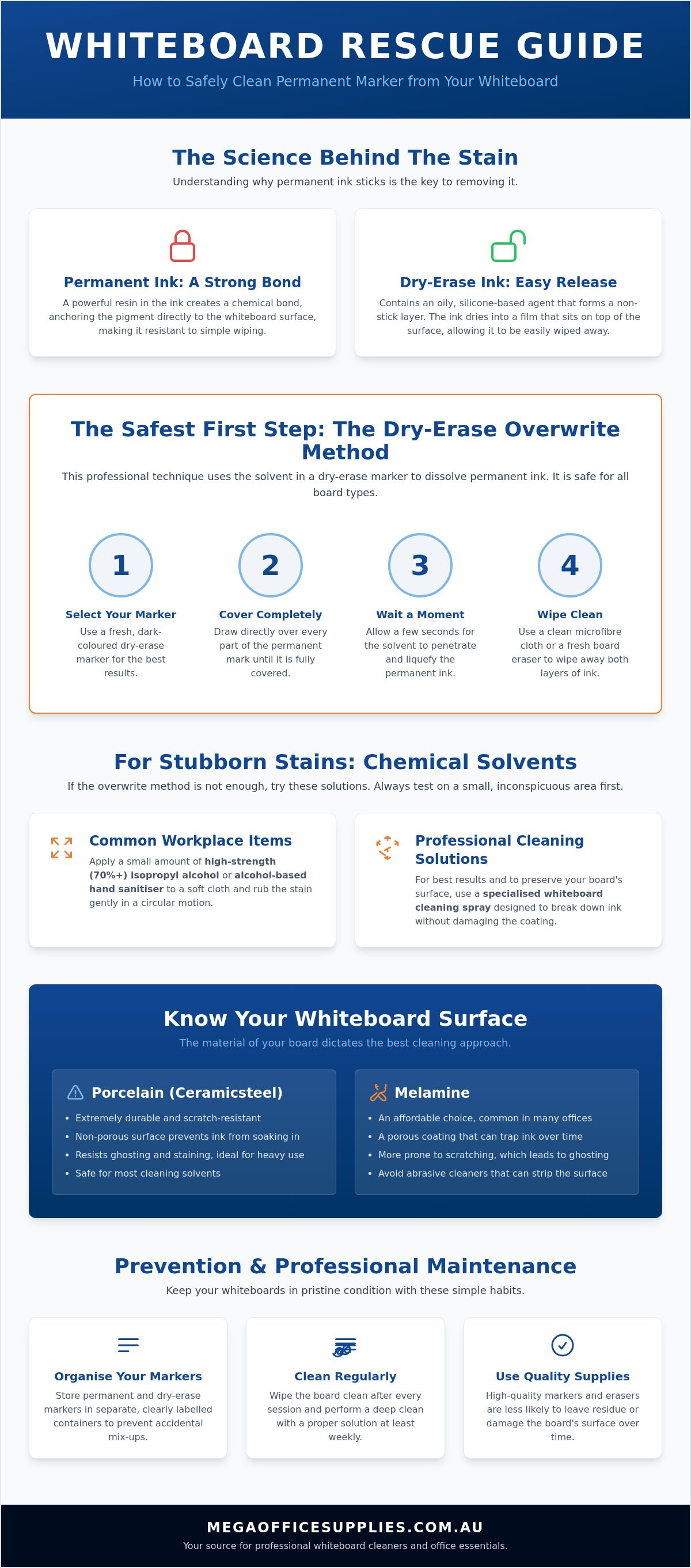
Realising you've grabbed the wrong pen during a meeting is a common frustration, but understanding the chemistry behind that mark is the first step in learning how to clean permanent marker off a whiteboard effectively. Permanent markers are engineered for longevity. They utilise a non-polar solvent and a specific resin that creates a hard, durable bond with almost any surface. Unlike their dry-erase counterparts, these pens are designed to be hydrophobic and resistant to simple friction, making them a challenge for standard office cleaning routines.
To better understand this concept and see a practical demonstration, watch this helpful video:
The primary reason a permanent "stain" occurs is the absence of a release agent. While dry-erase markers are formulated with an oily lubricant (typically silicone) that allows the ink to be wiped away as a dry film, permanent ink lacks this feature. Instead, the composition of permanent marker ink relies on solvents that evaporate quickly, leaving behind a concentrated layer of pigment and resin that anchors itself firmly to the board's surface. Professional board restoration relies on re-introducing a solvent that can break this resin bond without damaging the board itself.
Permanent vs. Dry-Erase Ink Chemistry
Permanent markers are meant to stay put. The resins in permanent markers create a fixed, plastic-like layer on non-porous surfaces that resists water and standard board erasers. Dry-erase ink is fundamentally different because it is designed to remain as a separate, removable film rather than bonding to the substrate. When you understand how to clean permanent marker off a whiteboard, you are essentially learning how to re-liquefy that fixed resin layer so it can be lifted away.
What Happens When Ink Meets the Board Surface
The material of your board significantly dictates the difficulty of the task. Smooth, high-quality surfaces like those found on premium whiteboards and glass boards allow ink to sit on the very top layer of the material. However, budget-friendly melamine or older, scratched boards are more porous. These surfaces have microscopic "valleys" that trap the permanent ink, making it much harder to lift. Standard erasers fail because they only provide physical friction; they cannot reach into these pores or provide the chemical catalyst needed to liquefy the resin and release the pigment.
The Dry-Erase Overwrite: The Safest Method for All Surfaces
When you are faced with the challenge of how to clean permanent marker off a whiteboard, the most effective tool is often already in your hand. The "marker-on-marker" or "overwrite" technique is the industry standard for safe restoration. It relies on the chemical properties of dry-erase ink, which contains a non-polar solvent designed to keep ink fluid until it hits the board. When you apply this over permanent ink, the solvent re-liquefies the hardened permanent resin, allowing both layers to be removed simultaneously.
This method is highly versatile. It works effectively on fresh mistakes and marks that have set for several days. Because it introduces no external chemicals or abrasive materials, it's considered the safest approach for every board type, from high-end glass to budget melamine. Many professionals prefer this over other proven methods for removing permanent marker that involve liquids, as it keeps the workspace dry and prevents ink from running into the board's frame.
Step-by-Step Overwrite Technique
To execute this properly, follow these specific steps to ensure a clean finish:
- Select your marker: Use a fresh dry-erase marker with plenty of ink. Darker colours often contain a higher concentration of solvents, which can be more effective.
- Cover the mark: Completely colour over the permanent marks. You must ensure every part of the permanent ink is covered by the new layer.
- Allow dwell time: Wait approximately 30 seconds. This pause is critical because it gives the solvents time to penetrate and soften the permanent resin bond.
- Remove the ink: Wipe away both layers using a clean microfibre cloth or a professional eraser.
Be aware that high-pigment colours like red or black can be more stubborn. These pigments are often more concentrated and may require two or three passes to lift completely. If a faint shadow remains after the first attempt, simply repeat the process until the surface is clear.
Why This Method Protects Your Board
Maintaining the integrity of your office equipment is essential for long-term use. This technique avoids the use of high-concentration alcohols or harsh industrial solvents that can dry out the board's surface over time. Repeated use of strong chemicals can eventually strip the "release" coating, leading to permanent ghosting issues. This is especially true for melamine boards, which are more susceptible to chemical wear than porcelain or glass.
By using the overwrite method, you also prevent the need for aggressive scrubbing. Physical abrasion is a leading cause of whiteboard degradation. Scratches create microscopic valleys that trap ink, making future cleaning much harder. This solution naturally integrates with existing stationery supplies already found in Australian staff rooms and offices. If your supplies are running low after a restoration project, you can find a wide range of professional whiteboard markers and cleaning kits to keep your workspace functional.
Chemical Solvents and Professional Cleaning Solutions
Isopropyl alcohol (IPA) with a concentration of 70% or higher is the benchmark for professional board restoration. It acts as a powerful solvent that breaks down the resinous bond of permanent ink without leaving a greasy film. In many Australian workplaces, hand sanitisers with high alcohol content serve as a convenient alternative when a dedicated solvent isn't immediately available. While these solutions are effective, they lack the conditioning agents found in specialised whiteboard cleaners. Professional formulations are designed to remove stubborn marks while simultaneously replenishing the board's surface to ensure smooth writing in the future. Knowing how to clean permanent marker off a whiteboard correctly involves choosing a solution that treats the material with care.
Avoid common internet "hacks" like hairspray or vinegar. Hairspray contains lacquers and sticky resins that might lift the ink initially but leave a residue that attracts dust and makes future ghosting worse. Vinegar is an acid that can alter the surface pH of certain board materials, potentially leading to long-term degradation of the release layer. Sticking to tested, industry-standard solvents ensures you don't trade one problem for a more permanent one.
Using Alcohol-Based Cleaners Correctly
Precision is key when using liquid solvents. Pouring alcohol directly onto the board can cause ink to run into the frame or seep behind the surface, leading to permanent damage. It's better to control the application to protect the surrounding equipment.
- Apply the solvent to a soft, lint-free cloth or a high-quality paper towel first.
- Use a gentle circular motion to lift the ink. This prevents the pigment from spreading across the clean sections of the board.
- Always follow up with a clean, damp cloth. Removing chemical residue is vital to prevent the board from drying out and becoming brittle.
The Danger of Abrasive 'Home Hacks'
Many online guides suggest using toothpaste, baking soda, or "magic erasers" to scrub away permanent ink. This is a significant mistake, particularly for melamine boards. Melamine is a plastic-based material that is relatively soft. Abrasive cleaners act like fine-grit sandpaper, creating millions of microscopic scratches across the surface. These micro-scratches trap ink from regular dry-erase markers, leading to permanent "ghosting" that no amount of cleaning can fix. Once the surface is physically compromised, the board is effectively ruined for professional use.
Professional cleaning chemicals are designed to dissolve rather than scrape. They work at a molecular level to break the bond between the ink and the board. Using the correct chemical solution preserves the essential non-porous "release" layer, ensuring your board remains functional for years to come. If you're managing a large facility or school, keeping a stock of dedicated board conditioners is a smarter long-term investment than relying on damaging household abrasives. This approach is the most reliable way to handle the problem of how to clean permanent marker off a whiteboard without causing lasting harm.
Restoring Different Whiteboard Materials: Porcelain vs. Melamine
Identifying your board material is the most critical step before applying any chemical solvent. Melamine boards, which account for approximately 41% of the global market share, are constructed from resin-infused paper over a wood core. While budget-friendly, these surfaces are naturally porous. This means that learning how to clean permanent marker off a whiteboard made of melamine requires a conservative approach. If you use a solvent that is too aggressive, you risk dissolving the thin "release" layer, which leads to permanent staining. Porcelain and glass alternatives offer much higher resistance to chemical wear.
Porcelain, or enamel-on-steel, is a non-porous ceramic surface fused at high temperatures. These boards are the standard in Australian schools and government departments because they can withstand daily use and more intensive cleaning routines. Because the surface is essentially a layer of glass, pigments cannot penetrate the substrate. This allows for the use of stronger alcohol-based solutions without the risk of the board becoming "thirsty" and absorbing future ink marks.
Material Comparison and Chemical Tolerance
Each material has a specific threshold for chemical exposure. Choosing the wrong method can cause the surface to degrade prematurely.
- Melamine: Use only the overwrite method or mild, specialised professional cleaners. Avoid soaking the board, as moisture can seep into the wood core and cause warping.
- Porcelain: These surfaces are safe for 70% to 90% isopropyl alcohol and most standard office supplies cleaners. They are highly durable and resistant to scratches.
- Glass: This is the most resilient material available. Glass boards are completely non-porous and can even handle acetone-based cleaners if a permanent marker has set for a long period, though this should still be a last resort.
Recognising the Signs of Surface Failure
Even with professional care, every whiteboard has a limited lifespan. You can tell a board has reached its limit if the surface feels "rough" to the touch or if standard dry-erase ink won't wipe clean with a regular eraser. This is a sign that the microscopic release coating has failed. Persistent ghosting, where shadows of previous writing remain visible after cleaning, often indicates that the board requires professional conditioning or, in many cases, a full replacement.
When restoration attempts fail to return the surface to a pristine white, it's usually more cost-effective to replace the unit than to continue using damaged equipment. Upgrading to high-durability furniture such as porcelain or glass boards can significantly reduce maintenance time and prevent future issues with permanent ink. If your current board is showing signs of permanent surface failure, you can explore our range of commercial-grade whiteboards and glass boards to find a long-term solution for your workspace.
Understanding how to clean permanent marker off a whiteboard is often a temporary fix for a surface that is already wearing out. Maintaining a regular cleaning schedule with the correct materials is the best way to ensure your office assets remain in peak condition for as long as possible.
Preventing Future Stains and Professional Board Maintenance
Proactive administrative controls are the most effective way to protect your workplace assets from accidental ink damage. While understanding how to clean permanent marker off a whiteboard is a vital skill, implementing a robust organisational system ensures these incidents are rare. Maintaining the board's surface involves more than just removing daily notes; it requires a structured approach to tool management and surface preservation to keep your equipment in peak condition.
Regularly replacing your erasers is a simple yet often overlooked maintenance task. Over time, erasers become saturated with fine pigment dust, which eventually stops being lifted and instead gets ground back into the surface. This can lead to persistent ghosting and premature wear of the release coating. Ensuring your staff have access to fresh, clean erasers prevents the buildup of old ink that makes boards look dull and stained.
Workplace Organisation Strategies
Physical separation of ink types is the most reliable method for preventing marker mix-ups. Store permanent markers in designated drawers or specialised educational supplies caddies to keep them distinct from dry-erase options. In high-traffic areas like staff kitchens or open-plan offices, labelling permanent markers with high-visibility tape provides an immediate visual warning to the user before they touch the board.
Keep a dedicated maintenance kit near every major presentation area. This should contain a microfibre cloth, a fresh eraser, and a professional surface conditioner. When these tools are readily available, staff are empowered to address mistakes immediately rather than leaving them to set. This immediate response is the best way to handle the problem of how to clean permanent marker off a whiteboard before the ink has a chance to bond permanently with the surface.
The Importance of Regular Board Conditioning
Deep-cleaning your boards on a weekly basis is essential for long-term durability. Standard erasing removes surface pigment, but professional surface conditioners are required to replenish the board's smooth finish and fill microscopic pores. This process maintains the "release" layer that allows ink to be wiped away easily. Neglecting this step can lead to a "thirsty" board that absorbs ink, making it much harder to clean over time.
Selecting the right maintenance products is a key part of professional procurement. You can find a comprehensive range of conditioners and cleaners within our office supplies category to support your facility's maintenance schedule. Consistent care combined with the right organisational habits will extend the life of your whiteboards and keep your workplace functional and professional.
Maintaining a Professional Workspace with Expert Care
Restoring your workplace equipment doesn't have to be a source of stress. By matching the correct solvent to your specific board material, whether it's a budget-friendly melamine or a high-durability porcelain surface, you can effectively remove accidental marks without causing permanent damage. Using the dry-erase overwrite method remains the safest first step for any office or classroom. Mastering how to clean permanent marker off a whiteboard ensures your assets last longer and continue to provide a professional backdrop for your team's ideas.
Mega Office Supplies has been family owned and operated since 2008. We provide reliable national delivery for all your workplace essentials, ensuring your organisation has the high-quality tools needed to maintain a pristine environment. If you need to restock your maintenance kit or upgrade your presentation hardware, Shop Professional Whiteboard Cleaning Supplies at Mega Office Supplies today. With the right technical approach and professional-grade products, you can restore your whiteboard surface and return to your daily operations with total confidence.
Frequently Asked Questions
Can I use hand sanitiser to clean a whiteboard?
Yes, hand sanitiser is an effective and convenient workplace alternative for removing permanent ink. Because it contains a high concentration of alcohol, it breaks down the resinous bond that holds permanent marker to the board. You should apply a small amount to a soft cloth rather than the board itself. Always follow this with a wipe using a damp cloth to remove any added moisturisers or fragrances that could leave a sticky residue.
Will methylated spirits damage my whiteboard surface?
Methylated spirits can be used on most whiteboards, but they require careful handling to avoid surface damage. This powerful solvent is excellent for removing stubborn ink from non-porous surfaces like porcelain or glass. However, on budget-friendly melamine boards, frequent use can dry out the material and cause the surface to become brittle. Always rinse the area with a clean, damp cloth after use to neutralise the solvent and preserve the board's integrity.
Why does my whiteboard still show 'ghost' images after cleaning?
Ghosting occurs when the board's essential release layer has been compromised or the ink has settled into microscopic scratches. When this coating fails, the surface becomes porous, allowing pigments to penetrate the substrate rather than sitting on top. This is often a sign of physical abrasion from rough erasers or the use of harsh, non-professional chemicals. Regular conditioning is necessary to fill these microscopic valleys and restore the board's non-porous properties.
Is it safe to use a 'Magic Eraser' on a whiteboard?
No, it is not safe to use abrasive sponges like Magic Erasers on most whiteboard surfaces. While they are effective at lifting stains, they work through physical abrasion, essentially acting like extremely fine-grit sandpaper. This process strips the protective topcoat and creates millions of tiny scratches. These scratches then trap ink from regular markers, making the problem of how to clean permanent marker off a whiteboard even more difficult in the future.
How do I tell if my whiteboard is melamine or porcelain?
You can identify the material by testing the board's magnetic properties and surface lustre. Porcelain boards are almost always magnetic and have a deep, glass-like finish that resists scratching. Melamine boards are typically non-magnetic, lighter in weight, and have a flatter, plastic-like appearance. If the board has ghosted significantly over a short period, it is likely a melamine surface, as these are more porous and prone to staining than ceramic porcelain.
Can I use WD-40 to remove permanent marker?
WD-40 can remove permanent ink, but it is generally discouraged because it leaves an oily film on the surface. While the lubricants effectively dissolve the marker, they also prevent dry-erase ink from adhering or erasing properly during future use. If you must use it as a last resort, you will need to follow up with a thorough cleaning using a degreasing agent or soapy water to ensure the board is functional again.
What should I do if the permanent marker has been on the board for months?
For ink that has set for months, the dry-erase overwrite method remains the safest starting point. If the mark persists, apply 70% or higher isopropyl alcohol using a soft cloth and allow it to sit for a minute before wiping. Extremely old stains may require several passes with a professional surface conditioner to slowly draw the pigment out of the board's pores without causing permanent damage to the underlying release layer.
How often should I professionally clean my office whiteboards?
High-traffic office whiteboards should be professionally cleaned and conditioned at least once a week. While daily erasing removes surface marks, it doesn't prevent the long-term buildup of ink dust and chemical residue. A weekly maintenance schedule using professional-grade cleaners ensures the board's release agent stays active. This proactive approach is the most reliable way to maintain your workplace assets and avoid the frustration of how to clean permanent marker off a whiteboard later.
Article by
Mega Office Supplies Team
The Mega Office Supplies Team provides practical guidance for Australian businesses, schools, government organisations, healthcare providers, hospitality venues, warehouses and home offices. Based in Tweed Heads South, Mega Office Supplies is an Australian business, family owned and operated since 2008, offering office stationery, workplace furniture, technology products, labels, printers, cleaning and janitorial supplies, safety products, art materials, education resources and everyday business essentials from trusted brands.
General Information
This article is provided as general information only to help customers compare and choose office, workplace, school, cleaning, technology, furniture, safety and business supplies. Product details, specifications, compatibility, availability, pricing and suitability may vary. Always check the individual product page, manufacturer information, workplace requirements and relevant safety guidance before purchasing or using a product.


