

The most expensive real estate in your office isn't the floor space; it's the surface of your desk. When you're comparing document trays vs vertical file holders, the wrong choice often leads to the "horizontal drift" where papers vanish into a messy, unmanageable stack. We understand the frustration of digging through a leaning tower of A4 sheets just to find one urgent invoice or patient record. It's a common drain on productivity that we see across Australian government departments, schools, and home offices alike.
This guide explores the practical differences between horizontal and vertical storage to help you reclaim your workspace and streamline your daily workflow. We'll examine how document velocity dictates your choice and which durable options fit standard Australian lever arch files. You'll learn how to establish a logical system for managing your daily tasks while keeping your desktop surface clear, professional, and organised.
Key Takeaways
- Identify your document "velocity" to determine whether you need the rapid access of horizontal trays or the high-capacity categorisation of vertical organisers.
- Evaluate the desk footprint of document trays vs vertical file holders to decide if stacking upwards or filing side-by-side best suits your available workspace.
- Establish a logical "In, Out, and Pending" system for high-traffic administrative roles to ensure tasks are processed efficiently without getting lost in loose piles.
- Choose professional-grade organisers designed for Australian standard A4 paper and lever arch files to guarantee durability and prevent desktop clutter.
The desktop dilemma: horizontal document trays vs vertical file holders
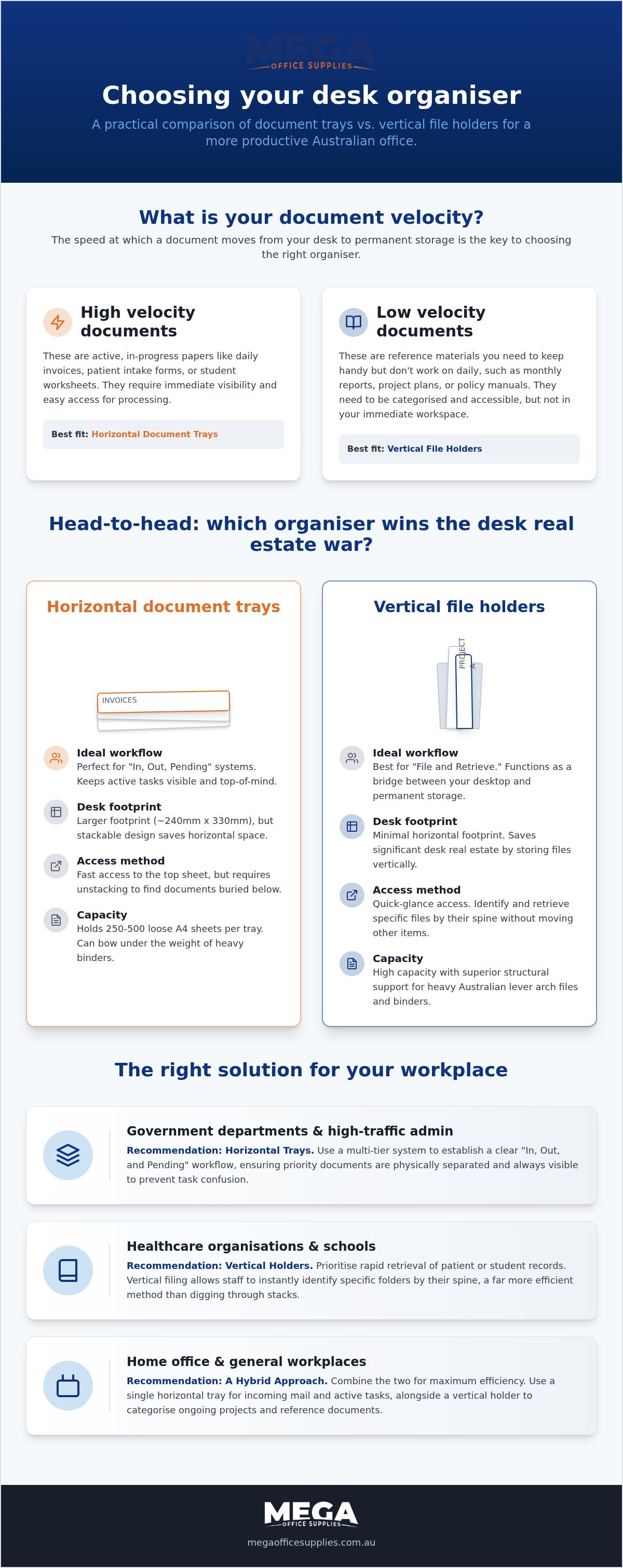
A desk buried under loose A4 copy paper is more than an eyesore; it is a logistical failure. When you can't see your desk surface, you can't focus on the task at hand. The choice between document trays vs vertical file holders often comes down to how you interact with your paperwork throughout the day. We define the horizontal tray as the classic contender for active stacks, providing a dedicated landing zone for incoming mail. Vertical holders, by contrast, offer quick-glance access to categorised files, allowing you to identify a specific folder by its spine without unstacking everything above it.
We categorise this decision by "document velocity." This refers to the speed at which a piece of paper moves from your hands into a permanent storage solution. High-velocity documents, like daily invoices or active student worksheets, require immediate visibility and easy physical access. Low-velocity items, such as reference manuals or monthly reports, need a logical home that doesn't consume your primary work zone. Matching the organiser to the speed of your workflow is the first step toward a clear desk.
Understanding the psychology of horizontal and vertical storage
Horizontal trays cater to the "out of sight, out of mind" fear. They keep active, in-progress work flat and visible, which helps ensure that urgent tasks remain top-of-mind for busy administrators. This orientation is ideal for "In, Out, and Pending" workflows common in Australian government and healthcare settings. However, be realistic about your stacking habits. A 10-tier horizontal tray is essentially just a vertical filing cabinet for optimists.
Vertical holders function as a high-capacity bridge between your desktop and your permanent filing and storage. They allow you to stand documents upright, making them easier to flick through while saving significant desk real estate. This setup is perfect for organising files before they are moved into lever arch files. By moving papers from a flat stack to a vertical slot, you effectively transition from "processing" to "referencing."
Performance and capacity: which organiser wins the desk real estate war?
Determining how much desk space you can afford to lose is the first step in choosing between document trays vs vertical file holders. A standard A4 document tray typically occupies a 240mm by 330mm area. While this takes up more horizontal space than a slim vertical holder, modular designs from trusted brands like Rexel and Marbig allow these units to grow upwards.
When comparing these two options for high-volume environments, consider the categorisation limit. Vertical holders offer fixed-width slots that are perfect for separating different project files or reference documents. They don't require the same unstacking effort as horizontal trays, making them faster for retrieving specific folders. If you frequently handle heavy lever arch files, vertical organisers provide the structural support needed to prevent your paperwork from slouching or sliding.
Technical specifications and material durability
Material choice impacts both longevity and performance. Solid plastic trays are the industry standard for daily administrative tasks because they are easy to sanitise and resistant to impact. For heavier loads, wire frames or professional-grade mesh offer superior ventilation and industrial strength. We find that a standard tray comfortably holds between 250 and 500 sheets of 80gsm paper. However, weight distribution is a critical factor. While horizontal trays are excellent for loose sheets, they can bow under the weight of thick binders. Vertical holders are structurally superior for supporting heavy folders, ensuring your filing and storage system remains upright and accessible.
Selecting the right solution for your specific workplace environment
Australian government departments and high-traffic administrative offices thrive on standardised workflows. We recommend using document trays to establish a clear "In, Out, and Pending" system. This physical separation prevents task confusion and ensures that priority paperwork is never buried under less urgent files. For healthcare and school environments, the priority shifts to the rapid retrieval of patient or student records. In these settings, vertical holders are superior because they allow staff to identify specific folders by their spines instantly. It's a far more efficient approach than the traditional "guess and dig" method used with unlabelled horizontal stacks.
Integrating your desktop organisers with wider filing systems
Desktop organisers shouldn't exist in isolation. Vertical holders serve as an excellent staging area for documents destined for long-term storage in filing cabinets. By grouping files vertically first, you streamline the final archive process. Clarity is maintained through precise labelling. We suggest using labelling machines to mark each slot, ensuring consistency across your stationery supplies Australia wide.
Often, the most efficient choice in the document trays vs vertical file holders debate is a hybrid setup. A single horizontal tray handles incoming mail and loose A4 sheets, while an adjacent vertical holder manages active project folders and reference manuals. This combination provides the best of both worlds: a landing zone for new tasks and a structured home for ongoing work. It is a pragmatic solution that keeps your desk functional and your mind focused, assuming you don't use your "In" tray as a permanent retirement home for junk mail.
Optimise your workplace with the right desktop organisation
Reclaiming your desk surface starts with matching your organiser to your document velocity. Horizontal trays provide the ideal landing zone for new tasks, while vertical holders offer the rapid retrieval needed for active files and student records. By integrating these tools with a clear labelling system, you eliminate the messy piles that lead to lost productivity.
When evaluating document trays vs vertical file holders, prioritising professional-grade durability ensures your system stands up to heavy commercial use. We support procurement officers across Australia with genuine local expertise and bulk pricing for business and school accounts. We also accept official Australian Government purchase orders to ensure a frictionless ordering process.
Browse our full range of professional filing and storage solutions
We look forward to helping you build a more efficient and logical workspace today.
Frequently asked questions
Are document trays or vertical holders better for saving desk space?
Vertical file holders win the horizontal real estate battle because they store documents on their edge. This orientation consumes less desk surface than a standard tray. However, if you have ample vertical clearance but limited width, stacking document trays allow you to grow your storage upwards. We recommend vertical options for narrow workstations and stacking trays for deep desks with high volume needs.
Can I use vertical file holders for thin A4 paper without them flopping over?
Loose A4 copy paper will likely curl or flop in a vertical holder unless it is placed inside a manilla folder or a document wallet first. Vertical holders are designed for structural support, making them better suited for heavier items like lever arch files or bound reports. For loose, high-velocity sheets, horizontal document trays provide the flat surface required to keep paper pristine.
What are the best brands for heavy-duty office organisers in Australia?
We recommend established brands like Rexel, Marbig, and Durable for professional Australian environments. These manufacturers focus on industrial-grade durability and offer modular stacking systems that remain stable under heavy loads. Choosing a reputable brand ensures that your document trays vs vertical file holders maintain their shape over years of use, avoiding the bowing or cracking common in generic plastic alternatives.
How do I clean mesh document trays and file holders?
Mesh organisers are prone to collecting dust within the wire weave. We suggest using a canister of compressed air or a vacuum with a soft brush attachment for regular maintenance. For deeper cleans, wipe the surfaces with a damp microfibre cloth and a mild pH-neutral detergent. Ensure the unit is completely dry before returning your A4 paper to prevent moisture damage or ink smudging.
Article by
Mega Office Supplies Team
The Mega Office Supplies Team provides practical buying guides and workplace advice for Australian businesses, schools, government organisations, healthcare providers, hospitality venues, warehouses and home offices. Family owned and operated since 2008 and based in Tweed Heads South on the Gold Coast–Tweed border, Mega Office Supplies helps Australian workplaces choose the right office supplies, furniture, technology, cleaning, safety and education products — backed by genuine local service from real people.
General Information
This article is provided as general information only to help customers compare and choose office, workplace, school, cleaning, technology, furniture, safety and business supplies. Product details, specifications, compatibility, availability, pricing and suitability may vary. Always check the individual product page, manufacturer information, workplace requirements and relevant safety guidance before purchasing or using a product.


