


A single misplaced hand sanitiser station can transform a vital hygiene solution into a significant fire hazard under current Australian safety laws. If you're managing a warehouse, school, or office, understanding the specific hand sanitiser station requirements for workplaces is no longer just about health; it's a matter of strict WHS compliance. With the 2026 transition to new Workplace Exposure Limits (WEL) and the updated Model Code of Practice for Biological Hazards, the margin for error has narrowed for facility managers across the country.
It's understandable to feel overwhelmed by the technicalities of GHS 7 labelling or the specific storage thresholds that trigger mandatory HAZCHEM placarding. You want to protect your team without failing a surprise audit or inadvertently creating a flammable liquid risk. This guide provides a definitive checklist to help you master Australian workplace hygiene standards. We'll examine the legalities of station placement, help you choose the right touch-free hardware, and outline the safety strategies needed to keep your organisation fully compliant through 2026 and beyond.
Key Takeaways
- Understand your WHS duty of care and how the 2026 Model Code of Practice defines the standard for hygiene facilities across Australian sectors.
- Identify the mandatory GHS 7 labelling and storage thresholds for alcohol-based sanitisers to manage fire risks and ensure safety compliance.
- Navigate hand sanitiser station requirements for workplaces by selecting durable, professional-grade hardware suited to your specific environment and volume needs.
- Implement a strategic placement strategy that targets high-traffic zones like entry points, lifts, and staff kitchens to maximise accessibility and hygiene rates.
- Develop a long-term facility management plan covering refill schedules and safe decanting practices to maintain a consistent supply of essential sanitisers.
Understanding WHS Obligations for Workplace Hand Hygiene
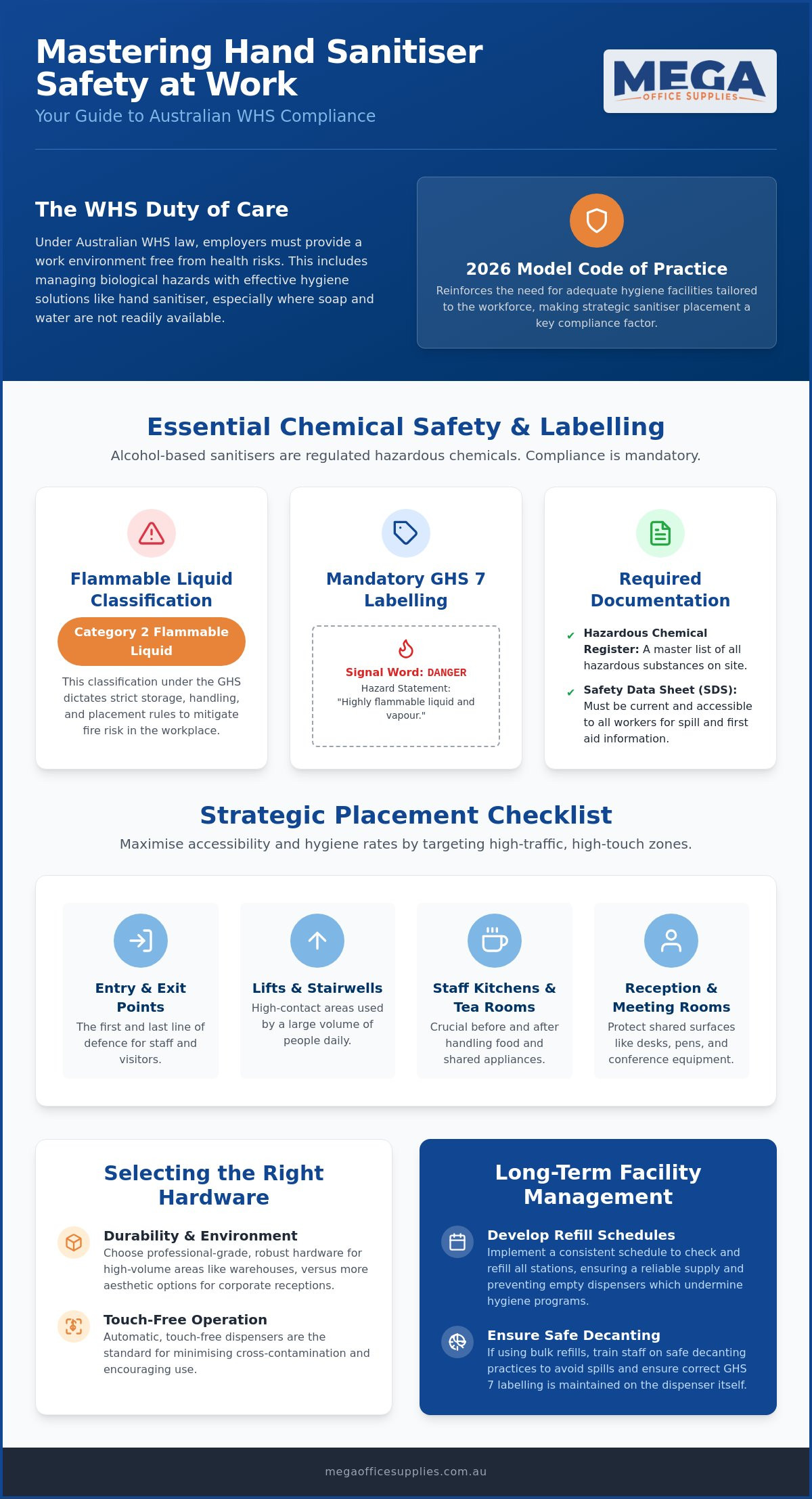
Under the Work Health and Safety (WHS) Act, every Australian employer carries a primary duty of care to provide a work environment that's free from health risks, so far as is reasonably practicable. This obligation extends beyond physical machinery or trip hazards; it includes managing biological risks through effective hygiene protocols. Hand sanitizer serves as a critical baseline tool in this effort, especially in areas where soap and water aren't immediately accessible. While general guidelines often suggest hygiene improvements, the legal framework requires active risk mitigation to protect staff and visitors alike.
Compliance with hand sanitiser station requirements for workplaces isn't just about following a trend. It's about fulfilling a legal mandate. Safe Work Australia's 2026 Model Code of Practice for managing biological hazards reinforces that hygiene facilities must be adequate for the size and nature of the workforce. If a risk can be minimised by providing sanitisation points, failing to do so may leave a business vulnerable during a WHS audit or workplace inspection. Meeting these standards requires a balance between accessibility and the safe management of the chemicals themselves.
To better understand how these systems function in a professional setting, watch this helpful video:
The Role of Hand Hygiene in Risk Management
High-touch surfaces like reception desks, lift buttons, and shared kitchenettes represent primary workplace hazards. An organised approach to maintenance ensures these areas don't become transmission hubs. Hand sanitiser stations act as a secondary line of defence that complements traditional hand-washing facilities. They're particularly effective in high-volume environments like warehouses or large-scale office fit-outs where staff movement is constant and access to sinks is limited. By strategically placing these stations, you address the risk at the point of contact.
WHS Consultation Requirements
Australian law mandates a duty to consult with workers who are, or are likely to be, directly affected by a health and safety matter. This includes the selection and placement of sanitisation hardware. Staff often have the best insights into which high-traffic zones need more attention. Documenting these protocols within your broader safety plan is essential for demonstrating compliance. When sourcing facility supplies, ensure the products meet GHS 7 standards to satisfy both hygiene and chemical safety regulations. This collaborative approach ensures your hand sanitiser station requirements for workplaces are met while fostering a genuine culture of safety.
Essential Chemical Safety and Labelling Requirements
Alcohol-based hand sanitisers are officially classified as Category 2 Flammable Liquids under the Globally Harmonised System of Classification and Labelling of Chemicals (GHS). This classification dictates many of the hand sanitiser station requirements for workplaces, moving the product from a simple cleaning consumable to a regulated hazardous chemical. Since January 1, 2023, Australia has fully transitioned to GHS 7. Every bottle or dispenser in your facility must feature compliant labelling that includes specific signal words, hazard statements, and pictograms. Failing to maintain these labels can lead to non-compliance during a WHS audit.
Managing these chemicals requires more than just correct labels. Employers must maintain a Hazardous Chemical Register if they store any volume of flammable sanitiser. This register acts as a master list of all hazardous substances on-site. It's also mandatory to have the current Safety Data Sheet (SDS) readily accessible to all workers. An SDS provides critical information on spill management, first aid, and fire-fighting measures. If you're managing bulk quantities, ensure your facility supplies are organised in a way that allows staff to locate this documentation instantly during an emergency.
Alcohol-Based vs. Alcohol-Free Sanitisers
Most professional environments utilise alcohol-based gels or liquids containing 60% to 95% ethanol or isopropanol for maximum efficacy. While highly effective at killing pathogens, these high concentrations increase the fire risk profile of your storage areas. Alcohol-free alternatives, often using benzalkonium chloride, are sometimes preferred in high-risk environments like primary schools or mental health facilities. These alternatives don't carry the same flammable liquid classification, which simplifies storage. However, they may have different contact time requirements to reach the same level of sanitisation as their alcohol-based counterparts.
Managing Fire and Explosion Risks
Strategic placement involves more than just accessibility; it requires heat source isolation. You must identify and control all potential ignition sources near your dispensing stations. In a standard office, this means keeping dispensers away from shared printers, photocopiers, and kitchen appliances like toasters or microwaves. Vapours from alcohol-based products can accumulate in poorly ventilated areas, creating a flash-fire risk. If your organisation stores more than 250 litres of sanitiser, you're legally required to display outer warning "HAZCHEM" placards at your facility entrances. For volumes exceeding 2,500 litres, you must prepare a formal manifest and notify your state's work safety authority. Regular inspections of dispenser seals help prevent leaks that could lead to dangerous vapour build-up in confined spaces.
Selecting the Right Sanitiser Station Hardware for Your Sector
Choosing the physical hardware for your hygiene strategy requires a balance between durability and user accessibility. The hardware you select must withstand high-volume use while remaining easy for staff to maintain. In many Australian industries, the hand sanitiser station requirements for workplaces dictate a move away from loose pump bottles toward fixed, professional-grade dispensing systems. These systems provide a consistent dosage and prevent the accidental removal or loss of sanitising supplies. Whether you opt for a permanent wall-mounted fixture or a mobile floor stand depends entirely on your facility's layout and traffic patterns.
Wall-mounted dispensers are the preferred choice for permanent high-traffic zones like lift lobbies and staff kitchen entrances. They're space-efficient and less likely to be knocked over in busy corridors. Conversely, free-standing floor stations offer the flexibility needed for temporary queues or large-scale events. When evaluating these options, consider the activation mechanism. Automatic, touchless dispensers use infrared sensors to eliminate the need for physical contact, significantly reducing the risk of cross-contamination. While manual push-pumps are reliable and don't require batteries, they're increasingly seen as a secondary option in 2026 workplace hygiene standards.
Sector-Specific Hardware Considerations
Maintenance and Refill Systems
The efficiency of your hygiene plan relies on the ease of the refill process. Open refillable reservoirs allow you to buy sanitiser in bulk, which is cost-effective for large organisations. However, sealed cartridge systems are often more hygienic because the liquid is never exposed to the air during the changeover. To protect your flooring from alcohol-based spills, ensure every station includes a sturdy drip tray. These trays are essential for preventing slip hazards and protecting carpet or timber finishes from chemical damage. Regular cleaning of the station itself is mandatory; a professional-grade station should feature smooth, non-porous surfaces that you can wipe down daily with standard cleaning chemicals.
Strategic Placement Checklist: Maximising Accessibility and Safety
The effectiveness of your hygiene strategy relies heavily on the physical location of your dispensing hardware. While previous sections covered the chemical and hardware specifications, the actual positioning of these units is where WHS compliance meets daily utility. According to industry best practices, hand sanitiser stations should be located within three metres of a facility’s main entrance. This ensures that every individual entering the building has the immediate opportunity to sanitise their hands before touching internal door handles, lift buttons, or reception counters.
Primary locations include entry points, lift lobbies, and the entrances to staff kitchens or breakout rooms. These are high-traffic zones where the risk of cross-contamination is highest. Secondary locations are equally important for maintaining hygiene throughout the workday. You should position stations near shared equipment hubs, such as meeting rooms and printing stations. Areas used for retrieving A4 copy paper or stationery supplies are often overlooked but represent significant touch-points that require accessible sanitisation options.
Safety must dictate placement as much as convenience does. Because alcohol-based sanitisers are flammable, you must maintain a minimum 2-metre distance from any potential ignition sources. This includes light switches, heaters, electrical outlets, and kitchen appliances. Furthermore, you must ensure that your hand sanitiser station requirements for workplaces do not conflict with fire safety regulations. Stations should never obstruct emergency exit paths, fire extinguishers, or hose reels. A station that creates a bottleneck in a narrow corridor during an evacuation is a liability, not a safety feature.
To ensure your facility is fully equipped for 2026 compliance, browse our comprehensive range of facility supplies to find the right hardware for your layout.
Visibility and Signage
A dispenser is only useful if it is seen. Use high-visibility floor decals to direct foot traffic toward your stations, especially in large open-plan offices or warehouses. Every station should be accompanied by clear instructional signage. These guides should explain the correct technique for sanitisation, ensuring staff use enough product to cover all surfaces of their hands. For bulk storage or decanting areas, ensure that Safety Data Sheet (SDS) information is prominently displayed and easily accessible to all employees.
Accessibility and Inclusivity
Inclusive design is a core component of modern WHS standards. Mount your dispensers at heights that accommodate all employees, including those who use wheelchairs. A height range of 900mm to 1200mm from the floor is generally considered the accessible standard. If you use free-standing floor stations, ensure they feature a weighted base to prevent them from becoming trip hazards or tipping over in high-traffic areas. Conduct regular audits of your station placement; as office furniture is moved or layouts change, your hand sanitiser station requirements for workplaces must be reassessed to maintain total coverage.
Implementing a Long-Term Facility Management Plan
Fulfilling hand sanitiser station requirements for workplaces involves a transition from initial installation to a structured maintenance cycle. An empty dispenser is a significant gap in your hygiene protocol and a potential WHS non-compliance. You must establish a rigorous refill schedule that aligns with your facility's foot traffic. In high-volume environments like warehouses or schools, this often requires daily checks to ensure that sanitisation points remain functional. Consistency is the cornerstone of effective facility management; if staff cannot rely on the hardware being stocked, the habit of hand hygiene quickly erodes.
Safe handling of flammable liquids during the refill process is a mandatory part of your safety plan. Because most effective sanitisers are Category 2 flammable liquids, staff must be trained in correct decanting procedures. This includes refilling in well-ventilated areas and ensuring that bulk containers are sealed immediately after use. Monthly inspections should also be formalised to check the structural integrity of wall mounts and floor stands. For automatic units, battery replacement cycles must be tracked to prevent hardware failure. Partnering with a reliable national office supplier ensures you have the logistical support needed to maintain these standards across all your sites.
Procurement Strategy for National Operations
Managing hygiene supplies across multiple branches requires a streamlined procurement approach to ensure consistency. Standardising your hardware selection across all locations simplifies maintenance and allows for bulk purchasing of specific cartridges or refill gels. This reduces the administrative burden on individual site managers and ensures every office meets the same high standard of safety. To facilitate this, many organisations utilise business application forms to establish dedicated accounts. This allows for rapid quoting and efficient volume management, ensuring your hand sanitiser station requirements for workplaces are met without friction or supply chain delays.
Mega Office Supplies: Your Facility Management Partner
With over 20 years of experience as a family-owned Australian company, Mega Office Supplies understands the practicalities of maintaining a safe work environment. We position ourselves as a dependable partner for procurement officers who value reliability and industrial-grade quality. Our catalogue extends beyond hygiene to include a comprehensive range of first aid supplies and professional cleaning chemicals. We provide national coverage for bulk facility supplies and proudly accept Australian Government official purchase orders. Our team possesses the cumulative decades of industry knowledge required to support large-scale office fit-outs and high-volume warehouse demands, ensuring your organisation remains compliant and your staff remain protected.
Future-Proofing Your Facility Safety Plan
Mastering hand sanitiser station requirements for workplaces is a continuous process that balances accessibility with strict WHS compliance. By prioritising GHS 7-compliant labelling and isolating flammable liquids from heat sources, you mitigate the most critical fire risks in your facility. Selecting durable, touch-free hardware ensures your hygiene strategy remains effective and user-friendly through 2026 and beyond. It's about creating a reliable environment where safety is integrated into the daily workflow without friction.
As a family-owned Australian retailer with over 20 years of combined industry experience, Mega Office Supplies provides the logistical prowess needed for national operations. We offer national delivery across Australia and specialise in high-volume fulfilment, including accepting official Government purchase orders for schools and departments. Browse our full range of Facility and Hygiene Supplies to find professional-grade hardware and chemicals tailored to your specific sector. Secure your workplace with confidence and maintain a safer environment for your entire team today.
Frequently Asked Questions
Are hand sanitiser stations mandatory in Australian workplaces?
Yes, providing adequate hygiene facilities is a mandatory requirement under the Work Health and Safety (WHS) Act to manage biological risks. While the Act doesn't name specific hardware, hand sanitiser stations are considered a "reasonably practicable" control measure in areas where soap and water aren't immediately accessible. This is particularly relevant for high-traffic entry points and shared workspaces where hand hygiene is critical for staff safety.
Do I need a Safety Data Sheet (SDS) for hand sanitiser in the office?
Yes, you must maintain a current Safety Data Sheet for all hand sanitisers used or stored in your workplace. Because most professional-grade sanitisers are classified as Category 2 flammable liquids, the SDS provides essential information on fire safety, spill management, and first aid. It's a legal requirement to ensure this documentation is readily accessible to any employee who may be exposed to the chemical during their shift.
What is the safest way to store bulk hand sanitiser refills?
Bulk refills should be stored in a cool, dry, and well-ventilated area away from direct sunlight and all potential ignition sources. You must ensure that containers are kept sealed when not in use to prevent the accumulation of flammable vapours. If your facility stores more than 250 litres of alcohol-based product, you are legally required to display "HAZCHEM" placards at your site entrances to alert emergency services.
Can I place a hand sanitiser station next to a light switch?
No, you should avoid placing dispensing hardware directly next to light switches, heaters, or electrical outlets. Alcohol-based sanitisers are highly flammable; therefore, maintaining a minimum 2-metre clearance from any potential ignition source is a standard safety protocol. This distance minimises the risk of fire if vapours accumulate or if a leak occurs near an electrical contact point during use.
What should I do if a hand sanitiser station leaks on the carpet?
You should clean the spill immediately and ensure the area is well-ventilated to disperse any alcohol vapours. Refer to your SDS for specific spill management instructions; typically, this involves using absorbent materials to soak up the liquid before it deeply penetrates the carpet fibres. Prompt action is necessary to prevent both a slip hazard and a potential fire risk in your office or reception area.
Are touchless automatic dispensers better than manual ones for compliance?
Touchless dispensers are often preferred for hand sanitiser station requirements for workplaces because they eliminate a common physical contact point. While manual push-pump dispensers are compliant if they are durable and fit for purpose, automatic units offer a higher standard of hygiene by reducing cross-contamination. Many organisations find that touchless technology encourages higher compliance rates among staff and visitors in high-volume environments.
How often should hand sanitiser stations be inspected for safety?
You should conduct formal inspections of all sanitisation hardware at least once a month. These audits ensure that dispensers are free from leaks, batteries are functional in automatic units, and that the stations haven't been moved to obstruct emergency exit paths. Regular checks also allow you to verify that SDS information and instructional signage remain clearly visible and that stock levels are sufficient for the coming month.
Does the sanitiser need to be a certain percentage of alcohol to be compliant?
Effective sanitisation in a professional setting generally requires an alcohol concentration between 60% and 95%. While WHS regulations focus on the safe placement and storage of the hardware, the sanitiser itself must be fit for purpose and compliant with TGA or cosmetic standards. Using a product with the correct alcohol percentage ensures that your hand sanitiser station requirements for workplaces actually deliver the intended health and safety outcomes.
Article by
Mega Office Supplies Team
The Mega Office Supplies Team provides practical guidance for Australian businesses, schools, government organisations, healthcare providers, hospitality venues, warehouses and home offices. Based in Tweed Heads South, Mega Office Supplies is a family-owned and operated Australian business offering office stationery, workplace furniture, technology products, labels, printers, cleaning and janitorial supplies, safety products, art materials, education resources and everyday business essentials from trusted brands.
General Information
This article is provided as general information only to help customers compare and choose office, workplace, school, cleaning, technology, furniture, safety and business supplies. Product details, specifications, compatibility, availability, pricing and suitability may vary. Always check the individual product page, manufacturer information, workplace requirements and relevant safety guidance before purchasing or using a product.


