


Is your current office setup a ticking time bomb for WorkCover claims? Most procurement officers and business owners find the shifting landscape of Safe Work Australia guidelines genuinely daunting, especially when trying to balance employee health against a strict bottom line. We understand that navigating these rules often feels like trying to assemble flat-pack furniture without the instructions; frustrating, time-consuming, and prone to structural failure.
This guide simplifies the WHS requirements for office workstations Australia for 2026. By reading on, you'll master mandatory ergonomic standards and understand your specific procurement duties to ensure every desk and chair meets AS/NZS criteria. We provide a clear compliance checklist and the confidence to purchase professional-grade furniture that reduces injury risks. Drawing on over 150 years of combined team industry experience, we're here to help you secure your workplace and your peace of mind.
Key Takeaways
- Understand the legal obligations of a PCBU under the Model WHS Laws to ensure a safe work environment for all staff.
- Master the specific WHS requirements for office workstations Australia by aligning your furniture procurement with AS/NZS 4438 for chairs and AS/NZS 4443 for desks.
- Implement a systematic workstation assessment process for every new hire or office relocation to minimise injury risks and potential WorkCover claims.
- Learn how to select professional-grade ergonomic equipment that balances strict compliance needs with your organisation's budgetary requirements.
Understanding the Australian WHS framework for office environments
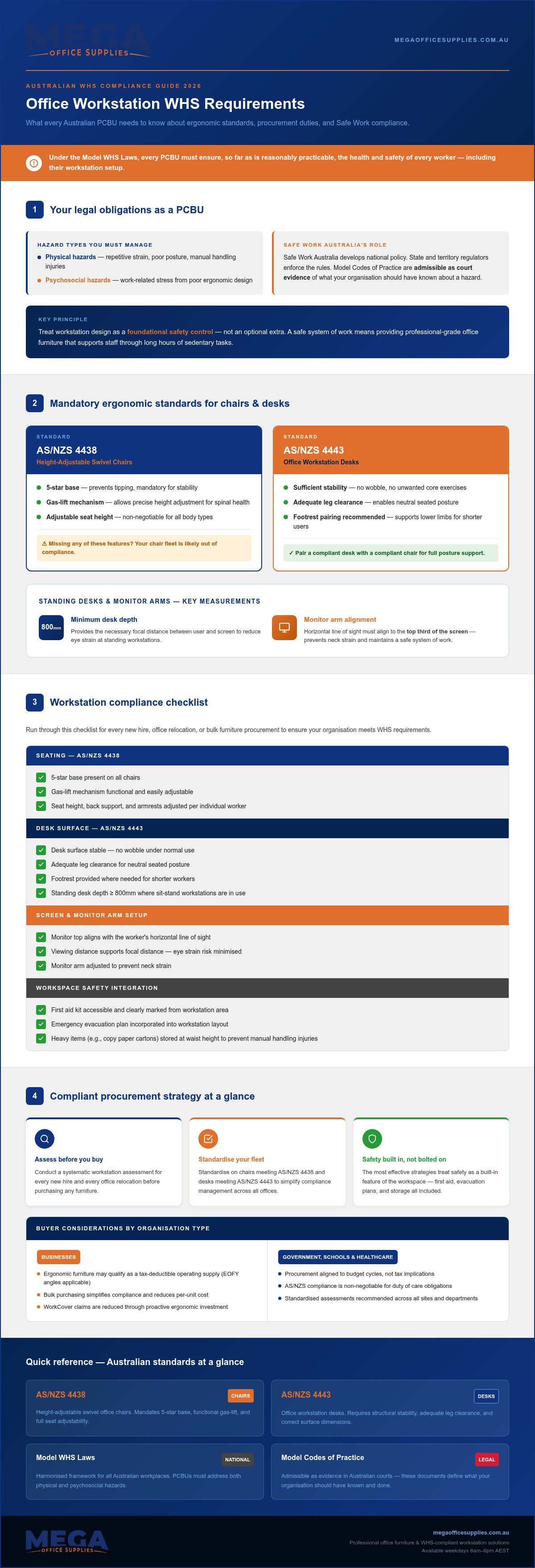
Managing your legal liability as a Person Conducting a Business or Undertaking (PCBU) starts with understanding your primary duty of care under the Model WHS Laws. In Australia, this responsibility requires you to ensure, so far as is reasonably practicable, the health and safety of every worker. Meeting the WHS requirements for office workstations Australia is a critical part of this obligation. While Safe Work Australia develops the national policy, state and territory-based regulators enforce these rules. It's important to note that while the core principles are consistent, some jurisdictions may operate under their own similar but distinct Occupational Health and Safety (OH&S) legislation. The fundamental duties remain similar across the nation.
By 2026, compliance requires addressing both physical and psychosocial hazards. You must manage risks such as repetitive strain or work-related stress caused by poor ergonomic design. A 'safe system of work' involves providing professional-grade office furniture that supports the human body through long hours of sedentary tasks. It's a legal necessity. We recommend treating workstation design as a foundational safety control rather than an optional extra.
The shift from OH&S to WHS and the role of Safe Work Australia
The transition from fragmented state-based OH&S systems to the harmonised WHS Act created a consistent national standard for businesses. This framework relies on Model Codes of Practice. These documents are vital because they're admissible as evidence in Australian courts to demonstrate what an organisation should have known about a hazard. Regardless of the specific state or territory regulator you engage with, these codes provide the blueprint for your workstation assessments. Safety is not optional. Following these standards ensures your procurement strategy is legally sound and your team remains protected.
Mandatory ergonomic standards for chairs and desks
Selecting the right hardware is the most effective way to meet WHS requirements for office workstations Australia. For seating, AS/NZS 4438 remains the definitive benchmark for height-adjustable swivel chairs. A compliant chair must feature a stable 5-star base and a reliable gas-lift mechanism. These components prevent tipping and allow for precise height adjustments, which are non-negotiable for spinal health. If your current fleet lacks these features, you're likely out of compliance.
Desks are governed by AS/NZS 4443. This standard ensures that work surfaces provide sufficient stability and leg clearance. A desk that wobbles is more of an unwanted core-strength exercise than a productive workspace; it creates immediate physical hazards. To achieve a neutral posture, we often recommend pairing these desks with footrests to support the lower limbs. You can browse our range of office chairs to find models that meet these rigorous Australian standards.
Adjustability requirements for standing desks and monitor arms
Modern workplaces benefit significantly from standing desks, which help minimise the health risks associated with prolonged sedentary work. When setting up these stations, ensure the desk depth is at least 800mm. This depth provides the necessary focal distance between the user and their screen to reduce eye strain. Monitor arms are equally vital. They must be adjusted so the user has a horizontal line of sight to the top third of the screen. This positioning prevents neck strain and maintains a safe system of work. Technical precision in these measurements is essential for long-term staff wellbeing.
Implementing a compliant workstation procurement strategy
A systematic workstation assessment for every new staff member or office relocation is the cornerstone of a proactive safety culture. By standardising your equipment, you ensure all employees have access to ergonomic office chairs that strictly meet AS/NZS 4438. This approach simplifies the management of WHS requirements for office workstations Australia and removes the guesswork from procurement. For instance, ensuring heavy items like cartons of copy paper are stored at waist height can prevent manual handling injuries before they occur.
Safety integration extends beyond the desk surface. You must incorporate first aid kits and emergency evacuation plans directly into the physical workstation layout. These items must be easily accessible and clearly marked to meet your duty of care. Drawing on over 150 years of combined team industry experience, we've seen that the most effective strategies treat safety as a built-in feature of the workspace rather than a secondary addition.
Managing WHS for hybrid and remote Australian workers
Your legal responsibility as a PCBU remains in force even when staff work from home or in satellite offices. To manage this, provide remote ergonomic checklists that help workers identify hazards like inadequate lighting or non-adjustable seating. We recommend facilitating 'work-from-home' gear packs to ensure remote workstations maintain the same corporate WHS standards as the head office. This ensures consistency in staff wellbeing and protects your organisation from liability, regardless of where the work actually happens.
Securing your workplace compliance for 2026
Mastering the WHS requirements for office workstations Australia is more than a legal checkbox; it's a commitment to your team's long-term health and productivity. By prioritising furniture that meets AS/NZS standards and implementing systematic workstation assessments, you've already taken the most difficult steps toward total compliance. Whether you're managing a local government department or a growing home-based operation, selecting professional-grade equipment remains your best defence against workplace injury and liability.
Our award-winning team brings over 150 years of combined industry expertise to every order. We accept official Australian Government purchase orders and offer specialised support for high-volume corporate fit-outs. We make compliance simple.
Browse our range of WHS-compliant ergonomic office furniture
Take the next step in future-proofing your office environment today.
Frequently Asked Questions
What is the minimum desk size for WHS compliance in Australia?
There isn't a single mandated size in the Act, but AS/NZS 4443 provides the technical benchmark for safety. We recommend a minimum desk depth of 800mm to maintain a safe focal distance from monitors. This depth prevents eye strain and allows for proper leg clearance. Surface width should accommodate all necessary equipment without overcrowding, typically ranging from 1200mm to 1800mm for standard office tasks.
Do I legally have to provide a standing desk for my employees?
You aren't legally required to provide standing desks to every employee by default. However, you must manage the risks associated with sedentary work. Sit-stand workstations are a highly effective control measure to meet your duty of care. If an employee has a specific medical requirement or a risk assessment identifies prolonged sitting as a hazard, providing a height-adjustable desk becomes a practical way to fulfil your obligations.
Is an ergonomic assessment mandatory for every new office workstation?
Conducting an ergonomic assessment is a critical part of the risk management process required under WHS requirements for office workstations Australia. You must identify hazards and implement controls for every new setup or office relocation. While it doesn't always require an external consultant, a systematic internal review ensures the equipment is adjusted correctly for the individual user, reducing the likelihood of work-related musculoskeletal injuries.
How often should office chairs be replaced under Australian WHS guidelines?
There's no fixed expiry date for office chairs under WHS law. You should replace them when they no longer provide adequate support or if the gas-lift and adjustment mechanisms fail. Most professional-grade ergonomic chairs are built for a service life of 5 to 10 years. Regular inspections should be part of your maintenance schedule to ensure every seat continues to meet AS/NZS 4438 safety standards.
Does WHS law apply to employees working from home in Australia?
WHS law applies to any location where your staff perform work, including home offices. As a PCBU, you have the same duty of care to ensure a safe environment for remote workers as you do for those in the head office. Providing a checklist or a 'work-from-home' gear pack ensures that domestic setups meet the WHS requirements for office workstations Australia and helps mitigate your organisation's legal liability.
What Australian Standards apply to office furniture procurement?
Procurement should focus on two primary standards: AS/NZS 4438 for height-adjustable swivel chairs and AS/NZS 4443 for office desks. These standards ensure the furniture is stable, durable, and adjustable enough for a diverse workforce. Buying equipment that carries these certifications is the most reliable way to prove you've met your procurement duties and provided a safe system of work for your staff.
Article by
Mega Office Supplies Team
The Mega Office Supplies Team provides practical buying guides and workplace advice for Australian businesses, schools, government organisations, healthcare providers, hospitality venues, warehouses and home offices. Family-owned and operated since 2009 and based in Tweed Heads South on the Gold Coast–Tweed border, Mega Office Supplies brings more than 150 years of combined team experience to helping Australian workplaces choose the right office supplies, furniture, technology, cleaning, safety and education products — backed by genuine local service from real people.
General Information
This article is provided as general information only to help customers compare and choose office, workplace, school, cleaning, technology, furniture, safety and business supplies. Product details, specifications, compatibility, availability, pricing and suitability may vary. Always check the individual product page, manufacturer information, workplace requirements and relevant safety guidance before purchasing or using a product.


