


Purchasing liquid ink for a high-volume office machine is often the most expensive mistake a procurement officer can make in 2026. You've likely felt the frustration of a $72 ink pack drying out after just a few weeks of minimal use or dealt with smudged documents during a critical meeting. It's a common misconception to ask, do laser printers use ink, when these professional-grade machines actually rely on toner, a dry, plastic-based powder designed for institutional stability.
We understand that reliability is non-negotiable for government and corporate buyers who manage large-scale operations. This guide explains why toner technology offers a superior shelf-life and how it can significantly reduce your total cost of ownership. We'll examine current May 2026 pricing for high-yield options like the $319 HP 26X, discuss Epson's scheduled exit from laser manufacturing by the end of this year, and provide a checklist for efficient procurement. By the end of this article, you'll know exactly how to optimise your workplace essentials for faster speeds and zero-waste compliance through our Australian based support network.
Key Takeaways
- Clarify the fundamental technology difference by learning why do laser printers use ink is a common myth, as these machines actually utilise a dry, electrostatic powder called toner.
- Compare the efficiency of a 3,000-page toner yield against a standard 500-page ink cartridge to identify the most cost-effective solution for your high-volume printing needs.
- Gain insight into the xerographic process to understand how heat and static electricity eliminate the risk of smudged documents in professional settings.
- Identify critical maintenance requirements, such as drum unit lifecycles and safe toner spill management, to ensure institutional stability and equipment longevity.
- Navigate the selection between genuine OEM and compatible cartridges to optimise your office budget while maintaining administrative compatibility and print quality.
The Short Answer: Do Laser Printers Use Ink or Toner?
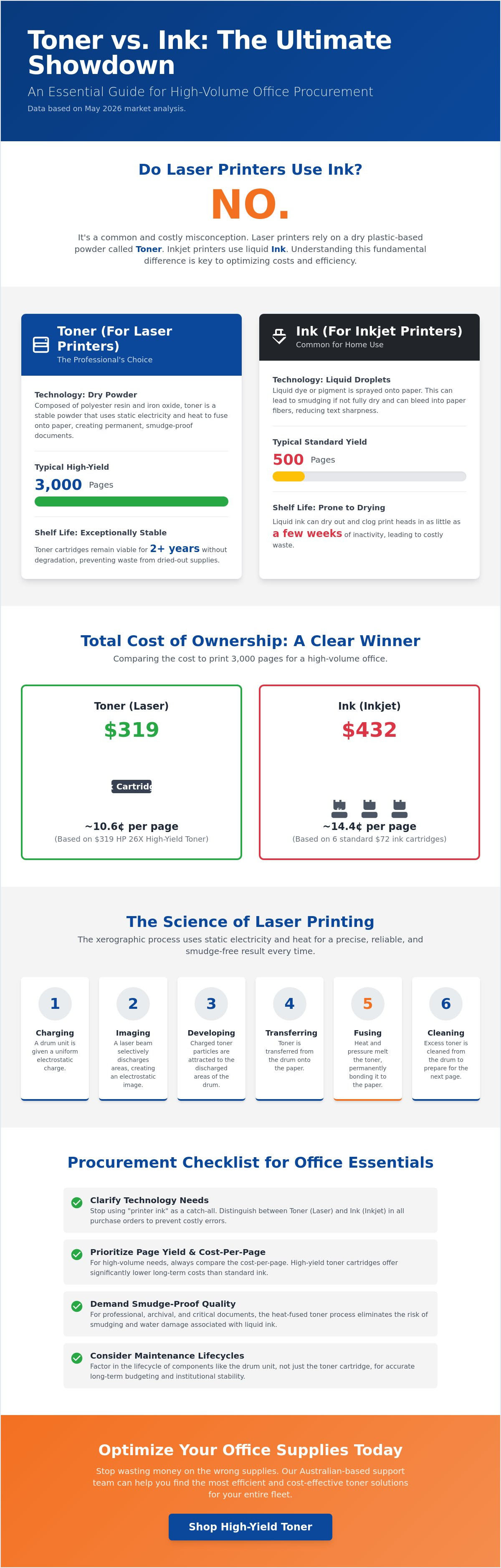
Procurement officers and office managers frequently ask, do laser printers use ink, when auditing their workplace essentials or preparing bulk orders. The definitive answer is no. Laser printers do not use liquid ink. Instead, these machines rely on toner, a dry, sophisticated powder designed for high-speed, high-volume environments. While inkjet printers spray microscopic droplets of liquid dye or pigment onto a page, laser systems utilise a dry process that involves no liquid components whatsoever. Understanding this technical distinction is the first step toward optimising your office logistics and reducing long-term overheads.
This terminology matters because mistaking one for the other leads to significant administrative friction. In many professional settings, "printer ink" has become a generic catch-all term, but using it during the procurement process can result in costly purchasing errors. To maintain institutional stability, your inventory management system must distinguish between these two technologies. To gain a deeper perspective on the technical foundation of these machines, reviewing the history of How Laser Printing Works reveals why the xerographic process is preferred for government and corporate sectors that demand smudge-free, permanent documentation.
What Exactly is Toner Powder?
Toner is a complex chemical compound, not just simple dust. It's primarily composed of polyester resin, iron oxide, and carbon black or specific pigments for colour. The polyester acts as a polymer base, which is critical because it allows the material to liquefy quickly when it passes through the fuser unit. Iron oxide provides the magnetic properties required for the powder to be manipulated by the internal components of the printer. Unlike liquid ink, which can dry out and clog nozzles if left unused for as little as 14 days, toner remains stable in its cartridge for years. Toner is a plastic-based powder that uses heat and static to bond with paper fibres.
Why the Confusion? Inkjet vs Laser Terminology
The confusion between these supplies often stems from the way products are marketed to the general public. Because "ink" is a shorter, more familiar word, it's often used incorrectly in search queries and office requests. This linguistic overlap can lead to staff ordering the wrong consumables for your fleet, causing unnecessary downtime. The physical differences are stark. Inkjet cartridges are typically small, lightweight plastic tanks filled with liquid. In contrast, laser printers use large, elongated toner cartridges that often integrate with a separate drum unit. Recognising these physical and chemical differences ensures that your purchase orders are accurate, allowing our Australian based support team to facilitate fast delivery without the need for returns or exchanges.
How Laser Printing Works: The Science of Static and Heat
Modern office efficiency depends on the xerographic process, a technology that relies on static electricity rather than liquid pigments. When professionals ask, do laser printers use ink, they're often surprised to learn that the process is closer to high-speed photocopying than traditional printing. A laser beam scans across a drum to create an electrostatic template of your document. This template attracts the dry toner particles, ensuring high-precision placement before any physical contact with the paper occurs. This technical superiority is a key reason why many procurement officers prioritise Toner vs Ink: Comparing Performance and Total Cost of Ownership when outfitting a new department.
The core of this technology is the interaction between the laser and the imaging drum. Because the system uses heat to bond the material, the final output is permanent and resistant to moisture. This differs fundamentally from inkjet systems where liquid can bleed into the paper fibres, causing feathered edges on text or smearing if the page is handled too quickly. For government and corporate buyers, the reliability of a dry process ensures that archived documents remain legible for decades without the degradation associated with liquid dyes.
The 6-Step Laser Printing Process
This systematic workflow ensures institutional reliability and consistent output quality across thousands of pages. It follows a logical progression from preparation to final fusion:
- Steps 1-2 (Cleaning and Conditioning): A rubber blade removes residual toner from the previous cycle while a corona wire applies a uniform negative charge to the imaging drum.
- Steps 3-4 (Laser Exposure and Toner Application): The laser discharges specific points on the drum to create a latent image; negatively charged toner then adheres only to those discharged areas.
- Steps 5-6 (The Fusing Process): The paper pulls the toner from the drum before passing through heat rollers that melt the plastic-based powder directly into the paper fibres.
Precision and Speed: Why Lasers Win for Text
Laser printers achieve higher speeds because the laser beam moves significantly faster than a physical inkjet head. While an inkjet head must travel back and forth across the page, a laser system processes the entire page width in one fluid motion. This allows for sharper edges on 12pt font text because the dry powder doesn't bleed into the paper fibres like liquid ink does. The "dry-to-the-touch" output is essential for high-volume office environments where documents must be filed or distributed immediately. It's a common misconception to ask do laser printers use ink when the heat-based fusion process provides a level of durability that liquid-based systems cannot match. You can find a wide range of these high-performance workplace essentials in our current inventory, all backed by local Australian based support and fast delivery.
Toner vs Ink: Comparing Performance and Total Cost of Ownership
Selecting the right hardware for a professional environment requires a detailed analysis of total cost of ownership (TCO) rather than just the initial purchase price. While many buyers still ask do laser printers use ink because they see a lower upfront cost on inkjet models, the long-term logistics tell a different story. For Australian businesses, the shift to laser technology is often driven by the need for institutional stability and predictable overheads. High-yield toner cartridges provide a logistical advantage by significantly extending the time between replenishment cycles. This efficiency streamlines administrative workflows and reduces the volume of purchase orders processed by your procurement team, ensuring your operation remains lean and focused on core objectives.
Page Yield and Cost Per Page (CPP) Breakdown
Page yield is calculated using the ISO/IEC 5% coverage standard, which provides a baseline for comparing different consumables across all major brands. A standard ink cartridge might offer a yield of 500 pages, whereas a high-yield toner like the Brother TN-253BK can produce up to 2,500 to 3,000 pages before requiring replacement. This disparity directly impacts your cost per page (CPP). While toner cartridges cost more upfront, their cost-per-page is typically 50-70% lower than inkjet, making them the preferred choice for high-volume text production. Understanding the science of laser printing helps clarify why these dry-powder systems are more efficient at scale than liquid-based alternatives. When you calculate the total investment over a 36-month period, the savings on supplies often exceed the initial cost of the printer itself.
The Shelf Life Advantage: Toner Does Not Dry Out
One of the most significant frustrations for schools and government offices with fluctuating print needs is the tendency for liquid ink to dry out or clog nozzles during periods of inactivity. Because toner is a dry, plastic-based powder, it's physically impossible for it to dry out, even if the machine sits idle for several months. This shelf-life advantage ensures that your workplace essentials are ready for immediate use without the waste of expensive cleaning cycles that consume liquid ink. You don't have to worry about wasting half a cartridge just to get the machine started after a holiday break. To maintain this reliability in the varied Australian climate, we recommend storing cartridges in a cool, dry environment away from direct sunlight. This stability makes laser technology a superior investment for professional sectors where reliability and readiness are non-negotiable requirements.
Maintenance and Environmental Impact of Laser Printing
While procurement officers often ask do laser printers use ink when troubleshooting, the maintenance requirements for laser machines are distinctly different from liquid-based systems. A primary technical consideration is the drum unit, a component that works alongside the toner cartridge to transfer the image to paper. Most professional-grade printers require a drum replacement after every three to four toner cycles. Monitoring these separate lifecycles is essential for institutional stability, as a worn drum will produce streaks or ghosting even with a full toner cartridge. If a spill occurs during replacement, never use hot water. Heat melts the plastic-based powder, which can permanently bond the toner to your skin or clothing; always use cold water and a dry cloth for safe removal.
The environmental footprint of printing has become a critical metric for Australian corporate and government buyers. As of May 2026, the Australian government classifies both toner and ink cartridges as e-waste, making it illegal to dispose of them in regular landfill in most states. This regulation reflects the complexity of the plastic-based powder and the specialised recycling processes required to manage these materials. To meet zero-waste-to-landfill goals, organisations should utilise established product stewardship programs that convert used supplies into industrial products like road paving materials.
Caring for Your Laser Printer and Toner Cartridges
Extending the life of your supplies is a practical way to reduce administrative overheads. Many machines display a "Toner Low" message when 10% to 15% of the powder remains, allowing you time to prepare a new purchase order without immediate downtime. You can often stretch this yield by selecting "Draft Mode" for internal documents or utilising thinner fonts that require less coverage. Unlike liquid ink, which requires frequent "head cleaning" cycles that waste up to 20% of a cartridge, laser printers remain efficient even during irregular use. This reliability ensures that your do laser printers use ink queries are replaced by a focus on long-term hardware health and consistent output quality.
Sustainable Printing: Recycling Toner in Australia
Australian businesses have access to robust recycling infrastructure through the "Cartridges 4 Planet Ark" initiative. This program, supported by major brands like Brother, Canon, and HP, provides free collection boxes for workplaces to ensure zero-waste-to-landfill compliance. For example, Epson Australia recently reported collecting and recycling over 21 tonnes of used cartridges through this program, demonstrating the scale of domestic sustainability efforts. Choosing high-capacity XL cartridges further reduces plastic waste by decreasing the frequency of cartridge replacements. Our team provides high-yield toner cartridges that align with these sustainability goals, ensuring your office maintains professional standards while meeting modern environmental regulations.
Finding the Right Supplies for Your Australian Office
Efficient procurement begins with accurate technical knowledge. While administrative staff might still ask do laser printers use ink during the initial onboarding process, the focus for experienced procurement officers is the strategic selection of toner supplies. Choosing the correct consumables is a balancing act between budget constraints and the need for institutional stability. For high-stakes environments like government departments or legal firms, the reliability of your printing fleet depends on a consistent supply chain and the quality of the cartridges you install. Selecting the wrong part number or a low-grade third-party alternative can lead to hardware downtime that compromises your operational deadlines.
Identifying the correct toner for your specific printer model is straightforward when you use the manufacturer's part number, such as the Brother TN-251 or the HP 26X. These identifiers ensure that the cartridge will interface correctly with the drum unit and fuser assembly. Because do laser printers use ink is a question of the past for most modern offices, the current debate centres on the logistical advantages of genuine versus compatible cartridges. Our Australian based support team is available to help you navigate these choices, ensuring that every purchase order aligns with your specific hardware requirements and performance standards.
Genuine vs Compatible Toner Cartridges
Genuine OEM (Original Equipment Manufacturer) cartridges from brands like Brother, Canon, or HP offer the highest level of reliability. These products are engineered to work with the specific electrostatic properties of your printer's drum. Using genuine supplies is often a requirement for maintaining the manufacturer's warranty on new machines, which is a critical consideration for government and education sectors. High-quality compatible cartridges provide a cost-effective alternative for internal documents and high-volume drafts. If you choose compatibles, ensure they're sourced from a reputable supplier that provides local accountability and a performance guarantee to protect your equipment investment.
Why Mega Office Supplies for Your Printing Logistics
Centralising your procurement through a 100% Australian-owned partner eliminates the logistical friction often found with international digital retailers. We project an image of grounded authority by providing professional solutions tailored to the needs of institutional buyers. Our administrative compatibility is a primary advantage; we offer a "Purchase Orders Accepted" service that serves as a professional handshake to our corporate and government clients. This allows for a seamless transaction flow that respects your time and internal accounting processes. With fast delivery across the country and a deep inventory of workplace essentials, we ensure your office stays productive without the risk of supply shortages. Browse our full range of Toner Cartridges and Laser Printers to optimise your office logistics today.
Streamline Your Office Printing Logistics for 2026
Transitioning your fleet to laser technology addresses the common frustration of asking do laser printers use ink by replacing liquid waste with a stable, dry-powder solution. You've learned that toner offers a significant cost-per-page advantage and a shelf-life that liquid pigments can't match. This shift ensures your documentation remains permanent and smudge-free; it's a critical requirement for institutional record-keeping and corporate compliance.
Mega Office Supplies is your dependable partner for maintaining these systems with 100% Australian owned and operated reliability. We provide fast nationwide shipping and bulk volume pricing for schools and corporate sectors to ensure your logistics remain efficient. Our team is ready to facilitate your next order with purchase orders accepted and local support. Shop Genuine Brother and HP Toner Cartridges at Mega Office Supplies to secure your workplace essentials today. Your office deserves the precision and stability of professional laser technology.
Frequently Asked Questions
Do laser printers ever use ink for colour photos?
No, laser printers rely exclusively on toner cartridges in Cyan, Magenta, Yellow, and Black (CMYK) to produce colour images. Even when generating high-resolution graphics, the machine uses the same xerographic process to fuse dry powder to the page. While colour lasers are excellent for business brochures and reports, they don't use liquid ink to achieve the saturated finish found in dedicated professional photo inkjet machines.
Can I put inkjet paper in a laser printer?
You shouldn't use paper specifically labelled for inkjet use in a laser printer. Inkjet paper often features a chemical coating designed to absorb liquid, which can melt onto the fuser rollers when internal temperatures exceed 200 degrees Celsius. This can cause permanent hardware damage and lead to costly repairs. Always select multi-purpose or laser-specific paper to ensure the institutional stability of your office equipment.
What happens if I do not use my laser printer for six months?
Your printer will likely function perfectly after six months of inactivity because toner is a dry powder that doesn't evaporate. While users often ask do laser printers use ink due to concerns about clogs, laser technology avoids this issue entirely. As long as you store the machine in a dry Australian climate to prevent moisture from clumping the powder, you can resume high-volume printing immediately without wasting supplies on cleaning cycles.
Why is toner more expensive than ink cartridges?
The higher upfront cost of toner reflects a significantly larger page yield and more complex internal engineering. For instance, a genuine HP 26X black toner priced at $319.00 in May 2026 produces thousands of pages, whereas a $32 ink cartridge might only yield 200 to 500 pages. When you calculate the total cost of ownership, the toner cartridge provides a much lower cost per page for professional environments.
Is toner dust toxic if inhaled?
Toner is generally classified as a nuisance dust and isn't considered toxic under normal office handling conditions. It's primarily composed of carbon black, iron oxide, and polyester resin. You should still avoid inhaling the fine powder if a leak occurs during replacement. If you encounter a spill, use a damp cloth with cold water to maintain a safe and clean workplace environment for your staff.
Can you refill a laser toner cartridge yourself?
Refilling cartridges isn't recommended for corporate or government sectors that prioritise reliability and speed. DIY refill kits are often messy and can damage the sensitive imaging drum or internal fuser assembly. For guaranteed performance and fast delivery, most procurement officers choose genuine or high-quality compatible cartridges that arrive pre-filled and tested to meet Australian quality standards.
How do I know if my printer is laser or inkjet?
You can identify the technology by checking the size of the consumables or the speed of the first print. Laser printers require a short warm-up period to heat the fuser and generally produce a mechanical "clicking" sound as the drum rotates. If the supplies look like large, elongated tubes rather than small liquid tanks, your machine is a laser. If you're still unsure, do laser printers use ink queries can be resolved by searching your specific model number on our website.
Does laser printer toner expire?
Toner cartridges typically carry a manufacturer's warranty date of approximately 24 months, but the powder itself doesn't expire like liquid food products. Unlike liquid ink which separates or dries over time, dry toner remains chemically stable for many years if kept in its original sealed packaging. Maintaining a cool, dry storage area ensures that your workplace essentials remain ready for immediate administrative use whenever they're needed.


