


According to the Office of the Australian Information Commissioner, human error and poor information handling remain leading causes of notifiable data breaches across Australia. You likely already know that a standard rubbish bin is a liability, but the fear of choosing a machine that constantly jams or fails to meet legal standards is a common frustration for many procurement officers. Finding the best paper shredder for small business security involves more than just picking a price point; it's about meeting specific obligations under the Privacy Act 1988 while maintaining a productive office workflow.
This checklist provides the technical clarity you need to master secure document destruction without the confusing jargon. We'll explain the DIN 66399 security ratings, the difference between cross-cut and micro-cut blades, and how to select a reliable machine that handles staples and credit cards with ease. By the end of this guide, you'll have a clear framework for choosing equipment that protects your organisation and your budget.
Key Takeaways
- Ensure compliance with Australian privacy obligations by understanding the DIN 66399 security levels, specifically the jump from P-4 cross-cut to P-5 micro-cut particles.
- Identify the best paper shredder for small business security by matching your monthly volume to technical specifications like sheet capacity and continuous run-times.
- Maximise staff productivity by comparing the benefits of walk-away auto-feed trays against the precision of manual-feed commercial units.
- Minimise data breach risks by establishing a "shred-all" policy and positioning hardware in high-traffic areas like print rooms and reception centres.
Understanding Security Levels: P-Ratings and Australian Privacy Standards
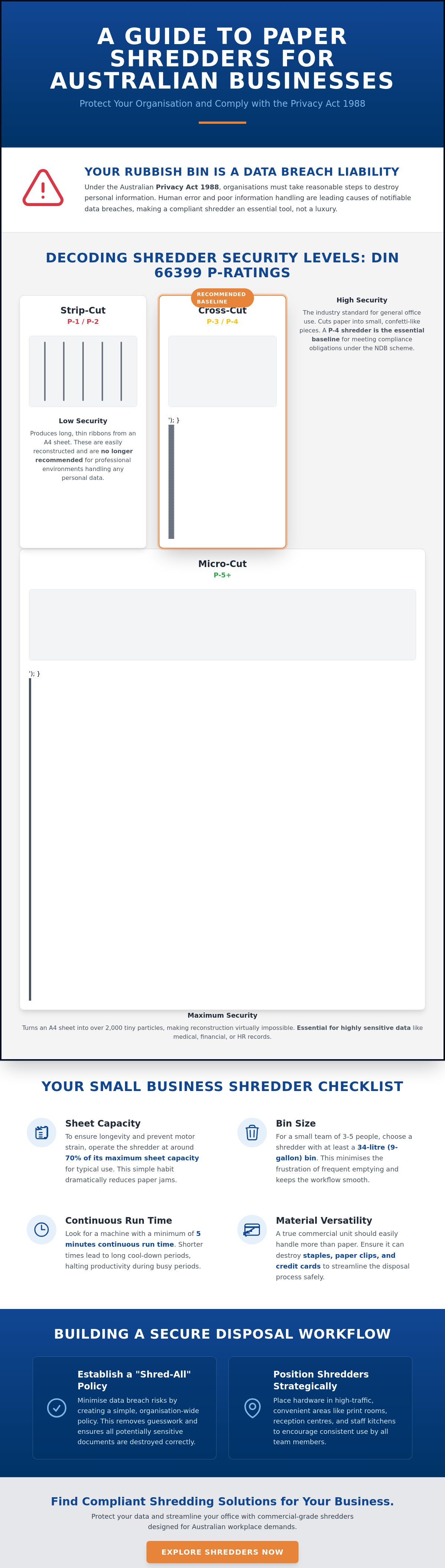
Procurement for office supplies often focuses on price, but for document destruction, the technical standard is the only metric that matters. The DIN 66399 standard is the global benchmark for data destruction. It classifies Paper shredder security levels into seven distinct categories, known as P-ratings. For an Australian organisation, these ratings aren't just technical specs; they're your primary defence against the legal ramifications of the Privacy Act 1988.
Under Australian Privacy Principle 11.2, businesses must take reasonable steps to destroy personal information once it's no longer needed. Simply tossing sensitive documents into a recycling bin doesn't cut it. Choosing the best paper shredder for small business security means selecting a machine that renders data unrecoverable to protect your clients and your reputation. Mapping your document types to the right rating is vital. While internal memos might only require basic shredding, invoices, HR files, and client data demand a higher level of destruction to remain compliant.
To better understand how these different cutting styles and security levels look in practice, watch this helpful comparison:
The Difference Between Strip-Cut, Cross-Cut, and Micro-Cut
The security level is determined by the final size of the shredded particle. Strip-cut machines (P-1 to P-2) produce long vertical ribbons. These are no longer recommended for professional environments because the strips can be reconstructed with basic software or even manual effort. Cross-cut shredders (P-3 to P-4) are the current industry standard for general office use, cutting paper into small, confetti-like pieces. For organisations handling highly sensitive medical or financial records, micro-cut models (P-5 and above) are essential. These machines reduce a single A4 sheet into over 2,000 tiny particles, making reconstruction virtually impossible even for determined identity thieves.
Compliance and the Notifiable Data Breaches (NDB) Scheme
In Australia, the Notifiable Data Breaches scheme requires organisations to report any incident where personal information is accessed or disclosed without authorisation. Improperly disposed of paperwork is a common trigger for these reports. If a staff member leaves a client file in a public skip bin, it's a reportable event that can lead to significant fines and brand damage. A P-4 cross-cut shredder serves as the essential baseline for Australian small business security. Investing in the right technology ensures that your disposal workflow meets the "reasonable steps" requirement outlined by the OAIC. By choosing a machine that exceeds basic consumer standards, you're building a culture of security that protects everyone in the workplace.
Small Business Shredder Selection Checklist
Selecting the best paper shredder for small business security requires a balance between technical durability and daily operational needs. Procurement officers often make the mistake of choosing a machine based solely on its sheet capacity without considering the duty cycle. If a device is rated for 12 sheets, running it at maximum capacity for every pass will shorten the motor's lifespan. To ensure longevity, aim for a machine where your typical shredding stack is roughly 70% of the maximum rated capacity. This buffer prevents the motor from straining and reduces the likelihood of paper jams.
Operational efficiency is also tied to the bin size and runtime. For a small team of three to five people, a shredder with at least a nine-gallon bin (approximately 34 litres) is recommended to avoid the frustration of frequent emptying. Additionally, the machine must have a sufficient continuous runtime. A minimum of five minutes of non-stop shredding is the baseline for professional environments. Machines with shorter runtimes often require long cool-down periods, which can halt productivity during heavy administrative tasks.
A truly versatile commercial unit should handle more than just standard A4 paper. Your checklist should include:
- Material Versatility: The ability to destroy credit cards, staples, and small paperclips without damaging the cutting head.
- Safety Sensors: Auto-stop technology that triggers when hands get too close to the entry throat, which is vital in high-traffic office areas.
- Bin Sensors: Indicators that alert staff when the bin is full or ajar to prevent mechanical blockages.
Determining Your Daily Shredding Volume
You need to calculate your peak usage rather than your average. While a small office might only shred 20 sheets a day on average, end-of-month financial processing or end-of-year archiving can see hundreds of documents processed at once. Under-speccing your hardware leads to thermal overload, where the machine shuts down to protect the motor. If multiple staff members use the same device, the cumulative heat build-up is significantly higher than in a single-user home office setup.
Physical Dimensions and Office Integration
Most Australian office desks are a standard height, so ensure your chosen model fits comfortably underneath to save floor space. Units equipped with heavy-duty castors are preferable for open-plan offices, allowing the machine to be moved between workstations or into a central print room as needed. Noise is another critical factor; look for "ultra-quiet" specifications to ensure that document destruction doesn't disrupt phone calls or meetings in shared workspaces. You can explore our full range of commercial-grade paper shredders to find a model that aligns with your specific volume requirements.
Performance vs. Volume: Finding the "Sweet Spot"
The search for the best paper shredder for small business security often leads to a choice between raw speed and autonomous operation. You must decide whether your staff's time is better spent feeding sheets manually or loading a tray and returning to their primary tasks. This decision directly impacts your office's operational rhythm and the longevity of the hardware itself. Finding the sweet spot means matching the machine's mechanical limits to your team's actual habits.
Falling into the "duty cycle" trap is a common procurement error. Many entry-level models are designed for light home use, meaning their motors overheat after just a few minutes of continuous operation. In a busy Australian office, this leads to significant downtime. Commercial-grade units offer runtimes of 30 to 60 minutes, ensuring that end-of-month archiving doesn't grind to a halt because the machine needs to cool down. High-volume environments require this industrial-grade endurance to maintain a consistent workflow.
Maintenance shouldn't be an afterthought if you want your investment to last. To keep the cutting cylinders running smoothly, regular oiling is required. You can choose between traditional bottled oil or convenient oil sheets, which are fed through the machine like a standard document. Neglecting this leads to increased friction, higher noise levels, and eventually, a burnt-out motor. Modern "Eco" settings and automatic sleep modes also help reduce power consumption, which is a key consideration for organisations looking to manage their facilities' overheads efficiently.
The Case for Auto-Feed Shredders
Auto-feed models allow for "walk-away" shredding. A staff member can load a stack of up to 100 or 500 sheets and return to their desk, which significantly boosts productivity in administrative hubs. For sensitive environments, look for models with security locks on the auto-feed tray; this prevents unauthorised access to the documents while the shredding cycle is in progress. Explore our range of office technology to see how auto-feed units can integrate into your secure disposal workflow.
Manual Feed for Immediate Destruction
Manual feed remains the preferred choice for immediate, single-page disposal near a desk or reception centre. These machines are often equipped with active jam-protection sensors that automatically reverse the motor if too many sheets are inserted. While a 10-sheet manual unit is built for frequent, short bursts of high-torque destruction, a 100-sheet auto-feed unit relies on a sustained, lower-intensity motor designed for endurance over raw power. Choosing the right motor type ensures your best paper shredder for small business security remains a reliable asset for years to come.
Implementation: Creating a Secure Disposal Workflow
Purchasing the best paper shredder for small business security is only the first step in a robust data protection strategy. High-quality hardware must be supported by a clear operational workflow to ensure that sensitive documents are destroyed immediately rather than sitting in vulnerable piles on desks or in open bins. Strategic placement is the most effective way to encourage compliance. By locating your shredding stations near printers, photocopiers, and filing centres, you capture the waste at its source before it can be misplaced or forgotten.
A "Shred-All" policy is a highly effective way to eliminate staff guesswork and minimise human error. When employees have to decide whether a document is sensitive, they often make mistakes that lead to data breaches. By mandating that every piece of discarded paper goes through a cross-cut or micro-cut machine, you create a streamlined habit that aligns with the Australian Privacy Act. This approach is particularly useful during bulk purges, such as when you are updating your lever arch file organisation and need to dispose of outdated client records or financial statements securely.
Centralised vs. Decentralised Shredding
Your office layout determines whether you need a single high-capacity machine or several smaller units. A centralised model, featuring one powerful shredder in a dedicated mailroom, is often more cost-effective for maintenance and handles higher volumes with ease. However, decentralised shredding places smaller units directly in departments like HR or accounts, which reduces the risk associated with transporting sensitive un-shredded paper across the building. Regardless of the model, ensure your office technology procurement accounts for the physical footprint and power requirements of each station.
Audit Trails and Disposal Logs
Maintaining a simple disposal log helps demonstrate compliance during a privacy audit. These logs don't need to be complex; a basic record of the date, the category of documents destroyed, and the staff member responsible provides an essential paper trail. This practice links your physical destruction workflow to your broader document retention policy, ensuring that records aren't kept longer than legally required. For more insights on why these processes are vital, read our guide on Data Security: Why Your Office Needs a Paper Shredder. Training your team to recognise what constitutes personal information under the Notifiable Data Breaches scheme is the final piece of the security puzzle.
Professional Shredding Solutions from Mega Office Supplies
Mega Office Supplies provides more than just hardware; we offer a partnership rooted in stability and regional expertise. Our team holds decades of combined industry experience, allowing us to guide procurement officers toward the best paper shredder for small business security based on their specific technical requirements. We understand the logistical flow required to maintain a secure workplace, whether you are managing a single site or multiple government departments. Our commitment to commercial-grade durability ensures that the equipment you acquire today will withstand the high-volume demands of a busy Australian office for years to come.
Supporting your document management requires a reliable supply chain. Beyond shredding hardware, we maintain a comprehensive inventory of office supplies to keep your organisation running efficiently. From high-capacity waste bins to specialised maintenance oils, we provide the tools necessary to implement the secure disposal workflows discussed in this guide. Our national delivery network ensures that healthcare facilities, schools, and corporate centres across Australia receive their equipment and consumables without friction.
Why Order Your Shredder from an Australian Specialist?
Purchasing from a local specialist ensures you have access to direct support and expert advice on model compatibility. If a machine fails during a critical end-of-month processing period, local warranty support is essential for minimising downtime. We also facilitate consolidated ordering for your workplace. You can secure your best paper shredder for small business security alongside your bulk A4 copy paper and stationery in a single transaction. This reduces administrative overhead and simplifies your accounts payable process. For a deeper look at specific model performance, see our Best Paper Shredder for Small Business Australia: The 2026 Professional Guide.
Customised Quotes for Large Scale Fit-outs
Large-scale operations often require volume-based pricing and customised delivery schedules. We assist procurement officers with complex requirements, providing rapid quoting for multiple units across various locations. Our capability extends beyond the print room; we offer a vast range of facilities and breakroom supplies to ensure your entire workplace is fully equipped. This holistic approach to procurement allows you to manage your facilities' needs through a single, dependable partner. Contact our team today for a professional recommendation or a comprehensive quote for your next office fit-out.
Securing Your Workplace with the Right Procurement Strategy
Protecting your organisation's sensitive data is a continuous process that relies on both high-quality hardware and disciplined office habits. By prioritising P-4 cross-cut or P-5 micro-cut ratings, you ensure your business remains compliant with Australian privacy standards while rendering sensitive information unrecoverable. It's equally important to match your shredder's motor duty cycle and bin capacity to your team's peak volume to prevent mechanical strain and operational delays.
Selecting the best paper shredder for small business security is simpler when you partner with a provider that understands the practicalities of the Australian workplace. Mega Office Supplies has been a dependable partner for government departments, schools, and healthcare sectors since 2005. Our team brings over 20 years of combined industry experience to every procurement request, ensuring you receive expert advice and reliable national delivery to help you maintain a secure office environment.
View our full range of professional paper shredders and take the final step toward a more secure and compliant workplace today.
Frequently Asked Questions
What is the best shredder security level for a small business in Australia?
A P-4 cross-cut or P-5 micro-cut machine is the recommended standard for most Australian organisations. While P-4 is sufficient for general business documents, P-5 provides higher security for sensitive financial or medical records. Choosing the best paper shredder for small business security involves balancing these security levels with your daily document volume to ensure you meet your legal obligations under the Privacy Act.
Can modern paper shredders handle staples and credit cards?
Most commercial-grade shredders are designed to process standard office staples and paperclips without damaging the cutting cylinders. Many units also feature a dedicated slot for destroying credit cards and ID badges. It's best to check the specific product data before purchase; however, high-capacity models typically handle these materials as part of a standard workflow to save staff time.
How often should I oil my office paper shredder to prevent jams?
You should oil your shredder every time you empty the waste bin or at least once a month for moderate use. Regular maintenance reduces friction between the blades, which prevents paper jams and extends the life of the motor. Using either bottled shredder oil or convenient oil sheets ensures the machine continues to operate at its rated sheet capacity without straining.
What is the difference between a P-4 and a P-5 security rating?
The primary difference is the size of the shredded particle and the level of data protection provided. A P-4 cross-cut shredder reduces an A4 sheet into roughly 400 pieces; a P-5 micro-cut machine reduces that same sheet into over 2,000 tiny particles. This smaller size makes it virtually impossible for someone to reconstruct the document, which is vital for highly confidential information.
Is an auto-feed shredder worth the extra cost for a small office?
An auto-feed shredder is a worthwhile investment if your administrative staff frequently process large stacks of paper. These machines allow employees to load a tray and walk away, which significantly increases workplace productivity. For small teams that only shred a few pages at a time, a high-quality manual-feed unit is often a more cost-effective choice for immediate disposal.
What happens if my shredder exceeds its continuous run-time?
If a machine runs beyond its continuous duty cycle, the thermal overload protection will automatically shut the motor down to prevent damage. Most small business models require a cool-down period of 30 to 60 minutes before they can be used again. To avoid this frustration, select a machine with a runtime that exceeds your largest typical shredding task.
Do I need a separate shredder for CDs and digital media?
You don't necessarily need a separate machine if you choose a model with multi-media capabilities. Many professional shredders include a separate entry throat and cutting head specifically for CDs, DVDs, and Blu-ray discs. These machines often have separate waste containers to ensure that plastic shards are kept apart from paper for easier recycling and disposal.
How does the Australian Privacy Act affect how I dispose of documents?
The Australian Privacy Act 1988 requires businesses to take reasonable steps to destroy personal information that is no longer needed. Under Australian Privacy Principle 11.2, simply discarding sensitive paperwork in a standard rubbish bin is a breach of compliance. Using a secure shredder ensures that your organisation meets these legal requirements and avoids the risks associated with the Notifiable Data Breaches scheme.
Article by
Mega Office Supplies Team
The Mega Office Supplies Team provides practical guidance for Australian businesses, schools, government organisations, healthcare providers, hospitality venues, warehouses and home offices. Based in Tweed Heads South, Mega Office Supplies is a family-owned and operated Australian business offering office stationery, workplace furniture, technology products, labels, printers, cleaning and janitorial supplies, safety products, art materials, education resources and everyday business essentials from trusted brands.
General Information
This article is provided as general information only to help customers compare and choose office, workplace, school, cleaning, technology, furniture, safety and business supplies. Product details, specifications, compatibility, availability, pricing and suitability may vary. Always check the individual product page, manufacturer information, workplace requirements and relevant safety guidance before purchasing or using a product.


