


Could a single millimetre of error or a missing safety guard be the silent bottleneck in your office's productivity? If you've ever watched a stack of expensive cardstock go to waste due to a jagged edge, you know that not all cutting tools are created equal. Learning how to choose a guillotine for paper cutting involves more than just checking the price tag; it requires a deep understanding of mechanical leverage and Australian workplace safety standards.
As a reliable Australian partner with decades of combined industry experience, we recognise that procurement officers and administrators need equipment that performs reliably under high-volume pressure. This guide provides the technical clarity you need to select a professional-grade machine that delivers a clean, square cut every time. You will learn about essential finger guards required by safety regulations, the difference between manual and electric models, and how to identify the durability markers that ensure your stationery processing remains efficient for years to come.
Key Takeaways
- Distinguish between high-volume lever-arm cutters and precision rotary trimmers to ensure you select the correct tool for your specific workload requirements.
- Master how to choose a guillotine for paper cutting by evaluating sheet capacity against standard 80gsm paper and selecting a base size that accommodates your most frequent document formats.
- Prioritise workplace safety and compliance by identifying essential features such as automatic finger guards and integrated blade locking mechanisms for shared environments.
- Match your hardware to your specific environment, from heavy-duty stack cutters for commercial print rooms to compact designs for general office stationery cupboards.
- Use a professional procurement checklist to verify paper dimensions and safety requirements before committing to a long-term equipment investment.
Understanding Paper Cutters: Guillotines vs. Rotary Trimmers
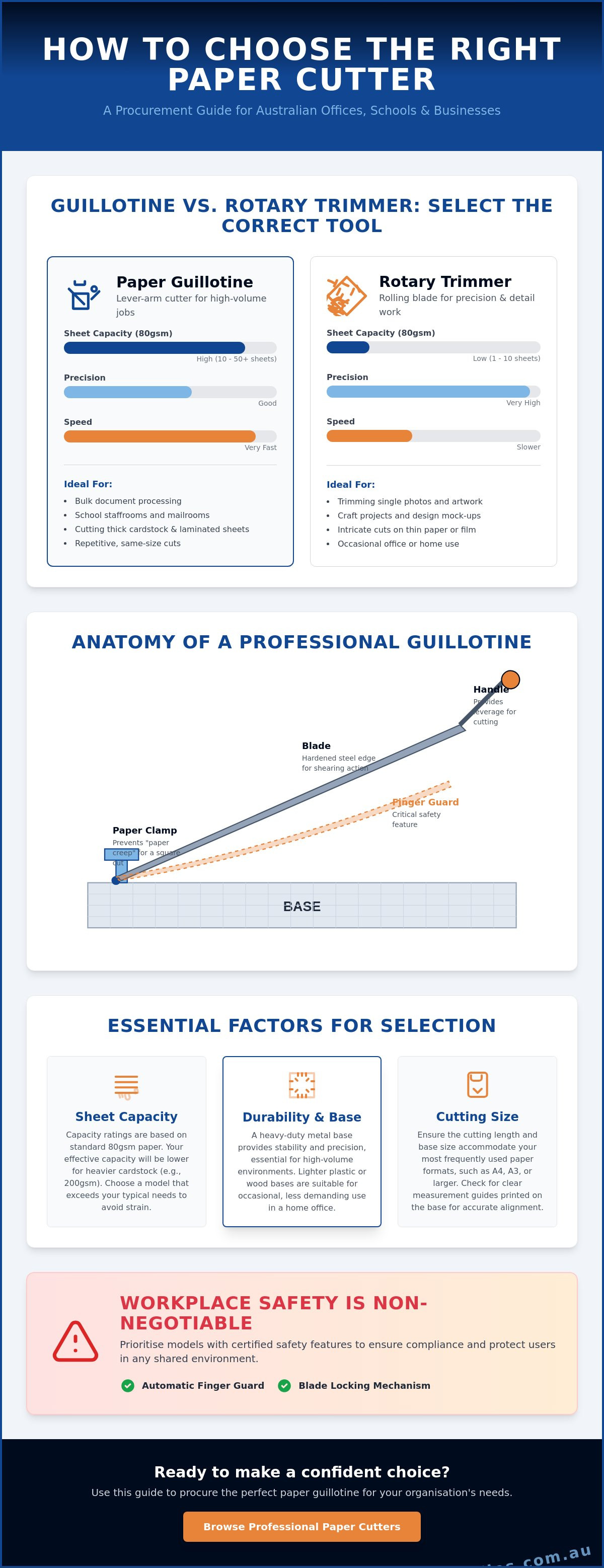
A guillotine is a heavy-duty tool defined by its long lever arm and distinct shearing action. Unlike smaller desktop tools, it's engineered to process substantial stacks of paper with a single downward stroke. This makes it the primary choice for any Australian workplace dealing with bulk office supplies or administrative tasks that require speed over intricate detail. It's a robust solution for environments that value durability and functional clarity.
While a rotary trimmer uses a circular blade encased in a plastic carriage for extreme precision, it lacks the raw power needed for thick documents. A professional Paper cutter of the guillotine variety uses a fixed pivot point to multiply the force applied by the operator. This mechanical advantage is a key factor when learning how to choose a guillotine for paper cutting, as it determines how much physical effort is required for high-volume tasks in a school staffroom or commercial print centre.
To better understand this concept, watch this helpful video:
The anatomy of a professional guillotine consists of four critical parts that work in unison. The base provides a stable, often grid-lined metal or wooden surface for alignment. The blade is the hardened steel edge that performs the cut, while the handle provides the necessary grip for the lever action. Finally, the paper clamp holds the stack firmly to prevent "paper creep," which occurs when the bottom sheets shift as the blade moves through the top layers of the stack.
The Lever-Arm Mechanism Explained
The shearing action is what sets this tool apart from a simple knife. As the blade descends, it slices through the stack from the pivot point outward. This specific movement provides a cleaner edge on bulk stacks compared to vertical pressure. The pivot point's location is vital because it determines the mechanical advantage. If the pivot is correctly engineered, the effort required for the downward stroke is significantly reduced, even when cutting through 40 or 50 sheets. Maintaining proper blade tension is equally important; if it's too loose, the blade might pull away from the base, resulting in a ragged or curved edge rather than a straight line.
When to Choose a Guillotine Over a Trimmer
Capacity is the deciding factor for most procurement officers. If your daily workflow involves cutting between 10 and 50 sheets of standard 80gsm paper at once, a guillotine is non-negotiable. It's the workhorse of busy mailrooms, school preparation areas, and government departments where time is a finite resource. While trimmers excel at trimming a single photo or a thin piece of paper, guillotines handle heavy cardstock and laminated documents without straining the mechanism. Knowing how to choose a guillotine for paper cutting starts with acknowledging that volume and material thickness dictate the tool. For reception areas or warehouses processing bulk stationery, the speed of a lever-arm cutter simply can't be matched by a rotary alternative.
Essential Factors When Choosing Your Office Guillotine
Selecting the right hardware requires a focus on functional clarity. When researching how to choose a guillotine for paper cutting, the most common specification you'll encounter is sheet capacity. However, these ratings are almost universally based on standard 80gsm paper. If your organisation frequently processes 200gsm cardstock or 150gsm brochures, your effective batch capacity will drop by more than half. Forcing a thick stack through a low-capacity machine is a primary cause of blade misalignment and jagged edges. You need a tool that handles your heaviest materials without straining the pivot point.
Durability is largely determined by the base material. Heavy-duty metal bases provide the manual precision and stability required for high-volume environments like school mailrooms or government archives. In contrast, lightweight plastic bases are suitable for occasional home office use but can flex under pressure, compromising the squareness of the cut. Ensure the base includes high-visibility printed grids for standardised Australian paper sizes, including A4, A3, and common envelope dimensions, to facilitate fast alignment.
Safety remains a critical component of workplace compliance. While local regulations are your primary guide, referencing international OSHA safety standards for paper cutters highlights the global importance of point-of-operation guards. These features aren't optional extras; they're essential for preventing workplace injuries in shared environments where multiple staff members access the same equipment.
Calculating Your Required Sheet Capacity
Don't just look at the maximum batch size. Consider your total daily volume. A machine rated for 40 sheets can handle a single large stack occasionally, but if you're processing hundreds of items daily, you need a heavy-duty stack cutter. Overworking a machine leads to blade creep, where the top sheets are cut differently than the bottom ones. If you frequently cut 200gsm card, choose a model with a capacity at least 30% higher than your average batch to maintain a clean shearing action. To find a model that balances these technical specs with your specific workplace needs, view the comprehensive selection of professional cutting tools available online.
Tabletop Footprint and Storage
A guillotine needs a stable foundation. Before purchasing, measure the available surface area on your office furniture to ensure the base doesn't overhang. Stability is paramount during the downward stroke, so look for models with non-slip rubber feet that grip the desk surface. If the unit needs to move between departments, weight becomes a factor, but remember that a heavier base usually translates to better cutting leverage and longevity for bulk stationery processing.
Prioritising Safety Features and Workplace Compliance
Workplace health and safety (WHS) isn't just a matter of policy; it's a fundamental requirement for any organisation processing bulk documents. When you are researching how to choose a guillotine for paper cutting, safety mechanisms should be your primary evaluation criteria. Modern professional units are designed to mitigate the inherent risks of a sharpened lever arm through physical barriers and mechanical locks. These features protect your staff and ensure your equipment meets the rigorous standards expected in Australian commercial environments.
Automatic finger guards and transparent safety shields are the first line of defence. A physical barrier that prevents fingers from entering the "point of operation" is essential for any shared workspace. Transparent guards are particularly effective because they allow the operator to maintain manual precision and see their alignment grids without exposing themselves to the blade. These shields should be made of high-impact materials that won't crack or cloud over time, ensuring long-term visibility and security.
The paper clamp, while often viewed as an alignment tool, plays a vital role in user safety. By firmly securing the stack, it prevents "paper creep," which is the tendency for sheets to shift during the cut. More importantly, an integrated clamp ensures the user's hands remain well away from the cutting path. Models that feature an automatic clamping action as the handle descends provide an extra layer of protection, as they remove the temptation for staff to manually hold the paper near the blade.
Guillotines in the Australian Classroom
Safety is the paramount concern when selecting educational supplies for schools and universities. For these environments, look for guillotines with enclosed blade systems where the sharp edge is never fully exposed. It's also vital to train staff on correct posture and the importance of a clear workspace to minimise repetitive strain injuries. Always store these tools in a locked cupboard or a restricted prep room to ensure they aren't accessible to students without direct supervision.
Compliance for Corporate and Government Offices
Procurement officers in corporate and government sectors must align their equipment choices with formal WHS risk assessments. Choosing a model with self-sharpening blades is a smart move for high-volume offices. These blades maintain their own edge through use, which significantly reduces the frequency of maintenance and the hazards associated with removing or replacing a dull blade. An integrated blade lock is a non-negotiable safety feature for any Australian office because it ensures the cutting arm remains immobilised whenever the equipment is unattended. This simple mechanical latch prevents accidental descents and protects anyone who might be moving the unit or cleaning the surrounding area.
Matching the Guillotine to Your Specific Workplace
The environment where your equipment resides is just as important as the paper it cuts. When you evaluate how to choose a guillotine for paper cutting, you must match the mechanical capabilities to the specific demands of your sector. A commercial print room requires a heavy-duty stack cutter. These industrial units often handle 300 to 400 sheets and feature manual screw-driven clamps that provide the immense pressure needed to keep a thick stack immobile during the shearing process. For these high-volume settings, anything less than a dedicated stack cutter will result in frequent equipment failure and inaccurate finishing.
General office environments have different priorities. Here, the focus is on versatility and ease of storage. You need a device that balances capacity with a compact footprint, allowing it to be stored easily in office supplies cupboards when not in use. These models typically handle 15 to 40 sheets and are ideal for preparing reports or internal memos. In warehouses and dispatch centres, speed is the primary metric. Guillotines in these spaces are often used for trimming shipping labels and packing slips with rapid, repetitive strokes where durability is more important than millimetre-perfect precision.
Art and design studios require a different level of manual precision. These users prioritise precision grids and calibrated scales over raw sheet capacity. They require a tool that supports custom work and fine adjustments, where a single millimetre of variance can ruin a project. Whether you are in a classroom or a reception area, the physical build of the machine must reflect the intensity of its intended use.
High-Volume Procurement Strategies
Large organisations benefit from standardising their hardware across multiple departments. This approach simplifies maintenance and ensures that staff don't need to learn new safety protocols when moving between offices. Linking your selection to a broader stationery supplies Australia procurement strategy allows for better inventory management of replacement parts. Always evaluate the total cost of ownership. A lower initial purchase price often masks higher long-term costs if the blade requires frequent professional sharpening or if the base lacks the stability to withstand daily use.
Durability and Long-Term Reliability
Professional-grade guillotines utilise solid steel blades rather than composite materials. In a commercial setting, steel maintains its edge significantly longer and can be resharpened multiple times. Maintaining accurate alignment over thousands of cuts is the hallmark of a quality machine. If your organisation also handles sensitive data, you might also consider the Best Paper Shredder for Small Business Australia to complete your document management suite. To ensure you have the right tools for your specific volume, browse our range of commercial paper cutters today.
Final Procurement Checklist for Paper Guillotines
The final stage of the procurement process requires a rigorous comparison of technical specifications against your operational reality. Before finalising your decision on how to choose a guillotine for paper cutting, you must confirm that the hardware supports the largest paper format your organisation handles. While an A4 base is sufficient for standard documents, an A3 model provides the versatility needed for posters, large-scale planning boards, and marketing collateral. Choosing a larger base size is often a prudent long-term investment that prevents the need for secondary equipment later.
Safety compliance remains the most critical box to tick on your checklist. Verify that the specific model includes the physical guards and blade locks discussed earlier, ensuring they align with your workplace risk profile. Beyond safety, inspect the base material for industrial stability. A heavy metal base with calibrated, high-visibility grids is essential for maintaining manual precision. Finally, assess the ergonomics of the handle. For staff performing repetitive trimming tasks, a contoured, non-slip grip reduces hand fatigue and minimises the risk of strain-related injuries.
- Capacity verification: Does the machine handle your heaviest cardstock without blade deflection?
- Safety audit: Are the finger guards and blade latches robust and easy to engage?
- Alignment accuracy: Are the measurement grids printed in metric units and aligned to the cutting edge?
- Footprint check: Does the unit fit securely on your existing workstations?
Maintenance and Blade Care
A professional guillotine is an industrial tool that requires regular attention to maintain its performance. Clean the cutting edge periodically using a dry, lint-free cloth to remove paper dust and adhesive residue, but never touch the sharpened edge directly. If you notice the blade tearing the paper rather than shearing it cleanly, it's time for professional sharpening or a blade replacement. Additionally, check the pivot bolt every few months. A loose pivot can lead to inconsistent tension, causing the blade to pull away from the base and resulting in inaccurate, ragged cuts.
Making the Purchase
Selecting a specialist Australian retailer for your equipment ensures you receive the regional support and technical expertise necessary for workplace hardware. Local retailers provide clear warranty details and, more importantly, access to spare parts that faceless global competitors often lack. When you buy locally, you're investing in a partnership that values the longevity of your equipment. To secure a reliable solution for your organisation, browse our range of professional guillotines and trimmers at Mega Office Supplies. Our team brings decades of combined experience to help you find the right hardware for your specific volume and safety requirements.
Optimising Your Workplace Finishing Workflow
Selecting the right cutting hardware is about more than just a sharp edge; it's about integrating safety, durability, and efficiency into your daily operations. By mastering how to choose a guillotine for paper cutting, you've taken the first step toward reducing stationery waste and protecting your staff from avoidable workplace hazards. You should prioritise models that feature automatic finger guards and robust steel blades that withstand high-volume processing in demanding Australian environments.
As an Australian family-owned and operated organisation with over 20 years of combined industry experience, we understand the practicalities of maintaining a productive office. We provide national delivery for all office and educational supplies, ensuring your team has access to professional-grade tools regardless of your location. Whether you're managing a school staffroom or a corporate mailroom, the right equipment ensures a clean, square cut every time.
Explore our range of professional guillotines and trimmers at Mega Office Supplies and secure the long-term reliability your workplace deserves.
Frequently Asked Questions
What is the difference between a paper guillotine and a paper trimmer?
A paper guillotine uses a pivoting lever arm to shear through thick stacks of paper, while a trimmer employs a circular blade on a rail for precision. Guillotines are the preferred choice for bulk tasks in mailrooms and busy offices. Trimmers are better suited for single-sheet photos or delicate craft projects where a millimetre of accuracy is paramount.
Can a paper guillotine cut through laminated sheets?
Most professional guillotines can cut through laminated documents, but you must account for the added thickness and density. Lamination significantly increases the resistance the blade encounters, so you should reduce your total batch size to avoid straining the pivot point. Always check if your specific model is rated for non-paper materials to prevent premature dulling of the steel edge.
How many sheets of paper can a standard office guillotine cut at once?
A standard office model usually processes between 15 and 50 sheets of 80gsm paper in a single stroke. If you are learning how to choose a guillotine for paper cutting for a high-volume print room, you may require a stack cutter capable of handling up to 400 sheets. Always remember that using heavier cardstock or specialty paper will significantly reduce this maximum capacity.
Are paper guillotines safe for use in primary schools?
Guillotines are safe for school environments when they include permanent safety guards, transparent shields, and integrated blade locks. It's best practice to choose models with enclosed cutting systems for primary schools to minimise risk. These tools should only be operated by staff in restricted preparation areas to ensure student safety is never compromised during the school day.
How do I maintain the blade of my guillotine to keep it sharp?
Keep the blade sharp by ensuring the pivot bolt remains tightened to maintain the correct shearing tension between the blade and the base. You should also wipe the cutting edge with a dry, lint-free cloth to remove paper dust and adhesive buildup from labels. Avoid using water or harsh cleaning chemicals, as these can cause corrosion on the hardened steel surface.
What size guillotine do I need for A3 paper cutting?
You require a guillotine with a cutting length of at least 420mm to accommodate the long edge of an A3 sheet. Most A3 models feature a larger base with extended grid lines to help you align oversized documents or posters accurately. This size is a versatile option for organisations that frequently produce marketing collateral or large-scale spreadsheets.
Can I cut materials other than paper, such as thin plastic or cardstock?
Professional guillotines easily handle cardstock and heavy paper, but thin plastics or vinyl require caution. Cutting non-paper materials can sometimes cause the blade to slip or dull prematurely if the machine isn't designed for industrial applications. If your organisation frequently processes plastic film or acetate, consult the manufacturer's specifications to ensure the blade material is suitable for those materials.
Do I need to sharpen my guillotine blade regularly?
Many modern office guillotines feature self-sharpening blades that maintain their own edge through the friction of regular use. You only need to seek professional sharpening or a replacement if the blade starts to tear the paper rather than cutting it cleanly. For most Australian offices, a high-quality steel blade will provide years of reliable service with basic cleaning and pivot maintenance.
Article by
Mega Office Supplies Team
The Mega Office Supplies Team provides practical guidance for Australian businesses, schools, government organisations, healthcare providers, hospitality venues, warehouses and home offices. Based in Tweed Heads South, Mega Office Supplies is a family-owned and operated Australian business offering office stationery, workplace furniture, technology products, labels, printers, cleaning and janitorial supplies, safety products, art materials, education resources and everyday business essentials from trusted brands.
General Information
This article is provided as general information only to help customers compare and choose office, workplace, school, cleaning, technology, furniture, safety and business supplies. Product details, specifications, compatibility, availability, pricing and suitability may vary. Always check the individual product page, manufacturer information, workplace requirements and relevant safety guidance before purchasing or using a product.


