

The most expensive writing surface in your office might actually be the one that saves your organisation the most money over the long term. If you've ever spent a Monday morning scrubbing at stubborn ghosting or permanent marker stains on an old board, you know that not all surfaces are created equal. When deciding between a glass whiteboard vs magnetic whiteboard, the choice often comes down to balancing aesthetic longevity with practical magnetic versatility.
We understand that procurement officers and facility managers need reliable hardware that withstands high-volume use in Australian boardrooms and staffrooms. You want a surface that stays crisp and white without requiring specialised chemicals for every clean. It's frustrating when magnets don't stick or surfaces stain, which is why choosing the right material is a critical workplace decision. This guide provides a professional comparison of durability, maintenance requirements, and the specific magnet strengths needed for tempered glass. We'll show you exactly how to avoid common pitfalls so you can invest in a solution that serves your team for years to come.
Key Takeaways
- Learn why non-porous tempered glass eliminates the risk of permanent ghosting and staining common in high-traffic Australian staffrooms.
- Understand the essential requirement for high-strength neodymium magnets to ensure reliable document attachment through thick glass surfaces.
- Compare the long-term maintenance benefits and initial procurement costs of a glass whiteboard vs magnetic whiteboard for your organisation.
- Discover the critical weight and safety considerations necessary for the secure installation of professional-grade writing surfaces.
- Identify which board material best suits your specific environment, whether it is a contemporary corporate boardroom or a busy industrial warehouse.
Comparing Glass and Magnetic Whiteboards: Key Differences
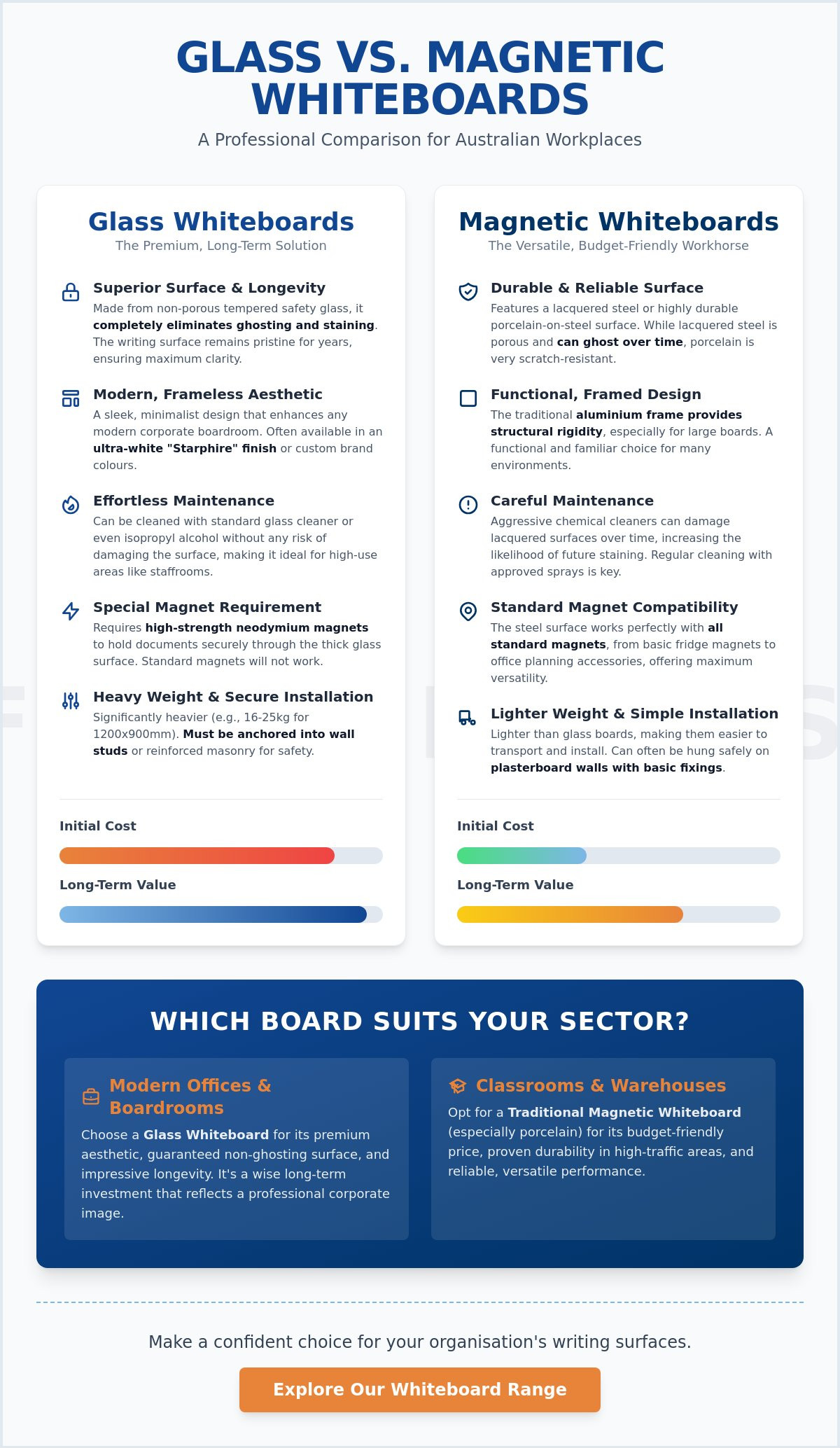
Choosing between a glass whiteboard vs magnetic whiteboard requires an understanding of both material science and workplace utility. While both serve the same primary function, their construction differs significantly. Traditional boards typically use a core of medium-density fibreboard or honeycomb paper sandwiched between a backing sheet and a writing surface of lacquered steel or porcelain. In contrast, glass boards are manufactured from a single sheet of tempered safety glass, often backed with a steel plate to provide magnetic properties. Understanding Whiteboard materials and history helps clarify why these surfaces perform so differently in high-use environments.
Initial cost is usually the first factor procurement officers notice. Standard magnetic boards are generally more budget-friendly because the manufacturing process for lacquered steel is less intensive than tempering glass. However, the price difference reflects the longevity of the materials. While a budget board might suit a home office, a high-traffic corporate environment often demands the resilience of glass.
To better understand the practical differences and installation requirements, watch this helpful video:
The Modern Glassboard Aesthetic
Premium glassboards often feature a "Starphire" or low-iron finish. This chemical composition eliminates the faint green tint found in standard tempered glass, providing a crystal-clear, ultra-white background. The frameless design is a major draw for modern office furniture fit-outs. These boards can be mounted side-by-side to create a continuous writing surface across an entire boardroom wall. Many organisations also choose coloured glass options to align with corporate branding or to add a professional accent to a minimalist workspace.
The Traditional Magnetic Whiteboard
The traditional magnetic whiteboard remains a staple in Australian classrooms and industrial warehouses. These boards use either lacquered steel or porcelain-on-steel surfaces. The aluminium frame isn't just for show; it provides essential structural rigidity, especially for larger sizes. Porcelain surfaces are particularly durable and resistant to scratches, making them suitable for heavy-duty daily use. While they lack the minimalist look of glass, their reliability and lower entry price make them the standard for large-scale education and logistics facilities.
Weight is a critical logistical factor when comparing a glass whiteboard vs magnetic whiteboard. A standard tempered glass board is considerably heavier than its steel counterpart, with a 1200mm x 900mm unit often weighing between 16kg and 25kg. This requires a careful assessment of your wall type. While a standard magnetic board might hang safely on a plasterboard partition with basic fixings, a glass board typically needs to be anchored into wall studs or reinforced masonry to ensure long-term safety in a busy workplace.
Surface Longevity and the Problem of Ghosting
Ghosting is the faint, cloudy residue of previous notes that refuses to vanish despite repeated wiping. It occurs because ink particles become trapped in microscopic pores on the writing surface. When evaluating a glass whiteboard vs magnetic whiteboard, porosity is the primary factor for long-term clarity. Glass is fundamentally non-porous. This means ink sits on top of the surface rather than sinking into it. Cheaper lacquered steel boards, however, have a painted finish that naturally contains tiny indentations. Over time, these pores collect marker pigment, leading to permanent staining that requires heavy scrubbing to remove.
Staffrooms and shared kitchens are notorious for marker mishaps. In these environments, the resistance to chemical cleaners is a major advantage for glass. You can use standard glass cleaner or even isopropyl alcohol to sanitise the surface without worrying about stripping the finish. On a painted steel board, aggressive chemicals can actually dissolve the top layer of lacquer. This damage makes the board even more prone to staining in the future.
Tempered Safety Glass Durability
Tempered glass is engineered for high-traffic environments like hospital wards and university lecture theatres. During manufacturing, the glass is heated and rapidly cooled to increase its strength. This process allows it to withstand impacts of up to 6,000 psi, making it incredibly safe for public spaces. Because the surface is chemically inert, it resists damage from heavy-duty use. Even if a staff member accidentally uses a permanent marker, the non-absorbent surface allows for easy removal with a standard solvent. Many manufacturers provide a lifetime surface warranty because the material simply does not wear down or scratch under normal writing conditions.
Porcelain vs Lacquered Steel
If you require a traditional magnetic surface, the choice between porcelain and lacquered steel is vital. Porcelain, also known as vitreous enamel, is a ceramic layer fired onto a steel backing at high temperatures. It shares many of the non-porous benefits of glass and is highly resistant to scratches. Standard lacquered steel is essentially painted metal; it is much easier to scratch during routine cleaning. Once the paint is compromised, ghosting becomes inevitable. While a budget lacquered board might last two or three years in a quiet home office, a porcelain board can easily serve an organisation for over a decade.
For teams looking to upgrade their collaborative spaces with high-quality hardware, browsing a range of professional-grade whiteboards and office supplies can help identify the best fit for specific departmental needs.
Magnet Compatibility and Practical Maintenance
One of the most common surprises for procurement officers is discovering that standard refrigerator magnets won't work on a glass board. While traditional steel boards are inherently magnetic across their entire surface, glass boards rely on a steel sheet bonded to the rear of the panel. When comparing a glass whiteboard vs magnetic whiteboard, this physical separation changes how you must select your accessories to ensure functionality in a busy office.
The Physics of Magnetic Glass
The thickness of tempered safety glass, usually between 4mm and 6mm, creates a significant gap between the magnet and the metal backing. Standard ferrite magnets lack the magnetic flux density to bridge this distance effectively. To hold even a single sheet of A4 paper, you must use specialised neodymium magnets, often called "Rare Earth" magnets. These provide the high pull-strength necessary to remain stationary against the glass surface. For professional environments, we recommend high-grade N42 neodymium magnets or stronger. Standard office magnets intended for steel surfaces will simply slide down a glass board, which can lead to frustration during critical presentations.
Maintenance Routines for Workplace Clarity
Maintaining a professional appearance requires different approaches depending on your board's material. Glass boards are remarkably low-maintenance; a simple microfibre cloth is usually sufficient for daily erasing. Unlike traditional felt erasers that can trap old pigment and smear it across the surface, microfibre lifts the ink entirely from the non-porous glass.
- Daily Cleaning: Use a dry microfibre cloth for glass surfaces to prevent ink smearing. Use a high-quality felt eraser for porcelain or steel boards, ensuring the felt is replaced when it becomes saturated with dust.
- Restoration: If a lacquered steel board begins to show signs of ghosting, use a specialised surface conditioner to seal the pores and restore the finish. Glass boards do not require these conditioners.
- Sanitisation: In healthcare and clinical settings, glass surfaces can be wiped with hospital-grade disinfectants and cleaning chemicals without the risk of clouding or surface degradation.
Visibility is another practical consideration, particularly in Australian office spaces with large windows. Glass boards have a higher gloss level than matte-finish porcelain. This can cause glare from overhead LED lighting or direct sunlight, which may hinder readability from certain angles. If your meeting centre has floor-to-ceiling windows, positioning the board away from direct light sources is essential. Conversely, the high-contrast white of a premium glass board often provides better clarity in dimly lit internal rooms compared to the slightly off-white tone of traditional magnetic boards. For those setting up a new space, ensuring you have the right stationery and accessories ready for your specific board type will prevent downtime during team collaborations.
Choosing the Right Board for Your Sector
Procurement decisions for large organisations often involve weighing the upfront investment against the long-term maintenance cycle. In a professional comparison of a glass whiteboard vs magnetic whiteboard, the intended environment dictates the most efficient choice. High-traffic areas require surfaces that resist wear, while back-office environments might prioritise cost-effectiveness and weight. Choosing correctly ensures that your staff has the right tools for daily brainstorming without the frustration of failing hardware.
Budget allocation for multi-site organisations and national office fit-outs requires a tiered approach. Many business owners opt for premium glass surfaces in client-facing areas while utilising porcelain or lacquered steel in internal workstations. This strategy balances the high-end aesthetic with functional utility across various departments. Safety is another critical factor; tempered glass is essential for high-traffic corridors to ensure that any accidental impact does not result in dangerous shards.
Corporate Boardrooms and Reception Areas
Glassboards have become the standard for modern corporate environments. Their frameless, minimalist design allows them to integrate seamlessly with contemporary furniture and architectural features. In reception areas, a glass board serves as a sophisticated directory or welcome sign that never stains. Using black or coloured glass can create a high-impact visual presentation that aligns with corporate branding. These surfaces project an image of permanence and quality that traditional framed boards cannot match.
Education and Healthcare Facilities
In Australian classrooms, the porcelain magnetic board remains the primary workhorse. Educators require a surface that can withstand hours of daily writing and erasing. Porcelain provides the necessary durability for these high-frequency environments while allowing for the use of standard magnetic teaching aids. Managing educational supplies is simpler when boards are standardised across a campus.
Healthcare facilities often prefer glass for its superior hygienic properties. In clinical environments and nursing stations, the ability to use hospital-grade disinfectants without damaging the writing surface is a significant advantage. Because glass is non-porous, it does not harbour bacteria or ink residue, making it the most sanitary option for patient care centres. Whether you are outfitting a single clinic or a major hospital, selecting the right material is vital for operational efficiency.
For procurement officers looking to secure high-volume orders for their organisation, you can view our full range of professional-grade whiteboards and office stationery to find the ideal solution for your specific sector.
Procurement and Installation Considerations
The final stage of choosing between a glass whiteboard vs magnetic whiteboard involves a realistic assessment of your facility's structural capacity. While a standard magnetic board is lightweight and adaptable to most office partitions, tempered glass requires a more rigorous approach to mounting. Glass is a dense material; a standard 1200mm x 900mm panel can weigh between 16kg and 25kg. This mass necessitates specialised fixings and, in many cases, a two-person professional installation to ensure the unit is level and securely anchored.
Safety standards for tempered glass in public Australian buildings are stringent. Most professional-grade glassboards are manufactured to withstand significant impact, often rated up to 6,000 psi. If a board does break, it's designed to shatter into small, blunt granules rather than sharp shards. This makes them suitable for high-traffic corridors and shared spaces. Before ordering, measure your available wall space carefully, allowing for at least 50mm of clearance around the perimeter for mounting hardware and ease of cleaning.
Mounting Systems and Wall Stability
Most glassboards utilise stand-off mounts. These are brushed-metal fixings that grip the glass and hold it approximately 20mm away from the wall. This creates a modern "floating" aesthetic but places specific shear stress on the fixings. Masonry or brick walls provide the most stable foundation for these heavy installations. If you're mounting onto plasterboard, you must locate the timber or metal studs. Heavy-duty toggle bolts shouldn't be used as the sole support for large glass panels. In environments where safety and first aid accessibility are paramount, ensuring these boards are professionally anchored prevents the risk of hardware failure. Traditional magnetic boards often use concealed fixings behind corner caps, which are simpler to install and place less stress on the wall structure.
Streamlining National Procurement
For organisations managing multiple sites, standardising your office supplies and hardware simplifies long-term maintenance. Bulk ordering standardised sizes across state-wide locations ensures that accessories like high-strength neodymium magnets are always compatible with the installed boards. Coordinating the delivery and installation for a large-scale commercial fit-out requires a partner with significant logistical scale and regional expertise. Integrating these physical writing surfaces with digital technology, such as ultra-short-throw projectors, requires careful planning regarding board height and surface reflectivity. By choosing a consistent board type for your organisation, you minimise the training required for staff and ensure a uniform professional appearance across all corporate boardrooms and staffrooms.
Investing in Long-Term Workplace Productivity
Selecting the right collaborative surface is a decision that impacts your organisation for years. While traditional magnetic boards offer a versatile and cost-effective entry point for classrooms and warehouses, premium glass surfaces provide a non-porous solution that eliminates ghosting entirely. Remember that magnetic glass requires high-strength neodymium accessories to bridge the gap created by the tempered safety glass. Standard magnets simply won't suffice for these professional-grade installations.
Deciding on a glass whiteboard vs magnetic whiteboard involves balancing your immediate budget with the long-term maintenance requirements of your specific sector. Whether you prioritise the minimalist aesthetic of frameless glass or the industrial reliability of porcelain-on-steel, your choice should support the daily workflow of your staff without the frustration of stained or faded surfaces. Investing in high-quality hardware now prevents the need for frequent replacements in the future.
We are a trusted supplier for government and education sectors, offering reliable national delivery across Australia. Browse our full range of professional whiteboards and glassboards to secure the best hardware for your next project. We look forward to helping you create a more efficient and professional workspace for your team.
Frequently Asked Questions
Do standard magnets work on glass whiteboards?
No, standard refrigerator or ferrite magnets don't have the magnetic pull-strength required to bridge the gap created by the glass. You must use high-strength neodymium magnets, also known as Rare Earth magnets, to hold papers securely. These specialised accessories are designed to work through the 4mm to 6mm thickness of tempered safety glass.
How do I remove permanent marker from a glass whiteboard?
You can remove permanent ink easily using isopropyl alcohol or a standard glass cleaner. Since glass is fundamentally non-porous, the marker pigment stays on the surface rather than sinking into the material. Another effective method is to trace over the permanent marks with a dry-erase marker and then wipe both away with a microfibre cloth.
Are glass whiteboards harder to install than magnetic ones?
Yes, glass boards require a more technical installation process due to their weight and specialised mounting hardware. They typically utilise stand-off mounts that must be precisely aligned with wall studs or anchored into masonry. Standard magnetic boards are much lighter and often use simple corner fixings that are easier for a single person to manage.
Which whiteboard surface is best for heavy daily use?
Glass and porcelain are the most reliable surfaces for high-frequency environments. Both materials are non-porous and resist the staining that plagues cheaper alternatives. When evaluating a glass whiteboard vs magnetic whiteboard for a busy boardroom, glass is the superior choice for long-term clarity and a professional appearance that doesn't degrade over time.
Why do magnetic whiteboards eventually start ghosting?
Ghosting occurs because lacquered steel surfaces have microscopic pores that trap ink particles. As the board is used and cleaned, these pores gradually fill with pigment, creating a cloudy residue that's difficult to remove. Once the top protective layer is compromised by scratches or harsh chemicals, the staining becomes more pronounced and permanent.
Can I use liquid chalk markers on both glass and magnetic boards?
Liquid chalk markers are ideal for glass surfaces and wipe away perfectly without leaving ghosting marks. While they can be used on some magnetic boards, they often cause permanent staining on budget lacquered steel surfaces. If you're using a traditional magnetic board, it's safer to stick to standard dry-erase markers unless you have a porcelain-on-steel surface.
Is tempered glass safe for use in primary school classrooms?
Tempered safety glass is very safe for educational settings because of its unique breaking characteristics. If the board is hit with enough force to break, it crumbles into small, blunt granules rather than sharp, dangerous shards. This safety feature makes it suitable for high-traffic areas, though porcelain remains the standard for most Australian classroom budgets.
How much heavier is a glassboard compared to a standard whiteboard?
A glassboard is significantly heavier, often weighing double or triple the amount of a standard steel board. A typical 1200mm x 900mm glass panel weighs between 16kg and 25kg. This extra weight means you can't simply hang it on a standard plasterboard wall with basic fixings; you must ensure it's anchored into a solid structure for safety.
Article by
Mega Office Supplies Team
The Mega Office Supplies Team provides practical guidance for Australian businesses, schools, government organisations, healthcare providers, hospitality venues, warehouses and home offices. Based in Tweed Heads South, Mega Office Supplies is an Australian business, family owned and operated since 2008, offering office stationery, workplace furniture, technology products, labels, printers, cleaning and janitorial supplies, safety products, art materials, education resources and everyday business essentials from trusted brands.
General Information
This article is provided as general information only to help customers compare and choose office, workplace, school, cleaning, technology, furniture, safety and business supplies. Product details, specifications, compatibility, availability, pricing and suitability may vary. Always check the individual product page, manufacturer information, workplace requirements and relevant safety guidance before purchasing or using a product.


