

A messy ring binder isn't just an eyesore; it's a clear indicator of a failing administrative workflow that compromises document security. You've likely dealt with the frustration of loose papers slipping out of folders or inconsistent hole spacing that leaves your important records looking unprofessional. Understanding exactly what is a three-hole punch used for goes far beyond simply making holes in paper. It's about establishing a consistent, durable system for archiving records and maintaining high-level office efficiency across your entire operation, whether you're managing a warehouse, a school, or a busy corporate reception desk.
Most procurement officers and administrators agree that nothing wastes more time than re-punching a stack of documents because of a misaligned guide or a jammed machine. We'll show you how a high-quality three-hole punch streamlines your filing system, ensures perfect binder compatibility, and improves overall workplace productivity. This guide previews the technical specifications of different models, from light-duty manual units to heavy-duty industrial punches capable of handling 150 sheets or more. You'll finish this article with the knowledge required to select the right hardware for your specific paper volume and organisational requirements.
Key Takeaways
- Learn exactly what is a three-hole punch used for in a professional setting, specifically for securing A4 copy paper into standard ring binders for reliable long-term archival.
- Understand the mechanical advantages of hardened steel punch heads and why all-metal construction is essential for durability in high-volume Australian workplaces.
- Identify the key differences between two-hole and three-hole configurations to ensure your documents are compatible with your specific filing system and lever arch files.
- Discover practical techniques for perfect document alignment using adjustable paper guides to prevent messy, "stair-stepped" hole placement in your binders.
- Evaluate how to select the correct hardware based on sheet capacity, whether you require a light 10-sheet punch or an industrial 100-sheet model for heavy-duty tasks.
Understanding the Role of a Three-Hole Punch in Modern Offices
A hole punch is a mechanical device engineered to create three precisely spaced apertures in paper, typically for the purpose of binder storage. While it appears to be a simple piece of desk hardware, its function is critical for maintaining the structural integrity of a filing system. In professional environments, this tool ensures that loose A4 copy paper is prepared for secure insertion into ring binders, preventing the common issue of loose documents slipping out of folders or becoming lost during transit between departments.
When considering what is a three-hole punch used for, the answer lies in workplace standardisation. By using a uniform punching system, an organisation ensures that every document, regardless of which department produced it, fits into the same filing hardware. This consistency is vital for administrative efficiency and document accessibility. For procurement officers managing high-volume environments, investing in professional-grade equipment is a matter of logistical stability. Reliable hardware from a trusted Australian retailer like Mega Office Supplies ensures that your team isn't battling with jammed machines or inconsistent hole spacing during critical deadlines.
To better understand this concept, watch this helpful video:
The Transition from Loose Sheets to Organised Files
Unpunched documents are a primary contributor to workplace clutter and information loss. Without a mechanical binding method, individual sheets are easily misplaced, leading to gaps in records. A three-hole punch facilitates the creation of a chronological or alphabetical archive, turning a stack of loose paper into a searchable resource. While digital storage is prevalent, physical backups remain a non-negotiable requirement for many government and legal sectors in Australia. These sectors rely on the tangible security of a well-organised binder system to satisfy compliance and audit requirements.
Why Three Holes? The Standardisation of Paper Filing
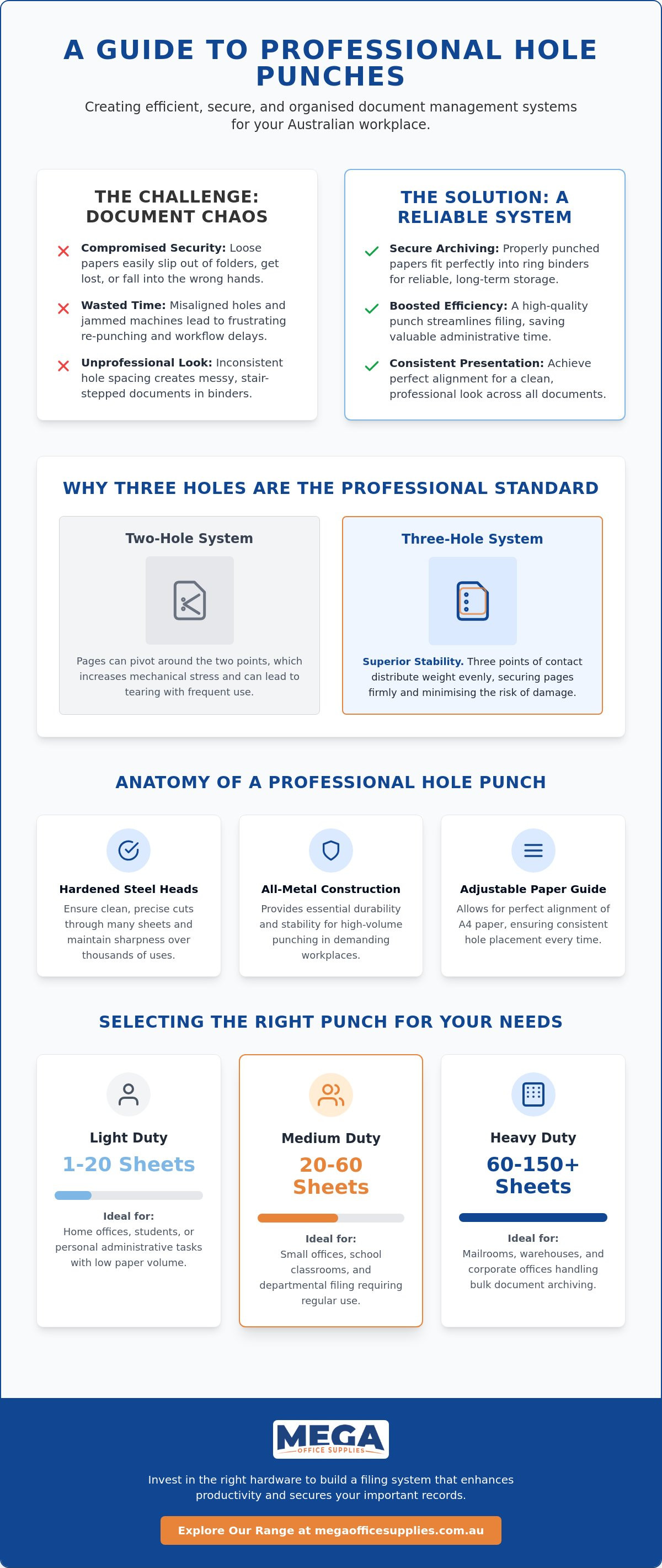
The three-hole standard has long dominated professional documentation because it offers superior stability. Unlike two-hole systems, which allow pages to pivot and potentially tear, three points of contact distribute the weight of the paper stack more evenly. This configuration minimises the mechanical stress on each hole, ensuring that pages remain secure even with frequent page-turning. The three-hole punch serves as the industry standard for high-security binding and professional document presentation across all commercial office supplies categories. Using this standard ensures your records are compatible with the vast majority of professional binders available on the Australian market.
The Mechanics and Anatomy of a Professional Hole Punch
A professional hole punch is a precision-engineered tool designed to withstand the repetitive stress of high-volume administrative tasks. The core of the device is the lever mechanism, which is designed to multiply the user's physical force. By distributing this pressure evenly across the three punch heads, the machine ensures a clean, circular cut through multiple sheets of paper without causing jagged edges or tearing. When evaluating what is a three-hole punch used for in a commercial setting, the focus shifts from simple utility to mechanical durability. Professional-grade models utilise hardened steel punch heads. These components maintain their sharpness over thousands of cycles, providing a level of reliability that plastic-heavy consumer alternatives cannot match.
Stability during operation is provided by a non-slip rubber base. This feature prevents the unit from sliding across the desk, which is essential for maintaining hole alignment when punching through thick stacks. Waste management is handled by the confetti tray, a removable compartment that captures the paper discs. A well-designed tray stays securely attached during use but remains easy to empty, preventing the "confetti" from spilling into desk drawers or onto the floor. High-capacity models often feature transparent windows on the tray so you can see when it requires emptying before it causes a mechanical jam.
Manual vs. Electric Hole Punches: Which Suits Your Volume?
Choosing between a manual and an electric model depends entirely on your daily document volume. Manual punches are the standard choice for individual desk use or small teams, typically handling between 10 and 30 sheets of 80gsm paper per press. However, for large administrative departments or busy mailrooms, electric models maximise efficiency. These units use a motorised drive to punch through stacks of up to 100 sheets with zero physical effort from the operator. This significantly reduces the risk of repetitive strain injuries in high-output environments where hundreds of documents are processed daily.
Key Components: From the Punch Head to the Paper Guide
The paper guide is perhaps the most critical component for ensuring a professional finish. It allows the user to set a fixed margin, ensuring that every page in a 200-page report aligns perfectly when placed in a binder. Many professional models also feature adjustable punch heads, allowing you to reconfigure the spacing to meet different international filing standards if required. For safety and space-saving, look for models with handle locks. This feature keeps the lever in a depressed position, making it easier to store the device safely inside office furniture or compact stationery cupboards. If you are looking to upgrade your current setup, exploring the range of professional hole punches available at Mega Office Supplies can help you find a durable solution tailored to your specific sheet capacity needs.
Three-Hole vs. Two-Hole and Four-Hole Punches
Selecting the correct hole configuration is a matter of administrative precision rather than personal preference. In the Australian market, the two-hole punch is the standard tool for managing lever arch files and simple manilla folders. These systems are designed for high-capacity archiving where documents are stored vertically. However, for active documents that require frequent referencing, the three-hole punch is the superior choice. When asking what is a three-hole punch used for, one must consider the specific requirements of professional presentations and heavy-duty ring binders. The three-hole system provides a more stable foundation for the paper, preventing the sagging and tearing often associated with two-hole configurations.
While less common, four-hole punches remain a specialised requirement in certain sectors. These are frequently utilised in European filing systems or specialised architectural and engineering contexts where oversized documents require maximum support. Determining compatibility requires a thorough audit of your existing binder inventory. Attempting to force a two-hole punched document into a three-ring binder results in damaged paper and a compromised professional image. For most Australian businesses, maintaining both a two-hole and a three-hole punch is the most efficient way to ensure all filing hardware is supported.
Understanding Ring Binder Compatibility in Australia
The 3-ring binder is the dominant standard across Australian corporate and educational environments. This prevalence is due to the balance it strikes between security and ease of use. When documents are prepared with a three-hole punch, they align perfectly with both "O-ring" and "D-ring" mechanisms. D-ring binders, in particular, benefit from three-hole punching as they allow the paper stack to lie flat against the back cover, minimising the risk of the pages catching on the rings. Mixing hole counts leads to messy, unaligned binders that hinder document accessibility and look unprofessional during client meetings.
When to Use Multi-Hole Configurations for Heavy Duty Filing
The physics of weight distribution plays a significant role in document organisation. For thick catalogues, legal briefs, and financial audits, the additional points of contact provided by more holes are essential. A three-hole configuration reduces the mechanical stress on each individual aperture by spreading the weight of the paper stack more evenly across the binder rings. This is particularly important for high-use records that are turned frequently. It is a fundamental rule of document management that the hole configuration is dictated by the binder, not the paper size. By standardising your punching process to match your binder inventory, you ensure that your archives remain secure and accessible for years to come.
Practical Tips for Precise Document Punching
Achieving a professional finish requires more than just physical force. It demands a structured approach to document preparation. When professionals ask what is a three-hole punch used for, the objective is always to create a uniform, archive-ready document that fits perfectly into a binder system. Precision prevents the "stair-stepped" look where holes on subsequent pages don't align, making the binder difficult to turn and prone to tearing. Follow this five-step process to ensure a clean result every time.
- Step 1: Set the paper guide to the correct size, typically A4 for standard Australian office documents.
- Step 2: Tap the paper stack on a flat surface to square the edges. This prevents individual sheets from sliding and ensures every hole is in the exact same position.
- Step 3: Apply steady, even pressure to the lever. Avoid slamming the handle, as this can cause the punch heads to bind or create jagged apertures.
- Step 4: Verify the alignment by punching a single scrap sheet before committing to a large or expensive stack of specialty paper.
- Step 5: Empty the confetti tray frequently. A clear waste path is essential for mechanical longevity.
Setting Up Your Paper Guide for Consistent Margins
The paper guide is the most underutilised feature on a hole punch. Its primary function is to prevent "creeping" margins, where the holes slowly shift position across a long report. By locking the guide into the A4 position, you ensure that the first page and the hundredth page align perfectly. For professional presentations, centring your document is the secret to a high-end look. If you are punching in landscape orientation, ensure the guide is adjusted to accommodate the wider edge, as failing to do so will leave your pages hanging unevenly from the binder rings.
Maintenance and Clearing the Confetti Tray
An overfull confetti tray is the primary cause of punch head failure. When the tray reaches capacity, the paper discs back up into the mechanism, placing immense pressure on the internal springs and hardened steel heads. This eventually leads to a permanent mechanical jam. To maintain a crisp edge on your punch heads, try punching through a sheet of aluminium foil several times. This simple trick helps sharpen the metal apertures. If a jam does occur, avoid using screwdrivers to pry the heads loose. Instead, gently remove the tray and use a pair of tweezers to clear the obstruction. For those managing high-volume administrative tasks, investing in professional-grade office supplies from Mega Office Supplies ensures you have access to hardware designed for easy maintenance and long-term durability.
Selecting the Right Hole Punch for Your Workplace
Procurement for a high-volume facility requires a shift from viewing stationery as a consumable to treating it as a long-term asset. When determining what is a three-hole punch used for in your specific workplace, the primary consideration must be the anticipated volume of documentation. A light-duty model suited for a home office will rapidly fail if deployed in a busy hospital reception or a school administrative centre. Professional buyers prioritise hardware that matches the daily demands of their staff, ensuring that filing tasks remain a seamless part of the workflow rather than a source of mechanical frustration.
The selection process should begin with a clear assessment of sheet capacity. Most standard office models are rated for 10 to 30 sheets of 80gsm paper. However, for departments managing thick legal briefs or financial audits, heavy-duty industrial punches are essential. These robust machines can process up to 100 sheets in a single press. Choosing a model with a higher capacity than your average requirement reduces the strain on the internal mechanism, extending the service life of the tool. Established office supplies providers like Mega Office Supplies focus on all-metal construction because it eliminates the flexing and cracking associated with plastic components under heavy loads.
Evaluating Capacity and Durability for Commercial Use
It is vital to distinguish between "sheet capacity" and the "daily duty cycle". While a punch may be rated for 30 sheets, using it at its maximum limit hundreds of times a day will lead to premature wear. You can identify a high-quality punch by its physical weight, the tension in the return springs, and the finish of the steel base. A heavy base provides the necessary ballast to prevent the unit from tipping during high-pressure operation. Investing in a professional-grade, heavy-duty punch initially saves significant capital on replacements and minimises the downtime caused by equipment failure.
Integrating Punching into Your Workplace Ergonomics
The health of your administrative staff is just as important as the durability of your hardware. Repetitive punching can lead to wrist and shoulder strain if the equipment is poorly designed or incorrectly placed. Ensure that the punch is situated at a height that allows the user to apply downward pressure using their body weight rather than just their forearm muscles. Modern ergonomic models often feature soft-grip handles and "reduced effort" gearing, which can decrease the required punching force by up to 50 percent compared to traditional designs. Selecting a tool that supports both productivity and employee health is the hallmark of an efficient, well-managed organisation. By choosing a reliable Australian partner for your workplace supplies, you ensure your team has the professional-grade tools required to maintain a secure and organised filing system.
Mastering Workplace Organisation with Professional Tools
Establishing a structured filing system is a direct investment in your organisation's long-term efficiency and professional image. By standardising your document preparation and choosing high-capacity, all-metal hardware, you eliminate the administrative friction caused by loose pages and misaligned binders. Understanding exactly what is a three-hole punch used for allows procurement officers to build a more resilient records management framework that supports both productivity and staff health through better workplace ergonomics. Proper maintenance and correct alignment techniques ensure that your physical archives remain accessible and secure for years to come.
Mega Office Supplies has been supplying Australian workplaces as a family owned and operated business since 2008. We understand the logistical demands of high-volume environments and prioritise durability and reliability in our professional product selection. Browse our full range of professional hole punches and office essentials at Mega Office Supplies to find the right equipment for your facility. Implementing the right tools today ensures your workplace remains organised, secure, and ready for future growth.
Frequently Asked Questions
Can a three-hole punch be used for A5 paper?
Yes, most professional three-hole punches can accommodate A5 paper if they feature an adjustable paper guide. You must slide the guide to the A5 marking to ensure the holes are centred on the smaller sheet. This ensures your A5 documents sit level when placed inside a standard binder, though you should verify that your specific binder rings align with the A5 dimensions before punching.
How many sheets of paper can a standard hole punch handle at once?
A standard office hole punch typically handles between 10 and 25 sheets of 80gsm A4 paper. While light-duty models might only manage 5 to 12 sheets, heavy-duty commercial units are designed to process 30 to 150 sheets in a single action. Exceeding the manufacturer's stated sheet capacity can lead to jagged edges, misaligned holes, or permanent damage to the internal springs.
What is the difference between a light-duty and heavy-duty hole punch?
The primary difference lies in the construction material and the daily duty cycle. Light-duty models often use plastic components and are designed for occasional home or desk use. In contrast, heavy-duty punches utilise all-metal construction and hardened steel heads to withstand the rigours of a high-volume workplace. When considering what is a three-hole punch used for in a warehouse or school office, a heavy-duty model is the only reliable choice for longevity.
Why are the holes in my paper not lining up with my binder?
Misalignment is usually caused by an incorrectly set paper guide or using a punch that doesn't match your binder's ring configuration. Most three-hole punches use a fixed spacing of 108mm between holes, which is the standard for three-ring binders. If you are attempting to use these documents in a two-ring lever arch file, the spacing will not match. Always check that your stationery and hardware are compatible before processing large document stacks.
Is it possible to adjust the spacing on a three-hole punch?
Adjusting the spacing is only possible if you have a specialised "adjustable" model. These units allow you to unscrew the individual punch heads and slide them along a track to meet different filing standards. Most standard office models have fixed heads that cannot be moved. If your organisation frequently handles international documents, investing in an adjustable professional model provides the necessary versatility for various folder types.
How do I clear a paper jam in an electric hole punch safely?
Safety is paramount when clearing jams, so you must unplug the device from the power source before starting. Remove the confetti tray to see if the obstruction is visible from the underside. Use a pair of tweezers or a small wooden pick to gently dislodge the stuck paper discs. Avoid using metal screwdrivers or excessive force, as this can chip the hardened steel punch heads or damage the motorised drive mechanism.
What should I do if the punch heads become dull?
You can often restore a crisp edge by punching through a sheet of aluminium foil several times. The abrasive nature of the foil helps to hone the steel heads and remove minor burrs. If the heads remain dull after this process, check if your model allows for replacement punch heads. High-quality commercial hardware is often designed so that individual heads can be replaced, which is a cost-effective alternative to purchasing an entirely new unit.
Are three-hole punches compatible with lever arch files?
No, three-hole punches are generally not compatible with standard Australian lever arch files. Lever arch systems almost exclusively utilise a two-hole configuration with 80mm spacing. Understanding what is a three-hole punch used for is vital here; it's specifically designed for ring binders. For lever arch filing, you should use a dedicated two-hole punch to ensure the documents sit correctly on the large internal arches without tearing.
Article by
Mega Office Supplies Team
The Mega Office Supplies Team provides practical guidance for Australian businesses, schools, government organisations, healthcare providers, hospitality venues, warehouses and home offices. Based in Tweed Heads South, Mega Office Supplies is an Australian business, family owned and operated since 2008, offering office stationery, workplace furniture, technology products, labels, printers, cleaning and janitorial supplies, safety products, art materials, education resources and everyday business essentials from trusted brands.
General Information
This article is provided as general information only to help customers compare and choose office, workplace, school, cleaning, technology, furniture, safety and business supplies. Product details, specifications, compatibility, availability, pricing and suitability may vary. Always check the individual product page, manufacturer information, workplace requirements and relevant safety guidance before purchasing or using a product.


