


What if the very layout designed to foster teamwork is actually the primary source of your staff's daily distractions? While shared spaces are intended to spark innovation, the reality often involves high noise levels and a frustrating lack of privacy for sensitive phone calls. Finding the right open plan office furniture layout ideas is no longer just a matter of aesthetics; it's a critical requirement for maintaining a professional, high-productivity environment that respects the need for focus.
We understand that an inefficient use of expensive commercial floor space can hinder movement and drain team morale. This guide provides practical, utilitarian strategies to help you reclaim your workspace through activity-based zoning. You'll learn how to use functional furniture as a primary tool to create acoustic boundaries without the need for permanent walls. We will examine how to organise desk clusters, integrate acoustic screens, and select ergonomic solutions that ensure your office remains flexible enough to grow alongside your team's requirements.
Key Takeaways
- Learn how to implement strategic zoning to separate high-traffic collaboration hubs from quiet focus areas without the need for permanent walls.
- Discover practical open plan office furniture layout ideas that utilise modular units and standing desks to create a flexible, future-proof workspace.
- Understand the mechanics of office acoustics and how specific furniture placement can effectively break the path of sound waves to reduce noise complaints.
- Explore sector-specific layout strategies tailored for Australian environments, ranging from high-visibility warehouse offices to dynamic classroom settings.
- Identify the essential ergonomic furniture required to support Activity-Based Working while maximising the efficiency of your commercial floor space.
The Evolution of the Australian Open-Plan Office Layout
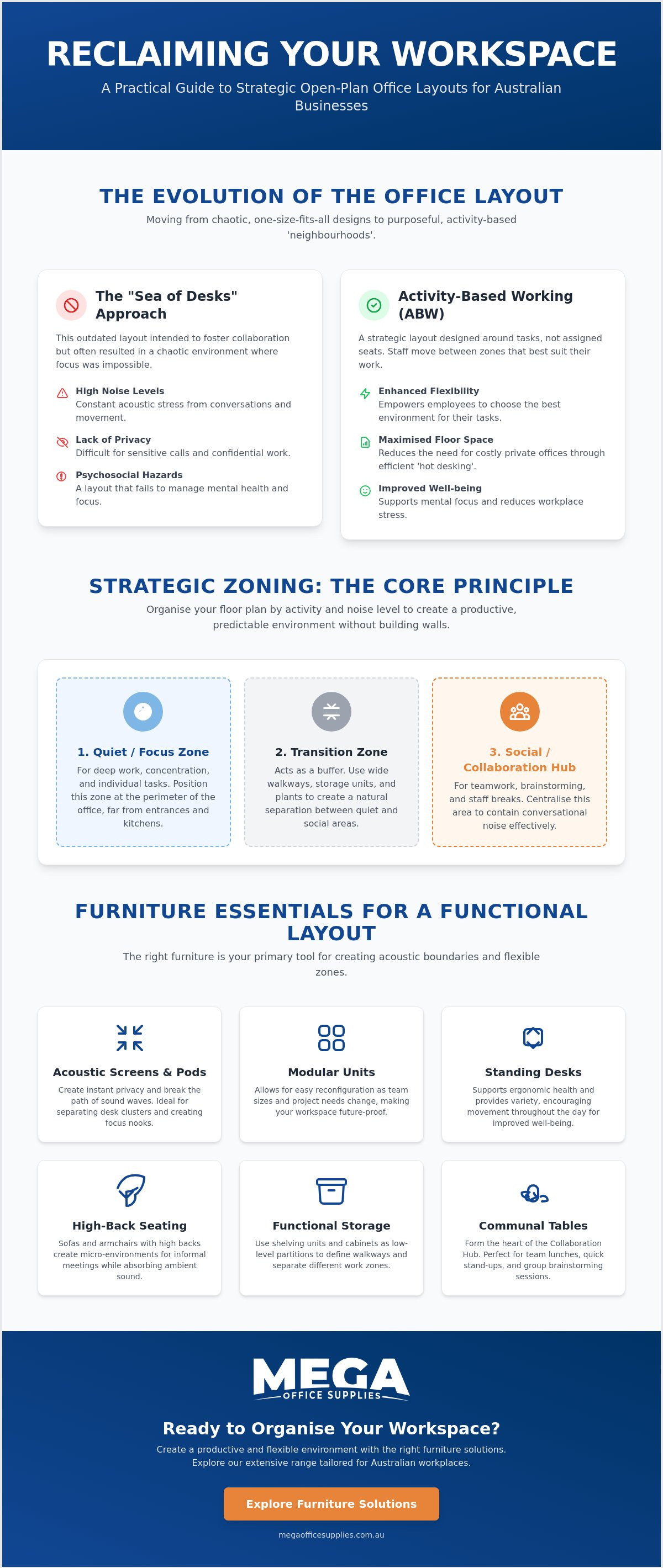
The Australian workplace has moved far beyond the rigid, high-walled cubicle farms that dominated the late 20th century. While those environments offered individual privacy, they often stifled communication and created a sense of isolation. The subsequent shift toward a "sea of desks" intended to foster collaboration but frequently resulted in a chaotic environment where noise levels surged and concentration plummeted. Modern Open-plan office design now focuses on creating distinct "neighbourhoods" within a single floor plan to support various work styles. This shift isn't just about aesthetics; it's about providing a reliable structure that supports how people actually work.
This evolution is driven by the need for better open plan office furniture layout ideas that prioritise both physical and psychological comfort. In 2026, managing psychosocial hazards became a regulated and enforceable obligation in all Australian jurisdictions. This means employers must now treat mental health and focus with the same seriousness as physical safety. A poorly planned layout fails this requirement by subjecting staff to constant interruptions and acoustic stress. By organising furniture into logical zones, businesses can create a more stable and professional environment.
To better understand the shift toward modern, flexible setups, watch this helpful video:
What is Activity-Based Working (ABW)?
ABW is a strategic layout designed around specific tasks rather than fixed, assigned seating. Instead of being tethered to one desk, employees move between zones that best suit their current objective, such as quiet pods for deep work or communal tables for brainstorming. This approach significantly reduces the need for expensive private offices. It also integrates "Hot Desking" as a tool for efficiency, allowing Australian commercial centres to maximise their floor space while providing staff with the variety they need to remain productive throughout the day.
The Problem with "One Size Fits All" Layouts
Generic layouts often ignore the unique acoustic profile of a building, leading to "dead zones" or excessive reverb that makes phone calls difficult. When a space doesn't distinguish between focus and collaboration, conflict is inevitable. Staff complaints about noise usually stem from this lack of variety in the furniture arrangement. The modern open-plan layout is a functional balance of shared energy and individual focus. By moving away from uniform desk rows, businesses can implement smarter open plan office furniture layout ideas that allow for quiet concentration and team synergy to exist within the same room without friction.
Strategic Zoning: Layout Ideas for Collaboration and Focus
Strategic zoning is the most effective way to organise a floor plan without the high cost of structural renovations. It involves grouping furniture based on the noise levels and activity types of different departments. By implementing smart open plan office furniture layout ideas, you can define boundaries that guide staff behaviour naturally. Research highlights the importance of balancing collaboration and focus to prevent the "over-collaboration" that leads to burnout. Successful zoning creates a predictable environment where staff know exactly where to go for deep thought or team discussions.
Effective zoning starts with identifying the "Quiet Zone" and the "Social Hub". Position focused workstations at the perimeter of the floor, far from elevators or entrance doors where foot traffic is highest. Centralise staff kitchens and breakout areas in the middle of the floor plan to contain conversational noise within a designated area. Use transition zones, such as wide walkways lined with storage solutions, to act as a physical and acoustic buffer between these two extremes. High-density shelving or filing cabinets don't just hold files; they absorb sound and provide a necessary visual break between departments. You might consider browsing our range of office furniture supplies to find cabinets that suit your specific zoning requirements.
Creating the "Library" Focus Zone
The "Library" zone should be a strictly enforced quiet area. Use back-to-back desk configurations to minimise visual distractions and maximise the use of floor space. Positioning these stations at the perimeter allows staff to look out windows or toward walls, further aiding concentration. Essential furniture for this zone includes desk-mounted acoustic panels and high-quality ergonomic office chairs to support long periods of seated work. Privacy screens are vital here; they provide a psychological sense of security that is often missing in standard open layouts.
The Collaborative "Huddle" Space
Spontaneous meetings require a different set of open plan office furniture layout ideas that prioritise agility. Design these spaces with mobile tables and whiteboards that can be moved as the project evolves. Place huddle spaces near central "spines" or windows to encourage movement and interaction. Modular lounge seating is an excellent choice for informal areas; it allows for quick reconfiguration to accommodate different group sizes. This flexibility ensures that the collaborative energy of the team doesn't spill over into the quiet zones, maintaining a professional balance across the entire office.
Furniture Essentials for a High-Functioning Open Layout
Building on the zoning strategies discussed earlier, the physical hardware you choose determines the longevity and success of your floor plan. Effective open plan office furniture layout ideas rely on modularity to ensure the space remains future-proof as team sizes fluctuate. Modular furniture allows you to reconfigure work zones without needing to purchase entirely new systems. This flexibility is vital for Australian businesses adapting to the permanence of hybrid work, where daily headcount can vary significantly. By selecting professional-grade components, you ensure the workspace remains organised and utilitarian.
Integrating standing desks is now a standard requirement rather than a luxury. With musculoskeletal disorders accounting for 52% of serious workers' compensation claims in New South Wales, providing height-adjustable options is a practical step toward meeting enforceable WHS obligations. These desks also create visual variety by varying the height levels across the floor, which helps break up the monotonous "flat" look of traditional rows. Beyond health benefits, they allow staff to adjust their environment to suit their immediate task, whether that's seated deep work or standing for a quick collaborative check-in.
Safety and organisation must be integrated into the furniture itself. The AS/NZS 62368.1:2026 standard sets safety requirements for office equipment, making proper cable management a critical priority. Unsecured leads are a primary cause of falls, trips, and slips, which accounted for 21.8% of all serious workers' compensation claims in Australia in 2023-24. Using desks with integrated cable trays and "umbilical" cord protectors ensures that your open space remains a safe, high-productivity environment free from cluttered floor hazards.
Desking Configurations: Benches vs. Pods
Bench desking is the most effective way to maximise floor space for high-density teams, such as sales or customer service departments. However, for teams requiring more distinct identities, pod layouts of 4 to 6 desks are superior. These "islands" foster a sense of belonging within a larger floor plan. If personal space is a priority, 120-degree (delta) desks are an excellent choice. Their unique shape increases the distance between workers and provides a larger primary work surface, naturally enhancing individual privacy without the need for high walls.
Storage as a Structural Element
In an open layout, filing cabinets and shelving units serve as dual-purpose assets. They store essential records while acting as low-level partitions that don't block natural light. An experimental study on acoustic screens and barriers confirms that physical obstructions are most effective when they disrupt the direct path of sound. Incorporating planter boxes atop these storage units adds a biophilic element that further dampens noise while improving air quality. This approach turns standard storage into a functional acoustic tool that supports a quieter, more focused workplace.
Managing the Noise: Acoustic Solutions in Open-Plan Design
"I can't hear myself think" is the most common grievance in modern workplaces. To address this, you must first identify the three distinct types of office noise: speech, impact, and environmental. Speech noise, such as overheard phone calls, is the most disruptive because the human brain is hardwired to process language. Impact noise includes footsteps on hard floors or the sliding of chairs. Environmental noise typically stems from HVAC systems or external traffic. Managing these requires more than just silence; it requires acoustic privacy, which is the ability to work without being distracted by others or being overheard yourself.
Furniture placement is a powerful, non-structural tool to "break" the path of sound waves. Sound travels in a direct line and reflects off hard surfaces like glass and concrete. By implementing smart open plan office furniture layout ideas, you can position physical barriers to intercept these waves before they reach the next workstation. This involves placing irregular surfaces, such as textured partitions or high-density storage, in the middle of the sound's path to disrupt its trajectory and reduce its volume.
Integrating soft furnishings is a practical way to lower decibel levels across the entire floor. Rugs, acoustic felt panels, and fabric-upholstered chairs act as sponges for sound. Unlike hard plastic or metal, these materials absorb vibrations rather than reflecting them. This is particularly important for meeting enforceable psychosocial obligations, as constant noise is a known contributor to workplace stress. You can browse our full range of professional-grade office furniture supplies to find acoustic solutions that suit your specific floor plan.
Furniture-First Acoustic Barriers
When considering open plan office furniture layout ideas, acoustic desk screens are your first line of defence for individual focus. They provide an immediate buffer between colleagues, reducing the "speech intelligibility" of nearby conversations. Free-standing floor screens offer even greater flexibility, allowing you to create temporary "rooms" or quiet nooks without the need for construction. For private phone calls or 1:1 meetings, high-back "booth" seating is highly effective. These units enclose the user in sound-absorbing fabric, containing the conversation and preventing it from bleeding into the wider office.
Acoustic Solution Comparison
The table below compares common furniture-based acoustic interventions based on their utility and investment level.
| Solution Type | Relative Cost | Noise Reduction | Flexibility |
|---|---|---|---|
| Acoustic Pods | High | High | Moderate |
| Desk Screens | Low | Moderate | High |
| Soft Furnishings | Moderate | Low-Moderate | High |
Combine desk-level screens with strategic floor-to-ceiling storage to maximise acoustic absorption.
Sector-Specific Layout Ideas for Australian Workplaces
Implementing effective open plan office furniture layout ideas requires a deep understanding of the specific operational demands within each sector. A generic approach rarely succeeds in environments with high-traffic visibility or strict confidentiality requirements. As a dependable partner with decades of combined experience, we recognise that utilitarian design must prioritise function and durability. Whether you are managing a busy healthcare clinic or a regional warehouse, the furniture configuration should guide staff behaviour and protect the professional integrity of the space.
For government departments and large-scale organisations, durability and compliance are non-negotiable. Designing for official standards often involves selecting AFRDI-certified furniture that can withstand heavy, 24/7 use. In healthcare and reception areas, the challenge lies in balancing a welcoming openness with the need for patient confidentiality. Using high-density shelving or curved reception counters can create a physical barrier that protects sensitive information without making the environment feel closed off or inaccessible to the public.
This need for specialised zoning also extends to creative and personal service environments where hygiene and privacy are paramount.
The Collaborative Classroom & Staff Room
Modern educational environments require high levels of agility to support diverse learning styles. Using mobile whiteboards as flexible room dividers allows teachers to create instant breakout zones for group work. Staff rooms also benefit from a tiered layout that separates socialisation hubs from quiet lesson-planning stations. Centralising stationery essentials within a shared storage zone ensures that teachers can access the tools they need quickly, reducing clutter and maintaining a professional, organised workspace.
Industrial & Warehouse Office Solutions
In rugged industrial settings, open plan office furniture layout ideas must account for dust, noise, and the need for constant floor visibility. Elevated desk configurations allow supervisors to maintain a clear line of sight across the warehouse floor while remaining accessible to the team. Document security is best managed through heavy-duty metal filing cabinets that protect essential paperwork from the harsh environment. Safety should be physically integrated into the layout by positioning first aid stations in high-visibility, central locations, ensuring a rapid response is always possible during an emergency.
Optimising Your Workspace for Long-Term Success
Transforming a shared workspace requires more than just moving desks; it's about using professional-grade furniture to define boundaries and absorb sound. By implementing strategic zoning and selecting modular acoustic barriers, you can successfully balance collaborative energy with the individual focus your team needs. These practical open plan office furniture layout ideas ensure your workplace remains efficient, organised, and compliant with modern Australian safety standards.
Mega Office Supplies has been family owned and operated since 2008, supporting workplace procurement with reliable advice and durable equipment. We provide national delivery across Australia for all business and government requirements, making it easier to scale your operations without friction. Browse our full range of professional office furniture and layout solutions at Mega Office Supplies today. With the right configuration, your office can become a high-performing destination that supports your staff's wellbeing and focus.
Frequently Asked Questions
What is the best layout for a small open-plan office?
The most efficient configuration for a small space is perimeter desking or back-to-back clusters. Positioning desks against walls or in central islands keeps walkways clear and prevents the room from feeling cluttered. This approach allows you to implement smart open plan office furniture layout ideas that maximise every square metre while ensuring staff have enough room to move safely. Using modular furniture helps you adapt the layout as your team grows without requiring a complete redesign.
How much space should be allocated per person in an open-plan layout?
Industry standards typically recommend 10 to 12 square metres per person to ensure a professional and comfortable environment. This measurement includes the individual's desk space plus their share of communal areas like walkways and breakout zones. Providing sufficient room is essential for compliance with workplace health and safety standards. It reduces the risk of collisions and ensures that the office doesn't become a high-stress environment due to overcrowding or restricted movement.
Do open-plan offices really decrease productivity?
Productivity only decreases if the layout fails to provide adequate acoustic privacy and dedicated focus zones. Poorly planned spaces subject staff to constant interruptions, which are now recognised as psychosocial hazards in Australian jurisdictions. When you balance collaborative hubs with quiet "library" zones, the open layout actually supports varied work styles. Success depends on using functional furniture to create a structured environment that respects the need for both teamwork and deep concentration.
How can I reduce noise in an open-plan office without building walls?
You can significantly lower decibel levels by using acoustic desk screens, free-standing floor partitions, and soft furnishings. These items work by breaking the direct path of sound waves and absorbing vibrations that would otherwise reflect off hard surfaces. Strategic furniture placement is a utilitarian alternative to expensive construction. Incorporating fabric-upholstered chairs and rugs further dampens impact noise, creating a quieter atmosphere that allows staff to focus on complex tasks without distraction.
What are the essential furniture items for a new office fit-out?
A high-functioning fit-out requires ergonomic office chairs, height-adjustable standing desks, and modular storage units. These items form the backbone of a professional workspace that supports staff health and logistical efficiency. You should also prioritise integrated cable management systems to prevent trip hazards. Selecting professional-grade hardware ensures longevity and demonstrates a commitment to workplace safety. These essentials provide the flexibility needed to implement various open plan office furniture layout ideas across different departments.
Can I use storage units as room dividers in an open-plan space?
Yes, high-density filing cabinets and shelving units are excellent non-structural tools for defining different work zones. They provide a physical and visual barrier that helps contain noise within specific areas while keeping essential documents accessible. Using storage as a divider is a practical way to maximise floor space without the need for permanent walls. Adding planter boxes to the top of these units can further improve the acoustic profile and air quality of the room.
How do I choose between bench desking and individual pods?
Base your decision on the specific density requirements and task types of each department. Bench desking is the most effective choice for high-density teams that require constant communication, such as customer support or sales. Individual pods of 4 to 6 desks are better suited for creative or technical teams that need a stronger sense of group identity. Pods naturally create smaller "neighbourhoods" within the floor plan, which can help reduce the overall noise level of the office.
What is the role of ergonomic chairs in an open-plan environment?
Ergonomic chairs are critical for reducing musculoskeletal disorders, which account for 52% of serious workers' compensation claims in New South Wales. In an open-plan setting where staff may spend long hours at their desks, providing adjustable support is a mandatory safety requirement. High-quality seating ensures that employees remain comfortable and focused, directly impacting their overall productivity. Investing in professional-grade ergonomic solutions is a reliable way to protect your team's physical health and reduce long-term business costs.

Article by
Mega Office Supplies Team
The Mega Office Supplies Team provides practical guidance for Australian businesses, schools, government organisations, healthcare providers, hospitality venues, warehouses and home offices. Based in Tweed Heads South, Mega Office Supplies is an Australian business, family owned and operated since 2008, offering office stationery, workplace furniture, technology products, labels, printers, cleaning and janitorial supplies, safety products, art materials, education resources and everyday business essentials from trusted brands.
General Information
This article is provided as general information only to help customers compare and choose office, workplace, school, cleaning, technology, furniture, safety and business supplies. Product details, specifications, compatibility, availability, pricing and suitability may vary. Always check the individual product page, manufacturer information, workplace requirements and relevant safety guidance before purchasing or using a product.


