


In 2026, a professional office is no longer just about desks and chairs; it is a complex integration of smart technology, strict safety standards, and ergonomic health. Most small business owners feel the weight of this complexity, often fearing that a simple move will result in spiralling costs or significant operational downtime. Managing a comprehensive office fit out checklist for small business operations requires a level of precision that balances functional needs with strict budget control. You want a workspace that works as hard as your team does, but without the constant anxiety of WHS non-compliance or hidden expenses.
This guide provides a step-by-step framework to ensure every procurement decision is backed by industry standards and practical utility. By following these stages, you'll learn how to plan your floor plate, meet Australian safety regulations, and select professional grade equipment to create a high-functioning environment. We draw on decades of collective industry experience to help you minimise organisation disruption and move into your new space with absolute confidence.
Key Takeaways
- Define your project's core objectives to create a realistic budget that accounts for both structural changes and essential facility supplies.
- Master space planning by balancing collaborative zones with ergonomic workstations to minimise workplace injury claims and boost team productivity.
- Utilise our comprehensive office fit out checklist for small business to procure durable, professional-grade furniture and high-speed technology infrastructure.
- Ensure operational readiness on day one by coordinating your stationery, safety equipment, and tea room essentials well in advance of the move.
- Streamline the final execution phase by conducting thorough defect inspections and integrating with a consolidated supplier for long-term maintenance.
Planning Your Small Business Office Fit-out: Strategy and Compliance
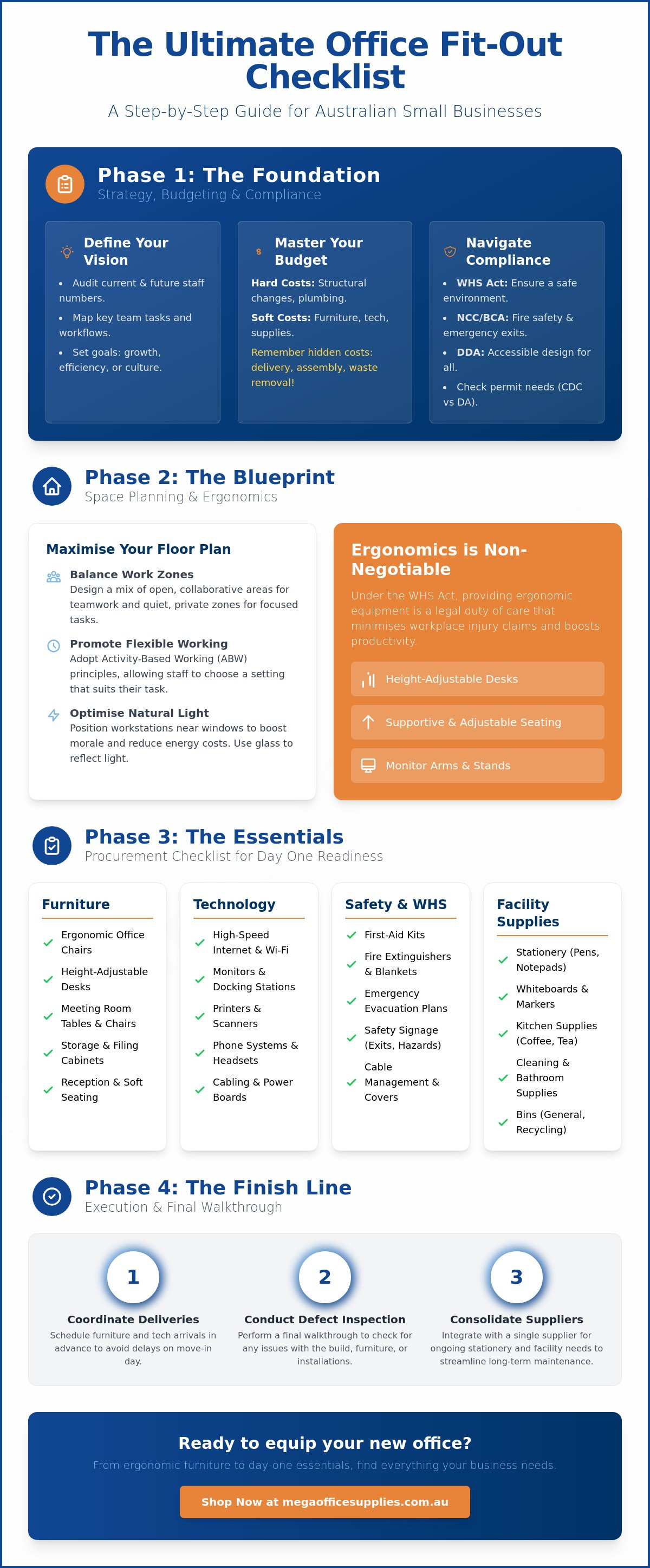
A successful project begins with a clear objective. Small businesses often undertake a fit-out to accommodate rapid growth, shift the company culture, or improve operational efficiency. Without a defined goal, procurement becomes disjointed and expensive. An office fit out checklist for small business must start with a rigorous needs analysis. This involves auditing current staff numbers, predicting future headcount, and mapping out specific tasks performed in the space. You need to know if your team requires quiet zones for deep work or open areas for high-volume collaboration before you commit to a single piece of hardware.
To better understand this concept, watch this helpful video:
Defining Your Vision and Commercial Budget
Establishing a realistic budget requires a dual-track approach. Hard costs generally refer to structural changes, such as partitions or plumbing. Conversely, a soft fit-out is the procurement of furniture, technology, and general office supplies. When calculating your total spend, you must account for hidden logistics. Delivery fees, professional assembly, and waste removal for packaging can consume a significant portion of your contingency fund. It's often these smaller, overlooked items that cause a budget to blow out in the final weeks of the project.
Navigating Australian Building Codes and WHS
Compliance is a non-negotiable component of any commercial project. The National Construction Code (NCC) and the Building Code of Australia (BCA) dictate strict standards for fire safety and emergency egress. Furniture layouts must never obstruct pathways to fire exits or access to firefighting equipment like extinguishers and hose reels. Integrating office space planning principles ensures that your floor plate respects these legal boundaries while remaining functional for daily operations.
Under the WHS Act 2011, employers have a legal duty of care to provide a safe working environment. This extends to the selection of ergonomic equipment, such as height-adjustable desks and supportive seating, to prevent long-term strain injuries. Additionally, the Disability Discrimination Act (DDA) requires that workspaces are accessible to all individuals, including appropriate corridor widths and desk heights. Small businesses should also identify whether their project requires a Complying Development Certificate (CDC) for minor internal works or a full Development Application (DA) for more extensive structural modifications. Getting this wrong can lead to costly delays, fines, or the requirement to redo non-compliant installations.
Designing for Productivity: Space Planning and Ergonomics
Productive design transcends simple aesthetics. It focuses on how a team moves and interacts within a physical space. For many, a primary item on an office fit out checklist for small business is balancing the energy of open-plan collaboration with the necessity of quiet, focused work zones. Small footprints don't have to be restrictive. By implementing Activity-Based Working (ABW) principles, you can create a versatile environment where staff choose their setting based on the task at hand. This approach maximises the utility of every square metre while ensuring that high-concentration tasks aren't disrupted by communal chatter.
Maximising existing features like natural light and ventilation is a low-cost way to boost morale. Positioning workstations near windows can reduce reliance on artificial lighting and help regulate circadian rhythms; this directly impacts afternoon energy levels. If your commercial lease has limited windows, consider using glass boards or mirrors to bounce light deeper into the floor plate. These small adjustments create a sense of scale and openness that benefits the entire organisation.
Maximising Your Floor Plan and Workflow
Effective space planning starts with mapping the staff journey. Consider the path from the entrance to the desks, then to high-traffic areas like the printer station or breakroom. This flow should be intuitive and unobstructed. In smaller offices, multi-functional spaces are essential; a boardroom can serve as a training area or a quiet lunch retreat when not in use. You can use high-quality ergonomic office chairs to define individual workstations without the need for heavy, permanent partitions that close off the room.
The Essentials of Workplace Ergonomics
Ergonomics is a commercial necessity, not a luxury. As you build your office fit out checklist for small business, remember that adjustable standing desks have become a standard requirement for modern Australian businesses looking to minimise workplace fatigue and long-term injury claims. Small additions like monitor arms and footrests allow for manual precision in setup, ensuring each employee's posture is optimised for their specific height and reach. Even colour psychology plays a role; blues and greens are often used to promote concentration, while warmer tones can energise a collaborative huddle space.
Investing in these professional-grade solutions protects your most valuable asset: your people. If you're ready to start selecting hardware, you can browse a wide range of ergonomic office furniture designed for Australian commercial standards.
The Essential Office Furniture and Technology Checklist
Procuring hardware is the stage where your vision meets the practicalities of daily operations. A robust office fit out checklist for small business prioritises commercial-grade durability over residential-style furniture, which often fails under the rigours of a standard eight-hour workday. Investing in professional-grade equipment ensures that your initial outlay is protected by longer warranties and superior structural integrity. Beyond the desks, you must consider the "First Impressions" zone. A well-selected reception desk and comfortable visitor seating signal stability and professionalism to every client who walks through your door.
Selecting Desks and Seating for Longevity
When evaluating furniture for your office fit out checklist for small business, look for AFRDI (Australasian Furnishing Research and Development Institute) certification. This standard ensures that chairs and desks meet strict Australian requirements for strength, stability, and safety. For the local climate, mesh chairs offer superior breathability and airflow, which is particularly beneficial in humid regions. Conversely, upholstered options provide better acoustic properties in larger, echo-prone spaces. Modular workstations are another strategic choice for small teams; they allow you to reconfigure the layout and scale up as your headcount increases without needing to replace your existing assets.
Infrastructure: Technology and Document Management
Technology infrastructure is the backbone of the modern office. You need to plan for adequate cabling, accessible power points, and high-speed networking before the furniture arrives. Security is equally vital. Integrating professional paper shredders ensures that sensitive client data is disposed of securely from day one. This prevents the build-up of clutter and protects your business from potential data breaches.
Centralised printer stations require careful planning, including adequate ventilation and dedicated storage for toner and ink cartridges to avoid mid-project delays. For physical record compliance, high-capacity filing cabinets paired with heavy-duty lever arch files provide a reliable system for long-term document archiving. This structured approach to storage keeps the workspace organised and allows your team to focus on their core tasks without the distraction of desktop clutter.
Operational Readiness: Stationery, Safety, and Facility Supplies
The final phase of a workspace transition determines how quickly your team returns to full productivity. While furniture and floor plans provide the structure, operational readiness depends on the consumables and safety equipment that keep the wheels turning. A rigorous office fit out checklist for small business must account for the high-volume supplies required to make a workspace functional from day one. Failing to procure these "soft" fit-out items leads to immediate friction and unnecessary downtime during the move.
Procurement Checklist: Stationery and Office Supplies
Stationery procurement should be handled as a bulk logistics task rather than a series of small purchases. Small businesses benefit from bulk ordering A4 copy paper and essential stationery supplies well before the move-in date. This ensures that every desk is equipped with a "Day One" pack containing pens, notebooks, and planners. Centralising these items in a dedicated cupboard facilitates better inventory control and reduces waste across the organisation.
Organising the supply zone requires manual precision. Use clear labels and display books to categorise items, making it easy for staff to find what they need without assistance. Every workstation requires a standard set of desk accessories; this includes staplers, hole punches, and tape dispensers. These small tools are often overlooked during the planning of an office fit out checklist for small business, yet they are vital for maintaining an efficient document management workflow.
Staff Wellness: Kitchen, Breakroom, and First Aid
The kitchen and breakroom are the heart of office culture and require significant logistical attention. Stocking a variety of coffee and tea supplies is a simple but effective way to boost team morale during the stress of a transition. Beyond beverages, ensure you have adequate waste bins, paper towels, and commercial cleaning chemicals to maintain hygiene standards in high-traffic areas. A clean, well-stocked tea room signals that the business values staff wellbeing and professional standards.
Safety compliance is a legal necessity under Australian WHS regulations. You must install first aid kits that are appropriate for the size of your workforce and the specific hazards of your environment. This includes placing kits in accessible locations like the staff kitchen or warehouse floor. Facility management also extends to bathroom hygiene; ensure you have a consistent supply of hand sanitiser, toilet paper, and soap. These supplies are fundamental to a safe, professional workspace.
If you are ready to finalise your operational setup, you can procure all your essential workplace facility and cleaning supplies from a single, reliable Australian source.
Executing the Move: Final Walkthrough and Supplier Integration
The final execution phase is the most critical hurdle in your office fit out checklist for small business. It requires a meticulous defects inspection before you provide final sign-off to contractors or furniture installers. You must check every power point, inspect joinery for surface damage, and ensure all paint finishes are consistent across the floor plate. Identifying these issues early prevents long-term maintenance headaches and ensures the space meets the professional grade expected for a commercial environment.
Managing the Logistics of the Move
Coordinating the delivery of bulk furniture is a logistical challenge that requires manual precision. You must schedule arrivals to avoid congestion at lifts and loading docks, particularly in multi-tenanted buildings. To streamline the internal transition, implement an "Empty Box" strategy where staff are responsible for organising their personal desk items into a single, labelled container. Consolidating your procurement through a single-source supplier reduces administrative friction and ensures logistical consistency across your entire facility requirement. This approach simplifies the delivery schedule and provides a clear point of contact for any assembly or installation queries.
Setting Up for Day One Success
Operational readiness is tested in the final 24 hours before your team arrives. You must verify all technology infrastructure, from testing the Wi-Fi signal strength in huddle rooms to ensuring every paper shredder and printer is fully functional. It is also a legal requirement to ensure the first aid station is clearly visible and accessible to all staff members from the moment they enter the building. Conduct a final walkthrough to check the "flow" of the office; look for ergonomic bottlenecks where furniture might obstruct pathways or create cramped conditions in high-traffic zones.
Once the move is complete, your responsibility shifts to education and maintenance. Provide an induction for staff to explain how to use the new ergonomic features, such as adjusting their standing desks or configuring their chair tension for maximum support. Establishing a regular maintenance schedule for furniture and machinery will protect your investment and ensure the workspace remains safe and efficient for years to come. By following this structured office fit out checklist for small business, you move from a planning phase to a high-performing operational reality with absolute confidence.
Finalising Your Workspace Strategy for 2026
A successful move is the result of careful logistical coordination and a commitment to professional standards. By following a structured office fit out checklist for small business, you ensure that every square metre of your new floor plate is optimised for both safety and productivity. Prioritising ergonomic health and regulatory compliance from the initial planning stages protects your workforce and your commercial investment for the long term.
Mega Office Supplies acts as a dependable partner throughout this transition. We offer a one-stop shop for furniture, technology, and stationery, drawing on over 20 years of combined industry experience to support your procurement needs. Our national delivery across Australia ensures that your facility supplies arrive exactly when you need them. You can rely on our logistical prowess to handle high-volume demands without friction; we understand the practicalities of workplace maintenance.
Browse our comprehensive range of Office Fit-out Products at Mega Office Supplies and take the next step toward a professional, functional workspace with absolute confidence.
Frequently Asked Questions
How much does a small business office fit-out cost in Australia?
Total expenditure depends on the specification level and the existing condition of the commercial space. A basic fit-out focusing on essential furniture and layout will differ significantly from a high-spec environment with integrated technology. Factors such as the age of the building and the requirement for structural modifications drive the final cost. You should always allow for a contingency fund to cover logistical variables like delivery, professional assembly, and waste removal.
What are the legal requirements for an office fit-out in Australia?
Legal compliance is governed by the National Construction Code (NCC) and the WHS Act 2011. You must ensure the layout provides unobstructed fire egress and adheres to Disability Discrimination Act (DDA) accessibility standards. These regulations dictate specific corridor widths, desk heights, and the placement of safety equipment. Engaging a professional to verify these standards protects your organisation from liability and ensures a safe environment for all staff.
How long does a typical office fit-out take for a small business?
A standard project typically spans four to twelve weeks from the initial planning phase to the final move-in. This timeline fluctuates based on the lead times for professional-grade furniture and the complexity of technology installations. Establishing a clear office fit out checklist for small business helps manage these milestones and prevents delays caused by disjointed procurement. Early planning is essential to ensure that long-lead items arrive before the scheduled opening date.
Do I need a permit for a minor office refurbishment?
Cosmetic changes like new paint or carpet usually don't require a permit, but any structural or safety modifications do. You should check if your project qualifies for a Complying Development Certificate (CDC), which is a faster approval process for minor works. If the fit-out involves changes to fire safety, plumbing, or accessibility, a full Development Application (DA) through the local council is often necessary to ensure the space is legally occupied.
What are the essential ergonomic features for a new office desk?
A productive desk must offer height adjustability and sufficient depth for proper monitor focal distance. Look for AFRDI-certified surfaces that provide stability under heavy equipment loads and integrated cable management to prevent trip hazards. These manual precision adjustments help minimise workplace fatigue and long-term strain injuries. Choosing professional-grade hardware ensures that the desk remains durable through years of constant commercial use.
What should be included in a workplace first aid kit?
Workplace kits must comply with the WHS Code of Practice and be sized according to your specific staff headcount. Essential items include sterile bandages, antiseptic wipes, disposable gloves, and a thermal blanket. You should also include a register for recording any incidents and ensure the kit is checked regularly for expired items. Placing these kits in high-traffic areas like the staff kitchen ensures they are accessible during an emergency.
How can I minimise business downtime during an office fit-out?
Phasing the move and scheduling furniture deliveries outside of peak hours are effective ways to reduce operational disruption. You can also prepare staff by using an "Empty Box" strategy for personal items to speed up the unpacking process. Utilising a comprehensive office fit out checklist for small business ensures that all technology and supplies are ready 24 hours before the team arrives, allowing for a seamless transition.
Why is a "soft fit-out" just as important as the construction phase?
The soft fit-out includes the furniture, stationery, and technology that your team interacts with every hour. While construction provides the physical shell, the soft fit-out defines the actual user experience and daily productivity levels. Procuring high-quality consumables and ergonomic hardware ensures that the office is functional from day one. This prevents the friction caused by missing stationery or inadequate equipment that can stall business operations.
Article by
Mega Office Supplies Team
The Mega Office Supplies Team provides practical guidance for Australian businesses, schools, government organisations, healthcare providers, hospitality venues, warehouses and home offices. Based in Tweed Heads South, Mega Office Supplies is a family-owned and operated Australian business offering office stationery, workplace furniture, technology products, labels, printers, cleaning and janitorial supplies, safety products, art materials, education resources and everyday business essentials from trusted brands.
General Information
This article is provided as general information only to help customers compare and choose office, workplace, school, cleaning, technology, furniture, safety and business supplies. Product details, specifications, compatibility, availability, pricing and suitability may vary. Always check the individual product page, manufacturer information, workplace requirements and relevant safety guidance before purchasing or using a product.


