

That $300 "bargain" seating solution might actually cost your organisation thousands in lost productivity and Work Health and Safety (WHS) compliance risks. With over 40% of employed Australians working from home in 2024 and new Victorian legislation proposing statutory WFH rights by September 2026, selecting the right office chairs desk chair configuration is a decision that impacts long-term health. You likely feel the frustration of replacing broken equipment every 12 months or managing staff complaints about persistent lower back pain caused by inadequate support.
At Mega Office Supplies, we help you choose hardware that lasts. This comparison explains why a professional office chair is a productivity tool rather than just a piece of furniture. You'll learn how to identify AFRDI Level 6 certified products and AS/NZS 4438:1997 compliance to ensure your workplace meets current Australian standards. We'll examine durability, ergonomic adjustments, and how the right investment can help reduce the 8.5 million tonnes of furniture waste generated annually in Australia. By the end of this guide, you'll be equipped to select seating that supports your team and your bottom line.
Key Takeaways
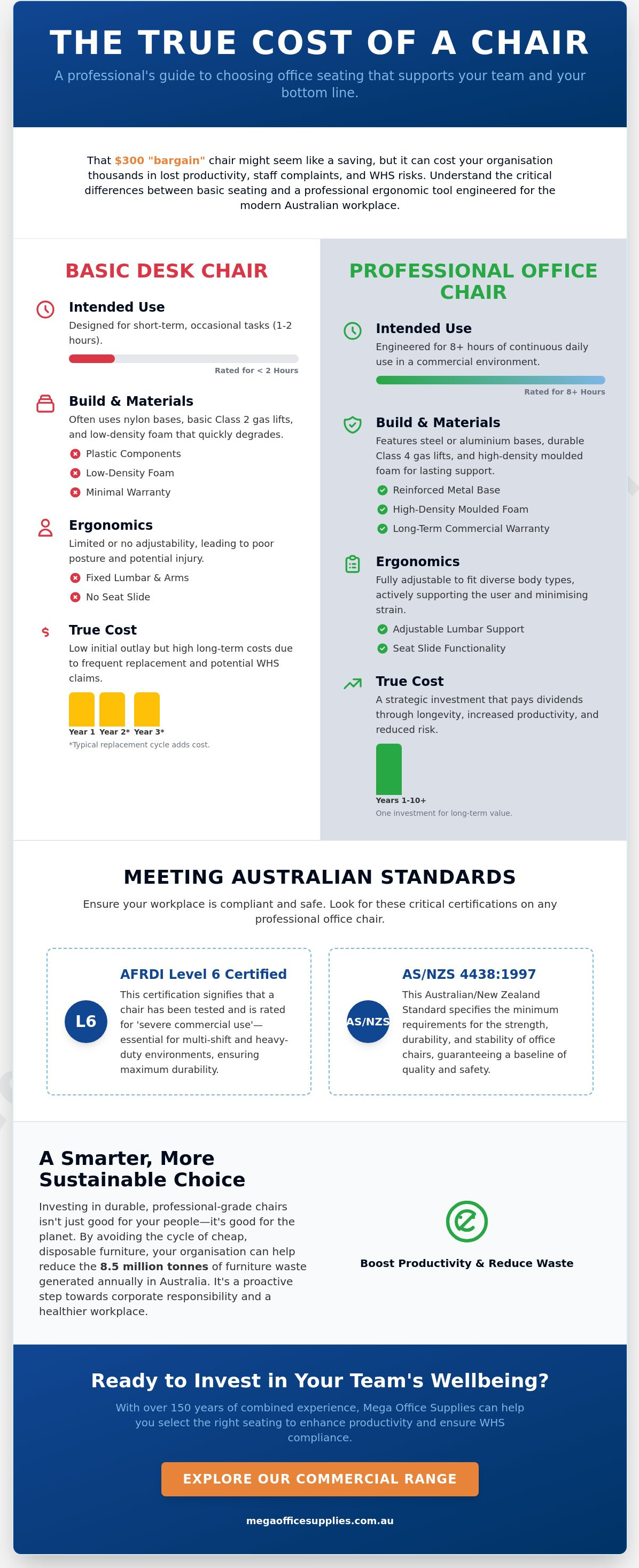
- Distinguish between basic seating designed for short-duration tasks and professional office chairs engineered for over eight hours of continuous daily use.
- Identify essential ergonomic features, such as adjustable lumbar support and seat slide functionality, that differentiate professional office chairs desk chair models to minimise workplace injury.
- Understand the importance of AFRDI Level 6 and BIFMA certifications to ensure your seating meets Australian durability and safety standards for commercial environments.
- Compare task and executive models to determine which chair type best supports specific roles in your organisation, from reception areas to boardrooms.
- Learn how to streamline bulk procurement for schools, government departments, and large-scale businesses.
Defining the Standard: Office Chairs vs. Basic Desk Chairs
While the terms are often used interchangeably in casual conversation, the technical distinction between office chairs desk chair options is significant for any professional Australian workplace. A standard desk chair is generally designed with a focus on aesthetics and light, occasional use, often prioritising how well it matches a home office's decor rather than how it supports the human frame. In contrast, a professional ergonomic office chair is a precision-engineered tool built to facilitate high-output work while protecting the user's physical health. Choosing the wrong category doesn't just lead to discomfort; it frequently results in a cycle of equipment failure and avoidable workplace injuries.
Intended Use and Daily Duration
Duration is the primary factor that dictates engineering requirements. A basic desk chair typically features low-density foam that loses its "memory" and support after 60 to 90 minutes of use. This is sufficient for checking emails or paying bills, but it's inadequate for a standard Australian workday. Professional models are rated for 8 to 12 hours of continuous use. These chairs utilise high-density moulded foam that maintains its shape for years, ensuring that the pressure on the user's spine and pelvis remains evenly distributed. When an organisation ignores these durations, they often find that "home-style" chairs lack the structural integrity required for deep, focused work.
Build Quality and Material Integrity
The mechanical longevity of a chair depends on the quality of its individual components. Budget desk chairs often utilise nylon or plastic bases that can stress and crack under constant load. Professional office furniture, available through our furniture range, typically features heavy-duty aluminium or reinforced steel bases designed to withstand the rigours of a busy commercial environment. Mechanical failure often starts at the gas lift. While entry-level chairs use basic Class 2 lifts, professional seating employs Class 4 gas cylinders, which are designed for thousands of cycles without losing pressure.
The reality for procurement officers is that a cheap chair often costs more over its lifespan. Every time a chair breaks after 12 months, the initial saving is immediately wiped out by the cost of procurement, assembly, and disposal of the old unit. Key differences in professional hardware include:
- Material Density: High-density moulded foam vs. standard cut-foam padding.
- Fabric Durability: High-rub-test fabrics (Martindale) that prevent premature thinning.
- Weight Capacity: Engineering that supports a wider range of body types safely.
- Mechanical Warranty: Long-term support for moving parts like castors and tilt mechanisms.
Investing in higher material integrity isn't just about comfort; it's a no-nonsense strategy to minimise the long-term costs of frequent replacements and potential healthcare claims.
The Anatomy of Ergonomics: Essential Features for Workplace Health
Understanding the mechanical components that separate professional seating from a basic office chairs desk chair setup is essential for maintaining a healthy workforce. While a standard chair provides a place to sit, an ergonomic tool is designed to support the musculoskeletal system through adjustable points of contact. When these features are absent, the body compensates with poor posture, leading to the lower back pain reported by many Australian office workers. To ensure your team remains productive, you must look for specific engineering benchmarks that align with OSHA ergonomic chair guidelines for workplace safety.
Adjustability is the foundation of ergonomic design. Lumbar support is the primary defence against lower back strain. Without the ability to adjust the height and depth of the lumbar section, the chair cannot accommodate the natural inward curve of the lower spine. Similarly, seat slide functionality is a non-negotiable feature for diverse teams. It allows the user to adjust the seat pan depth to match their leg length, ensuring there is a small gap between the seat edge and the back of the knees to prevent pressure on the popliteal veins. Armrests also play a critical role; they should be adjustable in height and width to support the weight of the arms, which effectively reduces strain on the shoulders and neck.
Dynamic Seating and Movement
Professional seating encourages movement rather than static posture. Most high-performance chairs utilise a synchro-tilt mechanism, typically featuring a 2:1 ratio. This means for every two degrees the backrest reclines, the seat pan tilts one degree. This specific movement opens the hip angle while keeping the feet flat on the floor, which is vital for spinal decompression. Tension control is equally important as it allows the chair's resistance to be calibrated to the user's body weight. This ensures the chair provides consistent support during the frequent micro-movements needed to reduce muscle fatigue over an eight-hour shift.
Specialised Postural Support
The shape of the seat itself influences long-term comfort. Contoured seat pans are engineered to distribute body weight evenly, preventing the formation of painful pressure points on the sit bones. Additionally, waterfall seat edges, which curve downwards at the front, are essential for maintaining healthy blood circulation in the legs. These details ensure that the user does not experience the "numbness" often associated with budget seating. For organisations looking to upgrade their current fit-out, you can view our range of ergonomic solutions designed for professional Australian environments.
Comparing Chair Types: Which Model Suits Your Role?
Selecting a professional seating solution requires matching the hardware to the specific duties of the user. While a generic office chairs desk chair might suffice for a spare bedroom, a commercial environment demands specialised models. Task chairs serve as the versatile workhorse for general staff. They're engineered for intensive use at standard workstations. Executive chairs provide high-back support, which is often preferred for long boardroom meetings or management roles where postural changes occur less frequently. For those working at elevated counters, art rooms, or in laboratory settings, drafting chairs offer the necessary height and foot-ring support to maintain ergonomic alignment at non-standard desk heights.
In addition to specialised seating, many organisations find that integrating high-quality preowned workstations is a cost-effective way to complete a professional fit-out.
Mesh vs. Fabric: The Great Debate
Mesh chairs are often the superior choice for temperature regulation in Australian climates. The open weave allows for maximum breathability. This is a critical factor in warehouses or offices where humidity levels fluctuate. In contrast, high-grade fabric chairs offer a plush, cushioned feel that many users find more substantial for deep work. Regarding maintenance, high-rub-test fabrics often survive an accidental coffee spill better if treated quickly with standard cleaning chemicals. Mesh can be more difficult to deep-clean once debris enters the weave. However, professional-grade mesh is engineered to resist sagging, whereas the low-density foam found in budget office chairs desk chair models will often compress permanently within 12 to 18 months of daily use.
Matching Chair to Function
Different workplace zones require different seating strategies. Boardroom seating should prioritise aesthetic uniformity and medium-term comfort for sessions lasting two to four hours. Hot-desking environments, which have become a staple since over 40% of employed Australians worked from home in 2024, require chairs with intuitive, easy-to-adjust controls. This allows various users to calibrate their support quickly without a complex manual. You can find specialised seating for every department in the Mega Office Supplies furniture range. Whether you're outfitting a school staffroom or a high-volume government call centre, selecting role-specific hardware ensures both durability and employee wellbeing.
Commercial Durability: AFRDI and BIFMA Ratings Explained
Technical certification is the only reliable way to distinguish a professional seating tool from a basic retail product. While many retailers offer a ten-year guarantee, these are often marketing promises rather than engineering benchmarks. Professional procurement for Australian workplaces relies on the Australasian Furnishing Research and Development Institute (AFRDI) and the Business and Institutional Furniture Manufacturers Association (BIFMA). These bodies provide third-party verification that a chair can withstand the rigours of a 1.9 billion dollar Australian office furniture market. Selecting professional office chairs desk chair configurations without these ratings often leads to premature mechanical failure and increased liability under Australian Work Health and Safety (WHS) laws.
The AFRDI Level 6 certification is the gold standard for commercial seating in Australia. This rating signifies the chair is fit for heavy commercial use, including 24/7 environments like emergency call centres, hospitals, and security hubs. Compliance with the AS/NZS 4438:1997 standard ensures the hardware meets strict requirements for strength, durability, and stability. For business owners and school administrators, these certifications provide peace of mind that the equipment won't fail under heavy load, protecting the organisation from potential injury claims and the administrative burden of constant replacements.
The Testing Process for Australian Standards
Certified chairs undergo rigorous stress testing to simulate years of intensive use. Engineers perform static load testing to determine the maximum weight a component can hold before breaking. They also conduct fatigue testing, which involves 200,000 cycles of repetitive mechanical action on the backrest and seat pan. This process ensures that the gas lift, castors, and tilt mechanisms remain functional after thousands of adjustments. Demanding certified seating is a no-nonsense requirement for any professional environment where equipment uptime is critical for productivity.
Long-term ROI of Certified Seating
The financial logic of professional seating is rooted in the cost-per-year of service. A basic 150 dollar chair that requires replacement after 12 months is significantly more expensive than a 500 dollar AFRDI-rated chair that lasts a decade. With the Australian office furniture market projected to reach 1.96 billion USD in 2026, organisations are increasingly prioritising hardware that reduces long-term waste and procurement costs. Investing in certified durability allows you to focus on core operations rather than managing furniture repairs. You can browse our range of AFRDI-certified office chairs to find a solution that meets your specific compliance and durability needs.
Organising Your Seating Strategy with Mega Office Supplies
Mega Office Supplies operates as a reliable industry veteran, assisting procurement officers and business owners with their fit-out requirements. Selecting the correct office chairs desk chair configuration for a large-scale workplace requires more than just browsing a catalogue. It involves understanding the logistical demands of national delivery and the specific durability needs of different Australian environments, from school staffrooms to high-volume government call centres. Our team provides the stability and local expertise required to handle high-volume demands without friction, ensuring your organisation receives hardware that complies with current WHS legislation.
A comprehensive wellness strategy often extends beyond simple seating. Integrating ergonomic office chairs desk chair setups with standing desk solutions allows for postural variation throughout the day, which is essential for reducing the musculoskeletal risks associated with sedentary work. By coordinating these hardware choices, businesses can create a cohesive environment that promotes both comfort and long-term productivity. Our no-nonsense approach prioritises functional clarity, helping you build a workspace that supports your team's health and your bottom line.
Bulk Procurement and National Delivery
Managing a furniture rollout for a government department or a multi-campus educational institution requires a partner capable of handling immense scale. We streamline this process through a fast-paced, structured workflow that mirrors the logistical flow of a modern warehouse. Professional buyers can utilise our 'Quick View' and 'View Quote' features to compare technical specifications and bulk quantities rapidly, facilitating a fast and efficient user experience. Whether you're outfitting a single reception area or coordinating a national refresh of heavy-duty seating, our logistical prowess ensures fast delivery and reliable service across Australia.
The Mega Advantage: Reliability and Scale
Our utilitarian approach prioritises functional clarity and efficiency over flashy marketing. High-volume professional buyers value the ability to manage a unified supply chain through a single, dependable partner. You can combine your furniture orders with essential office supplies, such as toner, lever arch files, and high-capacity stationery, reducing the administrative burden of dealing with multiple vendors. This "safe pair of hands" approach ensures that every item, from a high-back executive chair to a heavy-duty paper shredder, meets our standards for commercial reliability and longevity.
For organisations looking to optimise their workspace, our Australian-based service team is available to provide expert guidance. Contact our team on 1300 783 961 for a comprehensive workplace seating audit to ensure your team is supported by the right professional hardware.
Optimising Your Workplace for Long-Term Performance
Choosing the right seating is a strategic decision that affects your organisation's health and operational efficiency. You now understand that the technical engineering behind an office chairs desk chair setup determines whether a piece of equipment lasts twelve months or a full decade. Prioritising AFRDI Level 6 certification ensures your workplace remains compliant with Australian safety standards while reducing the logistical headache of frequent furniture replacements. Every adjustment point, from lumbar depth to synchro-tilt tension, serves as a productivity tool rather than a mere design feature.
Mega Office Supplies helps you navigate these professional choices. We offer heavy-duty, commercial-grade options backed by national Australian delivery and local support. Our no-nonsense approach ensures you get the functional clarity needed for high-volume procurement, whether you're outfitting a school art room or a government department. We're here to ensure your furniture investment stands the test of time.
Browse our full range of professional ergonomic office chairs to find a solution that supports your team's specific needs. Investing in quality hardware today creates a more resilient and productive workplace for the years ahead.
Frequently Asked Questions
What is the difference between an ergonomic chair and a standard desk chair?
An ergonomic chair prioritises musculoskeletal alignment through multiple adjustment points, whereas a standard desk chair is typically designed for aesthetic appeal and short-duration use. When selecting between office chairs desk chair models, the primary difference lies in the duration of support. Professional models include adjustable lumbar, seat depth, and tilt tension to support the user for over eight hours, while basic versions often lack these mechanical features.
How much should I expect to pay for a high-quality office chair in Australia?
Current market data from 2025 indicates that premium ergonomic chairs in Australia are priced at approximately $1,500 per unit, while mid-range models typically cost between $300 and $700. These values reflect the engineering quality and certification levels required for commercial environments. Investing in this price bracket ensures the hardware meets the durability standards necessary for long-term workplace use and provides a better return on investment.
Is a mesh chair better than a leather chair for long hours?
Mesh is generally superior for long hours in Australian climates because it facilitates constant airflow and temperature regulation. Leather or high-grade fabric options provide a more cushioned feel but can retain body heat, leading to discomfort during extended shifts. For intensive eight-hour use, a mesh backrest combined with a high-density foam seat pan often provides the most balanced support for professional staff in warehouses or offices.
What does an AFRDI rating actually mean for my business?
An AFRDI rating provides third-party verification that a chair meets the AS/NZS 4438:1997 standard for strength and safety. For your business, this translates to reduced liability under WHS laws and a lower risk of equipment failure. It serves as a technical insurance policy, confirming the furniture is fit for purpose in high-pressure commercial settings where equipment is used by multiple staff members daily.
How do I know if my current office chair is the right height?
You know your chair is at the correct height when your feet are flat on the floor and your thighs are parallel to the ground. Your knees should maintain a 90-degree angle, and there should be a small gap between the seat edge and the back of your knees. This position ensures optimal blood circulation and reduces pressure on your lower spine throughout the working day.
Can a good office chair really reduce back pain?
A properly calibrated office chair reduces back pain by supporting the natural "S" curve of the spine and preventing slouching. By distributing body weight evenly across a contoured seat pan, these chairs minimise the pressure on individual intervertebral discs. This proactive support is a key component of managing workplace wellness and reducing the risk of long-term musculoskeletal injuries among your employees.
How often should a professional office chair be replaced?
Professional office chairs engineered for commercial use should be replaced every 7 to 10 years, depending on the intensity of use. In contrast, budget desk chairs often require replacement within 12 to 24 months due to foam compression or mechanical failure. Monitoring for signs of "bottoming out" in the seat foam or loss of gas lift pressure is essential for maintaining a safe workplace.
What features are most important for a home office chair?
The most important features for a home office chairs desk chair setup include adjustable lumbar support, seat height, and high-density foam that maintains its shape. While space might be limited, the ergonomic requirements remain identical to a corporate office. Ensuring the chair fits under your specific desk height while providing full spinal support is critical for maintaining productivity in a residential environment.
Article by
Mega Office Supplies Team
The Mega Office Supplies Team provides practical guidance for Australian businesses, schools, government organisations, healthcare providers, hospitality venues, warehouses and home offices. Based in Tweed Heads South, Mega Office Supplies has been family owned and operated since 2008, offering office stationery, workplace furniture, technology products, labels, printers, cleaning and janitorial supplies, safety products, art materials, education resources and everyday business essentials from trusted brands.
General Information
This article is provided as general information only to help customers compare and choose office, workplace, school, cleaning, technology, furniture, safety and business supplies. Product details, specifications, compatibility, availability, pricing and suitability may vary. Always check the individual product page, manufacturer information, workplace requirements and relevant safety guidance before purchasing or using a product.


