

What if the simple act of choosing a 0.3mm tip over a 0.5mm variant could be the difference between a professional technical drawing and a cluttered, illegible mess? It is a common frustration in busy Australian offices, schools, and design studios when fineliner pens fray or bleed through paper, ruining hours of meticulous work. You likely agree that professional documentation requires tools that offer consistent line widths and reliable ink flow; whether you are colour-coding a complex project planner or signing high-stakes legal documents.
This guide is designed to help you select the ideal fineliner pens for professional documentation, technical drawing, and creative projects within the Australian workplace. We will provide the clarity needed to make confident purchasing decisions by examining tip resilience, archival ink qualities, and the specific requirements of different paper stocks. By the end of this article, you will be equipped to choose reliable pens that deliver crisp, smudge-free results and improve your workplace organisation through precise, professional-grade tools.
Key Takeaways
- Understand the functional advantages of fibre-tipped precision over standard ballpoints to ensure professional clarity in all documentation.
- Learn how to select the correct tip size and ink technology for your specific task, ranging from ultra-fine technical work to bold colour-coding.
- Discover why metal-encased nibs and archival pigment inks are critical for technical drawing and long-term workplace record keeping.
- Identify the best fineliner pens for high-volume Australian environments, including industry-standard options for everyday office and school use.
- Optimise your stationery procurement by standardising brands and evaluating the cost-efficiency of bulk sets versus individual colour stocking.
Understanding Fineliner Pens: Why Precision Matters in the Professional Environment
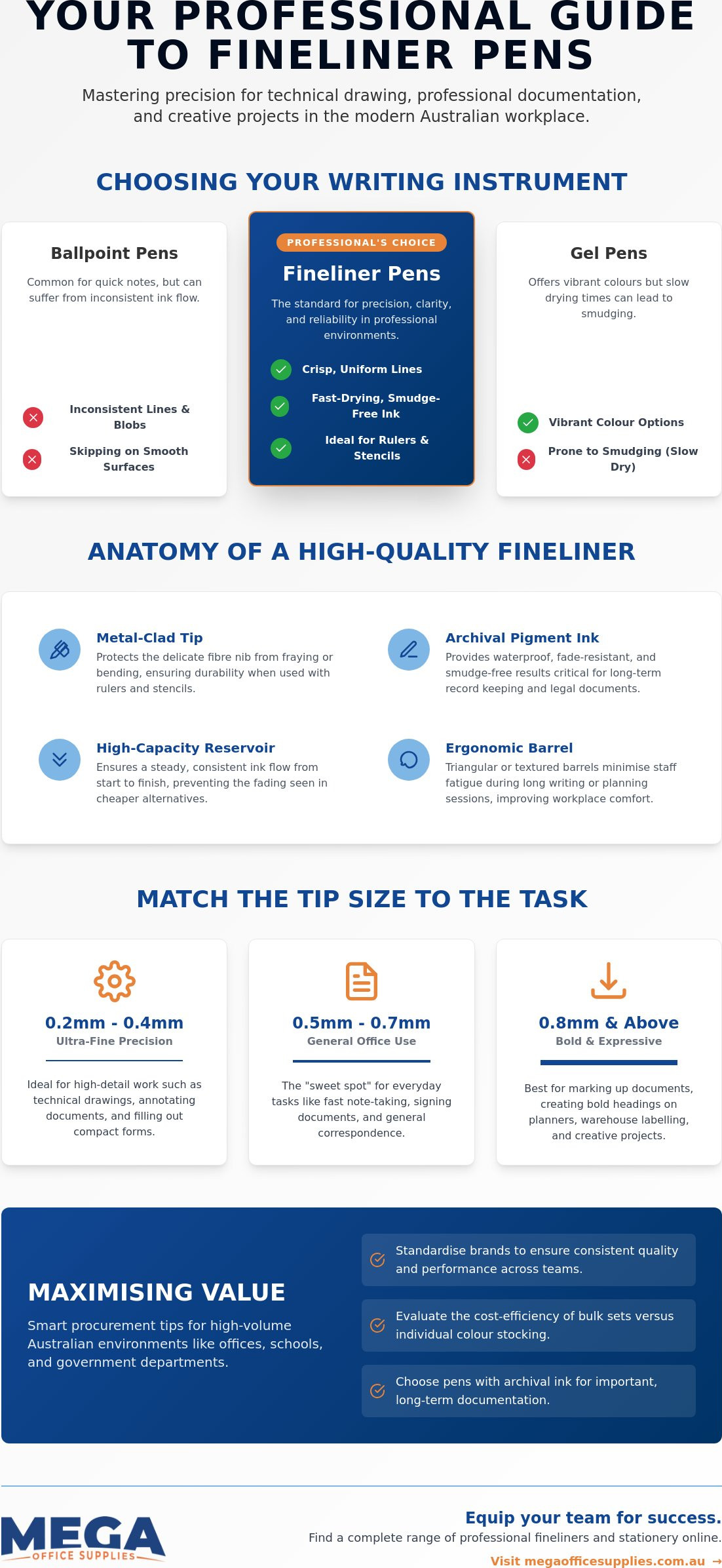
Professional fineliner pens represent a significant evolution from the early history of technical pens. While a standard felt-tip marker is often associated with casual art or classroom activities, a professional-grade fineliner is a precision tool designed for the rigours of the modern Australian workplace. These instruments utilise a fibre or plastic tip, typically encased in metal, to deliver either water-based or pigment ink with absolute consistency.
The primary benefit lies in the line quality. Ballpoint pens often suffer from ink blobs or skipping when the internal ball fails to rotate smoothly. In contrast, a fineliner provides a uniform stroke from the first millimetre to the last. This reliability is why they have become essential in architectural firms, medical facilities for clear patient notes, and government departments where document legibility is non-negotiable.
To better understand how these tools perform under different conditions, watch this helpful video:
The Anatomy of a High-Quality Fineliner
A professional fineliner is more than just a plastic tube. The most critical component is the metal-clad tip. This reinforcement protects the delicate fibre nib from fraying or bending, even when used against heavy metal rulers or plastic stencils. Inside the barrel, a high-capacity reservoir ensures a steady pressure of ink. This prevents the fading effect often seen in cheaper stationery. For procurement officers managing high-volume environments, choosing pens with ergonomic, triangular, or textured barrels is a practical step toward minimising staff fatigue during long planning sessions.
Fineliners vs. Gel Pens and Ballpoints
When comparing writing instruments, the fineliner wins on line consistency and drying speed. Gel pens offer vibrant colours but often require several seconds to dry, leading to smudges. This is a particular pain point for left-handed writers in fast-paced warehouses or reception areas. Fineliners, especially those using pigment ink, dry almost instantly upon contact with office stationery. Beyond functionality, there is an aesthetic advantage. The crisp, matte finish of fineliner ink elevates the appearance of professional diagrams and hand-written correspondence, projecting an image of meticulous organisation and attention to detail.
Key Features to Compare: Finding Your Perfect Point
Selecting the right fineliner pens involves more than just choosing a preferred ink colour. You must evaluate the technical specifications that dictate how the pen performs on various workplace surfaces. While the history of drawing instruments highlights a long-standing quest for precision, modern office requirements demand a balance between delicate line work and industrial-grade durability. Understanding the interplay between tip size, ink chemistry, and barrel ergonomics will ensure your procurement decisions support workplace efficiency.
Selecting the Right Tip Size for Your Task
Tip size is perhaps the most critical factor for professional users. While artists often keep a full range, most Australian office environments can standardise based on specific roles. Choosing the wrong size leads to cluttered notes or fragile tips that bend under the pressure of daily use.
- 0.2mm to 0.4mm: These ultra-fine tips are engineered for high-precision tasks. They are ideal for engineers making detailed annotations, administrators filling out compact forms, or staff using small-grid project planners.
- 0.5mm to 0.7mm: Often considered the "sweet spot" for general office use. These tips provide a smooth ink flow that accommodates fast handwriting while maintaining the crispness that defines a fineliner.
- 0.8mm and above: Best suited for bold headings, outlining diagrams on flipcharts, or labelling archive boxes where high visibility is required from a distance.
Ink Properties: Smudge-Resistance and Archival Quality
Ink technology generally falls into two categories: dye-based and pigment-based. For the professional sector, pigment ink is the superior choice. It is fade-resistant and archival, making it essential for legal documents, medical records, and permanent government filings. Pigment ink also offers excellent water-resistance. If a staff member accidentally spills water in the staff kitchen, notes written with pigment-based fineliner pens are far more likely to remain legible.
Bleed-through is another vital consideration. You must match your pen to the weight of your paper. While professional-grade A4 copy paper is designed to handle most fineliner inks without issues, thinner notebook pages may require a drier, dye-based ink to prevent ghosting on the reverse side. Beyond the ink, the physical design of the pen impacts long-term value. Triangular barrels are a practical choice for reception areas and design desks; they provide a comfortable grip and won't roll off flat surfaces. Furthermore, look for pens with extended "cap-off" times. This feature ensures the pen won't dry out if left uncapped during a lengthy boardroom meeting, reducing waste and replacement costs. To find the right fit for your team, you can browse our extensive office stationery range for reliable, professional-grade options.
Matching Your Fineliner to the Task: From Boardrooms to Studios
The utility of fineliner pens extends far beyond the art room. While creative professionals use varying weights to create depth and detail in illustrations, these tools are equally valuable in the corporate boardroom and the administrative office. In a high-pressure business environment, clear communication is paramount. Replacing standard ballpoints with fineliners ensures that handwritten records, meeting minutes, and signature lines remain perfectly legible and smudge-free. This is particularly important for professionals in healthcare or government sectors where record-keeping accuracy is a legal requirement.
For project managers and administrators, bullet journaling and planning are essential for maintaining workplace organisation. Using a range of fineliner colours allows for rapid prioritisation of tasks and the clear separation of different project streams on a single page. This visual hierarchy helps teams process information faster and reduces the likelihood of missed deadlines. Unlike standard pens, the consistent ink flow of a fineliner ensures that even the smallest annotations in a compact diary remain sharp and easy to read.
For technical drawing and architecture, the requirements are even more stringent. Professionals in these fields rely on metal-encased nibs. This specific design allows the pen to glide along straight edges and templates without damaging the fibre tip, ensuring the absolute precision required for scale drawings. These pens maintain a constant line width, which is essential when translating hand-drawn concepts into digital formats or presenting plans to clients.
Fineliners in the Educational Sector
Teachers across Australia frequently use fineliners for marking and feedback. Using a palette of bright colours helps to engage students and clearly distinguishes teacher comments from student work. In the classroom, students benefit from using these pens in their exercise books to develop fine motor skills and maintain neat handwriting. When procuring for schools, durability is a primary concern. It's best to select professional-grade options that can withstand the heavier pressure often applied by younger users, ensuring the pens last an entire term without failing.
Creative and Technical Applications
Effective mind mapping during brainstorming sessions relies on quick, fluid movements and instant colour-coding to categorise ideas. Fineliners provide the necessary speed and variety for these sessions. In more specialised roles, such as architectural sketching, the lightfastness of the ink is critical. This ensures that sketches and concept designs don't fade when displayed in sunlit studios or reception areas. When annotating blueprints or fragile site plans, the gentle tip of a fineliner is preferable to the sharp point of a pencil or the high-pressure ball of a standard pen. The fibre tip won't tear or emboss the paper surface, preserving the integrity of expensive original documents.
Top Professional Choices: Standout Fineliners in Our Collection
Selecting the right hardware for your desk is a matter of matching performance to high-volume demands. Our range features several industry-standard fineliner pens that have proven their reliability in Australian workplaces. These options have been curated based on their ink longevity, tip resilience, and ergonomic value, ensuring they meet the needs of diverse professional sectors.
The Artline 200 Series remains a permanent fixture in offices across the country. Its 0.4mm plastic tip is engineered for consistent flow, making it the preferred choice for standard administrative tasks and document signing. It's a utilitarian tool that delivers crisp lines without the risk of leaking, providing peace of mind for staff handling high-volume paperwork.
For those focused on complex project planning or colour-coding, the Stabilo Point 88 is instantly recognisable by its hexagonal barrel. It offers an extensive colour range, allowing teams to organise timelines and priorities with visual clarity. The metal-encased tip ensures the pen maintains its shape even under heavy use, which is vital for maintaining precision over time.
When technical precision is the priority, the Sakura Pigma Micron is the gold standard. This range remains a market leader with 10,000 units sold monthly. This high volume is largely due to its archival Pigma ink that resists fading and chemical degradation. It is an essential tool for long-term record keeping in government and medical environments.
The Staedtler Triplus series addresses workplace ergonomics with its triangular barrel, designed to reduce strain during extended writing sessions. It also features "DRY SAFE" technology. This allows the pen to be left uncapped for days without drying out, offering a practical benefit in busy meeting rooms where caps are easily misplaced.
Best for General Office Use
Most departments find that standardising on a 0.4mm tip provides the best balance of legibility and durability. Buying these in bulk packs of black or blue ink is a highly cost-effective strategy for procurement officers looking to minimise overheads while maintaining quality. You can browse our full range of stationery supplies to find high-capacity options for your team.
Best for Designers and Architects
Creative professionals require multi-size sets to achieve varied line weights in their sketches. The collection includes sets ranging from 0.05mm to 0.8mm to facilitate complex layering and depth. These pens feature "Copic-proof" ink that is compatible with alcohol-based markers, ensuring that outlines won't bleed when colour is applied. For those in technical sectors, we recommend you view our professional fineliner collection here to secure the specific hardware required for your next project.
Maximising Value: Procurement Tips for High-Volume Environments
Effective procurement for large-scale operations requires a shift from individual preference to departmental efficiency. In high-volume environments like government offices, schools, and medical centres, the cost of stationery can escalate quickly if not managed through a structured approach. Standardising your choice of fineliner pens across an entire organisation reduces inventory complexity and prevents the confusion that arises when different teams require incompatible refills or accessories. By selecting a primary brand for general use, procurement officers can leverage bulk pricing and simplify the replenishment process.
When evaluating your stock requirements, consider the balance between assorted sets and bulk single-colour boxes. While creative departments or design studios benefit from the variety found in multi-colour sets, administrative and legal teams almost exclusively require black or blue ink. Investing in 10-pack or 12-pack boxes of these essential colours is significantly more cost-effective than purchasing individual units. This strategy ensures that high-demand colours are always available, preventing the common issue of having surplus "niche" colours while essential pens are depleted.
Sustainability has become a core requirement for Australian business procurement. Many industry leaders now prioritise fineliner pens manufactured with recycled plastics or biodegradable materials to meet corporate social responsibility targets. Choosing durable, high-capacity pens also reduces the frequency of disposal, contributing to a lower environmental impact and better long-term value for money.
Managing Large-Scale Stationery Orders
Successful management starts with tracking usage patterns to identify which tip sizes and colours are consumed most rapidly. For instance, you might find that 0.4mm black pens are replaced three times more often than any other variant. Setting up a recurring order for these high-turnover items ensures your facility remains fully equipped without the need for constant manual auditing. For those in the public sector, we provide streamlined processes for Australian government purchase orders to facilitate rapid and compliant procurement.
Pro-Tips for Pen Maintenance
Extending the life of fibre-tip pens is a simple way to maximise your investment. While many believe pens should be stored vertically, storing fineliners horizontally is the preferred method. This practice ensures the ink remains evenly distributed within the reservoir, preventing the tip from drying out or becoming over-saturated. If a tip does become dry, it is occasionally possible to revive it by briefly dipping the nib in warm water, though for professional documentation, a replacement is usually necessary to ensure line integrity. Finally, educating staff on the delicate nature of fibre nibs can prevent premature damage. Unlike ballpoints, fineliners require very little pressure to write; teaching users to avoid "heavy-handedness" will keep the tips sharp and functional for the full life of the ink supply.
Equipping Your Workplace for Long-Term Precision
Securing the right fineliner pens is a strategic decision that impacts the clarity of your documentation and the efficiency of your team's workflow. Whether you're standardising on a 0.4mm tip for general administration or investing in archival pigment sets for technical drawing, the correct tool ensures professional-grade results. It's vital to store your pens horizontally to maintain ink distribution and consider bulk procurement to maximise your budget across high-volume departments.
Family owned and operated since 2008, Mega Office Supplies supports Australian businesses and schools with reliable guidance and national delivery on all office essentials. We prioritise functional clarity and logistical efficiency, ensuring your operation remains well-oiled and fully equipped. Shop the full range of professional Fineliner Pens at Mega Office Supplies. We're here to help you secure the precision tools your workplace demands.
Frequently Asked Questions
What is the best fineliner pen for writing on thin paper?
The best choice for thin paper is a fineliner with pigment-based ink and a needle-point tip between 0.2mm and 0.4mm. These specific fineliner pens deliver a drier ink flow compared to gel pens, which significantly reduces the risk of bleed-through or ghosting on the reverse side. This is particularly useful for staff using compact diaries or lightweight forms where space is limited and clarity is essential.
Are fineliner pens waterproof?
Waterproofing depends entirely on the ink technology used in the pen. Pigment-based fineliners are typically waterproof and fade-resistant once dry, making them the standard choice for permanent records and architectural plans. Conversely, dye-based inks are often water-soluble and will smudge if they come into contact with moisture. Always check the barrel for archival or pigment labels if water-resistance is a mandatory requirement for your workplace.
What is the difference between a 0.3 and 0.5 fineliner?
The primary difference is the physical width of the line produced by the nib. A 0.3mm tip is engineered for high-precision tasks such as technical drawing or annotating dense spreadsheets where space is at a premium. A 0.5mm tip is the industry standard for general handwriting, providing a bolder line that is easier to read in meeting notes. Choosing the correct size ensures your documentation remains professional and legible.
Can I use fineliners for professional legal signatures?
You can use fineliners for legal signatures if the pen uses archival, pigment-based ink. These inks are designed to be tamper-evident and resistant to light, heat, and chemicals, ensuring the signature remains permanent for decades. In government and legal sectors, using a professional-grade fineliner with these properties provides the security and peace of mind required for high-stakes documentation and permanent contract filing.
How long do fineliner pens typically last in an office setting?
Ink longevity varies by brand, but a professional fineliner typically offers a write-out length of several hundred metres. In a standard office setting, a pen's lifespan is often determined by how well the cap is maintained. Options featuring Dry Safe technology can last significantly longer in busy environments as they won't dry out even if left uncapped for several hours during lengthy planning sessions or board meetings.
Why does my fineliner tip keep bending or fraying?
Fraying or bending is usually caused by applying excessive downward pressure or using the pen on highly abrasive paper surfaces. Unlike ballpoint pens, fineliner pens use a delicate fibre or plastic nib that requires only a light touch to initiate ink flow. Selecting pens with metal-clad tips provides additional reinforcement, protecting the nib from damage when used against straight edges or stencils in technical environments.
Are fineliners suitable for left-handed writers?
Fineliners are excellent for left-handed writers because the ink dries almost instantly upon contact with the paper. This rapid drying time effectively eliminates the smudging and silver hand effect often associated with slower-drying gel or fountain pens. For left-handed staff in fast-paced warehouses or medical centres, these pens provide a reliable, smudge-free writing experience that maintains the professional appearance of all handwritten records.
What is the best way to store my fineliner pens to prevent drying?
The most effective way to store your pens is in a horizontal position. Storing fineliners flat ensures that the ink remains evenly distributed throughout the internal reservoir and doesn't settle at either end. This practice prevents the tip from becoming over-saturated or drying out prematurely. It's also vital to ensure the cap is clicked firmly into place after every use to maintain the integrity of the fibre nib.
Article by
Mega Office Supplies Team
The Mega Office Supplies Team provides practical guidance for Australian businesses, schools, government organisations, healthcare providers, hospitality venues, warehouses and home offices. Based in Tweed Heads South, Mega Office Supplies is an Australian business, family owned and operated since 2008, offering office stationery, workplace furniture, technology products, labels, printers, cleaning and janitorial supplies, safety products, art materials, education resources and everyday business essentials from trusted brands.
General Information
This article is provided as general information only to help customers compare and choose office, workplace, school, cleaning, technology, furniture, safety and business supplies. Product details, specifications, compatibility, availability, pricing and suitability may vary. Always check the individual product page, manufacturer information, workplace requirements and relevant safety guidance before purchasing or using a product.


