

Did you know that an estimated 1.1 million Australian accounts were leaked in the first quarter of 2026 alone? For procurement officers and office managers, this statistic is a stark reminder that data security is a constant battle. You likely already recognise that failing to destroy sensitive documents can lead to massive financial penalties under the Privacy Act 1988 and the Notifiable Data Breaches scheme. The challenge is finding a solution that balances high level security with a workflow that doesn't stop every ten minutes for maintenance or bin emptying.
In this professional comparison of the cross-cut vs micro-cut shredder, we'll show you why the high security option is often the best choice for operational efficiency. You'll learn how different P-ratings affect your compliance obligations and why particle size is the secret to reducing how often your staff visit the waste bin. We'll provide the practical guidance needed to select a reliable machine from Mega Office Supplies that keeps your Australian business, school, or medical clinic fully protected and running smoothly.
Key Takeaways
- Align your document destruction processes with Australian privacy obligations by understanding the P-rating security levels defined by international standards.
- Evaluate the performance trade-offs of a cross-cut vs micro-cut shredder, balancing higher sheet capacity against superior data protection.
- Maximise office efficiency by utilising micro-cut particles, which settle more densely and reduce the time spent emptying waste bins.
- Learn why high-precision cutting heads require specific maintenance routines, including regular oiling, to ensure long-term equipment reliability.
- Select the appropriate shredding technology based on your specific industry requirements, whether for a medical clinic, school, or government department.
Understanding the Fundamentals: Cross-Cut vs Micro-Cut Technology
Document destruction has evolved significantly from the basic strip-cut machines of the past. Those older models merely sliced paper into long ribbons, which provided minimal protection against determined data thieves. Today, professional environments across Australia rely on multidirectional cutting methods to ensure compliance and peace of mind. Choosing between a cross-cut vs micro-cut shredder is now the most critical decision in your office technology strategy, as the cut type directly determines how difficult it is for unauthorised parties to reconstruct your sensitive information.
The history and development of paper shredder technology show a clear trajectory toward smaller particle sizes. As identity theft risks increase, the precision engineering behind these machines has become more sophisticated. While standard office models often use a dual-blade system, high-security environments now look toward "nano-cut" mechanisms that reduce a single A4 sheet into thousands of tiny pieces. This level of destruction is no longer a luxury; it's a requirement for modern data management.
To see these mechanisms in action and understand the physical difference, watch this helpful video comparison:
The Mechanics of a Cross-Cut Shredder
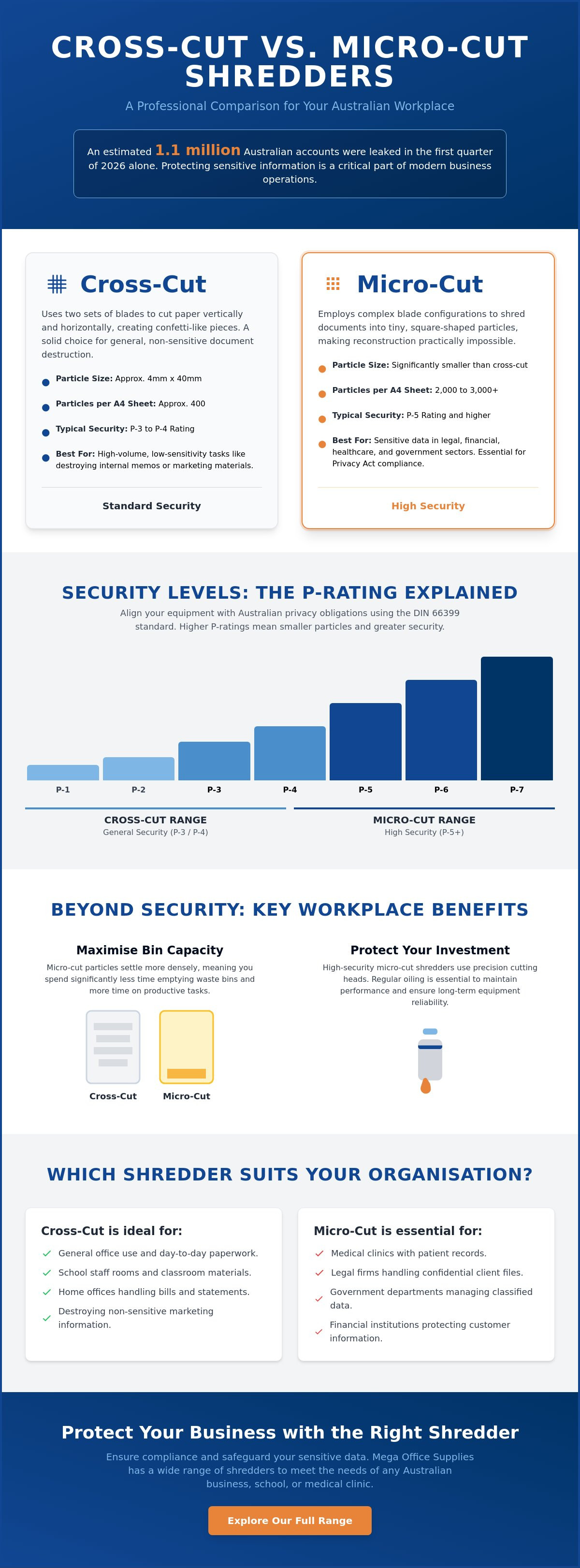
Cross-cut machines operate using two sets of blades that rotate in opposite directions. This dual-action system cuts the paper both vertically and horizontally, resulting in small, confetti-like particles. A typical office cross-cut model produces pieces measuring roughly 4mm x 40mm. While this is a vast improvement over strip-cutting, it's generally best suited for non-sensitive internal documents, general office stationery, and marketing materials that don't contain personally identifiable information (PII). These machines often offer faster throughput, making them a reliable choice for high-volume, low-sensitivity tasks.
The Mechanics of a Micro-Cut Shredder
Micro-cut technology takes precision a step further. These machines use more intricate blade configurations to produce significantly smaller, square-shaped particles. Where a cross-cut machine might turn a page into 400 pieces, a micro-cut version can create upwards of 2,000 or even 3,000 particles per sheet. This makes manual or digital reconstruction practically impossible. Because of this superior security, micro-cut technology is rapidly becoming the mandatory standard for sensitive workplace data in the Australian legal, financial, and healthcare sectors. Key benefits include:
- Enhanced Security: Smaller particles are much harder to reassemble.
- Waste Efficiency: Micro-cut particles settle more densely, meaning you empty the bin less often.
- Regulatory Compliance: Meets higher security standards required for sensitive client data.
Understanding these mechanical differences is the first step in choosing the right cross-cut vs micro-cut shredder for your specific workflow. While cross-cut machines offer speed, micro-cut provides the high-level security necessary for protecting confidential Australian business records.
Security Levels and Compliance: The P-Rating Explained
The security of your document destruction process is measured by the international DIN 66399 standard. This classification system provides a clear framework for procurement officers to evaluate a cross-cut vs micro-cut shredder based on the sensitivity of the data they handle. In Australia, aligning your equipment with these ratings is essential for meeting the "reasonable steps" requirement under the Privacy Act 1988. With publicly reported data breaches in Australia increasing by 48% in 2025, choosing the correct security level is a critical defensive measure for any organisation.
The P-rating system ranges from P-1 to P-7. Lower numbers indicate larger strips, while higher numbers represent smaller, more secure particles. For most professional environments, P-1 and P-2 are considered insufficient for confidential data. The real decision begins at P-3, where the physical destruction of the document becomes multidirectional, significantly increasing the difficulty of unauthorised reconstruction.
P-3 and P-4: The Cross-Cut Standard
Standard cross-cut models typically meet P-3 or P-4 security levels. A P-4 rating requires the machine to reduce a single sheet into particles no larger than 160 square millimetres. This level of destruction ensures that a standard A4 page is divided into approximately 400 pieces, making reconstruction extremely difficult and time-consuming. P-4 security is the industry standard for general office privacy.
Independent evaluations, such as those found in Consumer Reports shredder tests, often highlight P-4 machines as the sweet spot for balancing speed and security. These models are ideal for handling customer records, internal memos, and general business correspondence. If your organisation primarily deals with non-sensitive administrative paperwork, a P-4 cross-cut machine offers a reliable, cost-effective solution for your workplace.
P-5 and Above: The Micro-Cut Advantage
When your data sensitivity increases, micro-cut technology becomes a necessity rather than an option. A P-5 rating requires particles to be no larger than 30 square millimetres. This results in over 2,000 particles per A4 sheet, effectively rendering the information unreadable. For medical clinics handling patient records or legal firms managing litigation documents, P-5 is often the minimum ethical and legal baseline to prevent data breaches.
The highest levels, P-6 and P-7, are reserved for government-grade destruction. For example, the Australian Security Intelligence Organisation (ASIO) specifies that Class A shredders for Secret and Top Secret material must produce particles of 1mm x 20mm or smaller. This level of precision engineering ensures that even the most sophisticated reconstruction attempts will fail. If you need to upgrade your current office technology to meet these rigorous standards, selecting a high-capacity micro-cut model is the most dependable path forward. Ensuring your team has the right tools to dispose of sensitive files is a simple way to protect your professional reputation.
Practical Performance: Speed, Capacity, and Bin Efficiency
While security is the primary driver for most procurement decisions, operational efficiency is where the real-world impact of a cross-cut vs micro-cut shredder becomes evident. In a busy Australian office environment, the time spent managing waste can quickly add up. Cross-cut models typically offer higher sheet capacities, often processing 20 or more pages in a single pass. This makes them ideal for clearing large backlogs of non-sensitive files quickly. However, this raw speed is often offset by the frequency of bin maintenance required.
The concept of "bin density" is frequently overlooked during the purchasing process. Micro-cut particles are so small that they settle into the waste bin with almost no air gaps between them. In contrast, cross-cut particles tend to be "fluffy" and stack unevenly, creating false "bin full" signals. Industry observations indicate that a micro-cut bin can hold significantly more shredded paper compared to a cross-cut bin of the same volume. This means your team spends less time clearing jams and emptying bags, which directly improves daily productivity.
Bin Volume and Emptying Frequency
High-volume administration centres benefit most from this density factor. A 30-litre micro-cut bin effectively outperforms a much larger cross-cut unit simply because the particles pack together more efficiently. This reduces the "mess factor" during disposal. Highly compressed particles are less likely to spill or create dust clouds in staff kitchens or reception areas compared to larger strips. It's a practical way to maintain a clean workspace while minimising workflow interruptions for your administrative staff.
Throughput and Motor Endurance
There is a physical trade-off between security level and motor strain. Micro-cut blades must work harder to achieve their precision, which often results in lower sheet capacities per pass, typically 10 to 12 sheets for standard professional models. To compensate, high-quality machines feature robust, professional-grade motors with longer duty cycles. These motors can run for extended periods without overheating, which is essential when destroying sensitive archives. Choosing a machine with a high continuous run-time ensures that your document destruction remains consistent, even during peak periods of activity. This longevity is a hallmark of the industrial-quality equipment available through Mega Office Supplies, providing a dependable solution for long-term workplace maintenance.
Selecting the Right Shredder for Your Industry
Choosing between a cross-cut vs micro-cut shredder requires a clear assessment of your specific sector's risk profile. It's not just about the machine; it's about the sensitivity of the data you handle and the volume of waste your team produces daily. You must balance your budget against long-term security obligations, especially with the rising costs of data breaches in Australia. In many modern workplaces, noise levels are also a deciding factor. Higher-security micro-cut machines often feature more robust, insulated cabinets that help minimise disruption in open-plan office layouts.
Scenario A: Small Business and Home Office
For many entrepreneurs and remote workers, a cross-cut P-4 shredder is perfectly sufficient for daily operations. These units effectively handle everyday items like utility bills, internal memos, and general stationery. If your primary goal is to prevent opportunistic identity theft rather than meeting strict corporate compliance, the higher sheet capacity of a cross-cut model allows for faster clearing of your desk. Space-saving, compact designs are common in this category, making them a practical addition to smaller workspaces where floor area is at a premium.
Scenario B: Medical, Legal, and Financial Sectors
In environments where you handle patient records, litigation files, or sensitive financial data, micro-cut P-5 technology is a non-negotiable requirement. The Australian Privacy Act 1988 places a heavy burden on these sectors to ensure personal information is destroyed beyond any hope of recovery. Using anything less than a micro-cut machine creates an unnecessary vulnerability for your organisation. The peace of mind provided by unreadable document destruction is worth the investment, ensuring that your professional reputation remains protected even if waste is intercepted during transit.
Scenario C: Education and Government Departments
Managing bulk student records or sensitive educational supplies requires a high-capacity approach to destruction. Schools and government offices often generate massive volumes of paperwork that must be destroyed according to strict security protocols. Centralising destruction with a heavy-duty micro-cut machine in a shared staff room or administration centre ensures consistency across the organisation. These departments should prioritise machines with large bins and continuous-run motors to handle the high throughput required during peak periods, such as the end of a school term or the financial year.
Ready to upgrade your document security? You can browse our full range of professional paper shredders to find the perfect fit for your workplace requirements.
Maintenance and Longevity: Protecting Your Investment
Owning a professional machine involves more than just plugging it in. When comparing a cross-cut vs micro-cut shredder, maintenance requirements differ based on the complexity of the cutting head. Micro-cut machines feature hundreds of tiny, precision-ground teeth designed to create minute particles. This intricate design generates significant heat and friction during operation. Without regular care, these blades can dull prematurely, leading to increased motor strain and eventual failure.
You'll know your blades are dulling when the machine sounds strained or begins "chewing" the paper rather than producing clean, crisp cuts. If you notice a drop in sheet capacity or an increase in paper dust around the cabinet, it's time for a service. Professional-grade machines are built for durability, but they aren't indestructible. Proper lubrication is the single most effective way to protect your investment and ensure your office remains compliant with Australian privacy standards.
Oiling Protocols for Peak Performance
Oiling your shredder is a straightforward process that should be performed every time you empty the waste bin. You can choose between manual liquid application or pre-impregnated oiling sheets. To oil manually, apply a thin line of shredder lubricant across a sheet of paper in a zig-zag pattern and run it through the machine. Then, run the shredder in reverse for ten seconds to distribute the oil evenly across the cutting cylinders. Regular lubrication is essential for high-security hardware, as it can extend the operational life of a micro-cut motor by up to 50%.
Clearing jams also requires a specific approach depending on the cut type. While cross-cut machines can often be cleared by toggling between forward and reverse, micro-cut heads are more susceptible to damage from forced over-feeding. If a jam occurs, avoid using scissors or metal tools to pull paper out, as this can nick the precision teeth. Instead, use the manual override or reverse function to gently back the paper out of the cutting assembly.
Choosing a Reliable Australian Supplier
Accessing direct support and expert advice is invaluable when managing high-volume procurement for large organisations. Buying from an established Australian retailer ensures you receive hardware suited to local conditions and power standards. At Mega Office Supplies, we draw on decades of combined industry experience to help you select and maintain the right equipment for your specific sector. We understand the logistical needs of Australian workplaces and provide the technical specifications required to make an informed choice.
Selecting a machine is about finding the right balance of security, efficiency, and durability. For a deeper dive into specific models and their performance ratings, refer to our comprehensive guide on the Best Paper Shredder for Small Business Australia. Taking the time to understand these maintenance requirements ensures your document destruction remains secure and your equipment stays in service for years to come.
Securing Your Workplace with the Right Destruction Strategy
Selecting between a cross-cut vs micro-cut shredder is a decision that impacts both your regulatory compliance and daily office efficiency. While cross-cut models offer high-volume throughput for general administrative tasks, micro-cut technology provides the unreadable destruction required for sensitive medical, legal, and financial records. Beyond security, remember that micro-cut particles pack more densely. This reduces the time your staff spends emptying bins and managing waste, allowing for a more focused workflow across your organisation.
Mega Office Supplies is your dependable partner for professional workplace hardware. We offer expert local support via our regional telephone line and provide national delivery across Australia for all business and school supplies. Whether you're managing a small home office or a large government department, our team is ready to assist you in maintaining a secure and productive environment. We understand the practicalities of office maintenance and the importance of hardware longevity.
Browse our full range of professional cross-cut and micro-cut shredders to find the ideal solution for your document destruction needs. Protecting your professional reputation starts with the right equipment.
Frequently Asked Questions
Can a cross-cut shredder shred credit cards and staples?
Most modern professional cross-cut shredders are engineered to handle standard staples and credit cards without damaging the cutting assembly. High-grade steel cutters can process small metal fastenings, though it's always advisable to check the manufacturer's manual for your specific model. For credit cards, ensure the machine has a dedicated slot or is rated for plastic destruction to prevent the blades from dulling prematurely over time.
Is a micro-cut shredder much slower than a cross-cut model?
Micro-cut shredders typically have a lower sheet capacity per pass, but the total processing speed is comparable for most office tasks. While a cross-cut unit might process 20 sheets at once, a micro-cut unit might only handle 12. However, the superior bin density of micro-cut particles means you spend significantly less time emptying the machine, which often makes it the more efficient choice for high-volume administration centres.
How often do I need to oil my micro-cut shredder?
You should oil your micro-cut shredder every time you empty the waste bin to ensure the intricate cutting head remains lubricated. Because the blades in a micro-cut assembly are more complex and generate more friction than a standard cross-cut vs micro-cut shredder comparison would suggest, regular lubrication is vital. This simple maintenance task prevents paper dust from building up and protects the motor from overheating during heavy use.
Does the Australian Privacy Act require a specific shredder type?
The Australian Privacy Act 1988 does not mandate a specific brand or model, but it does require organisations to take "reasonable steps" to destroy personal information securely. In professional sectors like healthcare or finance, using a micro-cut shredder is generally considered the industry standard for meeting these obligations. Failure to provide adequate destruction can lead to significant penalties under the Notifiable Data Breaches scheme if information is intercepted.
Why does my shredder keep stopping before the bin is full?
Shredders often stop prematurely because of "bridging" or "fluffing," where paper particles stack unevenly and trigger the bin-full infrared sensor. This is a common issue with cross-cut models where the larger particles don't settle efficiently. To resolve this, you can gently shake the bin to level the waste. If you find this happens frequently, upgrading to a micro-cut model will improve bin density and reduce these false stop signals.
What is the main difference between P-4 and P-5 security levels?
The main difference lies in the particle size and the number of pieces an A4 sheet is divided into. A P-4 cross-cut machine produces approximately 400 particles, while a P-5 micro-cut machine produces over 2,000 pieces. This makes P-5 significantly more secure for highly sensitive data. In the debate of cross-cut vs micro-cut shredder suitability, P-4 is the baseline for general office privacy, whereas P-5 is required for confidential patient or legal records.
Are micro-cut shredders louder than standard office models?
Professional micro-cut shredders are often quieter than entry-level cross-cut models because they are housed in higher-quality, insulated cabinets. While the cutting mechanism itself involves more intricate blade contact, the robust engineering of high-security machines is designed to minimise noise in open-plan Australian offices. Check the decibel (dB) rating on the product specifications to ensure the machine meets your workplace requirements for a quiet environment.
Can I recycle the paper waste from a micro-cut shredder?
Yes, you can recycle the paper waste from a micro-cut shredder, though it's best to check with your local Australian waste management provider first. Some recycling facilities find very small particles difficult to process because the paper fibres are shorter, which can reduce the quality of the recycled pulp. To assist the process, ensure the shredded paper is contained in a paper bag or cardboard box before placing it in the recycling bin.
Article by
Mega Office Supplies Team
The Mega Office Supplies Team provides practical guidance for Australian businesses, schools, government organisations, healthcare providers, hospitality venues, warehouses and home offices. Based in Tweed Heads South, Mega Office Supplies has been family owned and operated since 2008, offering office stationery, workplace furniture, technology products, labels, printers, cleaning and janitorial supplies, safety products, art materials, education resources and everyday business essentials from trusted brands.
General Information
This article is provided as general information only to help customers compare and choose office, workplace, school, cleaning, technology, furniture, safety and business supplies. Product details, specifications, compatibility, availability, pricing and suitability may vary. Always check the individual product page, manufacturer information, workplace requirements and relevant safety guidance before purchasing or using a product.


