


Did you know that identity theft cost Australians over $2 billion in 2023, with many cases originating from improperly discarded paper documents? It’s a sobering figure that highlights why secure document destruction is no longer optional for local businesses or home offices. You likely understand the importance of data protection, yet finding yourself asking what paper shredder security level do I need often leads to a confusing maze of technical jargon like DIN 66399.
Choosing a machine that is too flimsy or slow is a common frustration for administrators who value workplace efficiency. We agree that you shouldn't have to compromise on speed to meet the "reasonable steps" requirement of the Australian Privacy Act. This professional guide simplifies the selection process by explaining how different security levels impact your data recoverability risk. You’ll gain the confidence to select a shredder that perfectly balances high-volume output with the precise particle size required for your specific industry.
Key Takeaways
- Master the international DIN 66399 standard to identify the specific shred size required for your sensitive business records and personal data.
- Align your document disposal processes with the Australian Privacy Act 1988 and the Notifiable Data Breaches (NDB) scheme to protect your organisation from legal risk.
- Utilise our 4-step risk assessment framework to determine exactly what paper shredder security level do I need for your unique workplace environment.
- Discover how micro-cut technology provides superior data protection while significantly increasing the volume of waste your shredder bin can hold.
- Implement essential maintenance routines, such as regular oiling, to ensure your machine maintains its security rating and industrial-grade performance.
Understanding DIN 66399: Decoding the P-1 to P-7 Security Levels
The DIN 66399 standard serves as the primary international benchmark for the destruction of data media. This standard defines the physical requirements for the size of particles remaining after shredding. The "P" classification specifically denotes paper-based data media; other prefixes exist for digital media like hard drives or optical discs. For many procurement officers and administrators, understanding these classifications is the first step in answering the question: what paper shredder security level do I need? The DIN 66399 security levels provide a clear framework for assessing risk and choosing hardware that matches your specific data protection requirements.
This standard organises security into three distinct protection classes. Class 1 covers general data where protection is required for internal documents. Class 2 is designed for sensitive data requiring higher protection, such as financial records or personnel files. Class 3 is reserved for top-secret or strictly confidential information. Selecting the correct class ensures your organisation complies with the "reasonable steps" required by Australian privacy laws while maintaining operational efficiency.
To better understand this concept, watch this helpful video:
The Low-Security Levels: P-1 to P-2
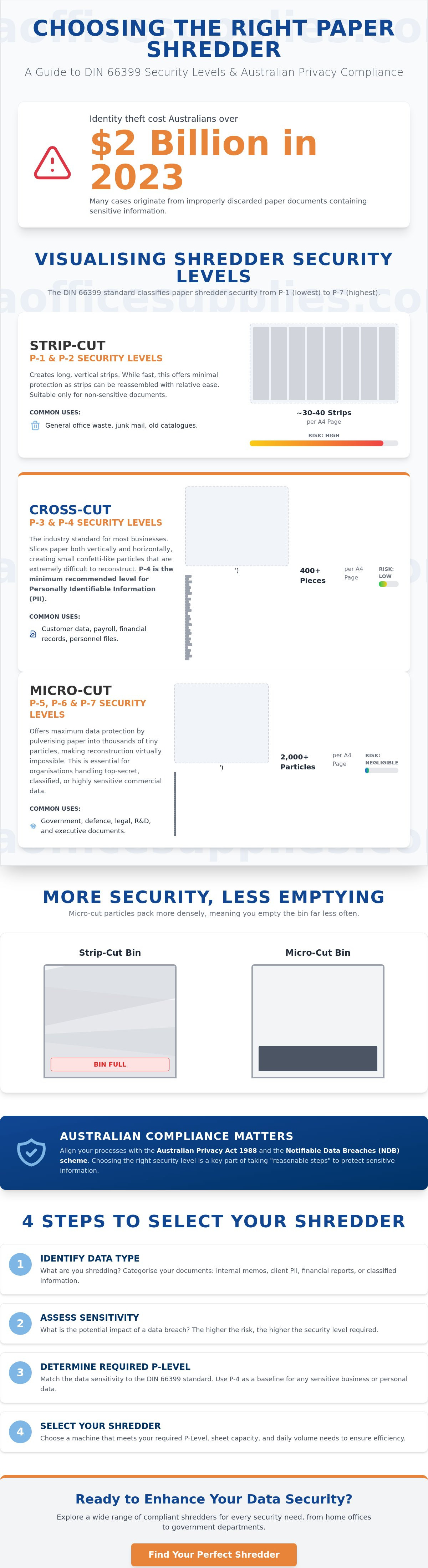
P-1 and P-2 levels are typically associated with strip-cut machines. These units slice a single A4 sheet into long, vertical strips. A P-1 shredder creates roughly 30 to 40 strips per page. While this is sufficient for non-sensitive internal memos, old catalogues, or general warehouse waste, it offers minimal protection. These strips can be reassembled with relatively little effort. These levels are often found in retail staff kitchens or environments where the primary goal is waste volume reduction rather than data security. If you handle any identifiable information, these levels are likely insufficient for your needs.
The Mid-Range Standard: P-3 to P-4
Level P-4 has become the definitive benchmark for the modern Australian office. While P-3 offers a basic cross-cut particle, P-4 provides a significant leap in security by reducing an A4 page into approximately 400 pieces or more. This level is the minimum recommendation for handling Personally Identifiable Information (PII) like customer addresses, employee payroll details, or tax records. The cross-cut mechanism ensures that even if a waste bin is intercepted, reconstructing the data becomes an impractical task for unauthorised parties. When you ask what paper shredder security level do I need for a standard professional environment, P-4 is almost always the starting point for reliable compliance.
Strip-Cut vs. Cross-Cut vs. Micro-Cut: Visualising the Risk
When assessing what paper shredder security level do I need, it helps to visualise the physical output of the machine. Imagine an A4 page transformed into roughly 35 long spaghetti-like strips. That is the result of a strip-cut machine. Now, imagine that same page turned into 400 pieces of confetti; this is the cross-cut standard. Finally, consider a micro-cut machine that reduces the page to over 2,000 tiny particles resembling grains of rice. This visual hierarchy directly correlates to the time and effort it would take an unauthorised person to reconstruct your data.
The size of these particles also dictates your daily operational efficiency. Larger strips "fluff" up inside the waste bin, creating air pockets that trigger "bin full" sensors prematurely. Conversely, micro-cut particles settle flat and pack tightly. This high-density waste allows you to shred significantly more paper before needing to empty the bin. While higher security machines often have a lower sheet capacity per pass, the reduced frequency of bin maintenance often results in a faster total workflow for high-volume environments.
Strip-Cut (P-1, P-2): Fast but Vulnerable
Strip-cut machines are designed for speed and high-volume throughput. They can often handle 20 or more sheets in a single pass because the motor only needs to drive a single set of vertical blades. However, this speed comes at a significant security cost. Because the strips remain intact along their length, basic reconstruction software can piece them together with minimal effort. These machines are becoming obsolete in professional Australian offices as they fail to meet the "reasonable steps" threshold for protecting sensitive information. For general waste like non-confidential packaging or internal memos, you can view basic paper shredders in our technology section, but we advise caution if handling any client data.
Cross-Cut and Micro-Cut (P-4 to P-7): The Security Leaders
Cross-cut and micro-cut shredders utilise a dual-blade action that cuts paper both lengthways and widthways. A P-4 cross-cut machine is the standard for most businesses, but medical and legal professionals often opt for P-5 micro-cut units. These machines offer a higher level of sanitisation that aligns with international standards, such as the U.S. government media sanitization guidelines, which emphasise the importance of specific particle sizes for sensitive data. For top-secret government or defence requirements, P-6 and P-7 "Super Micro-cut" machines reduce paper to a fine dust, making reconstruction virtually impossible even with forensic technology. If your office handles high-stakes documentation, upgrading to a micro-cut model provides the ultimate peace of mind for your compliance obligations.
Assessing Your Risk Profile: A 4-Step Selection Framework
Selecting the right hardware requires more than just picking a number off a chart. You must evaluate your specific data lifecycle to accurately determine what paper shredder security level do I need for your workplace. This four-step framework helps procurement officers and business owners move beyond guesswork and toward a defensible security strategy.
- Step 1: Identify the "Value" of Your Waste. Not all paper is created equal. General internal communications, such as staff lunch menus or non-sensitive marketing drafts, carry low risk. Conversely, documents containing tax file numbers, bank details, or proprietary trade secrets require high-level destruction to prevent identity theft or corporate espionage.
- Step 2: Determine Your Volume Requirements. A personal desk shredder used for three sheets a day has vastly different motor requirements than a centralised mailroom unit. High-volume environments require machines with longer "continuous run times" to avoid the motor overheating during large batch jobs.
- Step 3: Evaluate Your Physical Environment. In an open-plan office, noise levels are a critical consideration. You'll need a machine with a decibel rating that won't disrupt the team. If you operate a secure records room, you might prioritise raw speed and bin capacity over whisper-quiet operation.
- Step 4: Check for Industry Regulations. Specific sectors have higher benchmarks. Financial institutions often follow APRA guidelines, while healthcare providers must manage sensitive patient data under the My Health Record system. These regulations often dictate a minimum of P-4 or P-5 security.
Scenario A: The Home Office or Small Business
For most home-based professionals, a P-4 cross-cut machine is the ideal choice. It provides ample security for bank statements, utility bills, and personalised client correspondence. Because space is often at a premium in a home study, look for a compact footprint that fits neatly under a desk. If you're looking for specific model recommendations, our guide on the Best Paper Shredder for Small Business Australia covers the top-rated units for smaller workgroups.
Scenario B: Corporate, Legal, and Healthcare Hubs
In environments where client confidentiality is a legal mandate, P-5 micro-cut technology is the safest bet. These machines produce particles so small that reconstruction is virtually impossible. Reception areas and medical clinics benefit from auto-feed models that allow staff to stack 100+ sheets and walk away. While waiting for destruction, sensitive documents should be stored securely in lockable filing cabinets to maintain a clear chain of custody. This ensures your organisation meets the "reasonable steps" required by the Australian Privacy Act while maintaining a high-speed workflow.
Australian Compliance: Privacy Laws and Industry Standards
The Privacy Act 1988 and the Australian Privacy Principles (APPs) provide the legal backbone for data handling in Australia. APP 11.2 requires organisations to take "reasonable steps" to destroy or de-identify personal information that is no longer needed. While the Office of the Australian Information Commissioner (OAIC) does not mandate a specific DIN level, your choice of hardware is a primary factor during a compliance audit. When you evaluate what paper shredder security level do I need, you're looking for a solution that satisfies this "reasonable steps" threshold. A P-4 cross-cut or P-5 micro-cut machine serves as a robust defensive shield; it demonstrates that your organisation has prioritised data sanitisation over basic waste disposal. Major reforms to the Privacy Act rolling out through 2025 and 2026 bring a broader definition of personal information and significantly higher penalties for breaches, making the choice of shredder more critical than ever.
The Notifiable Data Breaches (NDB) Scheme
The Notifiable Data Breaches (NDB) scheme requires businesses to notify the OAIC and affected individuals if a data breach is likely to result in serious harm. Physical document loss remains a major risk. A 2023 OAIC report indicated that 61% of reported breaches were malicious, with many involving paper documents. If a bin of strip-cut paper is stolen, it constitutes a data breach because the information is still recoverable. If that same paper was reduced to P-5 micro-cut particles, the data is destroyed and the risk is mitigated. When deciding what paper shredder security level do I need to avoid an NDB notification, micro-cut is the safest path. The NDB scheme is a critical driver for P-4+ shredder adoption across the Australian commercial sector.
SCEC Endorsement for Government and Defence
Government agencies and defence contractors must adhere to even tighter controls. Hardware used in these sectors often requires endorsement by the Security Construction and Equipment Committee (SCEC). These standards categorise destruction into Class A for top-secret data and Class B for secret information. Class A destruction typically requires a P-7 security level, while Class B often aligns with P-5 or P-6. Aligning your procurement with these standards is vital for maintaining federal contracts and national security. You can browse our full range of SCEC-aligned hardware and other office supplies to ensure your department meets these rigorous benchmarks.
Avoid the reputational damage of a data breach by investing in the correct hardware for your risk profile. Secure your office with a high-security paper shredder today.
Maximising Shredder Performance and Data Security
Selecting the correct hardware is only half the battle in maintaining a compliant workplace. Once you have determined what paper shredder security level do I need, you must implement a maintenance routine that preserves the integrity of the cutting mechanism. A high-security machine that is poorly maintained will eventually fail to meet its DIN 66399 specifications. When blades become dull or dry, they begin to tear the paper rather than slicing it cleanly. This creates ragged edges and inconsistent particle sizes, which can inadvertently lower the effective security level of your output.
Maintenance Essentials: Oiling and Cleaning
Precision-engineered cutting cylinders require regular lubrication to function at peak efficiency. We recommend oiling your shredder every time the waste bin is emptied or after approximately 30 minutes of continuous shredding. Dry blades increase friction, which generates heat and places unnecessary strain on the motor. This leads to frequent jams and can cause the machine to "partial shred," where the document passes through without being fully destroyed. For a mess-free alternative to traditional bottled oil, specialised lubricant sheets can be fed directly into the entry throat. These sheets ensure an even distribution of lubricant across the entire blade assembly, extending the lifespan of your technology investment and ensuring every document is reduced to the correct particle size.
Managing your "bin full" sensors is equally critical for data security. If a bin is allowed to overfill, shredded waste can be forced back up into the cutting head. This often results in "re-shredding" that creates excessive dust, or worse, it can lead to paper jams that require manual intervention. Forcing a machine to operate with a packed bin increases the risk of mechanical failure and can lead to partial documents remaining visible in the entry throat.
Establishing a Secure Workflow
A secure office requires more than just high-grade hardware; it requires an established culture of data protection. Position your shredders in high-traffic zones where sensitive documents are most likely to be generated, such as near the centralised printer or within the mailroom. If the machine is difficult to access, staff are more likely to dispose of sensitive records in standard waste bins. We suggest implementing a "Shred-All" policy to remove the burden of choice from your employees. When staff don't have to decide what is or isn't sensitive, the risk of human error is significantly reduced.
Training your team on the capabilities of your specific model is also essential. While many professional-grade machines can handle staples and paperclips, micro-cut models are more sensitive to foreign objects. "A P-5 shredder is only as secure as the office culture that ensures every sensitive document actually reaches the blades." Finally, consider your disposal path. Shredded paper has short fibres and is often not accepted in standard kerbside recycling bins. For high-volume environments, consider a secure collection service that ensures your baled, shredded waste is processed in a way that maintains the chain of custody until it is pulped.
Securing Your Workplace Data for the Future
Selecting the right hardware is a critical step in fulfilling your "reasonable steps" obligations under the Australian Privacy Act. By aligning your equipment with the DIN 66399 standard, you effectively mitigate the risk of data recoverability and potential NDB scheme notifications. Whether you require a P-4 cross-cut unit for general business or a P-5 micro-cut machine for sensitive medical records, your choice dictates the long-term security of your workplace.
Answering the question what paper shredder security level do I need is simpler when you partner with a reliable industry veteran. Mega Office Supplies is a family-owned Australian business that has been operating since 2005. Our expert team draws on decades of combined industry experience to help you navigate technical specifications and compliance requirements. With national delivery available for all office and educational supplies, we ensure your workplace stays equipped and secure.
View our complete range of professional paper shredders here and take the first step towards a more secure office environment today. We look forward to helping you build a safer, more efficient workplace.
Frequently Asked Questions
Is a P-3 shredder secure enough for a home office in Australia?
A P-3 shredder provides a basic level of cross-cut security, but it's often insufficient for modern Australian home offices handling sensitive tax records or bank statements. While it's superior to strip-cut models, the resulting particles are large enough that reconstruction is still a minor risk. For better peace of mind and to align with current data protection trends, we recommend a P-4 model as the entry-level standard for any home-based professional.
What is the difference between Cross-cut and Micro-cut security?
The primary difference lies in the final particle size and the number of pieces an A4 sheet is divided into. Cross-cut shredders, typically rated P-3 or P-4, turn a page into roughly 400 confetti-like pieces. Micro-cut shredders, rated P-5 and above, utilise more precise cylinders to reduce that same page into over 2,000 tiny particles. This higher density makes reconstruction virtually impossible and allows the waste bin to hold significantly more paper before it requires emptying.
Does the Australian Privacy Act specify a particular P-level for businesses?
The Privacy Act 1988 does not mandate a specific numerical rating when you ask what paper shredder security level do I need for legal compliance. Instead, the legislation requires organisations to take "reasonable steps" to destroy personal information. In a professional Australian context, most legal and compliance experts view P-4 as the minimum reasonable step for general business data, while P-5 or higher is expected for sensitive health or financial records.
Can I shred credit cards and CDs in a high-security paper shredder?
You must check your specific model's technical specifications before attempting to shred non-paper media. While many P-4 machines include a dedicated slot for credit cards, some high-security P-5 and P-6 micro-cut machines have delicate blades that can be damaged by hard plastics. If you frequently destroy digital media, look for a machine with a separate O (optical) or T (magnetic) rating under the DIN 66399 standard to ensure long-term durability.
What happens if I don’t oil my shredder regularly?
Failing to oil your shredder leads to increased friction, which causes the motor to overheat and the cutting cylinders to dull prematurely. When blades lose their edge, they begin to tear and pull the paper rather than slicing it cleanly. This compromised cutting action can result in larger, irregular fragments that may no longer meet the security rating promised by the manufacturer. Regular lubrication is essential to maintain both the speed and the security level of your hardware.
What does SCEC-approved mean for Australian government shredders?
SCEC-approved hardware has been evaluated and endorsed by the Security Construction and Equipment Committee for use in Australian federal government departments. These machines meet rigorous standards for the destruction of classified information. If your organisation handles government contracts or high-level national security data, you'll likely require a SCEC-approved machine, which typically aligns with the highest DIN security levels like P-6 or P-7.
How do I know if my shredder is P-4 or P-5 level?
You can identify the security level by checking the manufacturer's data sheet or the product sticker usually located on the back or underside of the machine. If the documentation is missing, you can estimate the level by measuring the particle size. A P-4 particle must be less than 160mm², while a P-5 particle must be less than 30mm². Most modern professional machines clearly display their P-rating on the control panel or the retail packaging.
Is it better to shred in-house or use a professional destruction service?
In-house shredding is generally superior for maintaining a secure chain of custody and providing immediate destruction of sensitive documents. It eliminates the risk of documents sitting in an unsecured bin while waiting for a collection service. While professional services are useful for massive bulk purges, an on-site P-4 or P-5 shredder ensures that your data is destroyed the moment it is no longer needed, which is a core requirement of the Notifiable Data Breaches scheme.
Article by
Mega Office Supplies Team
The Mega Office Supplies Team provides practical guidance for Australian businesses, schools, government organisations, healthcare providers, hospitality venues, warehouses and home offices. Based in Tweed Heads South, Mega Office Supplies is a family-owned and operated Australian business offering office stationery, workplace furniture, technology products, labels, printers, cleaning and janitorial supplies, safety products, art materials, education resources and everyday business essentials from trusted brands.
General Information
This article is provided as general information only to help customers compare and choose office, workplace, school, cleaning, technology, furniture, safety and business supplies. Product details, specifications, compatibility, availability, pricing and suitability may vary. Always check the individual product page, manufacturer information, workplace requirements and relevant safety guidance before purchasing or using a product.


