

What if a single equipment failure could compromise an entire week's worth of training materials or warehouse safety signage? It's a frustration many Australian procurement officers and school administrators know well; a machine that jams exactly when the workload peaks or produces cloudy, bubbled finishes that look anything but professional. For any organisation, the cost of failed lamination isn't just the price of the pouch; it's the wasted time and the loss of document integrity. With 70% of businesses now ranking speed and output quality as their primary decision-making factors, the pressure to find reliable laminating machines has never been higher.
This guide will help you master the technical specifications and selection criteria needed to choose the perfect hardware for your specific environment. We'll provide the technical clarity required to evaluate micron thicknesses, roller configurations, and the latest automated features that reduce manual effort. You'll learn how to identify durable, professional-grade equipment that meets the essential AS/NZS 3760:2022 safety standards for Australian workplaces. Whether you're managing a high-volume distribution centre or a busy primary school, this overview ensures you invest in a solution that delivers crisp protection and long-term reliability.
Key Takeaways
- Identify the correct thermal or cold technology required to preserve critical OH&S signage and instructional documents in industrial and education settings.
- Evaluate your document volume to choose between the straightforward operation of pouch systems or the high-speed output of continuous roll laminating machines.
- Select hardware with user-friendly interfaces and rapid warm-up cycles to minimise downtime in shared environments like staffrooms and reception areas.
- Master the micron system to ensure you select the appropriate film thickness for every task, ranging from flexible office memos to heavy-duty warehouse notices.
- Maximise the lifespan of your equipment by prioritising essential safety and maintenance features such as reverse functions and automatic shut-off.
Understanding Laminating Machines: Protection for Professional Documents
Professional document protection is a fundamental requirement for any structured Australian workplace. While basic units might suffice for occasional home use, commercial-grade laminating machines are engineered to handle the rigorous duty cycles of schools, medical centres, and industrial sites. These devices facilitate the process of lamination by bonding a protective plastic film to paper or cardstock, creating a barrier against moisture, grease, and physical wear. This is particularly vital for preserving critical infrastructure such as OH&S signage, instructional posters, and staff ID cards.
To better understand the selection available for your workplace, watch this helpful video:
Standard Australian document formats require versatile hardware. Professional laminating machines typically accommodate everything from small 54 x 86mm ID pouches up to A3 or even A2 posters. Unlike retail-level units that often struggle with consistent heat distribution, office technology supplies designed for high-volume use feature multiple rollers to ensure a smooth, bubble-free finish every time. This precision prevents the common issues of peeling edges and cloudy transparency that often plague cheaper alternatives.
Thermal Lamination vs. Cold Lamination
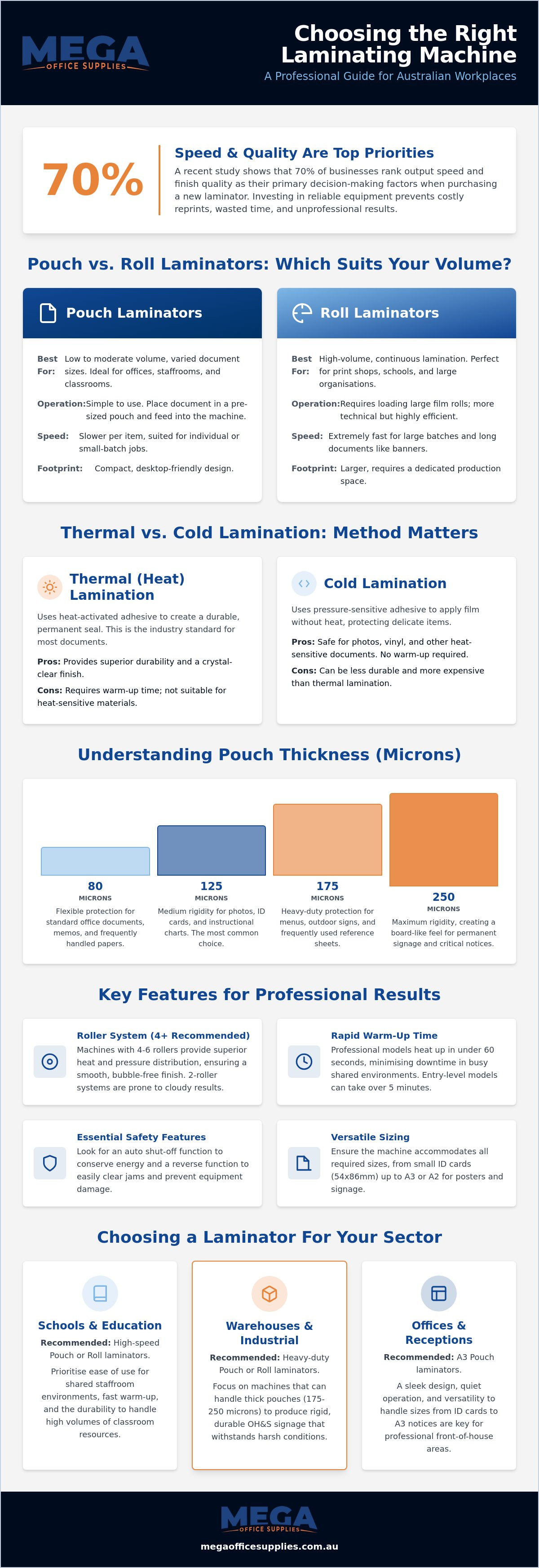
Thermal lamination uses heat-activated adhesives to create a permanent, airtight seal. This method is the industry standard for most office documents because it provides superior durability and a crystal-clear finish. However, the warm-up time is a critical factor for staff efficiency. High-end machines can reach operating temperature in under sixty seconds, whereas entry-level models may require five minutes or more. For heat-sensitive materials like certain photographs or vinyl signage, cold lamination is the preferred alternative. This method relies on pressure-sensitive adhesives and rollers to secure the film without risking damage to the original document.
The Business Case for High-Quality Lamination
Investing in professional hardware reduces long-term operational costs by protecting reusable assets and educational resources from premature degradation. In high-traffic environments like warehouses or outdoor loading docks, workplace safety signs must remain perfectly legible despite exposure to harsh conditions. A failure to maintain clear signage can lead to compliance issues or workplace accidents. Professional lamination delivers a measurable return on investment by extending the lifecycle of essential documents and significantly reducing the frequency of costly reprints.
Pouch vs. Roll Laminators: Which Technology Suits Your Volume?
Selecting the right hardware requires a clear understanding of your expected output volume and document variety. Pouch systems and roll systems serve distinct operational roles within the workplace. While pouch machines offer a compact footprint suitable for shared desks or staffrooms, roll laminators are high-capacity units designed for dedicated production areas. The decision to transition from one to the other is typically driven by the need for throughput speed and a significant reduction in long-term consumable costs.
The internal mechanics of these laminating machines define the quality of the finished product. Roller count is the most critical technical specification to evaluate. Entry-level 2-roller systems often struggle with heat consistency, which can lead to cloudy patches or peeling edges. In contrast, 4-roller and 6-roller professional models use the additional rollers to pre-heat the film and then flatten it under high pressure. This ensures an airtight, crystal-clear finish every time. Regardless of the technology you choose, following established safety protocols for maximising your machine's lifespan is essential to prevent mechanical failure and maintain workplace safety standards.
If you're currently evaluating your workplace requirements, you can view our professional range to compare specific model outputs and technical specs.
Pouch Laminators: The Office All-Rounder
Pouch laminators are the standard choice for most Australian offices, medical clinics, and reception areas. They handle standard A4 and A3 formats with virtually zero setup time. These machines are ideal for creating professional menus, staff certificates, and small-batch instructional notices. Higher roller counts in these models are particularly beneficial when using thicker 250-micron pouches, as they provide the consistent heat required to bond heavier films without bubbling or warping.
Roll Laminators: High-Speed Commercial Production
When document volume exceeds a few dozen pages per day, roll laminators become the more economical choice. These machines use continuous film rolls, which significantly lowers the cost-per-page compared to individual pouches. They are indispensable for schools managing bulk book covering or warehouses producing wide-format A1 safety posters. Integrating these units with other office technology supplies ensures a streamlined document finishing process that saves your team hours of manual labour each week.
Choosing a Laminator for Your Sector: From Classrooms to Warehouses
The operational environment directly dictates the necessary specifications of laminating machines. A device suited for a quiet home office will likely fail under the environmental stressors of a busy warehouse or the high-volume demands of a government department. Procurement officers must evaluate hardware based on the specific physical conditions of the site, including ambient dust levels, temperature fluctuations, and the frequency of use. For shared environments, such as a school staffroom or a corporate mailroom, intuitive interfaces are paramount. Complex settings often lead to user error, resulting in jammed rollers and wasted film. A professional-grade machine with one-touch controls ensures that every staff member can produce consistent results without specialised training.
Safety remains a non-negotiable factor in high-traffic Australian sectors. When selecting equipment for educational or government settings, look for features like heat-shield technology and automatic shut-off timers. These prevent the exterior housing from becoming a burn hazard and minimise the risk of electrical incidents if a machine is left on overnight. Matching the throughput speed to your procurement cycle is also vital. If your organisation requires hundreds of documents processed during peak periods, a machine with a high laminating speed (measured in millimetres per minute) is a critical investment to maintain workflow momentum.
Education and School Environments
Durability is the primary requirement for educational supplies and classroom aids. School resource centres often operate their equipment for hours at a time, making anti-jam technology a necessity rather than a luxury. Teachers rely on lamination to extend the life of student flashcards, posters, and exercise book covers. Protecting these assets ensures they can be reused across multiple terms, which effectively stretches the annual department budget. A robust machine capable of handling continuous runs prevents the frustration of mid-project mechanical failures during the busy start-of-year period.
Healthcare and Hospitality Requirements
In healthcare and hospitality, lamination serves as a critical tool for hygiene management. Creating wipeable, non-porous surfaces for medical charts and restaurant menus allows for frequent sanitisation with hospital-grade disinfectants. This is a key part of maintaining facility supplies and cleaning checklists in infection-controlled zones. High-touch items in public-facing centres require heavy-gauge film, often 150 to 250 microns, to prevent the edges from fraying or delaminating under constant use. Professional hardware provides the intense pressure needed to bond these thicker films securely, ensuring the internal document remains protected from moisture and bacterial ingress.
Key Features and Maintenance: Maximising Your Machine's Lifespan
Adhesive build-up is the primary cause of mechanical failure in professional laminating machines. Every time a pouch passes through the rollers, minute amounts of glue can escape from the edges, eventually hardening into a crust that causes jams or surface irregularities. To prevent this, your procurement team should prioritise machines with variable temperature control and reverse functions. Variable heat settings allow you to match the temperature precisely to the film thickness, which prevents the "over-cooking" that leads to excessive glue leakage. Meanwhile, a dedicated reverse function is your first line of defence against a misaligned document, allowing you to retract the pouch before it wraps around the internal rollers.
Troubleshooting common output issues often comes down to temperature calibration. If your finished document appears cloudy, the machine is likely too cold or the speed is too high for the film thickness. Conversely, bubbles and ripples usually indicate excessive heat, which causes the adhesive to boil. If you notice corner peeling, it's often due to a poor seal caused by trimming the pouch too close to the paper edge. Always leave a 3mm to 5mm border to ensure the plastic layers bond together securely. For those looking to upgrade their current hardware, you can browse our range of professional laminating machines to find models with advanced jam-sensing technology.
Understanding Film Thickness and Finish
The "Micron" system measures the thickness of the laminating film, and matching this to your specific task is essential for both cost-efficiency and document utility. We typically categorise film weights into three tiers:
- 75-80 Microns: Provides flexible protection. It's ideal for internal office memos, filing, and documents that need to remain lightweight.
- 125-150 Microns: Delivers a semi-rigid finish. This is the standard choice for staff ID cards, restaurant menus, and instructional signage in schools.
- 250 Microns: Creates a heavy-duty, rigid barrier. This industrial-grade film is required for outdoor OH&S signs or heavy-use items in warehouse environments.
Beyond thickness, the choice of finish impacts legibility. While gloss is the standard for vibrant colours, matt finishes are superior for high-light environments or outdoor areas where glare can make safety instructions difficult to read.
Preventative Maintenance for Office Machinery
Daily maintenance routines are simple but effective. After a heavy laminating session, run a dedicated cleaning sheet through the machine while it's still at operating temperature. These sheets are designed to strip excess adhesive from the rollers before it hardens. Regarding the "carrier" debate, most modern professional machines are designed to be "carrier-free," meaning you don't need a protective card sleeve. However, if you're laminating small, irregular shapes or using older hardware, a carrier can prevent the pouch from wrapping around the rollers.
To safely clear a document jam, immediately turn off the power, engage the manual release lever or reverse function, and gently guide the pouch backwards without using metal tools that could pierce the silicone rollers or damage the heating element.
Sourcing Reliable Laminating Solutions with Mega Office Supplies
Selecting the right hardware is only the first step; securing a reliable long-term supply partner is what ensures operational continuity. Mega Office Supplies has established itself as a cornerstone provider for national office furniture and equipment serving a diverse range of Australian sectors. We understand that for procurement officers and administrators, the value of a machine is tied directly to the reliability of its support network. Being family owned and operated since 2008 means we prioritise functional clarity and logistical efficiency over flashy marketing, ensuring you receive the hardware that actually fits your duty cycle.
Efficiency in procurement is a key requirement for modern workplaces. We've designed our systems to accommodate the specific workflow of professional buyers, which includes the seamless acceptance of Australian government official purchase orders. This eliminates the friction often found in standard e-commerce transactions. The ability to bulk order high-quality laminating pouches alongside your essential office supplies also reduces administrative overhead and ensures you never face downtime due to a lack of consumables. Our national delivery network is engineered to handle high-volume demands, providing the scale needed for large organisations while maintaining the direct assistance of a local partner.
Our Commitment to Australian Workplaces
Our team leverages decades of combined industry experience to provide technical guidance that goes beyond a standard product description. We don't just sell laminating machines; we provide comprehensive workplace solutions tailored to environmental stressors and usage volumes. This depth of knowledge is reflected in our extensive inventory, which supports everything from small home office setups to massive national fit-outs. Our historical depth in the industry has earned us significant awards recognition, reinforcing our market position as a dependable partner that values longevity and equipment durability.
Ready to Upgrade Your Document Finishing?
Simplifying your internal procurement starts with the right account structure. Australian businesses can apply for a business account to access streamlined invoicing and rapid quoting options, which are essential for managing costs and quantities quickly. Beyond heavy-duty machinery, we maintain a full range of technology consumables, including toner, ink cartridges, and binding supplies, to act as a total solution provider for your document finishing needs. If you require a specific hardware recommendation or a bulk volume quote, contact the Mega Office Supplies team today to speak with an industry veteran who understands the practicalities of your workplace maintenance.
Optimising Your Workplace Document Protection
Selecting the right hardware transforms document protection from a repetitive chore into a streamlined professional process. By matching your specific output volume to either pouch or roll technology and adhering to a strict preventative maintenance routine, you'll ensure your equipment remains a long-term asset rather than a source of frustration. Understanding the technical nuances of the micron system allows you to produce everything from flexible office memos to rigid, industrial-grade safety signage that withstands the harshest Australian conditions.
Mega Office Supplies has supported the procurement needs of the government and commercial sectors as a family owned and operated business since 2008. Our team will help you acquire laminating machines that meet your exact operational demands. With our national delivery network and comprehensive inventory, we provide the scale and reliability required for seamless workplace maintenance. Browse our range of professional laminating machines and supplies to secure a durable solution for your organisation. We look forward to helping you achieve professional, crystal-clear results for years to come.
Frequently Asked Questions
What is the best laminating machine for a small Australian business?
A professional A3 pouch laminator with a 4-roller system is often the most versatile choice for a small Australian business. This hardware handles standard A4 office documents while providing the capacity for larger A3 signage or promotional posters. These machines offer a compact footprint and intuitive controls, making them ideal for shared desk environments where space is at a premium but professional output is still a non-negotiable requirement.
Can I laminate photos with a standard thermal laminating machine?
You can laminate photographs with a standard thermal machine if the device features a cold setting or precise temperature adjustment. Standard thermal heat can sometimes damage the delicate emulsion of a photo, leading to permanent discolouration. Using a cold lamination process with pressure-sensitive pouches is the most reliable way to protect original prints without risking heat-related damage to the image surface.
What micron thickness should I use for outdoor signage?
Outdoor signage requires heavy-duty protection, so you should use a film thickness of at least 250 microns. This gauge provides the necessary rigidity to prevent the sign from flapping or warping in the wind. It also creates a robust barrier against moisture and UV exposure. Ensure you leave a 5mm border around the paper edge to maintain the airtight seal required for long-term durability in external environments.
How do I stop my laminating machine from jamming or bubbling?
Bubbling is usually a sign of excessive heat, while jamming is often caused by feeding the open end of a pouch into the rollers first. To stop these issues, always insert the sealed edge first and match the temperature setting to the micron thickness of your film. Regular use of cleaning sheets will also strip away the adhesive residue that causes documents to wrap around the internal rollers.
Is there a difference between A4 and A3 laminating machines besides size?
A3 laminating machines generally offer more robust internal components and higher roller counts than basic A4 models. Beyond the obvious width advantage, A3 units allow you to process two A4 documents simultaneously, which can significantly increase your efficiency during high-volume runs. Many professional A3 models are also engineered for longer duty cycles, making them more dependable for consistent daily use in a busy office or school.
Do I need a carrier when using a modern pouch laminator?
Most modern professional pouch laminators are designed to operate without a carrier. These devices use silicone-coated rollers that are resistant to adhesive, allowing the pouch to pass through safely. You only need to use a carrier if you're laminating small, cut-out shapes that might shift or if you're using an older machine that explicitly requires one to protect the heating elements from glue leakage.
How long does a professional laminating machine take to warm up?
Professional laminating machines typically take between sixty seconds and three minutes to reach their operating temperature. High-speed models with advanced heating technology are designed to minimise downtime in fast-paced environments like reception areas or medical centres. It's important to wait for the "ready" light to stop flashing, as attempting to process documents before the rollers have stabilised will result in cloudy or incomplete lamination.
Can I laminate multiple small items in one large pouch?
You can process multiple small items in a single large pouch provided you leave a 5mm gap between each piece. This space is essential because it allows the two layers of film to bond together securely. If you place the items too close together and then cut them out, the seal will be broken, leading to immediate delamination and exposing the document to moisture.
Article by
Mega Office Supplies Team
The Mega Office Supplies Team provides practical guidance for Australian businesses, schools, government organisations, healthcare providers, hospitality venues, warehouses and home offices. Based in Tweed Heads South, Mega Office Supplies has been family owned and operated since 2008, offering office stationery, workplace furniture, technology products, labels, printers, cleaning and janitorial supplies, safety products, art materials, education resources and everyday business essentials from trusted brands.
General Information
This article is provided as general information only to help customers compare and choose office, workplace, school, cleaning, technology, furniture, safety and business supplies. Product details, specifications, compatibility, availability, pricing and suitability may vary. Always check the individual product page, manufacturer information, workplace requirements and relevant safety guidance before purchasing or using a product.


