

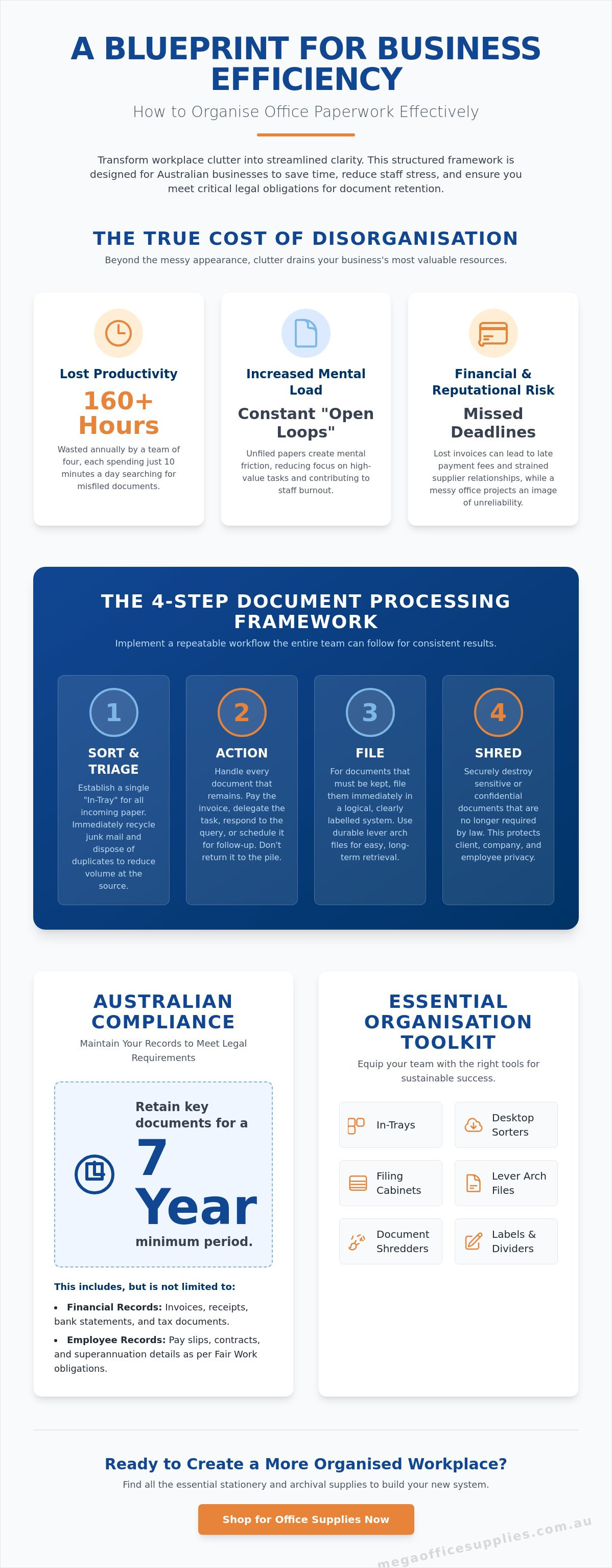
How many hours did your administration team lose last month simply hunting for a single misfiled invoice or an un-actioned piece of mail? If your desk is disappearing under a mountain of paper, you aren't alone; many Australian business owners and managers struggle to keep their physical records under control. Learning how to organise office paperwork effectively is about more than just aesthetics. It's a critical logistical requirement for maintaining compliance with Australian document retention laws, including the seven-year mandate for Fair Work and financial records.
We understand that a cluttered office leads to friction and lost productivity. This guide provides a structured framework designed for Australian business efficiency, helping you transition from a reactive pile of papers to a logical filing system the whole team can follow. We'll walk through a professional "Sort, Action, File, Shred" workflow and identify the essential archival tools required to keep your workspace clear and your records secure.
Key Takeaways
- Implement a structured "In-Tray" system and the "Immediate Sort" technique to prevent daily document pile-ups and reduce the mental load on your staff.
- Learn how to organise office paperwork effectively by adopting a professional logistical workflow that minimises time lost searching for misfiled invoices or mail.
- Understand your legal obligations regarding Australian document retention laws, including the mandatory seven-year period for financial and employee records.
- Select the right archival hardware, such as durable lever arch files and space-efficient filing cabinets, to build a storage system that remains retrievable for years.
- Equip every workstation with essential sorting tools and standardised stationery to ensure your document management system is sustainable across the whole team.
The Hidden Costs of Paperwork Disorganisation in the Workplace
Disarray on a desk isn't just a visual nuisance; it's a drain on your team's cognitive resources. Every unfiled invoice or stray memo acts as a persistent "open loop" in the mind, forcing staff to expend mental energy just to ignore the clutter. This friction reduces focus and slows down the execution of daily tasks. When your staff can't find what they need within seconds, the flow of work grinds to a halt. This mental load often leads to burnout, as employees feel they're constantly "catching up" rather than moving forward with high-value projects.
The cumulative time lost searching for misfiled documents in a team environment is often staggering. If four employees each spend just ten minutes a day hunting for paperwork, your business loses over 160 hours of productivity every year. Beyond the clock, "lost" mail often leads to missed payment deadlines, resulting in late fees or strained relationships with suppliers. Learning how to organise office paperwork effectively is a financial necessity that protects your bottom line and ensures your operational logistics remain fluid.
To better understand the practical steps for clearing your workspace, watch this helpful video:
Assessing Your Current Document Volume
Before implementing a new system, you must identify where the paper trail bottlenecks. Start by identifying the "pain points" in your current workflow, such as the pile of un-actioned mail on the reception desk or the overflowing archive box in the corner. Categorise your documents by frequency of access. Daily operational papers require immediate desk-side solutions, while archival records belong in long-term storage. If your current furniture is overflowing, it's a clear signal that your storage capacity no longer matches your volume. High-traffic areas like nurses' stations or school administration offices often require specific desktop sorters to manage the rapid influx of new information effectively.
The Professional Reputation of a Tidy Office
First impressions are foundational in any professional setting. A chaotic reception area or a cluttered meeting room signals to clients and stakeholders that your internal processes might be equally uncoordinated. Conversely, a streamlined environment projects an image of reliability and logistical prowess. Providing your team with the right office supplies to maintain order reduces workplace stress and ensures that everyone can operate with confidence. Professional organisation is a silent endorsement of your company’s stability and attention to detail, proving that you have the systems in place to handle high-volume demands without friction.
The 4-Step Framework for Effective Document Processing
Establishing a single point of entry is the first requirement for any professional document management system. Without a dedicated "In-Tray," paperwork fragments across desks, staff kitchens, and reception counters, making it impossible to track the status of critical tasks. By centralising all incoming mail, invoices, and internal memos into one physical location, you create a controlled logistical flow. This "Immediate Sort" technique ensures that nothing is left to languish in a disorganised pile, protecting your business from the friction of lost information.
A successful framework relies on differentiating between items that require immediate action and those kept for reference. Implementing a repeatable system is the most reliable way to learn how to organise office paperwork effectively across a large team. When every staff member understands the processing sequence, the office operates like a well-oiled distribution centre, moving documents from receipt to resolution without unnecessary handling.
Step 1: The Initial Triage
The triage stage is designed to reduce volume at the source. Junk mail, expired catalogues, and duplicate flyers should be disposed of immediately to prevent them from entering your filing system. For documents containing sensitive client information or employee details that are no longer required, use a high-quality paper shredder to maintain data security. The "Touch it Once" rule dictates that every piece of paper must be processed, delegated, or discarded the moment it is handled to prevent administrative backlogs. This discipline ensures that your workspace remains functional and that your focus stays on high-priority objectives.
Step 2: Assigning Action Categories
Once you've cleared the clutter, the remaining documents must be categorised by their required outcome. Create a tiered sorting station using durable trays or colour-coded document wallets to signal urgency. Standard categories typically include "To Pay" for accounts payable, "To Sign" for contracts or approvals, and "To File" for completed records. Setting a dedicated "clearing" time at the end of each day ensures these trays are processed and emptied, preventing a bottleneck. Using distinct colours for each category allows staff to identify the status of a project at a glance, which is particularly useful in high-volume environments like healthcare clinics or government departments.
To maintain this level of precision, ensure your team has access to professional-grade office supplies that can withstand daily use. Standardising your workflow across the entire office ensures that even if a team member is absent, their colleagues can easily locate and process urgent paperwork. This consistency is the cornerstone of workplace stability and long-term operational efficiency.
Selecting Professional Filing Systems for Long-Term Storage
Choosing the right hardware is what determines how to organise office paperwork effectively in a way that remains sustainable as your business scales. Flimsy, home-grade folders might suffice for a few utility bills, but professional environments like medical centres or schools require industrial-grade durability. High-capacity filing cabinets are the backbone of this storage, with vertical cabinets offering a deep, space-saving footprint and lateral cabinets providing wider, easier access for multiple users in busy corridors. Standardising your cabinet choice across departments ensures that your suspension files and dividers remain compatible throughout the entire organisation.
Fast retrieval depends entirely on logical indexing and standardised labelling. If every staff member uses a different naming convention, your filing system becomes a liability rather than an asset. Use clear, printed labels on every drawer and folder to eliminate guesswork. This level of manual precision ensures that even during peak operational periods, documents can be located and replaced within seconds, maintaining the logistical flow of your workplace.
Lever Arch Files vs. Ring Binders
For documents that require frequent reference, heavy-duty lever arch files are the industry standard. Their locking mechanism handles significantly higher volumes than standard ring binders, making them ideal for monthly accounts or project specifications. When selecting files, prioritising features like reinforced bottom edges and metal finger pull holes is essential for longevity in high-use areas. To preserve the integrity of original contracts or certificates, always use heavy-duty sheet protectors. These prevent the "tearing at the punch holes" that often occurs with high-traffic reference files, ensuring your records remain in professional condition for years.
Archive Boxes and Off-Site Storage
Floor space is a premium asset in any office. Once a project is closed or a financial year ends, moving non-current records into archive boxes is a logistical necessity. These boxes are designed to be stackable and easily transported, allowing you to clear your active filing cabinets for current work. A critical archival habit is the "Destruction Date" label. By marking exactly when a box can be legally shredded, you prevent the indefinite accumulation of unnecessary paper. Securing these boxes in dedicated storage and furniture zones, such as specialised racking or off-site facilities, keeps your primary workspace focused on immediate productivity while maintaining full compliance with historical record-keeping requirements.
Australian Document Retention and Secure Disposal
Compliance is a non-negotiable aspect of Australian business operations. Managing the lifecycle of a document from receipt to destruction is a core requirement that protects your organisation from legal and financial risk. Under the Corporations Act and the Fair Work Act, many financial and employment records must be retained for seven years. This creates a significant storage volume that requires a structured approach to prevent administrative bloat. Learning how to organise office paperwork effectively includes mastering the end-of-life process for sensitive data to ensure you aren't holding onto liability.
Privacy remains a paramount concern for procurement officers and administrators alike. The Office of the Australian Information Commissioner (OAIC) updated its guidance in March 2026, stating that identity documents must be destroyed or de-identified as soon as is reasonably practicable once they're no longer needed. Holding onto personal data indefinitely is no longer an option. Establishing an annual "Archive Day" allows your team to purge expired files in a systematic way, clearing space in your cabinets for the new financial year's records.
What to Keep and for How Long?
Distinguishing between permanent records and temporary reference material is essential for space efficiency. Permanent documents such as property deeds, titles, and partnership contracts require high-security, fireproof storage to prevent loss from environmental hazards. Most general transaction records and customer-provided documents must be kept for seven years from the date they were created or provided. The Australian Taxation Office (ATO) requires businesses to keep records for five years from the date of lodging a tax return, ensuring they explain all transactions and are in English or easily convertible. Correctly identifying these dates prevents the premature destruction of critical evidence during an audit.
Implementing a Secure Shredding Policy
Data privacy standards have evolved beyond the capabilities of basic strip-cut shredders. In a professional environment, these machines are no longer sufficient as the resulting strips can often be reconstructed. Cross-cut or micro-cut shredders are the current industry standard for high-security environments, such as healthcare clinics or legal firms, as they reduce sensitive documents to unreadable particles. Integrating secure shredding bins into the daily office workflow ensures that staff can dispose of sensitive drafts or duplicates immediately rather than leaving them in open waste bins. This creates a secure disposal chain that protects both your clients and your professional reputation.
To ensure your workplace meets these security standards, evaluate our range of professional-grade paper shredders and office technology designed for high-volume Australian business use.
Equipping Your Workplace for Sustainable Organisation
Sustainable organisation isn't a one-off event; it's a daily operational standard. For a system to survive the pressure of a high-volume workplace, every team member must have the necessary hardware at their fingertips. Providing each workstation with basic sorting tools, such as trays, staplers, and pens, removes the friction that leads to paper pile-ups. When employees have the immediate means to process a document, they're far more likely to follow the office-wide protocol. Learning how to organise office paperwork effectively across a large organisation requires this level of logistical support at the individual level.
Physical environment plays a significant role in administrative efficiency. There is a clear link between ergonomic standing desks and active document processing. Staff who use sit-stand workstations often report higher energy levels and a more proactive approach to "clearing the decks" of daily mail. Standing while sorting or filing encourages a faster, more decisive workflow, preventing the lethargy that often leads to mounting stacks of un-actioned paper on a traditional desk.
The Centralised Supply Hub
A system is only as strong as its weakest link. If your team runs out of archive boxes or labels, the entire workflow grinds to a halt. Maintaining a central office supply cupboard ensures that the tools of organisation are always accessible. This hub should be stocked with high-quality A4 copy paper, toner, and replacement lever arch files to prevent administrative delays. Conduct regular audits of these supplies to ensure you never face a breakdown in your filing chain during peak periods like the end of the financial year.
Reviewing Your Progress
Consistency is the final requirement for long-term success. Training new staff on your specific filing nomenclature is critical; they need to know exactly where a document belongs the moment they join the team. Implement a monthly "desk sweep" to ensure the established framework is being followed and to identify any new bottlenecks. As your business evolves, your filing categories should too. Adjusting your system to match your current volume ensures it remains a helpful tool rather than a rigid burden. Celebrating a clear, organised workplace isn't just about aesthetics; it's a way to boost team morale and reinforce the value of a well-oiled operation. Mastering how to organise office paperwork effectively provides the peace of mind that your records are secure and your business is ready for its next high-volume demand.
Securing Your Future Through Logistical Efficiency
Transitioning from a cluttered workspace to a structured environment requires a reliable framework and professional-grade hardware. By implementing the "Sort, Action, File, Shred" workflow and adhering to the seven-year retention mandate for Australian financial records, you protect your business from operational friction and legal risk. Mastering how to organise office paperwork effectively is a long-term investment in your team's focus and productivity.
As a family owned and operated business since 2008, Mega Office Supplies can help you maintain a compliant, well-oiled workplace. We provide national delivery for commercial and educational sectors, ensuring you have the durable tools needed for sustainable document management. With the right systems in place, your administration can move from reactive chaos to proactive precision.
Browse our full range of professional filing and storage solutions at Mega Office Supplies and take the first step toward a clearer, more efficient desk today. You've got the framework; now it's time to equip your team for success.
Frequently Asked Questions
How long should I keep business tax records in Australia?
Most Australian businesses must retain tax records for five years from the date of lodging their tax return. However, if your business is subject to the Corporations Act or the Fair Work Act, financial and employment records must be kept for seven years. Records related to assets subject to Capital Gains Tax must also be retained for five years after the tax year in which the sale or disposal occurs.
What is the most efficient way to label lever arch files?
Using printed spine labels with standardised naming conventions is the most efficient method for fast identification. Every label should include the broad category, a specific date range, and a clear destruction date to facilitate future audits. This level of manual precision ensures any team member can locate files without confusion, maintaining the logistical flow of your archive area and preventing retrieval delays.
Should I use a vertical or lateral filing cabinet for a small office?
Vertical filing cabinets are generally best for small offices because they offer a deep storage capacity with a minimal floor footprint. If you have limited wall space but need to house a high volume of documents, a 4-drawer vertical unit provides excellent density. Lateral cabinets are typically reserved for wider corridors or open-plan areas where multiple users require simultaneous access to the same filing bank.
How do I decide what paperwork to shred and what to keep?
You should shred any document containing sensitive personal data, expired client information, or internal drafts that have no legal or tax standing. Keep all records required for compliance, such as tax invoices, employee contracts, and property deeds. Using the "Touch it Once" rule helps you decide immediately whether a document is a permanent record or temporary reference material that can be securely destroyed.
What are the essential supplies needed to start an office filing system?
A professional filing system requires a foundation of high-capacity lever arch files, suspension files for cabinets, and indexed dividers. You also need desktop in-trays to centralise incoming mail and colour-coded document wallets for active projects. Standardising these supplies across your workplace ensures compatibility and makes it easier to learn how to organise office paperwork effectively as your team grows and your volume increases.
How can I prevent paperwork from piling up on my desk every day?
Preventing pile-ups requires a daily triage routine where all incoming documents are processed through a central in-tray. Use the "Immediate Sort" technique to move papers into specific "To Pay," "To Sign," or "To File" categories before they settle on your desk surface. Dedicating ten minutes at the end of each shift to clear these trays ensures that backlogs don't accumulate and impact your productivity.
Is it better to file by date, client name, or project type?
The best filing method depends on how your team retrieves information; alphabetical filing by client name is standard for service industries, while chronological filing is essential for financial records. Project-based filing works well for construction or legal sectors where all related documents must stay together. Consistency is more important than the specific method chosen, as it ensures any staff member can navigate the system confidently.
What is the difference between a ring binder and a lever arch file for organisation?
Lever arch files are designed for high-volume storage and feature a locking mechanism that secures large stacks of paper, making them ideal for archival use. Ring binders are better suited for thinner, daily reference manuals that don't require the same weight capacity. Understanding these hardware differences is key to learning how to organise office paperwork effectively without over-stressing your storage equipment or damaging your original documents.
Article by
Mega Office Supplies Team
The Mega Office Supplies Team provides practical guidance for Australian businesses, schools, government organisations, healthcare providers, hospitality venues, warehouses and home offices. Based in Tweed Heads South, Mega Office Supplies is an Australian business, family owned and operated since 2008, offering office stationery, workplace furniture, technology products, labels, printers, cleaning and janitorial supplies, safety products, art materials, education resources and everyday business essentials from trusted brands.
General Information
This article is provided as general information only to help customers compare and choose office, workplace, school, cleaning, technology, furniture, safety and business supplies. Product details, specifications, compatibility, availability, pricing and suitability may vary. Always check the individual product page, manufacturer information, workplace requirements and relevant safety guidance before purchasing or using a product.


