

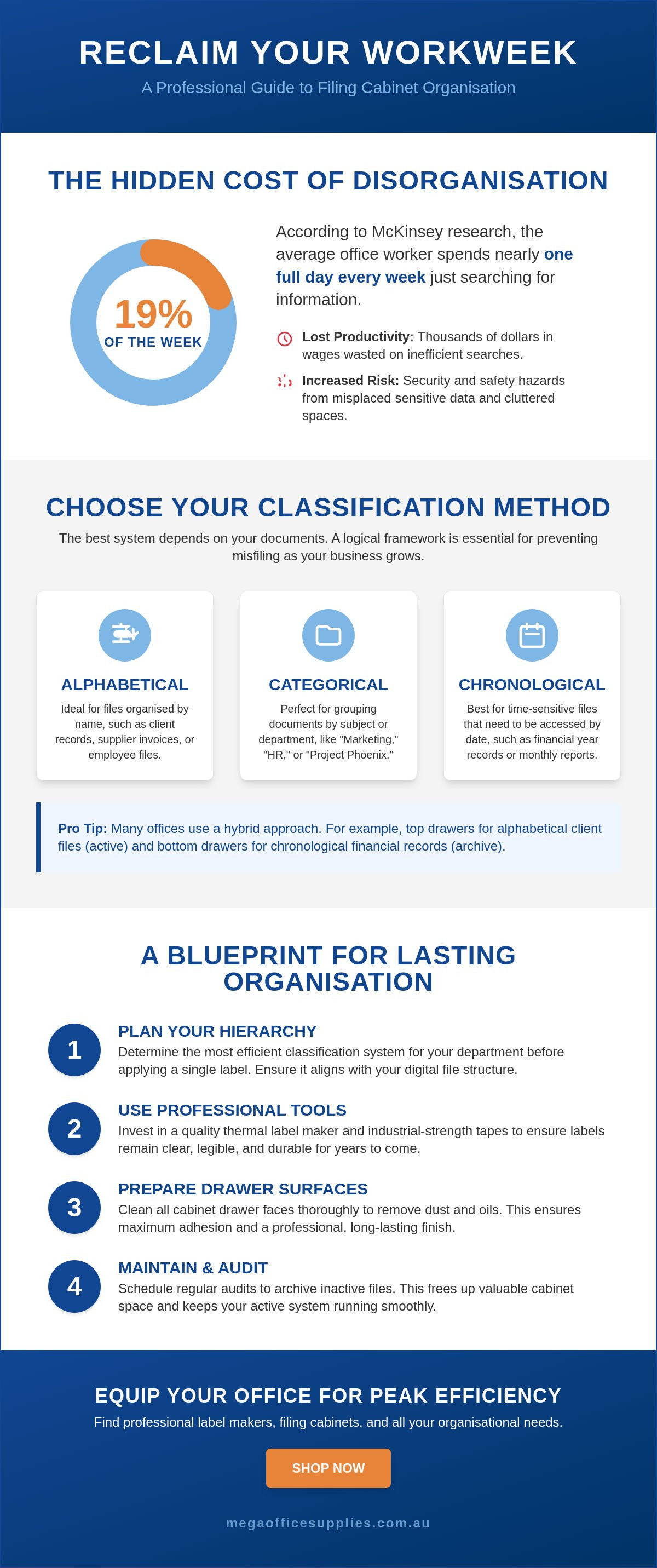
McKinsey research shows that office workers spend roughly 19% of their workweek just searching for information. That is nearly a full day every single week lost to the frustration of unorganised documents and messy storage. Most Australian administrators and business owners agree that inconsistent systems and illegible, peeling labels don't just look unprofessional; they actively drain workplace productivity. Finding the best way to label filing cabinet drawers is a critical step in reclaiming that lost time and building a reliable, scalable records system.
We understand that a functional office requires more than just high-capacity hardware. It needs a logical structure that any staff member can understand at a glance. In this guide, you'll learn the most efficient, professional methods to categorise your files and execute a labelling system that lasts. We'll preview the best classification strategies, discuss the importance of durable materials, and show you how to create a streamlined retrieval process that brings peace of mind to your daily operations. From local schools to massive distribution centres, these industry-standard practices will help you maintain a professional-looking environment while ensuring your team stays focused on high-value tasks.
Key Takeaways
- Determine the most efficient classification hierarchy for your department, whether based on alphabetical client names, chronological dates, or categorical project groups.
- Utilising professional-grade thermal label makers and industrial-strength tapes is the best way to label filing cabinet drawers to ensure long-term durability and clarity.
- Ensure maximum label adhesion and professional presentation by auditing document volumes and properly preparing drawer surfaces before application.
- Maintain a high-performance storage system by scheduling regular audits and migrating inactive files into archive boxes or lever arch files to manage capacity.
Establishing an Efficient Filing System: Why Clear Labelling is Non-Negotiable
Efficiency in a high-volume workplace depends on the speed of retrieval. When a procurement officer or office manager implements a standardised system, they're essentially installing a roadmap for every staff member to follow, regardless of their tenure or department. Establishing the best way to label filing cabinet drawers is a foundational step in professional records management, ensuring that vital information is never more than a few seconds away. This level of organisation reduces "search friction," allowing administrative staff to bypass the frustration of guessing which drawer holds specific contracts or invoices.
To better understand this concept, watch this helpful video:
Beyond simple productivity, professional labelling projects an image of competence to visiting clients and external auditors. A well-maintained cabinet suggests a business that values precision and detail. There's also a significant safety benefit to consider. Standardised labels minimise "drawer-fiddling," where staff repeatedly open and close multiple heavy drawers in a trial-and-error search. By identifying the correct drawer from a distance, you reduce the risk of cabinet tip-overs and repetitive strain, supporting a safer office environment.
The Cost of Poor Organisation
Inadequate storage systems represent a hidden drain on the bottom line. Research by McKinsey indicates that office workers spend approximately 19% of their workweek looking for information. In an Australian business context, this translates to thousands of dollars in lost wages every year per employee. Poorly categorised files also introduce security risks; sensitive personnel records or financial data can easily be misplaced in general drawers if the labelling is ambiguous. While a handwritten strip of masking tape might seem like a quick fix, these "temporary" solutions often become permanent eyesores that peel and fade, eventually becoming completely illegible.
Defining Your Filing Objectives
Before applying new labels, you must define the primary purpose of your storage. Is the cabinet intended for active, daily use or long-term archiving? Active files require clear, high-level category labels that facilitate rapid access for entire departments. Conversely, archive boxes and drawers should focus on retention dates and disposal schedules to meet legal compliance. It's also vital to align your physical labels with your digital folder structure. If your computer server uses a "Client Name, Year" format, your filing cabinet drawers should mirror this exactly. This consistency allows new staff to transition between physical and digital tasks without having to learn two different logic systems.
Choosing Your Classification Method: Alphabetical, Categorical, or Chronological?
Every professional office requires a logical framework to prevent the "misfiling" trap. The best way to label filing cabinet drawers depends entirely on the nature of the documents stored; for instance, a law firm might prioritise alphabetical client names, while a logistics hub might group files by project categories. Without a clear decision on the classification method, your organisation system will eventually break down as volume increases.
Many administrators opt for a hybrid approach to maximise utility. This involves using the top two drawers for high-frequency alphabetical client files and the bottom drawers for chronological tax records or categorical HR documents. This tiered structure keeps essential items within easy reach while maintaining a strict order for archival material. Adhering to established File Naming Organization Best Practices ensures that your physical labels match your digital naming conventions, which is vital for a seamless office workflow.
When to Use Alphabetical Labelling
Alphabetical filing is the industry standard for client records and general administrative files. When splitting the alphabet across multiple drawers, distribute letters based on document volume rather than a strict mathematical split. The "S" and "C" sections often require more space than "X" or "Z". Don't forget to ignore articles like "The" or "A" in company names to avoid overloading the "T" drawer. To add another layer of organisation, you can use coloured lever arch files within each alphabetical drawer to distinguish between active and closed accounts.
The Logic of Categorical Filing
Categorical systems group files by department, such as Finance, HR, or Marketing. This method is highly effective for internal operations where staff search for a function rather than a specific name. Colour-coded labels are essential here; assigning red to Finance and blue to HR allows for instant visual recognition. It's important to keep these categories broad enough to allow for future business growth. If you're setting up a new department, selecting the right professional filing equipment from the start will ensure your categories remain distinct and manageable.
Chronological filing is indispensable for tax records, invoices, and historical archives. By labelling drawers with financial years or quarters, you simplify the process of rotating old files into long-term storage or shredding them once their retention period expires. Implementing a tiered hybrid system is often the best way to label filing cabinet drawers in complex Australian workplaces where multiple departments share a single storage area.
Essential Tools for Professional Cabinet Labelling
Achieving a professional finish requires more than just a steady hand; it demands the right hardware. For administrators managing high-volume archives, sourcing premium stationery supplies Australia is the first step toward a system that resists wear and tear. High-quality materials ensure that labels remain legible and attached, even in humid environments or high-traffic areas. When your equipment matches the scale of your operation, the entire filing process becomes more efficient.
Industry veterans often agree that using dedicated thermal printers is the best way to label filing cabinet drawers. Brands like Brother and Dymo have set the standard for durability; their P-Touch and LabelWriter series produce crisp, smudge-proof text that withstands years of use. When developing a new file plan, your choice of physical labelling tools must mirror the structural rigour of your categorisation. While cardstock inserts are the traditional choice for built-in drawer slots, adhesive labels offer more flexibility for applying identifiers directly to metal or plastic surfaces.
Label Makers vs. Printed Inserts
Thermal label printers provide unmatched longevity because they don't rely on ink that can fade over time. These devices allow for rapid updates when departments shift or projects conclude. Alternatively, if your cabinets feature clear plastic windows, using A4 cardstock templates is an excellent way to maintain a uniform look. You can print multiple inserts at once, ensuring every drawer has a consistent appearance. Avoid the common mistake of using clear sticky tape over paper labels. This often results in yellowing adhesive and trapped air bubbles, which look unprofessional and leave a difficult residue when removed.
Selecting the Right Fonts and Colours
Legibility is paramount in a fast-moving office. Choose clean, sans-serif fonts like Arial or Helvetica; these are easier to read from a distance than decorative or serif styles. Consistency is key, so maintain the same font size across all cabinet drawers to prevent a cluttered visual environment. Colour psychology also plays a vital role in retrieval speed. Many Australian offices use a red-coded system for urgent or high-priority files, while blue is frequently reserved for finance and payroll. By combining clear text with distinct colours, you create a dual-signal system that allows staff to identify the correct drawer before they even reach the cabinet.
Step-by-Step: The Best Way to Label Filing Cabinet Drawers
Executing a professional labelling project requires a disciplined, step-by-step methodology. Before you touch a label maker, you must conduct a thorough audit of your existing paperwork to determine the exact volume for each category. This prevents the common mistake of overcrowding one drawer while another sits half-empty. Once your volume is mapped, you can establish the best way to label filing cabinet drawers for your specific office layout. Standardising your naming conventions on a master list before printing ensures that you don't waste expensive thermal tape on trial-and-error attempts.
Placement is just as important as content. Labels should be applied at eye-level or slightly below for maximum visibility. For the bottom drawers of a vertical cabinet, ensure the text is large enough to be read without excessive bending. Finally, validate your work with a "blind" search; have a colleague attempt to retrieve a specific file without guidance. If they can find it in seconds, your system is ready for full implementation.
Preparing the Surface
Long-term adhesion depends on the quality of the surface. Start by removing any old adhesive residue from previous systems; a small amount of isopropyl alcohol usually works well for metal cabinets. If you are working with laminate or wood-veneer furniture, use a milder cleaning agent to avoid damaging the finish. Ensure the area is completely dry and free from dust before applying the label. Even a tiny amount of moisture can cause the edges of a professional-grade label to lift over time.
Executing the Naming Convention
A master list of all intended labels prevents duplicates and ensures a uniform aesthetic. Use a "Noun First" approach to naming; for instance, label a drawer "Invoices - 2026" rather than "2026 Invoices". This logic ensures that if you have multiple drawers of invoices, they remain grouped together in the mind of the user. Consistent naming prevents filing errors by eliminating ambiguity and ensuring every staff member follows the same logical path to the document they need.
To ensure your system remains durable, invest in high-quality office supplies that are built for high-volume commercial use.
Maintaining Your Archive: Ensuring Your System Scales
Establishing a professional filing system is a significant achievement; however, maintaining that system requires consistent oversight. As your business grows, the volume of paperwork will inevitably shift, making certain drawers more crowded than others. Conducting quarterly "Filing Audits" allows you to identify these bottlenecks before they impact productivity. During these reviews, check for drawers that have reached roughly 80% capacity. Overfilled drawers lead to damaged documents and increased search friction, so proactively rebalancing your files is the best way to label filing cabinet drawers for long-term functional success.
Operational shifts, such as department mergers or the launch of new projects, often necessitate label updates. Rather than allowing outdated identifiers to linger, ensure that your labelling remains a live reflection of your current business structure. Training new staff on the logic behind your system is equally vital. When every team member understands why you use specific naming conventions and colour codes, the integrity of the archive remains intact, preventing the chaotic "misfiling" that often occurs during rapid growth periods.
The Transition to Archiving
Differentiating between active documents and "dead files" is essential for maintaining cabinet space. Documents that are no longer accessed daily but must be kept for legal or tax compliance should be moved out of prime drawer real estate. Transferring these records into lever arch files or sturdy archive boxes keeps your primary cabinets streamlined for current tasks. You can also leverage modern technology, such as high-speed document scanners, to digitise older records. This hybrid approach reduces physical bulk while ensuring that your most important physical files remain easily retrievable in their designated drawers.
Standardising Across the Organisation
Consistency is the hallmark of a well-oiled operation. To prevent individual departments from inventing their own methods, create a simple "Label Style Guide" for the entire office. This document should specify the exact font, size, and colour coding to be used on all cabinet drawers. Centralising your label supplies, such as specific tape widths and thermal cartridges, ensures that every new label matches the existing ones perfectly. This attention to detail reinforces your professional environment and makes the system intuitive for everyone.
If your current storage has reached its limit, explore our full range of filing cabinets and furniture to expand your organisational capacity with professional-grade solutions.
Optimising Your Workplace Storage for Long-Term Success
A high-performance office relies on the silent efficiency of its storage systems. By implementing a logical classification hierarchy and using durable thermal materials, you transform a standard cabinet into a precision tool for information retrieval. Finding the best way to label filing cabinet drawers is about more than just aesthetics; it's about establishing a standardised language that every staff member can speak fluently. Regular audits and a clear transition path to archiving ensure that your organisation remains scalable as your business operations expand.
Mega Office Supplies provides a comprehensive range of Brother and Dymo label solutions designed for the rigours of Australian workplaces. With national Australian delivery, we ensure your team has the hardware required to maintain a seamless workflow. Browse our Professional Range of Labels and Label Makers to start your organisational upgrade today. A well-ordered office is within your reach, and the right tools make all the difference in achieving lasting clarity.
Frequently Asked Questions
What is the best font size for filing cabinet labels?
A font size between 24 and 36 points is generally considered the standard for drawer labels. This range ensures the text remains legible from a distance of several metres, allowing staff to identify the correct cabinet without standing directly in front of it. While the primary category should be large, any sub-text or date ranges can be reduced to 14 or 18 points to maintain a clean, professional appearance.
Should I label drawers from top to bottom or bottom to top?
Labelling should always follow a top-to-bottom sequence to align with natural reading patterns. High-frequency documents should be stored in the top drawers to minimise bending and physical strain for administrative staff. This logical flow ensures that new employees can navigate the system instinctively. If your cabinet spans multiple units, continue the sequence from left to right, maintaining a consistent hierarchy across the entire office suite.
How do I remove old, sticky label residue from metal cabinets?
Isopropyl alcohol is the most effective agent for removing stubborn adhesive residue from metal filing cabinets. For laminate or powder-coated surfaces, a milder solution or a specialised citrus-based adhesive remover is safer to prevent discolouration. Apply the liquid to a microfibre cloth rather than the cabinet itself, allowing it to sit for 30 seconds before wiping. This preparation is essential for the best way to label filing cabinet drawers, as it ensures the new labels adhere perfectly.
Is colour-coding really better than plain white labels?
Colour-coding is significantly more effective than plain white labels for high-volume environments. The human brain processes colour faster than text, meaning staff can identify the correct department or project category at a glance. For example, assigning red for urgent contracts and blue for financial records creates a dual-signal system. This method reduces search time and minimises the cognitive load on staff who frequently retrieve physical records throughout the day.
What information should be included on a drawer label?
A professional drawer label should include the primary category, a specific sub-category, and a clear date range. Using "Noun First" logic, such as "Invoices, Marketing, 2026," ensures that files are grouped logically in the user's mind. Avoid overcrowding the label with excessive detail; the goal is to provide just enough information to guide the user to the correct drawer. Clear, concise descriptors prevent filing errors and streamline the retrieval process.
How often should I update or refresh my filing cabinet labels?
You should refresh your labels at least once a year during a formal filing audit. However, high-growth businesses or departments that undergo frequent restructuring may need quarterly updates. Labels that have become faded, peeled, or illegible should be replaced immediately to maintain a professional office environment. Regular maintenance ensures that the best way to label filing cabinet drawers remains a live reflection of your current organisational structure and document volume.
Can I use a regular printer for filing cabinet labels?
While you can use a regular printer with A4 cardstock templates, a dedicated thermal label maker is the more professional choice. Standard inkjet or laser prints can smudge or fade when exposed to sunlight and frequent handling. Thermal printers produce durable, smudge-proof text that is specifically designed for industrial use. They also offer the flexibility to print single labels on demand as your filing needs evolve without wasting a full sheet of adhesive paper.
What is the most durable type of label for high-traffic offices?
Laminated thermal tape is the most durable option for high-traffic offices. These labels are resistant to water, chemicals, and extreme temperatures, ensuring they won't peel or fade over several years of use. For industrial settings or warehouses, "extra strength" adhesive versions provide even greater longevity on textured metal surfaces. Investing in these professional-grade materials is a core component of a reliable filing system, providing security and peace of mind for long-term records management.
Article by
Mega Office Supplies Team
The Mega Office Supplies Team provides practical guidance for Australian businesses, schools, government organisations, healthcare providers, hospitality venues, warehouses and home offices. Based in Tweed Heads South, Mega Office Supplies is an Australian business, family owned and operated since 2008, offering office stationery, workplace furniture, technology products, labels, printers, cleaning and janitorial supplies, safety products, art materials, education resources and everyday business essentials from trusted brands.
General Information
This article is provided as general information only to help customers compare and choose office, workplace, school, cleaning, technology, furniture, safety and business supplies. Product details, specifications, compatibility, availability, pricing and suitability may vary. Always check the individual product page, manufacturer information, workplace requirements and relevant safety guidance before purchasing or using a product.


