


Is your seating infrastructure quietly undermining your team's performance? While a chair might look functional, a failing gas lift or a subtle wobble can lead to chronic back pain and decreased focus across your organisation. Knowing exactly when to replace your office chair is a vital part of maintaining a productive, OH&S-compliant workspace. Most managers wait until a seat is visibly broken, but by then, the impact on staff wellbeing and efficiency has already cost more than a new fit-out.
At Mega Office Supplies, we understand that justifying a new furniture budget requires more than just a gut feeling about comfort. You need clear markers of wear and tear and an understanding of modern safety standards, such as Class 4 explosion-proof cylinders and BIFMA structural certifications. This guide provides a professional checklist for identifying end-of-life furniture and explains how to spot high-durability markers in replacement options. You'll learn how to balance repair costs against the long-term benefits of ergonomic seating, helping you make informed procurement decisions that protect both your bottom line and your people.
Key Takeaways
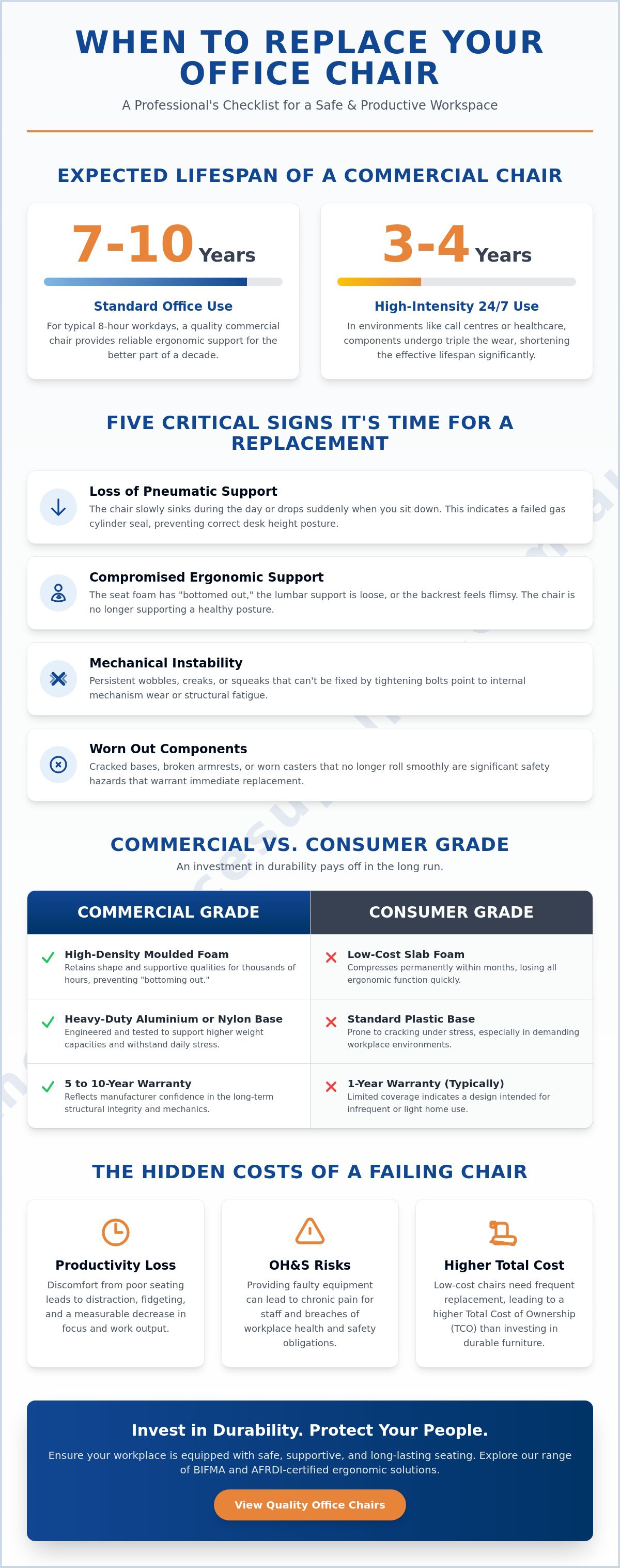
- Commercial-grade task chairs generally provide a reliable lifespan of 7 to 10 years, though high-intensity environments like 24/7 call centres require more frequent assessments.
- Identify the specific mechanical failures and ergonomic sags that signal exactly when to replace your office chair to maintain workplace safety.
- Recognise the hidden productivity costs and legal OH&S obligations associated with providing compliant seating for Australian staff.
- Evaluate the Total Cost of Ownership (TCO) by comparing initial procurement costs against the long-term durability of BIFMA-certified furniture.
- Gain insights into standardising your office fit-out to streamline maintenance and simplify future furniture budget justifications.
Understanding the Lifespan of a Professional Office Chair
The lifespan of a commercial-grade task chair typically spans seven to ten years under standard conditions. This durability is largely defined by the quality of internal components and adherence to Australian standards such as AFRDI. While a chair might look acceptable on the surface, structural integrity often fails long before the fabric tears. Procurement officers must look past aesthetic wear to identify when to replace office chair assets that no longer provide adequate support, especially when auditing their wider office supplies inventory. Professional seating is engineered with specific ergonomic design considerations to withstand repetitive mechanical stress, but this resilience isn't infinite.
Usage patterns dictate the actual replacement cycle. A chair used in a standard eight-hour shift will naturally outlast one stationed in a 24/7 call centre or healthcare facility. In high-intensity environments, the mechanical components undergo three times the wear, often necessitating a replacement cycle of just three to four years. Understanding these variables is the first step in deciding when to replace office chair inventory across your organisation. This proactive approach prevents the gradual decline in staff comfort that often goes unnoticed until productivity is already impacted.
To better understand the mechanical components that often require attention, watch this helpful video:
The Difference Between Commercial and Consumer Grade
Professional seating relies on high-density moulded foam that retains its shape over thousands of hours. In contrast, standard retail chairs often use low-cost slab foam that compresses permanently within months. This loss of loft leads to "bottoming out," where the user feels the hard structural plate beneath the seat. Durability also extends to the base. While nylon bases are common, heavy-duty aluminium bases offer superior longevity in demanding Australian workplaces. A manufacturer's warranty is a transparent indicator of this build quality; professional-grade products typically carry five to ten-year warranties, reflecting the industrial precision of their construction.
Environmental Factors in the Australian Workplace
The Australian climate introduces unique challenges to furniture longevity. High UV exposure in sunlit, open-plan offices can cause "chalking" of plastic components and premature fading of upholstery. In warehouse-adjacent offices or industrial sites, fine dust and debris often infiltrate the caster housings and gas lift mechanisms. This grit acts as an abrasive, grinding down the seals and causing the chair to lose height over time. Regular maintenance, such as vacuuming casters and wiping down the gas cylinder, can help to minimise these issues. However, once a gas lift begins to bypass or a tilt mechanism seizes due to internal debris, a full replacement is usually the most cost-effective path forward for maintaining workplace safety.
Five Critical Signs Your Office Chair Needs Replacing
Identifying exactly when to replace office chair units requires a keen eye for mechanical fatigue. While some damage is obvious, other failures happen internally, slowly degrading the user's posture and focus. Managers should look for these five indicators during routine workplace audits to ensure the environment remains safe and productive.
- Loss of Pneumatic Support. If a chair sinks slowly throughout the day or "bottoms out" upon sitting, the gas cylinder's seals have failed. This forces the user to work at an incorrect height relative to their desk.
- Compromised Ergonomic Support. A failing lumbar mechanism or a permanent sag in the seat pan forces the spine into unnatural positions. Once the structural shape is lost, the chair no longer performs its primary function.
- Mechanical Instability. Persistent wobbles or squeaks that remain after tightening bolts indicate structural fatigue in the frame or the multi-tilt mechanism. This instability creates constant micro-stress on the user's core muscles.
- Upholstery Degradation. Cracked leather and frayed fabric aren't just aesthetic issues. They harbour bacteria, are difficult to sanitise, and project a poor professional image in reception areas or boardrooms.
- Persistent Physical Discomfort. When staff report new aches or need to adjust their position frequently, the chair is likely failing to mitigate work-related musculoskeletal disorders.
Identifying Mechanical and Structural Failure
Start with the "sink test." Set the chair to its maximum height and leave it overnight; if it's lower by morning, the cylinder is compromised. Inspect the five-star base for hairline cracks, especially around the caster housings where stress is highest. These small fractures can lead to sudden, dangerous collapses in high-traffic areas like staff kitchens or classrooms. Check the multi-tilt lock; if it slips or fails to hold a specific angle, the internal springs or locking pins are worn beyond safe use. Mechanical sounds like grinding or clicking during movement suggest that internal bearings have reached the end of their service life.
The Ergonomic "Silent Failure": Cushion Fatigue
Foam "memory loss" is often invisible. Over time, even high-quality moulded foam loses its ability to rebound, increasing pressure on the sit-bones and restricting blood flow to the lower limbs. You can test this with a simple compression check: press your fist firmly into the centre of the seat. If the foam doesn't snap back instantly or if you feel the hard base plate, the cushion is ergonomically dead. A chair that "looks new" can still be a liability if the padding has collapsed internally. If you notice these symptoms across your floor, it's time to browse the professional seating range at megaofficesupplies.com.au to restore staff comfort and maintain operational standards.
The Impact of Compromised Seating on Productivity and OH&S
Australian workplace safety extends far beyond warehouse floors and construction sites. It applies directly to the office environment where staff spend most of their working lives. Under Australian Work Health and Safety (WHS) legislation, employers hold a non-delegable duty of care to provide a safe work environment, which includes providing ergonomic equipment. Deciding when to replace office chair inventory is a matter of legal compliance as much as comfort. Neglecting faulty seating exposes your organisation to long-term musculoskeletal disorders and potential WorkCover claims, which often result in costs that far exceed a proactive furniture refresh.
Beyond the legal risks, compromised seating creates a measurable drain on daily productivity. Staff using chairs with failing lumbar support or collapsed foam take frequent micro-breaks to stretch or shift their weight. These constant physical adjustments break cognitive flow and reduce overall focus. The science of designing equipment to fit the user is essential for maintaining high output. When a chair fails to support the body, the user's brain must dedicate resources to maintaining posture, leaving less energy for complex tasks.
Workplace Health and Safety (WHS) Obligations
Australian WHS laws require proactive risk management. This means you shouldn't wait for a staff member to report a chronic injury before taking action. Regular furniture audits help identify mechanical fatigue before it causes harm. Maintaining a detailed equipment register for your commercial fit-out allows you to track the age and warranty status of every chair. This documentation provides a clear paper trail of safety compliance and makes it easier to justify replacement budgets to stakeholders. Identifying when to replace office chair units during these audits prevents small mechanical issues from becoming significant workplace liabilities.
The Psychology of the Workspace
High-quality tools signal to your team that their health and contribution are valued. Providing professional-grade seating directly influences staff morale and long-term retention. Physical comfort serves as the foundation for cognitive performance, particularly during the challenging afternoon hours. Ergonomic failure creates a constant background of physical discomfort that rapidly accelerates mental fatigue and increases the likelihood of errors. When staff feel supported by their environment, their perceived value increases, leading to higher engagement levels across the organisation.
Don't overlook the impact on external stakeholders. A dilapidated chair in a reception area or boardroom reflects poorly on your company's attention to detail and stability. Cracked upholstery or a sinking base in a client-facing zone can undermine professional trust before a meeting even begins. Replacing these items is a strategic brand protection move that ensures your physical environment matches your professional reputation.
Evaluating Your Next Investment: Durability vs Initial Cost
Investing in new seating requires a shift from viewing furniture as a simple expense to seeing it as a long-term capital asset. When calculating the Total Cost of Ownership (TCO), high-quality commercial chairs often prove more economical than several consecutive budget replacements. A chair backed by a ten-year warranty effectively fixes your seating costs for a decade, whereas a cheaper retail model might require replacement every two years. This financial foresight is essential when deciding when to replace office chair assets across a large organisation. Standardising on specific models simplifies your maintenance inventory and ensures that every staff member receives the same level of ergonomic protection.
Weight ratings are a critical indicator of structural integrity. While standard office chairs might offer a 135kg capacity, heavy-duty models rated for 160kg provide a greater margin of safety and long-term durability for a diverse workforce. It's also vital to scrutinise the fine print of commercial warranties. A "parts-only" warranty can still leave you with significant labour costs for repairs. Look for comprehensive agreements that cover both components and the labour required to fit them, ensuring your investment remains protected without unforeseen service fees.
Key Features of a High-Performance Office Chair
High-performance seating must include specific adjustability features to be truly effective. A seat slide mechanism is necessary to provide correct thigh support for users of different heights, while 4D armrests allow for height, width, depth, and angle adjustments to minimise shoulder strain. In Australian climates, breathable mesh backrests are often preferred for their thermal properties, though antimicrobial fabrics are essential for healthcare and staff kitchen environments. For severe commercial use, prioritise furniture with AFRDI Level 6 certification. This "Blue Tick" indicates the product has been rigorously tested to withstand the most demanding professional environments.
Procurement Strategies for Australian Businesses
Bulk ordering for national office fit-outs ensures aesthetic consistency and typically facilitates more efficient logistical planning. New seating should be evaluated for its compatibility with your existing standing desks to ensure a seamless transition between sitting and standing heights. Proper procurement also involves planning for the end-of-life cycle. Many modern commercial chairs are designed for easy disassembly, allowing for the responsible recycling of steel, aluminium, and plastic components once they reach the end of their service life.
You can browse our full range of commercial office furniture to find durable seating solutions that fit your organisation's budget and durability requirements.
Sourcing Quality Ergonomic Solutions with Mega Office Supplies
Managing a commercial furniture fleet requires a partner who understands the logistical and safety complexities of the Australian market. Mega Office Supplies supports procurement officers in navigating the transition from failing equipment to high-performance assets. Determining when to replace office chair units across multiple sites is simplified through our extensive catalogue, which caters to high-volume demands without the friction common in global supply chains. We operate as a hardworking partner for businesses that value stability, reliability, and regional expertise.
Our logistical prowess ensures that large-scale furniture requirements are met with speed and precision. Whether you are outfitting a single reception area or a national network of government departments, our distribution model is designed for efficiency. A proactive audit is the most effective way to decide exactly when to replace office chair assets before they become a liability. By identifying high-risk units early, you can maintain a consistent standard of support across your entire organisation while staying within your projected maintenance budget.
Tailored Solutions for Every Sector
Different environments demand different durability standards. For educational settings and staff rooms, we provide high-durability options designed to withstand the rigours of constant use. In corporate environments, our executive and task ranges prioritise both aesthetic precision and long-term health. We view ergonomic office chairs as a core pillar of workplace wellness, ensuring that every product in our range meets the functional demands of modern Australian professionals. From antimicrobial fabrics for healthcare to heavy-duty bases for industrial offices, our selection is grounded in real-world utility.
Streamlining Your Procurement Process
The Mega Office Supplies platform is engineered for the specific workflow of professional buyers. Our system facilitates rapid quoting and bulk ordering, allowing administrators to evaluate costs and quantities quickly. This efficiency extends beyond furniture; you can manage your facility requirements, including first aid and cleaning supplies, through a single, reliable source. This integrated approach reduces administrative overhead and ensures your workplace remains fully equipped and compliant. Our team is large enough to handle massive volume but remains grounded enough to provide direct, local assistance through our regional support lines.
Don't wait for mechanical failure to disrupt your team's productivity. Explore our full range of ergonomic office furniture today and secure the long-term stability of your workplace infrastructure.
Optimising Your Long-Term Seating Strategy
Maintaining a safe and efficient work environment relies on identifying the early mechanical failures that signal exactly when to replace office chair inventory. By prioritising AFRDI-certified components and commercial-grade durability, organisations can significantly reduce the risk of workplace injuries and long-term musculoskeletal issues. High-quality seating is a direct investment in staff focus and operational stability, moving beyond the hidden costs of micro-breaks and physical discomfort associated with aging furniture.
Mega Office Supplies facilitates national delivery across Australia, ensuring that your school, government department, or business receives a consistent standard of equipment regardless of location. Our comprehensive range includes professional-grade options specifically engineered to support diverse workforces and demanding commercial shifts. We understand the practicalities of workplace maintenance and provide the logistical scale necessary to handle high-volume demands without friction.
Upgrade your workplace with our range of Ergonomic Office Chairs
Taking a proactive approach to furniture maintenance today ensures a more productive and compliant workspace for years to come. We look forward to helping you build a more supportive office environment.
Frequently Asked Questions
How long do office chairs usually last in a commercial setting?
Commercial-grade chairs typically provide a service life of seven to ten years under standard conditions. This duration is influenced by the density of the seat foam and the quality of the mechanical tilt components. In 24/7 environments like security monitoring rooms or healthcare facilities, this lifespan is often halved due to continuous mechanical stress. Regular maintenance and choosing AFRDI-certified models are the most effective ways to ensure your seating reaches its full functional potential.
Is it worth repairing a broken gas lift on an old office chair?
Repairing a gas lift is generally only recommended for high-end chairs that are still within their warranty period. For most task chairs, the cost of a replacement cylinder and the specialised labour required to fit it often approaches the price of a new unit. Replacing the entire chair is usually more efficient, as it ensures all ergonomic components, including the seat foam and lumbar support, are restored to a professional standard simultaneously.
What are the most common signs of ergonomic failure in a chair?
The most common signs include the seat bottoming out, where the foam no longer rebounds, and the gas lift slowly sinking during the day. You should also watch for mechanical instability, such as a persistent wobble in the base or a tilt lock that slips under pressure. These failures indicate that the internal seals or springs have reached their limit, helping you determine when to replace office chair units across your floor.
How does an old office chair affect my back and neck health?
Compromised seating forces the spine out of its natural alignment, causing the muscles in the back and neck to work harder to maintain posture. This constant strain leads to tension headaches and chronic lower back pain. Without proper lumbar support and adjustable armrests, users often lean forward or slouch, which places excessive pressure on the neck vertebrae and can lead to long-term postural issues that require medical intervention.
What does AFRDI-rated mean for office chairs in Australia?
An AFRDI rating, often called the Blue Tick, signifies that a chair has been independently tested to Australian standards for durability and safety. Level 6 is the standard required for severe commercial use, ensuring the chair can withstand the demands of a professional office. This certification provides procurement officers with peace of mind that the furniture is fit for purpose and built to last in demanding Australian workplace conditions.
Can I use a chair mat to extend the life of my office chair?
Chair mats are effective tools for extending the life of your seating by reducing strain on the castors and base. On carpet, they provide a smooth surface that prevents the wheels from snagging, which protects the internal bearings from premature wear. On hard surfaces, they act as a barrier against dust and grit. This prevents abrasive particles from entering the mechanical parts of the castor, ensuring smooth movement and reducing structural fatigue.
How often should a business perform a furniture safety audit?
Businesses should conduct a formal furniture safety audit at least once a year to comply with workplace health and safety recommendations. In high-use zones like hot-desking areas or healthcare clinics, a six-month inspection cycle is more effective. These reviews allow facility managers to spot hairline cracks in bases or failing cylinders early. Identifying when to replace office chair assets during these audits prevents sudden mechanical failures and potential workplace injuries.
Does the weight of the user affect how often a chair should be replaced?
User weight directly affects the rate of mechanical fatigue on the gas cylinder and seat padding. Every professional chair has a specific weight capacity, typically between 135kg and 160kg for commercial models. If a user is consistently near or above the rated limit, the foam will compress faster and the seals in the pneumatic lift will wear out more quickly. Choosing a chair with a higher weight rating ensures greater longevity for a diverse workforce.
Article by
Mega Office Supplies Team
The Mega Office Supplies Team provides practical guidance for Australian businesses, schools, government organisations, healthcare providers, hospitality venues, warehouses and home offices. Based in Tweed Heads South, Mega Office Supplies is an Australian business, family owned and operated since 2008, offering office stationery, workplace furniture, technology products, labels, printers, cleaning and janitorial supplies, safety products, art materials, education resources and everyday business essentials from trusted brands.
General Information
This article is provided as general information only to help customers compare and choose office, workplace, school, cleaning, technology, furniture, safety and business supplies. Product details, specifications, compatibility, availability, pricing and suitability may vary. Always check the individual product page, manufacturer information, workplace requirements and relevant safety guidance before purchasing or using a product.


