


As of July 1, 2026, compliance with approved Codes of Practice in New South Wales is now mandatory, and businesses across the country are facing stricter enforcement than ever before. If you're feeling overwhelmed by the recent WHS amendments or the new defibrillator mandates in South Australia, you aren't alone. It's a challenge to maintain consistency across multiple sites while trying to figure out exactly what should be in a workplace first aid kit Australia to satisfy a safety audit. We understand that procurement officers need clarity and efficiency, not regulatory jargon.
Drawing on our team's decades of combined industry experience, this guide provides a definitive procurement checklist to ensure your facility meets the latest 2026 standards and is ready for any incident. You'll gain the peace of mind that comes from knowing your equipment is durable, professional grade, and fully compliant with current legislation. We'll provide a clear breakdown of required supplies based on your specific risk profile, explain the updated ratios for trained first aiders, and offer a printable stock management list to keep your supplies current across every department.
Key Takeaways
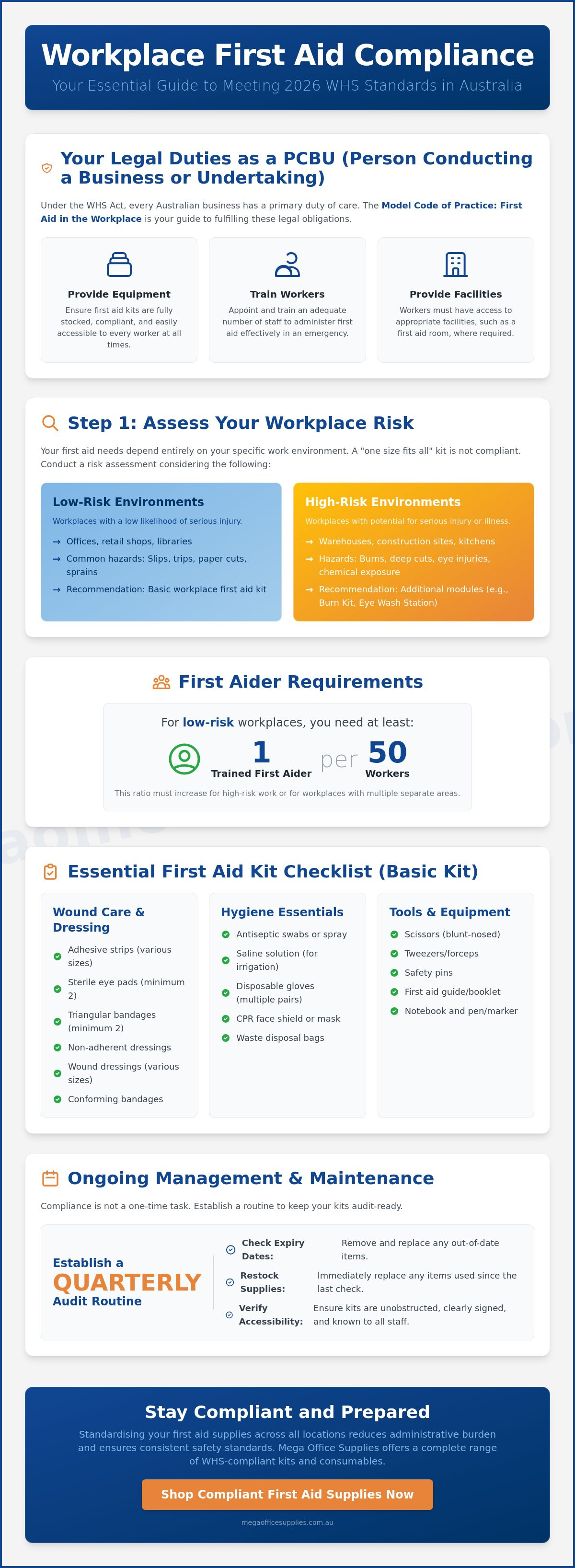
- Learn how the 2026 WHS amendments and the Model Code of Practice define your legal obligations as a PCBU to ensure workplace safety.
- Access a comprehensive checklist detailing exactly what should be in a workplace first aid kit Australia to address wound care, hygiene, and emergency tools.
- Master a step-by-step framework for conducting a risk assessment to identify specific hazards, from warehouse machinery risks to kitchen burns.
- Understand the 1:50 first aider ratio for low-risk sites and establish a quarterly audit routine to manage stock levels and expiry dates.
- Discover how standardising your first aid supplies across all national locations reduces administrative burden and lowers long-term costs.
Understanding Australian WHS Compliance for First Aid
The Work Health and Safety (WHS) Act places the primary duty of care on the Person Conducting a Business or Undertaking (PCBU). This definition includes employers, sole traders, and partners who manage a workplace. Under these regulations, a PCBU is legally obligated to provide adequate first aid equipment and facilities for every worker. Determining exactly what should be in a workplace first aid kit Australia is the first step in fulfilling this legal duty. A PCBU must ensure:
- First aid equipment is provided and remains accessible to each worker.
- An adequate number of workers are trained to administer first aid.
- Workers have access to facilities for the administration of first aid.
In 2026, the Model Code of Practice: First Aid in the Workplace serves as the definitive guide for meeting these obligations. While Safe Work Australia provides the national framework, recent changes have increased the stakes for businesses. In New South Wales, compliance with approved Codes of Practice became mandatory on July 1, 2026. This means that failing to meet the standards outlined in the Code is now a direct breach of law, potentially leading to civil penalty proceedings. Maintaining a consistent standard across all your sites ensures your organisation remains compliant regardless of state borders.
To better understand how to maintain your equipment correctly, watch this helpful video from St John Queensland:
Your Legal Duties as an Australian Employer
Your responsibilities as an employer involve more than a one-time purchase. You must ensure that first aid facilities are accessible to all staff at all times. This includes personnel working night shifts, overtime, or those based at remote sites. When determining The Essential Workplace First Aid Kit Checklist for your specific location, you must consult with your workers. They provide the best insight into the daily hazards they face, whether it is high-volume paper handling in a government office or heavy machinery operation in a warehouse. This consultation is not just good practice; it is a legal requirement under the WHS Act.
The Definition of "Adequate" First Aid
The term "adequate" is intentionally flexible because a standard office doesn't face the same risks as a commercial kitchen or a construction site. When deciding what should be in a workplace first aid kit Australia, you must perform a risk assessment that considers the nature of the work, the size of the workforce, and the distance to the nearest medical facility. The 2026 safety standards for workplace consumables demand that all items are sterile and within their expiry dates. The primary goal of first aid is preserving life and promoting recovery. You can find a range of compliant first aid supplies to suit various industries, ensuring your organisation stays ahead of safety audits and protects its most valuable asset: its people.
The Essential Workplace First Aid Kit Checklist
While the risk assessment discussed in the previous section dictates the final inventory, every Australian workplace requires a baseline of supplies to manage common injuries. For low-risk environments like offices or retail centres, a standardised "Basic" kit serves as the foundation of your safety strategy. When evaluating what should be in a workplace first aid kit Australia, procurement officers must prioritise the durability of the container. It should be high-visibility green, dust-proof to maintain the sterility of the contents, and ideally wall-mountable in a central location. A standard office typically requires one kit for every 50 employees, but this density must increase if your staff are spread across multiple floors or separate buildings.
Wound Care and Dressing Essentials
The bulk of your kit will focus on managing cuts, grazes, and minor burns. You must include adhesive strips in various sizes to accommodate different injuries. For more significant incidents, sterile eye pads and triangular bandages are required for limb support or head injuries. Non-adherent dressings and gauze swabs are critical for sensitive wounds because they won't stick to the injury during removal. Ensure you have a supply of adhesive tape and crepe bandages of varying widths to secure these dressings firmly in place. Maintaining these items in sterile, individual packaging is a core requirement for Australian WHS Compliance for First Aid.
Hygiene and Protective Equipment
Protecting the first aider is just as important as treating the patient. Your kit must contain disposable nitrile gloves. We recommend nitrile over latex to avoid potential allergic reactions among your staff. Hygiene is further maintained through antiseptic swabs and saline solutions, which are used for wound irrigation to remove debris before dressing. For emergency situations, resuscitation masks or face shields with one-way valves are mandatory for performing CPR safely. These items prevent the transfer of fluids and ensure the first aider can act confidently during a crisis.
Tools and Documentation
A compliant kit is not complete without the necessary hardware and record-keeping tools. Stainless steel scissors and splinter forceps provide the manual precision needed for treatment. You should also include safety pins and a thermal blanket to manage patients suffering from shock or exposure. Finally, every kit must contain a first aid logbook. Recording every incident, no matter how minor, is essential for your WHS compliance and helps identify recurring hazards in your workplace. If you need to restock your supplies, you can browse our range of professional grade first aid kits to ensure your site remains compliant and prepared for any emergency. Understanding what should be in a workplace first aid kit Australia allows you to build a scalable safety system that grows with your business.
Assessing Your Specific Workplace Risks and Hazards
A standard kit provides a baseline, but the 2026 WHS standards require a tailored approach for every site. Conducting a first aid risk assessment is a practical process that determines the exact scale and contents of your medical supplies. You should begin by walking through your site to identify potential injury points. This assessment ensures that your answer to what should be in a workplace first aid kit Australia is based on real-world hazards rather than generic guesses. A robust 2026 framework for this assessment includes:
- Identify Hazards: Look for physical, chemical, and biological risks specific to your industry.
- Assess Risk Levels: Determine the likelihood of an injury occurring and its potential severity.
- Determine Controls: Decide which first aid modules are required to manage those specific risks.
- Review Regularly: Re-evaluate your needs whenever you change workplace layouts or introduce new equipment.
Location and access are critical factors in your assessment. If your staff work in a multi-level building, you must ensure a kit is accessible on every floor. The general rule is that a first aider should be able to reach a kit within two minutes of an incident. For mobile employees or those working in remote areas, vehicle-based kits are mandatory. These portable units must be secured within the cabin and protected from extreme Australian heat, which can degrade the adhesive properties of bandages and the efficacy of sterile solutions over time.
Office vs. Industrial Risk Profiles
Low-risk environments like corporate offices or retail outlets typically face minor injuries such as trips or small cuts. However, the staff kitchen remains a high-risk zone in even the safest office. Burn modules containing hydrogel dressings are essential here to manage scalds from boiling water or steam. Conversely, high-risk industrial sites must prepare for more severe trauma. These environments require larger quantities of heavy-duty dressings and specialised equipment to manage deep lacerations or crush injuries common in the manufacturing and construction sectors. Sales representatives and delivery drivers should also carry compact vehicle kits to ensure they aren't left without supplies while on the road.
Specialised Modules for Specific Hazards
Specialised modules allow you to expand your kit's capabilities without replacing the entire unit. Burn modules are a primary example, providing hydrogel dressings that cool the skin and provide a barrier against infection far more effectively than water alone. If your facility stores or uses cleaning chemicals, eye wash stations are a non-negotiable requirement. These stations provide a continuous flow of saline or water to flush out irritants immediately, preventing permanent ocular damage. For regional work sites or outdoor environments, adding a snake bite module with specialised compression bandages is a vital precaution. By addressing these specific hazards, you ensure that what should be in a workplace first aid kit Australia is perfectly matched to your team's daily environment.
Management, Maintenance, and First Aider Requirements
Hardware alone cannot guarantee safety. Effective management relies on the human element, specifically your trained first aiders. In low-risk environments, the mandatory ratio is one first aider for every 50 workers. This requirement increases to one for every 25 staff in high-risk settings. These designated officers carry the weight of responsibility for both emergency response and equipment maintenance. Part of their role involves understanding what should be in a workplace first aid kit Australia to ensure the inventory remains compliant with 2026 WHS standards. A kit is only an asset if it is fully stocked and managed by someone who knows how to use it.
First Aid Training and Certification
Staff members must hold a nationally recognised statement of attainment to be considered a compliant first aider. The current standard is the unit HLTAID011 - Provide First Aid. While the certificate is valid for three years, the CPR component (HLTAID009) requires a refresher every 12 months to maintain proficiency. In 2026, many organisations are moving beyond basic compliance by integrating these skills into their broader workplace wellness initiatives, fostering a culture where safety and health are prioritised across every department.
Kit Maintenance and Restocking Protocols
A kit with missing or expired items is a liability. You should establish a formal schedule for quarterly audits to verify that all components are sterile and functional. Sterile items like saline solution, eye pads, and bandages have specific expiry dates that must be monitored closely. If an item is used during an incident, it must be replaced immediately. This proactive approach ensures your facility remains ready for an inspection at any time. When conducting your audit, refer back to your checklist of what should be in a workplace first aid kit Australia to confirm no specialised modules have been depleted.
Signage and Accessibility
Visibility saves lives during a crisis. Australian standards require standardised green-and-white signage to clearly mark the location of every kit. These signs must be mounted at a height that is visible over partitions and furniture. Strategic placement is equally important. You should install first aid kits in high-traffic areas and near known hazard zones, such as the staff tea room or heavy equipment bays. This ensures that the time between an injury occurring and treatment beginning is minimised.
Ensure your organisation is prepared by viewing our range of professional first aid supplies designed for high-volume workplaces.
Streamlining Your First Aid Procurement with Mega Office Supplies
Managing a single office is a straightforward task, but overseeing safety across a national network of branches requires a high-capacity logistical partner. When you determine what should be in a workplace first aid kit Australia for your organisation, standardising those contents across every site is the most efficient way to maintain compliance. This approach ensures that a first aider moving between a Melbourne warehouse and a Brisbane head office will find an identical layout in every medical cabinet. Mega Office Supplies provides the scale and regional expertise needed to facilitate this level of consistency, drawing on our team's decades of combined industry experience to support your procurement goals.
Standardisation for National Operations
Centralising your safety spend allows you to monitor compliance levels in real-time. By ordering identical kits for every branch, you simplify the training process and make quarterly audits more predictable. This efficiency reduces the administrative burden on your local managers and ensures that no site falls behind the 2026 WHS requirements. Our distribution network is built to handle high-volume demands without friction, allowing you to monitor your total safety investment from a single account. This level of organisation is essential for government departments and large corporations that value stability and financial transparency.
Beyond the Kit: A Total Facility Solution
A safe workplace involves more than just medical supplies. Integrating your first aid needs with other essential categories creates a more resilient environment. You can bundle your medical kits with stationery supplies and janitorial products to streamline your monthly deliveries and reduce shipping costs. For a comprehensive approach to staff health, consider pairing your first aid infrastructure with ergonomic office chairs to prevent long-term musculoskeletal injuries before they occur. This proactive strategy reduces the likelihood of workplace incidents and promotes a culture of genuine care.
Large-scale operations often require a dedicated first aid room to manage more serious incidents. This space needs specific furniture, high-volume PPE, and professional grade cleaning supplies to maintain a sterile environment. Sourcing these items from a single high-capacity provider ensures that every part of your facility meets the same rigorous standards. Understanding what should be in a workplace first aid kit Australia is only the beginning; maintaining that standard through efficient bulk ordering is what keeps your organisation operational and compliant. We are here to act as your dependable partner, providing the manual precision and logistical prowess your business demands.
Securing Your Workplace Safety Standards
Maintaining a compliant workplace requires a proactive commitment to risk assessment and equipment maintenance. By understanding exactly what should be in a workplace first aid kit Australia, you ensure your organisation is prepared for emergencies while meeting the latest 2026 WHS standards. A scalable safety system relies on durable, professional grade supplies and a consistent audit schedule to manage expiry dates effectively. Protecting your staff is not just a legal obligation; it's a fundamental part of a successful business operation.
Mega Office Supplies is a family-owned Australian private company that has been supplying schools, government departments, and businesses since 2005. With a comprehensive range of over 50,000 office essentials, we provide the logistical scale and industry expertise needed to keep your facility fully equipped. You can rely on our established background to deliver the precise hardware and consumables required for your specific risk profile. Browse our range of compliant Workplace First Aid Kits to find the right solution for your site today. Taking these steps now protects your workforce and provides the security of knowing your facility is prepared for any situation.
Frequently Asked Questions
Is it a legal requirement to have a first aid kit in an Australian workplace?
Yes, providing access to first aid equipment is a mandatory legal requirement for all Australian workplaces under the Work Health and Safety (WHS) regulations. This duty falls on the Person Conducting a Business or Undertaking (PCBU) to ensure that every worker has immediate access to a kit and trained personnel. Failing to provide these facilities can result in significant fines and legal liability during safety audits.
How many first aiders are required for an office of 100 people?
In a low-risk office environment with 100 staff, you are required to have at least two trained first aiders. The standard ratio for low-risk sites is one first aider for every 50 workers. If your workplace is classified as high-risk, such as a construction site or warehouse, this requirement doubles to four first aiders to maintain a 1:25 ratio.
What is the Model Code of Practice for first aid in the workplace?
The Model Code of Practice: First Aid in the Workplace is a practical guide developed by Safe Work Australia to help businesses meet their WHS duties. It provides detailed instructions on how to determine what should be in a workplace first aid kit Australia based on your specific industry hazards. While it's a national framework, states like New South Wales have made compliance with these codes mandatory as of 2026.
Can I include medications like Paracetamol in my workplace first aid kit?
Workplace first aid kits shouldn't generally include medications like Paracetamol or Ibuprofen. The primary purpose of a kit is to provide emergency treatment for injuries, not to dispense over-the-counter drugs. Including medications can create risks regarding allergies or incorrect dosages. If a business chooses to provide them, they must be managed separately from the first aid kit and stored in a secure location.
How often should a workplace first aid kit be checked and restocked?
You should audit and restock your kit at least every three months to ensure all items are sterile and within their expiry dates. It's also vital to replace any items immediately after they're used in an incident. Regular inspections help you maintain a compliant inventory and ensure that your facility is always prepared for a workplace emergency or an unannounced safety inspection.
Do I need a different first aid kit for a company vehicle?
Yes, a specialised portable kit is required for any company vehicle used for work purposes. These kits are often more compact than those found in a fixed office but must still contain essential wound care and hygiene supplies. Mobile workers face unique risks, especially in remote areas, making it critical to include modules for specific environmental hazards like snake bites or severe burns.
What signage is required for first aid kits in Australia?
Australian standards require that all first aid kits are identified by a clearly visible sign featuring a white cross on a green background. These signs must be positioned so they're easily seen from a distance, even in large warehouses or multi-level offices. Proper signage ensures that staff can locate medical supplies quickly during a crisis, reducing the time between an injury and treatment.
Who is responsible for maintaining the first aid kit in the office?
The PCBU holds the ultimate legal responsibility for ensuring first aid kits are maintained and compliant. In practice, this duty is usually delegated to a designated first aid officer or a procurement manager. This individual is responsible for checking stock levels, monitoring expiry dates, and ensuring that what should be in a workplace first aid kit Australia matches the findings of the site's latest risk assessment.
Article by
Mega Office Supplies Team
The Mega Office Supplies Team provides practical guidance for Australian businesses, schools, government organisations, healthcare providers, hospitality venues, warehouses and home offices. Based in Tweed Heads South, Mega Office Supplies is a family-owned and operated Australian business offering office stationery, workplace furniture, technology products, labels, printers, cleaning and janitorial supplies, safety products, art materials, education resources and everyday business essentials from trusted brands.
General Information
This article is provided as general information only to help customers compare and choose office, workplace, school, cleaning, technology, furniture, safety and business supplies. Product details, specifications, compatibility, availability, pricing and suitability may vary. Always check the individual product page, manufacturer information, workplace requirements and relevant safety guidance before purchasing or using a product.


