

Could the choice to go green actually be the reason your office printer keeps jamming and requiring expensive maintenance? Most procurement officers worry that switching to recycled stock means sacrificing quality or dealing with excessive paper dust that clogs delicate internal machinery. When weighing up recycled copy paper vs standard A4, it's easy to feel caught between corporate social responsibility and the practical need for high-volume reliability. You don't want to choose an option that saves the planet but stalls your organisation's productivity.
We understand that stability and performance are your top priorities when managing a busy office, school, or government department. This guide promises to clarify the technical differences between these two options so you can choose with confidence. We will look at how modern manufacturing has closed the performance gap and explain why the 2026 National Packaging Targets are making sustainable choices more critical for Australian businesses. From printer health to meeting the new 5% contamination standards for paper waste effective from July 2026, you will get the facts needed to secure your supply chain without the guesswork.
Key Takeaways
- Learn how modern CIE Whiteness standards and consistent 80gsm weights ensure that contemporary recycled options match the professional appearance of virgin fibre paper.
- Identify the factors that prevent printer jams, such as paper curl and moisture content, to ensure your high-speed duplex machines remain operational.
- Evaluate the specific benefits of recycled copy paper vs standard A4 based on real-world performance metrics rather than outdated myths regarding paper dust.
- Decipher Australian environmental labels, including FSC and Carbon Neutral certifications, to ensure your procurement strategy aligns with the 2026 National Packaging Targets.
- Establish a low-risk transition plan for your workplace using phased rollouts and internal testing to maintain staff satisfaction and operational efficiency.
The A4 Dilemma: Performance vs Sustainability in the Modern Office
Procurement officers in Australian workplaces often face a choice that feels like a trade-off. Choosing between recycled copy paper vs standard A4 used to be a decision between machine reliability and environmental ethics. This gap has now narrowed significantly. With the transition of Australia's National Packaging Targets from voluntary to mandatory, businesses are now required to integrate higher percentages of recycled content into their daily operations to meet sustainability benchmarks.
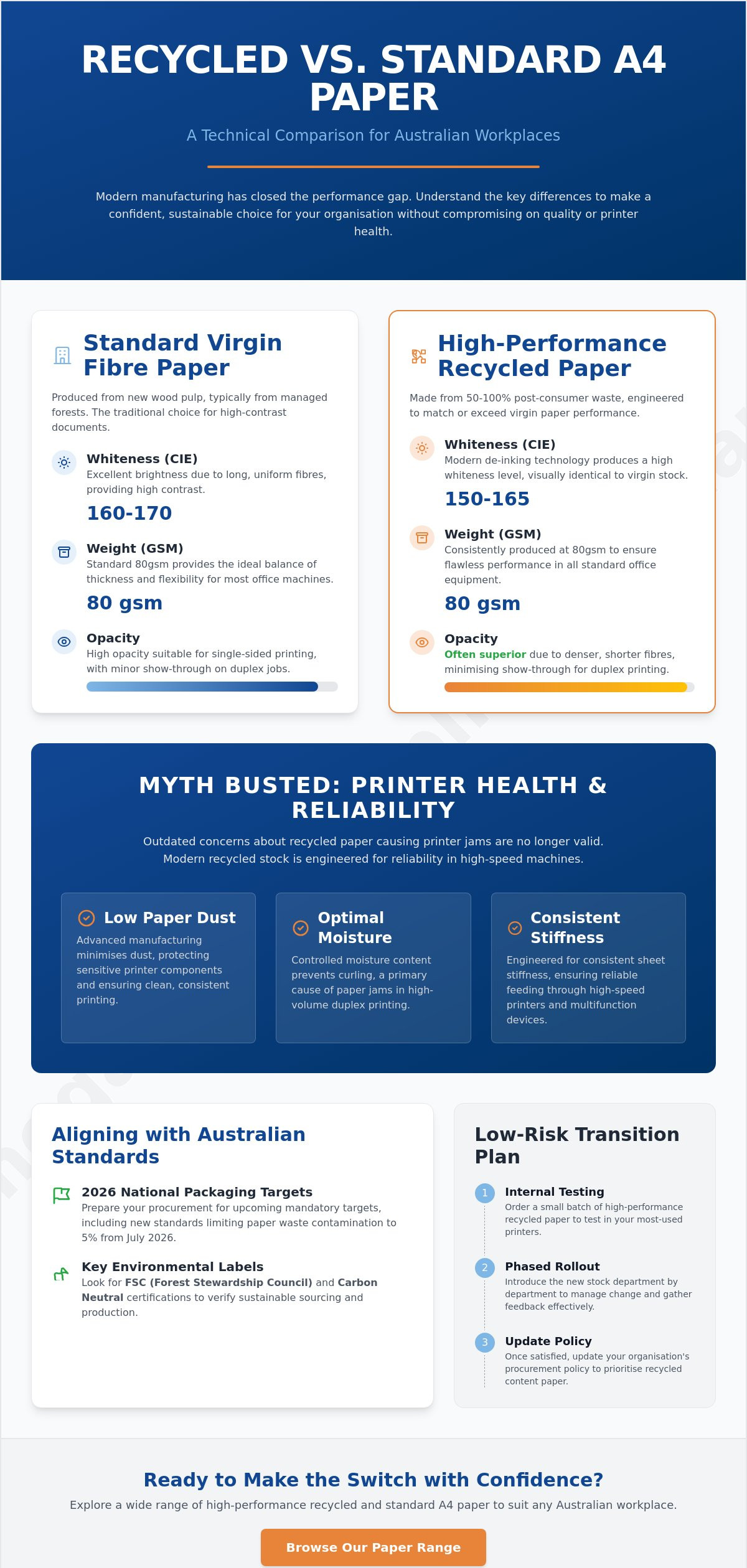
To understand how we arrived at this point, it's helpful to examine the paper recycling process and how it has evolved locally. Historically, recycled stock was associated with greyish tones and high dust levels that could lead to printer downtime. Today, advanced de-inking and fibre-strengthening technologies mean that modern recycled sheets often perform identically to their virgin counterparts in high-speed laser printers and multi-function devices.
Watch this helpful video to see this concept in action:
What Defines Standard A4 Copy Paper?
Standard A4 is produced from virgin wood fibres, typically sourced from managed forests. These fibres are long and strong, providing excellent tensile strength and a high degree of "whiteness" often measured on the CIE scale. For documents requiring the highest level of contrast, such as legal contracts or external marketing presentations, standard paper remains a common baseline. However, the reliance on virgin pulp is becoming less viable as global supply chains shift toward circular economy models. While it's still widely available, the Australian market is seeing increased price volatility as local production shifts toward imported alternatives.
The Rise of High-Performance Recycled Paper
High-performance recycled paper isn't just about reusing old office waste. It involves sophisticated closed-loop systems that maintain fibre integrity through multiple uses. You'll find products ranging from 50% to 100% post-consumer waste, with the latter becoming a standard requirement for many Australian government departments and schools. This shift in office supplies procurement reflects a broader commitment to corporate social responsibility. It also aligns with new regulations, such as the July 2026 export standards which limit paper contamination to 5% by weight, pushing the industry toward cleaner recovery and production cycles.
The Australian office culture has moved beyond the idea that sustainable choices are a compromise. Modern recycled paper is engineered to handle high-volume duplex printing without the curling or jamming issues that plagued earlier versions. By choosing high-recycled-content stock, organisations can meet their CSR goals while maintaining the operational efficiency required for a productive workplace.
Technical Specifications: Whiteness, GSM, and Opacity Compared
Technical performance is defined by three key metrics: whiteness, weight, and opacity. When evaluating recycled copy paper vs standard A4, professional buyers must look beyond the marketing and focus on the technical data sheets. Modern manufacturing has largely erased the visual gap between these two categories. You'll find that technical benchmarks for stiffness and ink absorption are now remarkably consistent across both virgin and recycled stocks.
Opacity is the measure of how much light passes through a sheet. This is a critical factor for double-sided printing. Recycled fibres often provide superior opacity compared to virgin pulp. The slightly shorter fibres in recycled stock create a denser sheet. This reduces "show-through" when printing high-density graphics or bold text on both sides. Inkjet users will find that modern recycled paper has been treated to ensure fast drying times. This prevents smudging in high-volume output trays.
Whiteness and Professional Presentation
The CIE Whiteness index is the industry standard for measuring paper shade. Standard virgin paper typically sits between 160 and 170 CIE, offering a crisp, blue-white finish. High-grade recycled options now regularly achieve 150 CIE or higher. This level of whiteness provides excellent contrast for colour documents. Most staff cannot distinguish between the two when viewing a standard business letter. You might reserve the highest CIE paper for external client proposals while using standard recycled stock for internal records and draft reports.
Weight and Durability (GSM)
In Australia, 80gsm (Grams per Square Metre) remains the preferred weight for general office use. This weight provides the necessary stiffness for reliable feeding in multi-function printers. Fibre density plays a vital role in how a document feels in the hand. It also impacts how well sheets withstand being punched and stored in lever arch files for long-term archiving.
Choosing the right balance of whiteness and weight ensures your documents look professional while meeting your sustainability targets. Comparing recycled copy paper vs standard A4 often reveals that the functional differences are minimal for standard office tasks. If you're ready to update your inventory, you can browse our full range of A4 copy paper to find the right specification for your hardware.
Machine Compatibility and the Truth About Printer Health
Reliability is the non-negotiable metric for any high-volume office or busy reception area. The primary concern for procurement officers when comparing recycled copy paper vs standard A4 is often the fear of increased maintenance costs or sudden machine failure. Historically, recycled stock was prone to shedding microscopic fibres, commonly known as paper dust, which could accumulate on pickup rollers and optical sensors. Modern milling processes have largely eliminated this issue. Contemporary recycled paper is surface-treated to ensure fibre lock, meaning it produces no more debris than standard virgin stock.
Machine rollers rely on precise friction to pull a single sheet from the tray. Standard A4 is known for its consistent surface texture, but high-quality recycled alternatives now offer comparable grip levels. Internal mechanics like fuser units and drums are designed to handle 80gsm stock regardless of the fibre source. Using a reputable brand ensures that the paper's moisture content is controlled. This is the most critical factor in preventing static and ensuring a smooth path through the internal transport system. It's a simple way to maintain the longevity of your hardware without sacrificing your sustainability goals.
Preventing Paper Jams in High-Volume Copiers
Paper jam risks are more closely linked to moisture levels and storage conditions than the recycled content itself. Standard paper and recycled variants both react to humidity, which causes "paper curl" as the sheet passes through the high-heat fuser unit. Modern printers often include de-curling technology to counteract this effect. When first introducing recycled reams to your fleet, we recommend testing a single carton across different machine models to monitor performance during high-speed duplex tasks. This allows you to verify that your specific office technology handles the stock without friction.
Managing Paper Dust and Maintenance
While dust levels are now minimal, routine maintenance remains essential for any organisation running high volumes. Oxygen-bleached recycled paper is preferable as it reduces chemical residue that can impact drum life over time. If your workplace uses 100% recycled stock exclusively, consider a slightly more frequent cleaning schedule for your pickup rollers. Wiping these components with a lint-free cloth can prevent the minor build-up that leads to multi-sheet feeding issues. Don't forget to consult with your managed print service provider to ensure your maintenance contract covers the use of sustainable A4 copy paper without affecting your warranty terms. This proactive approach ensures your equipment stays in peak condition while you transition to greener alternatives.
Navigating Australian Environmental Certifications
Procurement audits require verifiable data rather than vague environmental claims. When you evaluate recycled copy paper vs standard A4, the logos on the ream act as your primary defence against greenwashing. These certifications provide a transparent chain of custody. They ensure that the paper you buy for your organisation actually meets the environmental standards required for annual sustainability reporting and compliance with the 2026 National Packaging Targets.
Australian businesses should also look for the Climate Active Carbon Neutral certification. This indicates that the greenhouse gas emissions associated with the paper's entire lifecycle have been measured, reduced, and offset. For organisations aiming to hit net-zero targets, this is a critical differentiator. It's often the deciding factor when choosing between standard virgin stock and high-performance recycled alternatives for high-volume use.
FSC and PEFC in the Australian Context
FSC (Forest Stewardship Council) remains the most recognised global standard for responsible forestry. It guarantees that the timber used is harvested from forests managed with strict social and environmental criteria. In Australia, you'll also frequently see the PEFC (Programme for the Endorsement of Forest Certification) logo, which often incorporates the local Responsible Wood standard. While both systems promote sustainability, FSC is often the preferred choice for government departments due to its rigorous auditing process. Ensuring your stationery supplies carry these marks is a vital step in any professional procurement strategy.
Imported paper stocks may also carry the Blue Angel or EU Ecolabel. These European standards are among the world's strictest, covering chemical use, water consumption, and energy efficiency during the manufacturing process. While they aren't Australian-born, they're highly regarded in local corporate audits as evidence of a low-impact supply chain.
The Role of Post-Consumer Waste
The distinction between post-consumer and pre-consumer waste is vital for true circularity. Pre-consumer waste consists of industrial offcuts from the paper mill that never reached a customer. While recycling these is efficient, it doesn't directly address the volume of waste in the community. Post-consumer waste is paper that has been used in homes or offices and returned through the recycling loop. Achieving 100% post-consumer recycled content is the gold standard for circularity. It's the benchmark for businesses serious about meeting the 2026 mandate for an average of 50% recycled content across all packaging and paper products.
You can view our range of certified A4 copy paper to find products that align with your specific sustainability reporting requirements and corporate goals.
Implementation Strategy: Transitioning Your Workplace
Successfully moving to a sustainable paper model requires more than just a change in your procurement catalogue. It involves managing staff expectations and refining logistical workflows. A "blind test" in the staff room is a practical way to gauge reception. Load one tray with standard A4 and another with 100% recycled stock without identifying labels. In most cases, users won't notice a difference in print quality or tactile feel. This internal data provides the confidence needed to move forward with larger volumes without fear of pushback.
We recommend a phase-in approach. Start by using recycled stock for internal documents, drafts, and administrative filing. This method allows your team to get used to the new stock while you monitor machine performance. Educating staff on the "why" behind the switch is also essential for buy-in. Remind them that these changes align with the mandatory 2026 National Packaging Targets. It also ensures your organisation is prepared for the July 2026 export standards which limit paper contamination to 5% by weight. Clear communication turns a procurement change into a shared corporate achievement.
Cost-Benefit Analysis for Procurement
When evaluating recycled copy paper vs standard A4, the initial price per ream is only one part of the equation. While recycled reams may carry a small premium, the brand reputation value and ESG credits often outweigh the direct cost. Businesses can mitigate these costs by leveraging office supplies bulk purchasing. Ordering by the pallet rather than the carton reduces delivery frequency. This lowers your overall carbon footprint and secures more competitive rates. It's a logistical win that supports both your budget and your sustainability goals.
Setting Up Your Sustainable Printing Hub
Organising your stationery cupboard is the final step in a successful transition. Clearly label printer trays so staff know which one contains recycled stock for internal use and which holds premium virgin paper for external correspondence. This system reduces waste and ensures the right material is used for the right task. You can integrate these paper choices with other facilities and breakroom sustainability efforts, such as centralised recycling stations. Creating a dedicated sustainable printing hub reinforces your organisation's commitment to efficiency and environmental responsibility. It shows that your workplace is modern, organised, and ready for the future of Australian business.
Securing Your Workplace Supply Chain for a Sustainable Future
The decision between recycled copy paper vs standard A4 is no longer a trade-off between performance and ethics. Modern manufacturing ensures that sustainable alternatives match virgin stock in whiteness, opacity, and machine reliability. With the 2026 National Packaging Targets now in effect, integrating recycled content is a practical necessity for any organisation focused on compliance and corporate responsibility. By following a structured transition plan, you can maintain operational efficiency while meeting these new environmental benchmarks.
Mega Office Supplies has been family owned and operated since 2008, ensuring that schools, government departments, and businesses receive reliable products with efficient national delivery. We understand the logistical requirements of high-volume procurement and provide the stability your workplace depends on for daily productivity. Whether you are managing a single office or a national fleet of printers, we have the expertise to support your requirements.
Browse our full range of A4 copy paper and sustainable office solutions to find the right fit for your equipment. We look forward to helping you build a more sustainable and productive office environment.
Frequently Asked Questions
Does using recycled paper void my printer warranty in Australia?
No, using recycled paper will not void your printer warranty as long as the stock meets the manufacturer’s technical specifications for weight and surface finish. Modern recycled brands are engineered to match the exact GSM and stiffness requirements of high-speed laser and inkjet machines. If a mechanical fault occurs, the technician must prove the paper was the direct cause, which is rare with professional-grade recycled reams.
Is recycled paper always more expensive than standard A4?
Not necessarily. While some 100% post-consumer waste products carry a slight premium, the price gap has narrowed significantly. When you compare recycled copy paper vs standard A4 in bulk pallet quantities, the cost difference is often minimal. Many organisations find the reputational value and compliance with the 2026 National Packaging Targets provide a much higher return on investment than the small saving of virgin stock.
Why does some recycled paper look darker or more yellow?
Variation in shade is usually due to the source of the waste material and the specific de-inking process used by the mill. Lower-grade recycled options might retain a slightly greyish hue if they haven't undergone oxygen bleaching. However, high-performance recycled stocks now regularly achieve CIE whiteness levels above 150. This ensures a crisp, professional appearance that is virtually indistinguishable from standard virgin paper for daily office documentation.
Can I use recycled paper for high-quality colour presentations?
Yes, provided you select a high-whiteness grade with a smooth surface finish. Modern recycled paper is treated to handle the heavy ink loads of colour laser printers without smudging or bleeding. Its naturally high opacity often makes it a superior choice for double-sided colour presentations, as it reduces the show-through of dense graphics. This allows you to maintain professional contrast while meeting your organisation’s sustainability reporting goals.
What is the best GSM for everyday office printing?
80gsm remains the industry standard for general office printing across Australia. This weight provides the necessary stiffness for reliable feeding in multi-function devices and high-volume copiers. While heavier weights like 100gsm are used for premium letterheads, 80gsm is the baseline for both standard A4 and recycled variants. It ensures consistent performance in diverse environments, from busy school staff rooms to high-pressure government administrative centres.
How many times can a piece of A4 paper be recycled?
Paper fibres can typically be recycled between five and seven times before they become too short and brittle to form a stable sheet. Each trip through the recycling loop breaks the fibres down slightly. To maintain the professional durability required for office use, manufacturers often blend these recycled fibres with a small percentage of long-fibre virgin pulp to ensure the final product doesn't tear or jam during high-speed printing.
Is "carbon neutral" paper the same as "recycled" paper?
No, these are two different environmental benchmarks. Carbon neutral paper means the total greenhouse gas emissions from the paper’s lifecycle have been measured and offset, regardless of the fibre source. You can find virgin paper that is carbon neutral and recycled paper that is not. For the most sustainable procurement choice, look for products that carry both high recycled content and the Climate Active Carbon Neutral certification.
Does recycled paper cause more "paper dust" in my copier?
Historically this was a valid concern, but modern surface-sizing technology has largely eliminated the problem. When evaluating recycled copy paper vs standard A4 today, you'll find that reputable recycled brands use treatments to lock fibres in place. This prevents the accumulation of microscopic debris on pickup rollers and optical sensors. While regular maintenance is always required for high-volume machines, modern recycled stock is no longer a primary cause of dust build-up.
Article by
Mega Office Supplies Team
The Mega Office Supplies Team provides practical guidance for Australian businesses, schools, government organisations, healthcare providers, hospitality venues, warehouses and home offices. Based in Tweed Heads South, Mega Office Supplies is an Australian business, family owned and operated since 2008, offering office stationery, workplace furniture, technology products, labels, printers, cleaning and janitorial supplies, safety products, art materials, education resources and everyday business essentials from trusted brands.
General Information
This article is provided as general information only to help customers compare and choose office, workplace, school, cleaning, technology, furniture, safety and business supplies. Product details, specifications, compatibility, availability, pricing and suitability may vary. Always check the individual product page, manufacturer information, workplace requirements and relevant safety guidance before purchasing or using a product.


