

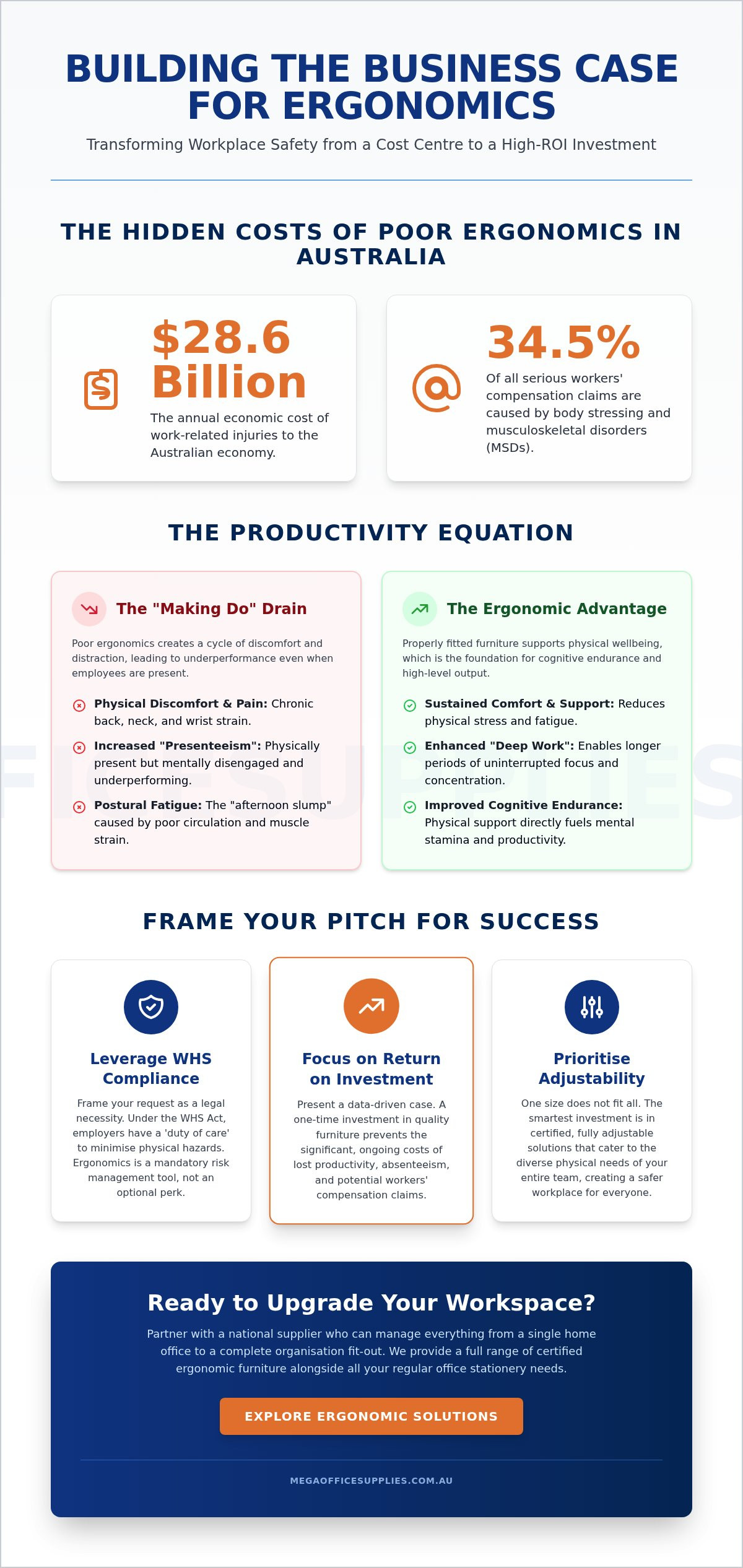
With work-related injuries costing the Australian economy $28.6 billion annually, the real expense isn't the desk you buy, it's the physical toll of poor equipment. If you're struggling with chronic back pain or a sharp drop in productivity every afternoon, you've likely wondered how to convince your boss to buy ergonomic furniture without it sounding like a request for a luxury perk. Most managers view high-quality office furniture as a "nice-to-have" expense, yet body stressing remains the cause of 34.5% of all serious workers' compensation claims in Australia.
We understand that bridging the gap between employee comfort and budgetary approval can be difficult. That's why we've designed this guide to help you build a data-driven business case that proves ergonomic furniture is a high-ROI investment for your organisation. You'll learn how to leverage current WHS regulations, utilise tax depreciation facts, and present a professional pitch that focuses on long-term savings. We've even included a clear proposal template to help you move from a sore back to a signed purchase order.
Key Takeaways
- Align your request with the Work Health and Safety (WHS) Act to frame ergonomic furniture as a mandatory risk management tool rather than an optional luxury.
- Learn how to convince your boss to buy ergonomic furniture by presenting a data-driven business case that highlights the high ROI of preventing musculoskeletal disorders.
- Conduct a thorough workplace audit to document specific pain points and inefficiencies before proposing a tiered "Good/Better/Best" investment plan.
- Identify the technical specifications required for certified ergonomic solutions, focusing on adjustability to suit the diverse physical needs of your entire organisation.
- Simplify the procurement process by partnering with a national supplier capable of handling high-volume furniture fit-outs alongside your regular office stationery.
The Hidden Cost of Poor Workplace Ergonomics in Australia
Ergonomics is often misunderstood as a luxury office trend, yet its true purpose is rooted in a foundational definition of ergonomics: the science of fitting the workplace to the user, rather than forcing the user to adapt to the workplace. In a professional Australian context, this means designing environments that account for human capabilities and limitations. When you begin researching how to convince your boss to buy ergonomic furniture, it is essential to frame the conversation around risk mitigation and operational efficiency. A standard chair might seem like a cost-saving measure, but if it doesn't support the user, it becomes a recurring liability through lost productivity and increased injury risk.
The financial impact of poor ergonomics on Australian organisations is substantial. According to data from May 2026, the total economic cost of work-related injuries in Australia reaches $28.6 billion annually. For a business owner or procurement officer, the one-time cost of a high-quality ergonomic chair or standing desk is negligible when contrasted with the potential for thousands of dollars in lost billable hours or rising workers' compensation premiums. Investing in ergonomic furniture is a strategic move to protect the organisation's most valuable asset: its people.
To better understand this concept, watch this helpful video:
Understanding Musculoskeletal Disorders (MSDs)
Musculoskeletal Disorders, or MSDs, encompass a range of conditions including carpal tunnel syndrome, tendonitis, and chronic lower back pain. Safe Work Australia reports that body stressing remains the primary cause of serious workers' compensation claims, accounting for 34.5% of all cases. These injuries are often the result of static posture, where non-ergonomic furniture forces the body into awkward positions for hours at a time. This lack of movement and support accelerates wear on joints and soft tissues; eventually leading to serious medical intervention and lengthy absences from the workplace.
The Productivity Drain of "Making Do"
Beyond physical injury, poor ergonomics fuels a phenomenon known as "presenteeism," where employees are physically at their desks but underperforming due to persistent discomfort. When a staff member is distracted by a stiff neck or a sore back, they take frequent micro-breaks and struggle to achieve "deep work" states. The common "afternoon slump" is frequently a result of postural fatigue and poor circulation caused by inadequate seating. Physical support is the direct precursor to cognitive endurance. If an employee is comfortable, they can maintain focus for longer periods, directly impacting the bottom line of the organisation. Learning how to convince your boss to buy ergonomic furniture involves proving that comfort is the engine of high-level output.
Building the Business Case: ROI and WHS Compliance
Securing approval for new equipment requires moving the conversation from employee comfort to corporate compliance. When you are preparing how to convince your boss to buy ergonomic furniture, focus on the legal framework governing Australian workplaces. Under the model Work Health and Safety (WHS) Act, employers must ensure the health and safety of workers so far as is reasonably practicable. This isn't a suggestion. It's a primary duty of care. Failing to address known physical hazards, such as poorly configured workstations, exposes the organisation to significant legal and insurance liabilities.
Duty of Care and Legal Obligations
Australian law places the burden of risk management on the employer. This includes identifying and minimising the risk of musculoskeletal injuries before they occur. From July 1, 2026, compliance with approved Codes of Practice in New South Wales will be mandatory, meaning businesses must either follow these codes or prove they manage hazards to an equal or higher standard. Mentioning risk mitigation during a budget review is a powerful tactic. It frames the purchase of ergonomic chairs as a necessary step to prevent future legal proceedings or civil penalty claims initiated by unions or regulators.
Calculating the Return on Investment (ROI)
The financial logic for an upgrade is equally compelling. Research into the return on investment (ROI) of ergonomics demonstrates that even marginal productivity gains quickly offset equipment costs. A 1% increase in daily output, often achieved simply by reducing postural fatigue and the need for frequent stretching breaks, can pay for a high-quality task chair within months. When pitching, shift the focus toward the total cost of ownership. A cheap chair that requires replacement in two years is far more expensive than a professional-grade solution that lasts a decade.
Consider the cost of a single lost-time injury. In 2023-24, Australia saw 146,700 serious workers' compensation claims, with a median time lost of 7.4 weeks per claim. The price of a standing desk is a fraction of the cost associated with nearly two months of lost productivity and the subsequent rise in insurance premiums. Proactive injury prevention is a tactical financial decision. Providing a supportive environment also serves as a powerful retention tool, signaling that the organisation values its staff's long-term health. If you are ready to present a range of options, you can browse our workplace furniture solutions to find models that meet Australian standards.
Identifying the Right Solutions for Your Organisation
Successful procurement requires a systematic approach rather than a reactive one. When evaluating how to convince your boss to buy ergonomic furniture, it's effective to present a clear hierarchy of needs, often referred to as the "Ergonomic Pyramid." This framework prioritises investments that offer the highest impact on physical health and operational output. The foundation of this pyramid is the chair, followed by the desk, and finally, the specific accessories that fine-tune a workstation for individual requirements. Understanding the technical difference between "standard" office furniture and certified ergonomic solutions is vital for ensuring your pitch is grounded in functional value rather than aesthetics.
Ergonomic Chairs vs. Standard Task Chairs
Standard task chairs often lack the necessary adjustment points to accommodate diverse staff bodies. A professional-grade solution must offer independent lumbar support, adjustable seat depth, and tension control to manage the user's weight effectively. Dynamic seating is a critical feature; it allows the chair to move with the user, which reduces long-term spinal pressure and encourages micro-movements that maintain circulation. "One size fits all" is a myth in office seating. A procurement officer should look for chairs with breathable mesh and multidirectional armrests to ensure long-term durability and comfort. You can find detailed technical specifications in our guide to ergonomic office chairs to help justify the higher upfront cost of certified seating.
The Role of Sit-Stand Desks
Alternating between sitting and standing throughout the workday is a proven method for reducing postural fatigue and improving metabolic health. For large-scale office fit-outs, electric height-adjustable desks are often the most reliable choice due to their ease of use and precise control. Manual desks offer a lower-cost alternative for smaller teams but may be used less frequently due to the effort required to change positions. Implementing sit-stand workstations provides the flexibility needed for modern, agile office environments where different staff members may share the same desk throughout the week.
Essential Ergonomic Accessories
Accessories represent "early wins" in your pitch because they provide immediate relief at a lower price point. Monitor arms are essential for eye-level alignment, which directly reduces neck strain and the headaches associated with poor screen positioning. Footrests and keyboard trays are low-cost entry points that can significantly improve the ergonomics of an existing desk setup. Additionally, document holders minimise repetitive neck rotation for staff who frequently refer to physical paperwork. These tools allow for precise fine-tuning of the workstation, ensuring that the organisation's investment in furniture is fully utilised. Presenting these as part of a comprehensive strategy is key to how to convince your boss to buy ergonomic furniture as a total workplace solution.
A 5-Step Guide to Pitching Your Request
Moving from the theoretical benefits of ergonomics to a physical office upgrade requires a structured, professional approach. When you are determining how to convince your boss to buy ergonomic furniture, you must treat the request as a business proposal rather than a personal grievance. Managers respond to data, risk mitigation, and clear financial pathways. Following a logical sequence ensures your request is taken seriously and fits within the organisation's procurement framework.
- Step 1: Audit and Document. Begin by auditing your current workstation. Track your productivity levels and physical status over a full work week. Note specific times when discomfort forces a break or when concentration begins to slip.
- Step 2: Tiered Quoting. Research specific hardware and prepare a "Good/Better/Best" comparison. This gives decision makers a sense of control over the budget while ensuring even the entry-level option meets Australian ergonomic standards.
- Step 3: Goal Alignment. Connect your request to existing company objectives. If your organisation has a current focus on "Employee Wellbeing" or "Operational Efficiency," use this exact terminology in your pitch.
- Step 4: Formal Meeting. Avoid casual conversations in the staff kitchen. Schedule a formal "Workplace Optimisation" meeting. This signals that you are presenting a professional solution to a business problem.
- Step 5: Propose a Pilot. If there is hesitation regarding a full-office rollout, suggest a pilot program. Testing a single ergonomic workstation for 30 days provides local data to prove the ROI before a larger capital expenditure.
Gathering Your Evidence
Data is the most effective tool in any professional pitch. Beyond tracking your own output, consider collecting anonymous feedback from colleagues to demonstrate that physical fatigue is a widespread issue. This transforms the request from an individual need into a departmental efficiency upgrade. Prepare a comparison sheet using the various Mega Office Supplies furniture categories to show you have done the legwork. Highlighting specific features like AFRDI ratings or extended commercial warranties proves you are looking for long-term durability rather than a quick fix.
The Formal Proposal
The language you use can determine the outcome of your request. Always refer to the project as an "Efficiency Upgrade" or "Infrastructure Optimisation" rather than a "Furniture Request." Your proposal should include technical specifications for the equipment, such as weight capacities and adjustment ranges. Emphasise that commercial-grade furniture is an investment in the building's infrastructure. High-quality seating and desks often carry significant warranties, minimising future replacement costs for the organisation. If you are ready to begin drafting your proposal, you can browse our commercial furniture range to find the technical data needed for your pitch.
Streamlining Procurement with Mega Office Supplies
Selecting a vendor capable of executing a national rollout is the final hurdle in the procurement process. Once you have navigated how to convince your boss to buy ergonomic furniture, the focus shifts to reliability and logistical capacity. Mega Office Supplies positions itself as a seasoned industry veteran with decades of combined experience, offering the stability required by government departments, healthcare providers, and large-scale commercial operations. We understand that procurement officers value functional clarity and efficiency over marketing hype; that's why our system prioritises rapid access to technical specifications and transparent pricing structures.
National Delivery and Support
Centralising your procurement through a single national supplier significantly reduces administrative friction. Our distribution network is built to handle high-volume demands without the delays often associated with smaller, less established retailers. By sourcing your office supplies and furniture from one location, you simplify your accounts payable and logistical tracking. It's a more efficient way to manage a diverse inventory. Our catalogue covers every essential aspect of the modern workplace, from WHS-compliant first aid kits to the latest sit-stand workstations. This breadth ensures that as your organisation grows, your supply chain remains consistent and dependable across every regional office.
Bulk Orders and Commercial Solutions
Standardising furniture across an organisation provides more than just a cohesive aesthetic. It streamlines future maintenance and replacement schedules. For professional buyers, our rapid quoting feature functions as a vital tool for evaluating costs across different tiers of equipment. This efficiency allows you to present finalised figures to management quickly, maintaining the momentum of your initial pitch. We advocate for a comprehensive approach to facilities management where ergonomic support is integrated into every room, from the reception desk to the staff kitchen.
Choosing a partner with proven logistical prowess ensures your furniture arrives on time and according to specification. We've spent years refining our delivery systems to support the specific workflow of professional buyers who need to evaluate quantities and costs without friction. Our local support team provides direct assistance for any technical queries, ensuring you're never dealing with a faceless global competitor. When you're ready to move from a proposal to a physical fit-out, our team is equipped to handle the high-volume demands of any Australian organisation.
Secure Your Organisation's Future Health
Transitioning to a supportive workplace requires a strategic shift in how equipment is viewed. By framing ergonomic furniture as a risk mitigation tool rather than a staff perk, you align your request with the organisation's legal duty of care and financial interests. The data is clear; reducing musculoskeletal strain directly lowers the risk of serious compensation claims and minimises the hidden costs of presenteeism. Learning how to convince your boss to buy ergonomic furniture is ultimately about proving that physical support is a prerequisite for sustained cognitive performance and long-term staff retention.
Mega Office Supplies has been family owned and operated since 2008. We provide the logistical scale needed for national delivery across all office and educational sectors. Our team understands the specific requirements of professional procurement officers who need reliable, commercial-grade solutions that last. Browse our full range of commercial-grade ergonomic furniture to find the technical specifications for your next proposal. Taking these steps today ensures a more productive, resilient workplace for years to come.
Frequently Asked Questions
Is ergonomic furniture a legal requirement in Australia?
Employers have a primary duty of care under the model Work Health and Safety (WHS) Act to ensure a safe environment. Providing equipment that minimises physical strain is a mandatory part of managing workplace risks. Failing to address known hazards like poorly configured desks can lead to legal liabilities and rising insurance premiums. It is an essential component of modern workplace compliance rather than an optional staff benefit.
How much more productive are employees with ergonomic chairs?
Ergonomic chairs increase productivity by eliminating the physical distractions caused by postural fatigue. When a staff member is comfortable, they experience fewer micro-breaks and a reduced "afternoon slump." This leads to higher levels of cognitive endurance and sustained focus throughout the workday. By supporting the body's natural alignment, these chairs help maintain the energy levels required for high-output professional environments.
Can I claim ergonomic furniture on my taxes if I work from home?
Australian taxpayers can generally claim a deduction for ergonomic furniture used for work purposes. Items costing up to $300 are usually deductible in full during the year of purchase. For assets exceeding this amount, you can claim a deduction for the decline in value over time. Eligible small businesses may also utilise the Instant Asset Write-Off scheme to manage these costs effectively. Always consult with a qualified tax professional for specific advice.
What is the most important piece of ergonomic furniture to start with?
The ergonomic chair is the foundational piece of any professional workstation. It provides critical support for the lumbar region and pelvis, which are the areas most susceptible to body stressing injuries. While standing desks and monitor arms are valuable, a high-quality chair is the primary tool for regulating posture and circulation. It is the most effective first step for any organisation looking to improve workplace health.
How do I know if my current office chair is actually ergonomic?
A true ergonomic chair offers multiple independent adjustment points to fit your specific body dimensions. You should be able to modify the seat height, seat depth, lumbar support, and armrest position. If the chair lacks these features or forces you into a static position, it is likely a standard task chair. Professional-grade seating is designed to adapt to the user rather than forcing the user to adapt to the furniture.
What should I do if my boss says there is no budget for ergonomics?
When facing budget resistance, focus on the financial risk of inaction. Presenting data on how to convince your boss to buy ergonomic furniture often means comparing the one-time cost of a desk to the $28.6 billion annual cost of workplace injuries in Australia. Suggest a pilot program or a tiered rollout to spread the expenditure over multiple quarters. This demonstrates a professional approach to facilities management and fiscal responsibility.
Do I need a doctor’s note to get an ergonomic chair at work?
A doctor's note isn't a strict legal requirement, but it provides powerful documentation for your request. It formally identifies a health risk that the employer must address under their WHS duty of care. For procurement officers, a medical recommendation simplifies the approval process by categorising the furniture as a necessary medical or safety requirement rather than a discretionary office expense.
How long does it take to see the benefits of a standing desk?
Many people report an immediate increase in alertness and reduced lower-back stiffness on the first day. However, the long-term benefits of a standing desk, such as improved posture and core strength, typically take two to three weeks to become fully evident. It's important to alternate between sitting and standing in short intervals to allow your body to adapt to the new movement patterns without causing muscle fatigue.
Article by
Mega Office Supplies Team
The Mega Office Supplies Team provides practical guidance for Australian businesses, schools, government organisations, healthcare providers, hospitality venues, warehouses and home offices. Based in Tweed Heads South, Mega Office Supplies has been family owned and operated since 2008, offering office stationery, workplace furniture, technology products, labels, printers, cleaning and janitorial supplies, safety products, art materials, education resources and everyday business essentials from trusted brands.
General Information
This article is provided as general information only to help customers compare and choose office, workplace, school, cleaning, technology, furniture, safety and business supplies. Product details, specifications, compatibility, availability, pricing and suitability may vary. Always check the individual product page, manufacturer information, workplace requirements and relevant safety guidance before purchasing or using a product.


