

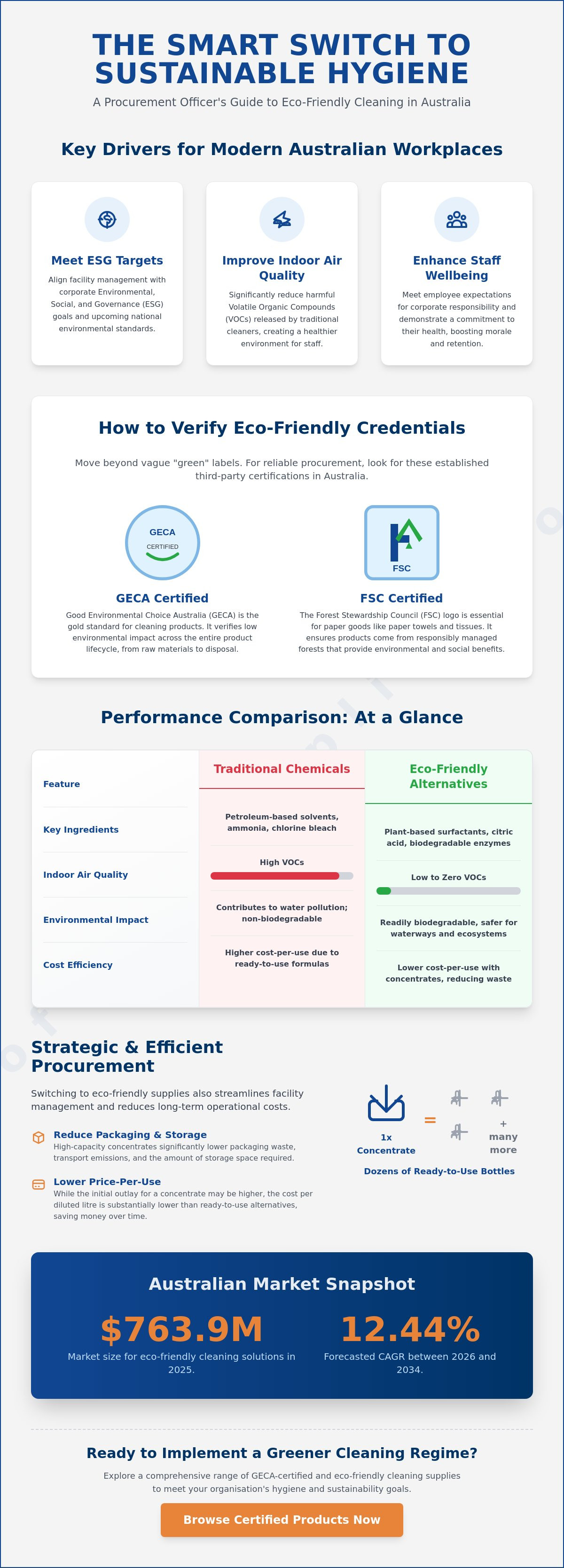
The Australian eco-friendly cleaning solutions market reached USD 763.9 million in 2025, signaling a permanent shift in how national organisations manage their facility maintenance. Most procurement officers understand the urgent need for sustainability, yet they often face the challenge of distinguishing genuine high-performance products from vague, "greenwashed" labels. It's a common concern that moving away from traditional chemicals might compromise hygiene standards or complicate the logistics of bulk supply for multi-site operations.
This guide provides a clear, structured framework to help you transition to eco-friendly cleaning supplies for the office that deliver professional results while reducing your organisation's environmental footprint. We draw on decades of collective industry experience to simplify the selection process for schools, government departments, and corporate centres. You'll learn how to identify compliant GECA-certified essentials, improve indoor air quality for your staff, and implement a procurement strategy that balances rigorous hygiene with long-term commercial efficiency.
Key Takeaways
- Understand the role of sustainable hygiene in meeting corporate ESG goals and improving indoor air quality by minimising harsh VOCs.
- Learn how to verify professional-grade eco-friendly cleaning supplies for the office using recognised standards like GECA and FSC certifications.
- Evaluate the performance of plant-based alternatives against traditional chemicals to ensure workplace hygiene standards remain uncompromised.
- Improve procurement efficiency by switching to high-capacity concentrates and consolidating facility orders to reduce environmental impact and delivery costs.
- Access a structured framework for managing national supply chains using reliable distribution networks and decades of industry expertise.
The Shift Toward Sustainable Workplace Hygiene in Australia
Australian workplace standards are undergoing a significant transformation. The passage of the Environment Protection Reform Bills in late 2025 has accelerated the shift toward ESG (Environmental, Social, and Governance) targets across all sectors. For procurement officers, this isn't just about optics; it's a logistical move toward operational reliability. Adopting Green cleaning protocols allows organisations to meet these new regulatory standards while maintaining rigorous hygiene.
A primary driver for this change is the measurable improvement of indoor air quality. Traditional industrial cleaners often release high levels of Volatile Organic Compounds (VOCs), which can contribute to respiratory issues and reduced productivity. By selecting eco-friendly cleaning supplies for the office, facilities managers can effectively eliminate these irritants. This approach balances the need for high-level sanitisation with biodegradable chemical profiles that are safer for both the user and the local environment.
To better understand the practical application of these solutions, watch this helpful video:
Meeting Staff Expectations for a Greener Office
Australian employees now expect visible evidence of corporate responsibility. Simple changes, such as providing plant-based soaps in staff kitchens or using biodegradable bin liners in reception areas, significantly impact workplace culture. It moves the conversation from hidden janitorial cupboards to transparent sustainability reporting. Staff retention often improves when employees feel their health and values are prioritised in shared spaces.
The Business Case for Eco-Friendly Facility Management
There's a strong financial argument for sustainable facility management. Concentrated formulas and refillable systems reduce long-term costs by lowering the price-per-use and decreasing storage requirements. Minimising chemical sensitivities also reduces the risk of workplace health issues and related absenteeism. Integrating these purchases with your broader office supplies strategy streamlines procurement and reduces delivery miles. With the Australian eco-friendly cleaning market forecasted to grow at a CAGR of 12.44% between 2026 and 2034, moving to sustainable solutions is a prudent hedge against future regulatory changes and rising disposal costs.
Evaluating Eco-Friendly Credentials: What Procurement Officers Must Know
Selecting eco-friendly cleaning supplies for the office requires moving beyond aesthetic marketing and into technical verification. For a professional buyer, "green" is a performance metric, not just a colour scheme. Navigating the sheer volume of eco-labels can be difficult, but focusing on established third-party certifications provides the necessary security for commercial tenders. Resources such as the EPA's guide on Identifying Greener Cleaning Products offer a solid baseline for understanding how these standards are developed and applied internationally.
In Australia, the Good Environmental Choice Australia (GECA) certification is the gold standard for cleaning chemicals. It assesses products across their entire lifecycle, from raw material extraction to disposal. Similarly, the Forest Stewardship Council (FSC) logo is essential when procuring paper-based consumables like paper towels and tissues. These certifications ensure that products meet rigorous environmental and social impact criteria, providing procurement officers with the data needed to justify purchasing decisions to stakeholders.
Understanding chemical terminology is equally important for maintaining workplace safety. Labels such as "Phosphate-Free" and "pH-Neutral" aren't just buzzwords; they indicate a product's impact on local waterways and its safety on delicate office surfaces. Phosphates can cause harmful algal blooms when they enter the drainage system, while pH-neutral formulas minimise the risk of skin irritation for janitorial staff and prevent the degradation of floor finishes and stone benchtops.
Australian Standards and Certifications to Look For
GECA standards are specifically tailored to the Australian market, accounting for local environmental regulations and waste management infrastructure. When reviewing commercial cleaning supplies, look for the GECA seal as a primary indicator of low toxicity and high biodegradability. For paper products, FSC certification confirms that the pulp is sourced from responsibly managed forests. Always verify third-party testing data by requesting the certification number; reliable manufacturers will provide this information readily to prove their claims aren't merely marketing slogans.
Avoiding Greenwashing in Commercial Tenders
Greenwashing remains a significant challenge in the procurement process. Be wary of vague descriptors like "natural," "eco-safe," or "chemical-free." Scientifically, every liquid cleaner is a chemical compound, so the claim of being "chemical-free" is a major red flag. The most reliable way to verify an ingredient profile is to request the Safety Data Sheet (SDS). This document reveals the actual concentration of active ingredients and any potential hazards. Additionally, ensure that claims regarding "recycled" plastic packaging specifically refer to post-consumer waste rather than industrial offcuts, as this represents a more genuine commitment to the circular economy.
Comparing Commercial Cleaning Supplies: Traditional vs. Eco-Friendly Alternatives
Professional procurement involves more than just swapping labels. It requires a rigorous comparison of efficacy and logistical impact. Many buyers worry that eco-friendly cleaning supplies for the office lack the "kill-rate" of traditional sodium hypochlorite (bleach). However, modern lactic acid-based sanitisers often meet the same commercial standards for disinfection while being significantly safer for surfaces and staff. Large-scale institutions, such as those participating in a Sustainable Cleaning Program, demonstrate that plant-based surfactants can outperform petroleum-based alternatives in removing grease and biofilms without leaving toxic residues.
For high-capacity offices, the transition from Ready-to-Use (RTU) bottles to concentrated chemicals is a primary efficiency driver. Concentrates reduce plastic waste by up to 90% and lower delivery costs by minimising the volume of water shipped between warehouses. It's a practical move that supports both sustainability and the bottom line. When selecting these products, ensure they are compatible with existing janitorial equipment. Most modern eco-friendly floor cleaners are formulated to work seamlessly with standard battery-powered sweepers and polishers, preventing the clogging or seal degradation often associated with older, soap-heavy natural formulas.
Surface Cleaners and Sanitisers
Modern plant-based surfactants are engineered to lift dirt and oils using renewable sources like coconut or corn. These offer a distinct advantage over petroleum-based cleaners, which can leave a persistent film on glass and polished desks. In high-traffic staff tea rooms, lactic acid-based sanitisers provide an alternative for food-prep surfaces where bleach exposure is a concern. pH-neutral cleaners maintain a balanced acidity level of 7.0 to ensure they clean effectively without causing chemical etching or long-term damage to expensive timber veneers and stone finishes.
Sustainable Paper Consumables
Choosing between recycled paper and rapidly renewable fibres like bamboo is a key decision for facility managers. While recycled paper is a staple, bamboo offers high durability and softness, making it suitable for premium office environments. Implementing "coreless" rolls in large commercial buildings further reduces waste by eliminating the cardboard tube in every roll. Standardising your facilities and breakroom equipment is the most effective way to reduce paper waste, as modern controlled-dispense systems prevent users from pulling excessive lengths of paper towel or toilet tissue.
Strategic Procurement: Bulk Buying and Facility Management Efficiency
Managing high-volume distribution for Australian businesses requires more than just a large warehouse. It demands a sophisticated logistical flow that prioritises reliability and minimises environmental impact. Procurement officers often struggle with the fragmented nature of workplace maintenance, but consolidating your orders for eco-friendly cleaning supplies for the office into a single shipment is a highly effective way to reduce "delivery miles". Mega Office Supplies leverages decades of combined industry experience to handle these complex requirements, allowing organisations to receive stationery, kitchen essentials, and cleaning chemicals in one coordinated delivery.
Implementing a "refill station" model is another strategic move for multi-floor facilities. Instead of purchasing individual spray bottles for every desk or tea room, procurement teams should purchase bulk containers to refill reusable dispensers. This model drastically reduces single-use plastic waste and lowers the cost-per-litre for high-performance chemicals. It's also vital to integrate your cleaning procurement with your broader safety and first aid protocols. Ensuring that Safety Data Sheets (SDS) are accessible and that janitorial staff have the correct PPE is a fundamental part of responsible facility management.
Consolidating Your Workplace Supplies
Administrative overhead drops significantly when you source coffee and tea supplies alongside your eco-friendly dish soap and multi-purpose cleaners. Bulk ordering doesn't just reduce packaging waste; it simplifies the reconciliation process for accounts departments. Setting up a predictable replenishment cycle for high-use items like bin liners and hand sanitiser ensures that your facility never runs short of essentials. This structured approach allows for better budget forecasting and reduces the need for emergency, high-emission courier deliveries.
Staff Engagement and Workplace Education
The success of any sustainable cleaning regime depends on clear communication. Use signage and colour-coding to help cleaning staff and employees distinguish between different eco-products. Encouraging the use of reusable microfibre cloths over disposable paper towels in the staff kitchen is a simple change that yields significant waste reduction. You can also utilise professional stationery supplies Australia to organise your cleaning cupboard. Labelling systems and organised binders for maintenance logs ensure that your sustainability efforts are documented and easy for staff to follow.
Browse our full range of commercial cleaning and facility supplies here.
Implementing a Greener Cleaning Regime with Mega Office Supplies
Transitioning to eco-friendly cleaning supplies for the office requires a partner who understands the logistical pressures of Australian workplaces. Mega Office Supplies curates a catalogue that balances environmental responsibility with professional performance. We provide access to a massive range of facilities and breakroom chemicals and equipment. This ensures that your organisation doesn't have to compromise on hygiene to meet sustainability goals. Our scale allows us to provide high-capacity solutions that are often unavailable through smaller, niche providers.
Our operation combines national scale with a grounded, local touch. We provide direct assistance to procurement officers across Australia, from metropolitan corporate centres to regional educational supplies hubs. We understand the specific administrative workflows of the government, education, and commercial sectors. This allows us to offer streamlined quoting and ordering processes, facilitating rapid cost evaluation for high-volume demands. We prioritise speed of fulfilment, ensuring that your supply chain remains robust and responsive to workplace needs.
Why Reliability Matters in Eco-Procurement
Reliability is the cornerstone of any facility management strategy. As a family owned and operated business since 2008, we prioritise fast dispatch of critical hygiene items to avoid workplace disruptions. Eco-procurement shouldn't mean waiting for niche imports. It should mean having access to professional-grade solutions that stand up to the rigours of high-traffic commercial environments. This proven track record gives administrators the security they need when managing multi-site facilities. We focus on manual precision in our product selection, choosing hardware and chemicals that deliver results the first time.
Next Steps for Your Organisation
Implementing a greener regime is a tiered process. We recommend starting with a comprehensive waste audit of your current cleaning cupboard to identify redundant or high-VOC chemicals. From there, trial concentrated eco-formulas in a single department to benchmark performance before a national roll-out. This methodical approach minimises risk and allows for staff feedback. For a tailored facilities management quote or to discuss specific product specifications, contact the Mega Office Supplies team directly on our regional support line. We're here to provide the direct assistance needed to make your transition to sustainable cleaning both efficient and cost-effective.
Strengthening Your Workplace Sustainability Strategy
Transitioning to a sustainable hygiene model is a practical step toward meeting modern ESG targets and improving the daily environment for your staff. By prioritising verified certifications like GECA and switching to high-capacity concentrates, procurement officers can maintain rigorous sanitisation standards while minimising chemical waste. Consolidating your orders for eco-friendly cleaning supplies for the office with your broader facility needs reduces delivery miles and streamlines administrative workflows.
Mega Office Supplies provides national delivery across Australia and remains a trusted partner for the government, education, and healthcare sectors. Our extensive catalogue ensures that you have access to professional-grade solutions that stand up to the demands of any commercial environment. It's about finding the right balance between high-performance chemistry and environmental responsibility.
Browse our full range of professional cleaning and facility supplies to begin your transition toward a more responsible and efficient workplace today. We look forward to supporting your organisation's sustainability journey with reliable, high-capacity solutions.
Frequently Asked Questions
Are eco-friendly cleaning products as effective at killing germs as traditional ones?
Yes, modern eco-friendly sanitisers are engineered to meet the same commercial kill-rate standards as traditional bleach. Many professional formulations use lactic or citric acid to achieve high-level disinfection without the corrosive side effects of chlorine. These products are rigorously tested to ensure they effectively eliminate pathogens in high-traffic zones like staff kitchens and reception areas, providing the same level of hygiene security as industrial chemicals.
Do eco-friendly office cleaning supplies cost more in the long run?
Eco-friendly solutions often prove more cost-effective when you factor in the price-per-use of professional-grade concentrates. While the initial purchase price of a concentrate may seem higher, a single five-litre container can produce hundreds of litres of ready-to-use cleaner. This reduces the frequency of orders and the administrative overhead associated with processing multiple small transactions, while also protecting expensive office surfaces from chemical degradation.
What are the most important certifications to look for in Australian cleaning products?
The most critical certifications for the Australian market are GECA (Good Environmental Choice Australia) and FSC (Forest Stewardship Council). GECA provides a comprehensive, third-party assessment of a product's environmental and social impact throughout its entire lifecycle. FSC certification is the non-negotiable standard for paper-based consumables, ensuring that paper towels and tissues are sourced from responsibly managed forests rather than high-conservation areas.
Can I use eco-friendly cleaners in my existing floor scrubbers and industrial equipment?
You can use eco-friendly cleaners in industrial equipment provided they are pH-neutral and low-foaming. Modern sustainable floor cleaners are specifically designed to be compatible with standard battery-powered sweepers and polishers. Using these formulations helps prevent the build-up of soap scum and the premature degradation of rubber seals, which are common issues when using older, soap-heavy natural formulas in commercial machinery.
How does bulk buying cleaning supplies help with my office’s sustainability goals?
Bulk buying significantly advances sustainability goals by reducing the delivery miles and secondary packaging associated with frequent, small orders. Consolidating your procurement into larger shipments allows for a more efficient logistical flow and fewer courier visits to your facility. This approach also facilitates a refill station model, which helps eliminate the need for hundreds of single-use plastic spray bottles across multiple office floors.
What is the difference between biodegradable and compostable bin liners for the office?
Biodegradable liners are designed to break down over time in standard landfill conditions, whereas compostable liners require specific commercial composting environments to decompose fully. For most Australian offices, biodegradable options are the more practical choice for general waste management. Compostable liners should only be used if your organisation has a dedicated organic waste collection service for food scraps in staff tea rooms.
How do concentrated cleaning chemicals reduce an office’s environmental footprint?
Concentrated formulas drastically reduce your footprint by eliminating the need to ship large volumes of water. By choosing concentrated eco-friendly cleaning supplies for the office, you reduce plastic packaging waste by up to 90% and lower the carbon emissions related to heavy freight. This system allows janitorial staff to mix precise amounts of cleaner as needed, which prevents product over-use and reduces chemical runoff.
Are plant-based cleaners safe for all office surfaces, including ergonomic furniture?
Plant-based cleaners are generally safer for sensitive surfaces, including ergonomic furniture finishes and timber veneers. Because they lack the harsh solvents found in traditional industrial cleaners, they don't cause the chemical etching or discolouration often seen on high-end office desks and chair mats. It's always best to check the Safety Data Sheet (SDS) to confirm the specific pH level and compatibility with specialty materials in your workplace.
Article by
Mega Office Supplies Team
The Mega Office Supplies Team provides practical guidance for Australian businesses, schools, government organisations, healthcare providers, hospitality venues, warehouses and home offices. Based in Tweed Heads South, Mega Office Supplies is an Australian business, family owned and operated since 2008, offering office stationery, workplace furniture, technology products, labels, printers, cleaning and janitorial supplies, safety products, art materials, education resources and everyday business essentials from trusted brands.
General Information
This article is provided as general information only to help customers compare and choose office, workplace, school, cleaning, technology, furniture, safety and business supplies. Product details, specifications, compatibility, availability, pricing and suitability may vary. Always check the individual product page, manufacturer information, workplace requirements and relevant safety guidance before purchasing or using a product.


