

A single smudged signature on a legal contract or an illegible entry in a medical log can stall an entire workflow, yet many organisations treat the selection of pens as a minor administrative afterthought. You likely understand the daily frustration of a bulk order that runs dry mid-shift or ink that feathers on standard A4 copy paper.
This guide provides a professional reference for procurement officers and business owners to help you make informed decisions based on technical specifications and workplace suitability. We draw on decades of collective industry experience to ensure your team remains equipped with reliable tools that perform under high-volume pressure. You'll learn the critical differences between ballpoint, gel, and rollerball technologies. We also provide a structured look at matching ink types to your specific paper stock and document requirements to ensure every record remains legible and professional. By the end of this article, you'll be equipped to streamline your supply chain and minimise the waste associated with poor hardware selection.
Key Takeaways
- Identify the technical distinctions between ballpoint, gel, and rollerball ink to ensure your team has the correct tools for their specific daily workload.
- Minimise document errors by selecting ink viscosities that resist smudging and bleed-through on standard A4 copy paper and official records.
- Streamline your administrative processes by standardising models to simplify inventory tracking and reduce the complexity of refill management.
- Recognise the hidden operational costs associated with low-quality pens and how professional-grade selection reduces overall stationery waste.
- Optimise your procurement strategy by leveraging industry expertise to maintain a reliable supply chain for high-volume Australian workplace environments.
Understanding Modern Pen Technology and Ink Chemistry
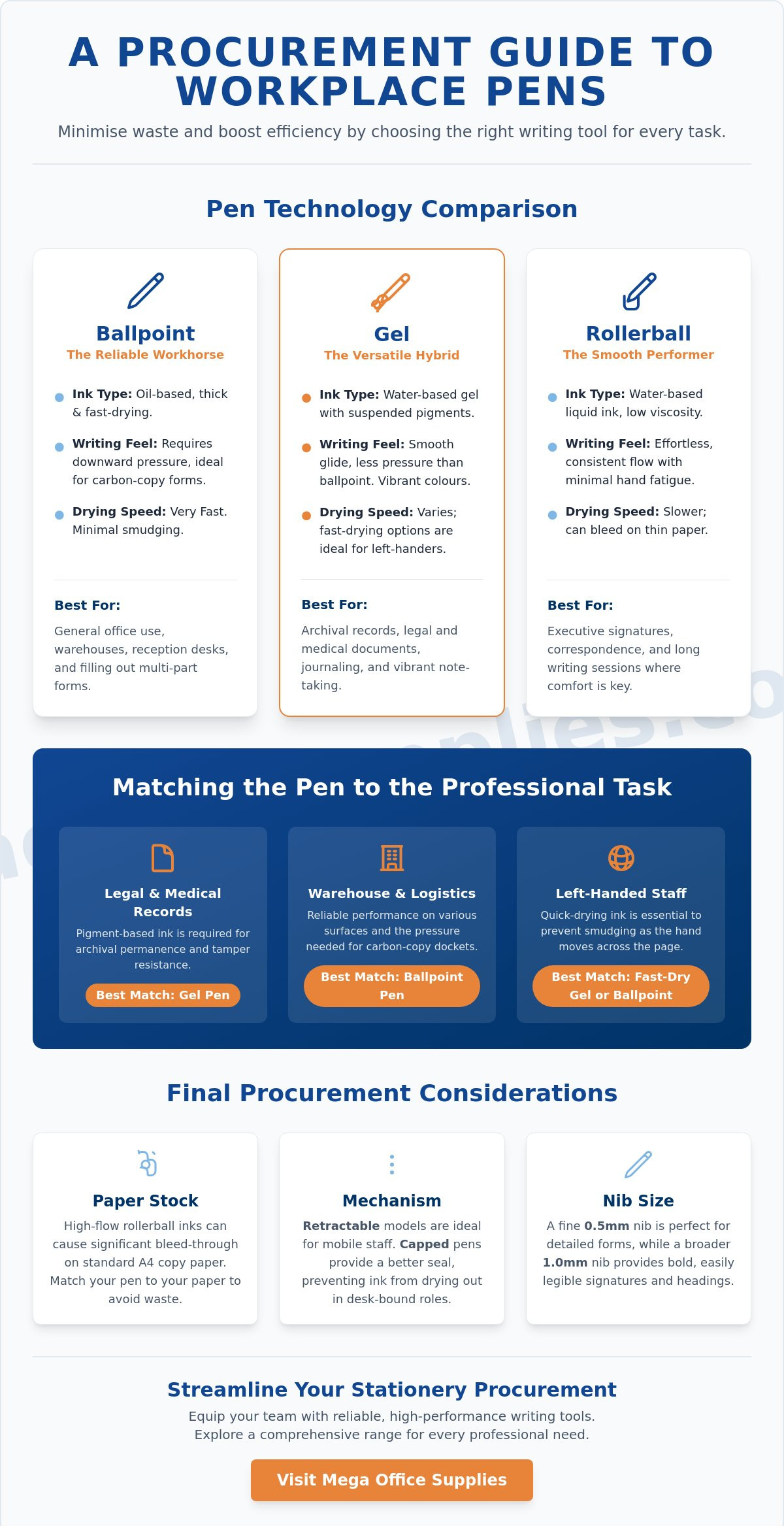
Selecting the right pens for a high-volume workplace involves more than comparing unit costs. At its core, the modern writing instrument relies on a tiny tungsten carbide ball. This material is chosen for its extreme hardness and resistance to deformity, ensuring the ink flow remains consistent from the first word to the last. Understanding the relationship between this ball and the ink's viscosity is essential for any procurement officer looking to reduce hand fatigue and improve staff productivity.
The evolution of these tools is documented through the history and types of pens, moving from simple quills to the complex capillary systems we use today. For Australian organisations, choosing between oil, water, or pigment-based systems determines how well a document survives long-term storage. This is particularly vital for archival records in the healthcare and legal sectors where legibility must be maintained for decades.
To better understand the practical differences between these technologies, watch this helpful comparison:
Ink viscosity is the primary factor in writing comfort. High-viscosity inks, found in standard ballpoints, require significant downward pressure to transfer onto the page. While this is ideal for carbon-copy forms, it often leads to cramping during extended note-taking. Conversely, low-viscosity liquid inks flow with minimal effort, though they often require high-quality office supplies like premium paper to prevent feathering or bleed-through.
Oil-Based vs. Water-Based Inks
Ballpoint pens utilise oil-based ink that's thick and fast-drying, making them the reliable workhorse for warehouses and reception desks where signatures are needed on various surfaces. Rollerball pens use water-based liquid ink for a smoother experience that requires less hand pressure. Gel pens offer a hybrid solution. They use a water-based gel with suspended pigments, providing vibrant colours and excellent archival permanence. This pigment-based ink is often a non-negotiable requirement for legal and medical documentation because it's resistant to tampering and fading.
Specialised Writing Instruments
Beyond the standard trio, fineliners provide the manual precision required for technical drawing or architectural notation. Multifunction pens serve professionals on the move, combining different colours or stylus tips into one barrel to minimise clutter. For high-level executive correspondence, the fountain pen is seeing a resurgence.
Matching Pen Types to Professional Workplace Tasks
Effective procurement requires more than just ordering a box of blue or black pens. You must account for the specific environment where the tool will be used. For instance, left-handed staff members often struggle with slow-drying inks that smudge as the hand moves across the page. In fast-paced medical or educational settings, a smudge-free experience is a matter of record accuracy.
The choice of mechanism also impacts operational efficiency. Retractable models are the logical choice for mobile professionals, such as warehouse supervisors or healthcare workers, who need to deploy a writing tool with one hand. In contrast, capped pens are often preferred for desk-bound roles because they provide a better seal, preventing the nib from drying out during periods of inactivity. When selecting for the office, consider the weight of the paper stock. High-flow rollerballs may cause significant bleed-through on standard A4 copy paper, leading to illegible notes on the reverse side. Matching the nib size to the task is equally important; a fine 0.5mm nib is ideal for detailed forms, while a broader 1.0mm nib provides the bold legibility required for signatures.
The Signature Test: Pens for Legal and Financial Documents
High-stakes signing requires ink that anchors deeply into the paper fibres. Gel and rollerball pens are frequently preferred for these tasks because they offer a fluid writing experience that captures the nuances of a person's signature. However, security is paramount. You should look for pigment-based inks rather than dye-based alternatives. Pigment inks are essentially tamper-evident, as they resist "check washing" and chemical lifting. This level of security has been a focus throughout the history of the pen manufacturing industry, where the goal has always been to balance ease of use with permanent records. Once a document is signed, it must remain legible for years while stored in archives or lever arch files.
Rapid Note-Taking and Daily Administration
Ballpoint pens remain the undisputed workhorse for general administrative duties. Their oil-based ink is low-maintenance and works reliably on almost any surface, from glossy delivery dockets to standard notebooks. For staff engaged in long writing sessions, ergonomics shouldn't be ignored. Pens with rubberised grips and balanced barrels help minimise the risk of Repetitive Strain Injury (RSI). Colour-coding also plays a vital role in modern project management. Using red, green, or purple ink allows for clear annotation and quick visual scanning of complex documents. If you're looking to refresh your inventory, exploring a diverse range of office stationery can help you find the specific tools your team needs for these daily tasks.
Stationery Procurement: Bulk Buying and Inventory Management
Organisational procurement requires a transition from individual preference to large-scale efficiency. Standardising your inventory of pens is the most effective way to reduce administrative overhead and ensure every department has access to reliable tools. Buying in bulk is the standard approach to driving down unit costs, but it requires a strategic balance between immediate savings and available storage space. When you limit your selection to a few proven models, managing refills and tracking consumption rates becomes significantly more efficient.
Tracking these rates is vital for preventing a "stationery drought" during peak periods, such as the end of the financial year or the start of a new school term. You should evaluate the lifecycle cost of your writing instruments rather than just the initial purchase price. A cheaper tool that runs dry quickly or leaks in storage eventually costs more in waste and staff frustration. Research into the physics of how ink moves shows that consistent flow is a product of precision engineering. Investing in professional-grade pens ensures that every unit in a bulk order performs reliably. This provides peace of mind for procurement officers who must guarantee that high-volume demands are met without constant troubleshooting or frequent re-ordering cycles.
Refills vs. Disposable: The Sustainability and Cost Debate
Refillable systems often make financial sense for permanent staff or executive roles where high-quality reusable barrels can be utilised over several years. This approach significantly reduces plastic waste in the workplace and aligns with modern corporate responsibility goals. To manage this effectively, organise a central stationery hub within your facility. A well-structured hub allows for controlled distribution and makes it easier to monitor which departments are consuming supplies at a higher rate. This visibility helps in making data-driven decisions for future procurement cycles while ensuring that premium hardware is maintained and reused rather than discarded prematurely.
Supply Chain Reliability for Australian Organisations
Partnering with a national office supplies provider ensures you can maintain a consistent standard across multiple locations. Whether you are managing educational campuses or regional government offices, supply chain reliability is non-negotiable. You must manage lead times for specialised or custom-branded items to ensure your team always has the tools required for their daily operations. This is particularly important for organisations with remote sites where logistics can be more challenging. Leveraging the expertise of a seasoned partner helps you navigate these hurdles and maintain a steady flow of essential hardware. This level of support distinguishes a reliable distributor from a faceless global competitor and provides the stability needed for long-term operational success.
Common Pitfalls in Professional Pen Selection
Procurement errors often stem from a narrow focus on the initial unit price rather than the total cost of ownership. The most frequent mistake is falling into the "Cheap Pen" trap. While a bulk bag of budget pens might look attractive on a balance sheet, the operational reality is often different. Poor-quality ink frequently skips or dries out prematurely, forcing staff to waste time scribbling on scrap paper just to start the flow. This creates significant frustration in high-pressure environments like medical clinics or busy reception desks where every second counts.
Ignoring paper compatibility is another critical oversight. A high-flow rollerball is an excellent tool, but it will fail on low-grade, porous paper by causing excessive bleed-through. This compromises the legibility of records and makes professional correspondence look sloppy. Similarly, neglecting the physical needs of the user carries hidden financial risks. Staff in high-writing roles require instruments with proper weight distribution and ergonomic grips to minimise the long-term risk of strain. Finally, over-complicating your range creates administrative chaos. Carrying too many disparate models makes it impossible to standardise refills and leads to a cluttered, inefficient stationery cupboard.
The Impact of Temperature and Environment
Australian workplaces often involve extreme conditions that directly affect ink performance. In cold storage facilities or winter warehouses, certain inks thicken and refuse to flow smoothly. Conversely, instruments left in hot vehicles can leak as the ink thins and the internal pressure rises. Specialised environments require specific solutions. Healthcare workers need tools that can be easily sanitised; construction teams require ink that adheres to dusty or damp surfaces. Changes in air pressure during air travel can cause the air inside a liquid-ink reservoir to expand and force ink out through the nib, potentially damaging clothing or documents.
Storage and Maintenance for Longevity
Proper storage is essential to preserve your inventory. Ballpoints are best stored horizontally to keep the ink in contact with the ball, while fineliners and felt-tips should be stored tip-down to prevent the nib from drying out. You can often revive a "dead" ballpoint by gently heating the tip or using a drop of rubbing alcohol to dissolve a dried ink plug. Maintaining an organised, temperature-controlled stationery cupboard will significantly extend the shelf life of your supplies. To ensure your team is equipped with tools that last, order professional pens from a supplier that understands the demands of the Australian workplace.
Standardising Your Workplace with Mega Office Supplies
Standardising an entire organisation's writing instruments is a strategic move that goes beyond simple procurement. It's about creating a frictionless environment where every team member has the right tool for their specific task. We leverage decades of combined industry experience to help you curate a stationery list that balances performance with budgetary requirements. Whether your facility needs high-volume ballpoints for a distribution centre or premium executive pens for the boardroom, our inventory is built to meet the scale of professional Australian workplaces.
Professional procurement officers require more than just a product list; they need a reliable partner with logistical prowess. Our systems are designed to facilitate a fast user experience through direct action-oriented commands and rapid quoting options. We understand the workflow of large-scale operations, from government departments to national healthcare providers. This regional expertise ensures that your supply chain remains robust, backed by domestic support and a local contact line for direct assistance whenever your team needs it.
Our Commitment to Quality and Reliability
Next Steps for Your Procurement Strategy
Optimising your supply chain starts with a clear understanding of your current consumption. We recommend conducting a brief audit of your existing stationery usage to identify areas of waste or confusion caused by disparate models. Once you've identified these opportunities, our team is available to help you develop a tailored standardisation plan that simplifies your inventory and reduces long-term costs.
Ready to streamline your office inventory? Explore our full range of professional pens and writing instruments today.
Optimising Your Organisational Writing Standards
Selecting the correct writing instruments is a foundational step in maintaining professional records and operational speed. By understanding the technical differences between ballpoint, gel, and rollerball technologies, you can eliminate the hidden costs of smudged documents and staff hand fatigue. Standardising your inventory around high-quality, reliable hardware ensures that your procurement process remains efficient and predictable across all locations. This strategic approach to stationery prevents the common pitfalls of poor ink performance and environmental failures.
Mega Office Supplies has been family owned and operated since 2008. We provide comprehensive national delivery across Australia, ensuring your organisation receives the volume and quality it needs without friction. Whether you are stocking a single reception area or coordinating a national school supply run, our catalogue offers the manual precision and durability required for professional use.
Browse the complete range of professional pens at Mega Office Supplies
We look forward to helping you equip your workplace with the precision tools your team deserves.
Frequently Asked Questions
What is the best pen type for signing legal documents?
Pigment-based gel or rollerball pens are the standard for legal and financial signatures. These instruments use archival-quality ink that anchors into the paper fibres, making it resistant to fading and chemical tampering. Ensure the pen is specifically labelled as document proof or archival to guarantee that records remain legible in long-term storage.
How can I prevent ink smudging if I am left-handed?
Left-handed writers should prioritise fast-drying gel pens or traditional oil-based ballpoints. These options minimise the time the ink remains wet on the page, preventing the hand from dragging through the text. Avoid liquid-ink rollerballs, as their slow drying time on standard office paper often results in significant smudging for southpaws.
Are gel pens better than ballpoint pens for general office use?
The choice depends on the specific workplace task and writing volume. Gel pens offer superior comfort and vibrant pigment, which is ideal for colour-coding and signatures. However, ballpoint pens remain the workhorse for high-volume environments because their oil-based ink is more reliable on varied surfaces and generally has a longer writing life per unit.
How do I choose the correct nib size for professional handwriting?
Select a 0.5mm nib for detailed form-filling and precise notation where space is limited. For general correspondence and signatures, a medium 0.7mm or broad 1.0mm nib provides better legibility and a smoother writing experience. Broad nibs are particularly effective for executive signatures as they create a bold, authoritative mark on the page.
Why do some pens leak when I travel by plane?
Leaking occurs because the air trapped inside the ink reservoir expands as cabin pressure drops during ascent. This expansion forces the liquid ink out through the nib. To minimise this risk, keep your writing instruments in a vertical, tip-up position during the flight, or stick to retractable ballpoint models which are less prone to pressure-induced leaks.
Is it more cost-effective to buy pen refills or new disposable pens?
Refills are the most economical choice for premium, professional-grade barrels used by permanent staff. For high-traffic areas like reception desks or warehouses where tools are frequently misplaced, purchasing bulk disposable models is often the more practical procurement strategy to maintain a consistent supply.
How long do professional-grade pens typically last in storage?
Standard ballpoint models generally remain functional for two to three years if stored in a cool, dry environment. Gel and rollerball versions have a shorter shelf life, typically lasting between 12 and 24 months before the water-based ink begins to dry or settle. Store your inventory horizontally to ensure the ink stays in contact with the ball and prevents air pockets.
What ink type should be used for writing on glossy or thermal paper?
Use a standard oil-based ballpoint for glossy surfaces, delivery dockets, or thermal receipts. The thick, oil-based ink adheres to non-porous coatings where water-based gel or liquid inks would simply bead up and wipe off. This is essential for warehouse logistics and retail environments where clear, permanent notation on specialty paper is required for audit trails.
Article by
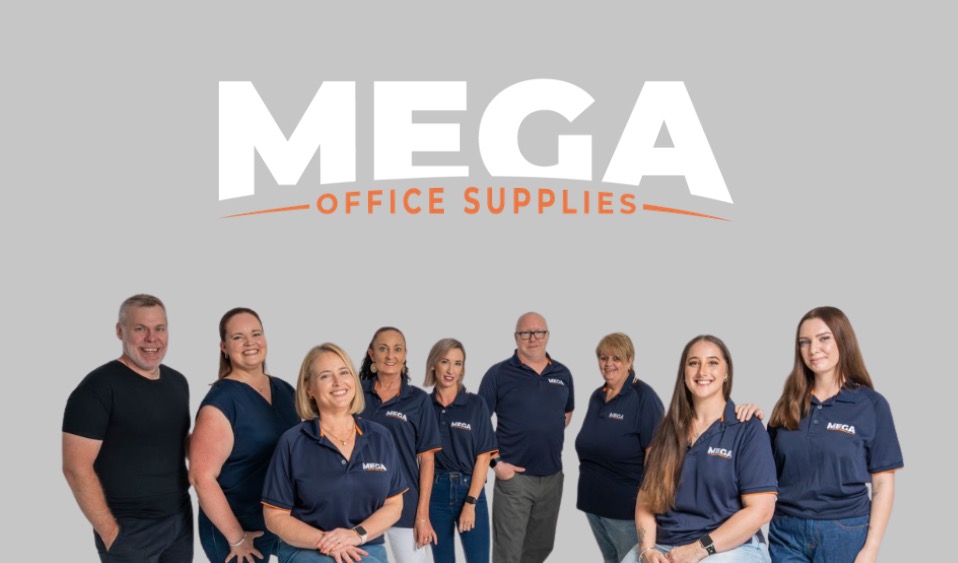
Mega Office Supplies Team
The Mega Office Supplies Team provides practical guidance for Australian businesses, schools, government organisations, healthcare providers, hospitality venues, warehouses and home offices. Based in Tweed Heads South, Mega Office Supplies has been family owned and operated since 2008, offering office stationery, workplace furniture, technology products, labels, printers, cleaning and janitorial supplies, safety products, art materials, education resources and everyday business essentials from trusted brands.
General Information
This article is provided as general information only to help customers compare and choose office, workplace, school, cleaning, technology, furniture, safety and business supplies. Product details, specifications, compatibility, availability, pricing and suitability may vary. Always check the individual product page, manufacturer information, workplace requirements and relevant safety guidance before purchasing or using a product.


