

Is your archive room a functional retrieval system or simply a graveyard for paper where boxes go to collapse under their own weight? Most Australian office managers understand the frustration of losing valuable floor space to haphazard stacks that make finding a single tax record feel like a forensic investigation. You shouldn't have to choose between a tidy office and regulatory compliance. By implementing professional archive box storage ideas, you can reclaim your square meterage while ensuring your records remain accessible and intact.
We'll show you how to transform cluttered storage areas into professional, high-capacity systems that meet National Archives of Australia (NAA) standards. This guide provides a clear roadmap for maximising vertical space and choosing durable, professional-grade equipment suited for long-term record keeping. You'll learn how to maintain an organised inventory that simplifies compliance for the mandatory seven-year retention period while protecting your documents from environmental damage.
Key Takeaways
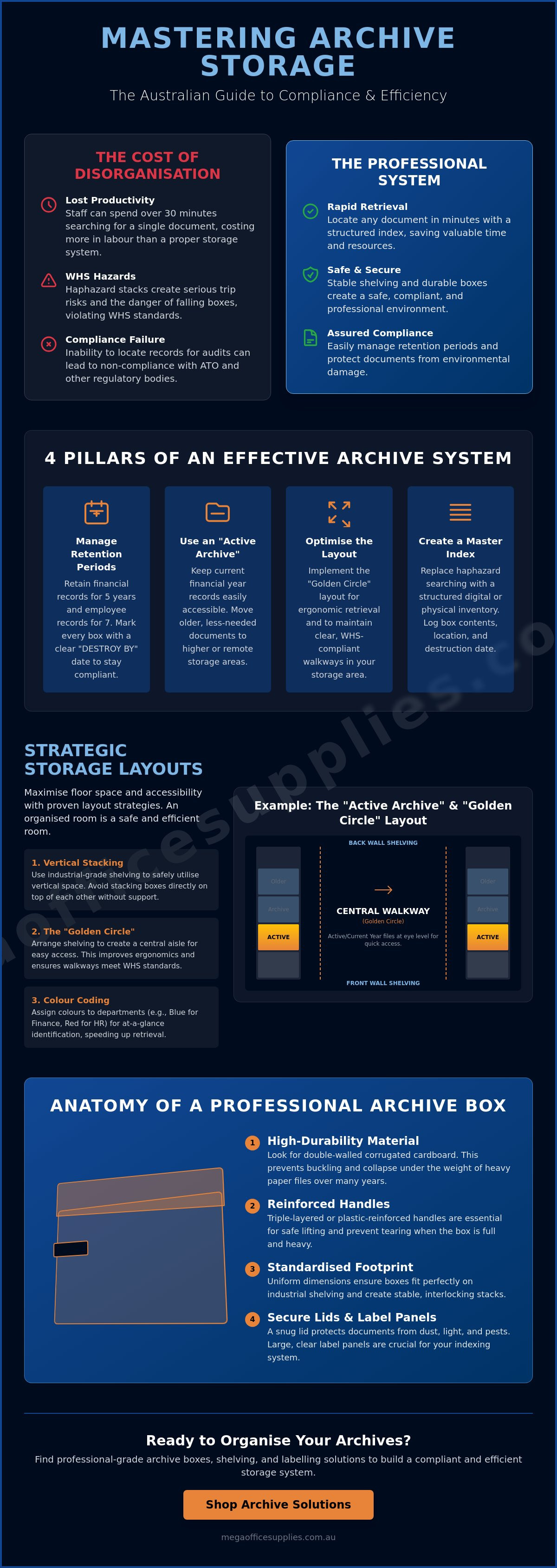
- Learn how to align your storage system with Australian record-keeping regulations, including mandatory seven-year document retention periods.
- Discover practical archive box storage ideas like the "Active Archive" system to keep current records accessible while reclaiming valuable office space.
- Master the "Golden Circle" layout to improve retrieval ergonomics and maintain clear walkways in accordance with Australian WHS standards.
- Establish a Master Archive Index to replace haphazard search methods with a structured inventory system for rapid document location.
- Identify high-durability features, such as double-walled corrugated cardboard and reinforced handles, to prevent box failure during long-term storage.
Why Standardised Archive Box Storage is Essential for Australian Offices
A professional archive box serves as a standardised unit for records and information management, providing a consistent footprint for long-term document retention. These containers are engineered to withstand the weight of dense paper files while fitting precisely onto industrial shelving systems. In the Australian business landscape, the standard archive box is the fundamental building block of any compliant storage strategy. Using uniform box sizes isn't just about aesthetic consistency; it's a structural necessity. When every box shares the same dimensions, you can create stable, interlocking stacks that maximise vertical space without the risk of the bottom layer buckling. This uniformity is vital for maintaining a tidy, professional-looking storage area that reflects an organised operation.
Professional storage solutions also act as a critical barrier against environmental factors. The Australian climate presents unique challenges, from high humidity levels in tropical regions to the fine dust prevalent in rural areas. A high-quality cardboard box protects sensitive documents from light degradation, moisture, and pests. By keeping your records in a controlled, standardised environment, you ensure that paper remains legible and intact for the duration of its required lifespan. To better understand how to integrate these boxes into a tidy workspace, watch this helpful video:
Compliance and Document Retention
Australian record-keeping requirements are strict and non-negotiable. The Australian Taxation Office (ATO) generally requires businesses to retain financial records for five years, while employee records and certain legal documents must be kept for seven years after an employee departs. While many offices are moving toward digital workflows, original physical copies are often still required for specific legal and auditing purposes. It's essential to mark every box with a clear "destroy by" date. This practice prevents the accumulation of redundant files and reduces storage costs over time. For procurement officers managing large-scale archive projects, our guide on stationery supplies Australia provides a deeper look into selecting the right materials for high-volume environments.
The Cost of Disorganisation
Disorganisation is a hidden drain on business productivity. If a staff member spends thirty minutes searching for a single invoice in a sea of unlabelled, mismatched boxes, the labour cost can quickly exceed the price of a proper storage system. Poorly implemented archive box storage ideas often lead to workplace health and safety (WHS) hazards. Haphazard stacks create trip risks and the potential for boxes to fall on employees. Adopting a retrieval-first mindset means you aren't just "hiding" old files; you're placing them in a system where any document can be located in minutes. This approach transforms a cluttered backroom into a functional asset, ensuring your team remains focused on high-value tasks rather than digging through unstable piles of cardboard.
Innovative Archive Box Storage Ideas for Every Workspace
Effective archive box storage ideas focus on the balance between storage density and retrieval speed. The "Active Archive" system is a primary example of this logic in practice; keep boxes containing the current financial year's records within arm's reach while moving older, less frequently accessed documents to higher shelves or remote storage areas. This tiered approach ensures that the majority of daily record queries are resolved instantly. Vertical stacking is the most efficient method for utilising expensive floor space, provided you use high-capacity shelving units specifically designed to support the concentrated weight of dense paper records without bowing.
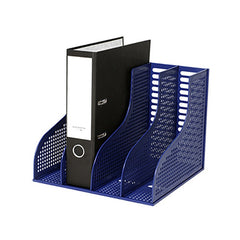
Visual organisation is just as critical as physical placement. Implementing a colour-coded system using labels or specific box lids allows staff to identify departments at a glance. For example, you might assign blue for finance, red for human resources, and green for client projects. To increase internal organisation, many professionals use a hybrid system where lever arch files are stored directly inside the archive boxes. This keeps documents upright and categorised even when a box is only partially full, preventing the "slumping" that often leads to torn papers and lost tabs. You can find a wide range of professional filing options at Mega Office Supplies to suit these systems.
Small Office and Home Office Solutions
Managing limited space requires a strategic approach to dead zones. Low-profile archive boxes are ideal for under-desk storage, turning unused floor space into a functional repository for semi-active files. If your storage area is visible to clients or situated in a multipurpose room, consider using decorative archive boxes that complement your existing office furniture. Even in a home office environment, maintaining Australian government standards for document security and protection is essential for long-term compliance.
Commercial and Warehouse Scale Storage
In a warehouse setting, the scale of document retention requires an industrial mindset. Heavy-duty racking should be configured so that shelf heights match archive box dimensions exactly, eliminating wasted air space. Implementing an "aisle and bay" system, similar to a commercial distribution centre, ensures every box has a specific coordinate for rapid retrieval. Always prioritise weight distribution by placing the oldest, heaviest boxes on the lowest levels. This prevents the structural failure of lower boxes and ensures the entire stack remains stable and safe for staff to navigate.
Strategic Layouts: Maximising Floor Space and Accessibility
Maximising your footprint requires more than just stacking cardboard; it demands a logical floor plan that prioritises safety and speed. The "Golden Circle" layout is a professional standard where the most active records are positioned at chest height. This zone, typically between 70cm and 140cm from the floor, ensures that staff can retrieve files without excessive bending or reaching. Implementing these archive box storage ideas helps maintain a fast workflow while ensuring your office remains compliant with Australian WHS standards. Clear walkways are non-negotiable. You must maintain a minimum aisle width of 900mm to allow for safe passage and the use of trolleys or step ladders during retrieval operations.
For organisations with high-density requirements, such as law firms or government departments, mobile shelving systems or "compactuses" offer the best return on space. These units eliminate permanent aisles, allowing you to store double the volume in the same square metreage. If a full-scale renovation isn't feasible, you can integrate your archives into your existing office furniture by using dedicated storage cupboards or heavy-duty credenzas designed for lateral filing. This keeps your records secure and out of sight while maintaining a professional office aesthetic.
Ergonomic Retrieval Practices
Heavy boxes should always be stored on middle shelves to keep the centre of gravity stable and reduce the risk of back strain during lifting. Frequent-access boxes are best kept at a height between the waist and shoulders to minimise reaching and repetitive strain. High-stacking areas must be supported by industrial-grade safety equipment, such as platform ladders or sturdy kick-steps. Following established University of Illinois storage guidelines ensures that your retrieval process remains safe and efficient for all employees. Never allow staff to stand on chairs or desks to reach upper levels.
Climate and Environment Considerations
Australian warehouses often have concrete floors that can leach moisture, leading to dampness and mould in cardboard boxes. Never place archives directly on concrete; use pallets or bottom-shelf racking to create a thermal break. Proper airflow is vital to deter silverfish and prevent the slow chemical degradation of paper records. In bright Australian offices, position your storage away from windows to protect against UV fading, which can bleach ink and weaken cardboard over time. Consistent temperature control is the best way to ensure your records remain legible for their entire mandated lifespan.
Labelling and Inventory Systems for Rapid Document Retrieval
Implementing a physical container is only half the battle; the real efficiency lies in the administrative framework you build around it. Professional archive box storage ideas must include a robust inventory system that survives staff turnover and organisational changes. Start by standardising your labelling format across the entire organisation to ensure every department follows the same protocol. This consistency allows any authorised staff member to locate records without needing to understand a specific department's unique filing quirks. It's about creating a predictable environment where information is a shared asset rather than a hidden burden.
The core of your system should be a Master Archive Index, maintained in a secure spreadsheet or database. Instead of relying on vague handwritten descriptions like "Old Invoices," assign every box a unique numeric or alphanumeric ID. Descriptions can be subjective, but a unique ID is absolute. When a box is moved or its contents updated, the index is modified, but the box ID remains the same. To maintain your system's integrity, perform an annual audit to identify and remove documents that have reached their legal disposal date. Training staff on the "one-in, one-out" rule ensures that your storage area never exceeds its capacity. Under this rule, a new box is only added when an expired one is decommissioned and shredded.
Professional Labelling Techniques
For long-term reliability, use high-contrast permanent markers and industrial-grade adhesive labels that won't peel in fluctuating warehouse temperatures. Label at least two sides of each box, typically the front and one side, to ensure visibility regardless of how the box is orientated on the shelf. At a minimum, every label must clearly display the department name, the specific date range of the contents, and a prominent "Destroy Date" based on Australian record-keeping regulations. Clear, bold text prevents retrieval errors and reduces the time staff spend handling boxes.
Digital Integration for Physical Boxes
Modern workflows benefit from bridging the gap between physical and digital records. You can print unique QR codes that link a physical box directly to a detailed file list stored in your company's cloud drive. This allows staff to scan a box with a mobile device and see exactly what is inside without breaking the tape seal. Using professional technology tools like high-speed label makers ensures these codes remain legible and durable over many years. You can find the necessary equipment to build your tracking system at Mega Office Supplies, where we provide the tools required for professional-grade document management.
Selecting Professional-Grade Archive Boxes for Long-Term Durability
The success of your archive box storage ideas depends entirely on the structural integrity of the containers you select. While a box might look sturdy when empty, the true test occurs when it is filled with 15 kilograms of paper and stacked four levels high. Professional-grade boxes are typically categorised by their board grade. Single-wall corrugated cardboard is suitable for light-duty storage or short-term transport, but double-walled corrugated cardboard is the industry standard for long-term archiving. This extra layer of fluting provides the vertical crush resistance necessary to prevent the bottom box in a stack from collapsing over time.
Durability also extends to the box design and handling features. Reinforced handles are essential for frequent transport; they distribute the weight across multiple layers of cardboard to prevent tearing during retrieval. You must also choose between a separate lid or a one-piece (flip-top) design. Separate lids offer easier access in high-turnover environments, while one-piece designs ensure the lid is never misplaced and provide a more secure seal against dust. Sourcing your hardware in bulk from a reliable office supplies partner ensures that every box in your repository shares identical dimensions, which is critical for maintaining stable, uniform stacks.
Material Choice: Cardboard vs. Plastic
Cardboard remains the most popular choice for Australian businesses due to its cost-effectiveness and sustainability benefits, as high-quality archive boxes are fully recyclable at the end of their lifecycle. However, for permanent records or environments prone to high humidity, acid-free polypropylene boxes offer superior protection against moisture and chemical degradation. Double-walled corrugated cardboard provides the structural integrity required for vertical stacking up to five units high, whereas standard retail boxes often buckle under the weight of a single loaded archive. Choosing the material that matches your specific retention period ensures your records remain protected until their disposal date.
Specialty Archive Sizes
While the standard archive box is designed for A4 and Foolscap documents, specialised records require specific dimensions to prevent damage. We provide specialised boxes for computer printouts, cheques, and even large-format plans that must remain flat. Using a box that is too large for its contents leads to internal shifting and potential paper curling, while an overstuffed box will bulge and ruin the stack's stability. Always match your box capacity to your shelving depth to avoid overhang, which is a significant WHS hazard in narrow aisles. Precise sizing ensures that you utilise every cubic centimetre of your storage area without compromising the safety of your staff or the condition of your professional records.
Streamlining Your Professional Record Management
Transforming your workplace storage from a cluttered backroom into a precision retrieval system is a matter of operational efficiency and legal necessity. By implementing the archive box storage ideas discussed, such as the "Active Archive" method and standardised labelling, you ensure your records remain accessible and compliant with Australian regulations. Professional-grade hardware is the foundation of this system. It prevents box failure and protects your valuable data from environmental degradation.
As a family owned and operated business since 2008, we understand the logistical demands of domestic workplaces. We provide reliable solutions that stand up to the rigours of long-term storage. Whether you're managing a small office or a large-scale warehouse repository, our national delivery service ensures your bulk orders arrive promptly to keep your project moving forward. Our team is dedicated to providing the stability and regional expertise you need to maintain a well-oiled operation.
Browse our range of professional archive boxes and storage solutions to begin organising your workplace today. With a structured approach and the right equipment, you can achieve a tidy, compliant, and highly functional storage environment.
Frequently Asked Questions
How many archive boxes can I safely stack on top of each other?
You can safely stack professional-grade archive boxes up to five units high, provided you use double-walled corrugated cardboard. Stacking beyond this height increases the risk of the bottom box buckling and creates a significant workplace health and safety hazard. Always ensure the heaviest boxes are at the base of the stack to maintain a low centre of gravity. For higher density requirements, industrial shelving is a safer alternative to free-standing stacks.
What is the standard size of an archive box in Australia?
The standard size for an archive box in Australia is approximately 390mm long, 306mm wide, and 260mm high. These dimensions are specifically designed to accommodate both A4 and Foolscap documents, as well as standard lever arch files. This uniform sizing is essential for implementing consistent archive box storage ideas because it allows for stable stacking and efficient use of industrial shelving units across different departments and storage facilities.
How long should a business keep tax records in Australia?
Australian businesses must generally keep tax and financial records for five years from the date they lodged their tax return. However, certain documents, such as employee records or files relating to capital gains tax events, should be retained for seven years. It's best practice to label every box with a clear "Destroy Date" to ensure compliance and prevent the unnecessary accumulation of redundant physical paperwork in your professional storage area.
Are cardboard archive boxes better than plastic ones?
Cardboard boxes are typically better for standard office environments due to their cost-effectiveness and recyclability. They provide excellent breathability, which helps prevent moisture buildup that can lead to mould. Plastic polypropylene boxes are superior only in high-humidity environments or for permanent records requiring maximum protection against water damage. For most Australian workplaces, professional-grade double-walled cardboard offers the best balance of durability, structural integrity, and environmental responsibility during the mandated retention period.
How can I prevent silverfish and pests from damaging my archived documents?
Preventing silverfish and pests requires maintaining a cool, dry environment with consistent airflow and avoiding direct contact with the floor. Never place boxes directly on concrete; use pallets or shelving to create a barrier. Using high-quality boxes with secure lids minimises entry points for insects. Regularly inspecting your storage area and using cedar blocks or professional pest control treatments can further protect your sensitive paper records from being destroyed by infestations over time.
What is the best way to label archive boxes for easy retrieval?
The most efficient way to label is to mark both the front and one side of the box using high-contrast permanent markers or adhesive labels. Every label should include a unique box ID, the department name, a brief content description, and the disposal date. This dual-sided approach ensures that archive box storage ideas remain effective even when boxes are turned or moved, allowing staff to identify contents at a glance without moving heavy stacks.
Should I use a separate lid or an attached lid for archive boxes?
Separate lids are generally preferred for high-access archives because they allow you to remove the top without moving the entire box. However, attached lids (one-piece designs) are excellent for long-term storage as the lid cannot be lost or swapped with another box. Attached lids also provide a more consistent seal against dust in warehouse environments. Your choice should depend on whether you prioritise frequent retrieval or the long-term security and integrity of the contents.
Can archive boxes be recycled after the documents are shredded?
Cardboard archive boxes can be fully recycled once the documents inside have been securely shredded. Most professional shredding services in Australia will take the cardboard along with the paper for processing. If you are managing the disposal internally, simply flatten the boxes and place them in your standard paper recycling bin. This makes cardboard a highly sustainable choice for businesses looking to minimise their environmental footprint after the legal retention period for their records expires.
Article by
Mega Office Supplies Team
The Mega Office Supplies Team provides practical guidance for Australian businesses, schools, government organisations, healthcare providers, hospitality venues, warehouses and home offices. Based in Tweed Heads South, Mega Office Supplies is an Australian business, family owned and operated since 2008, offering office stationery, workplace furniture, technology products, labels, printers, cleaning and janitorial supplies, safety products, art materials, education resources and everyday business essentials from trusted brands.
General Information
This article is provided as general information only to help customers compare and choose office, workplace, school, cleaning, technology, furniture, safety and business supplies. Product details, specifications, compatibility, availability, pricing and suitability may vary. Always check the individual product page, manufacturer information, workplace requirements and relevant safety guidance before purchasing or using a product.


