


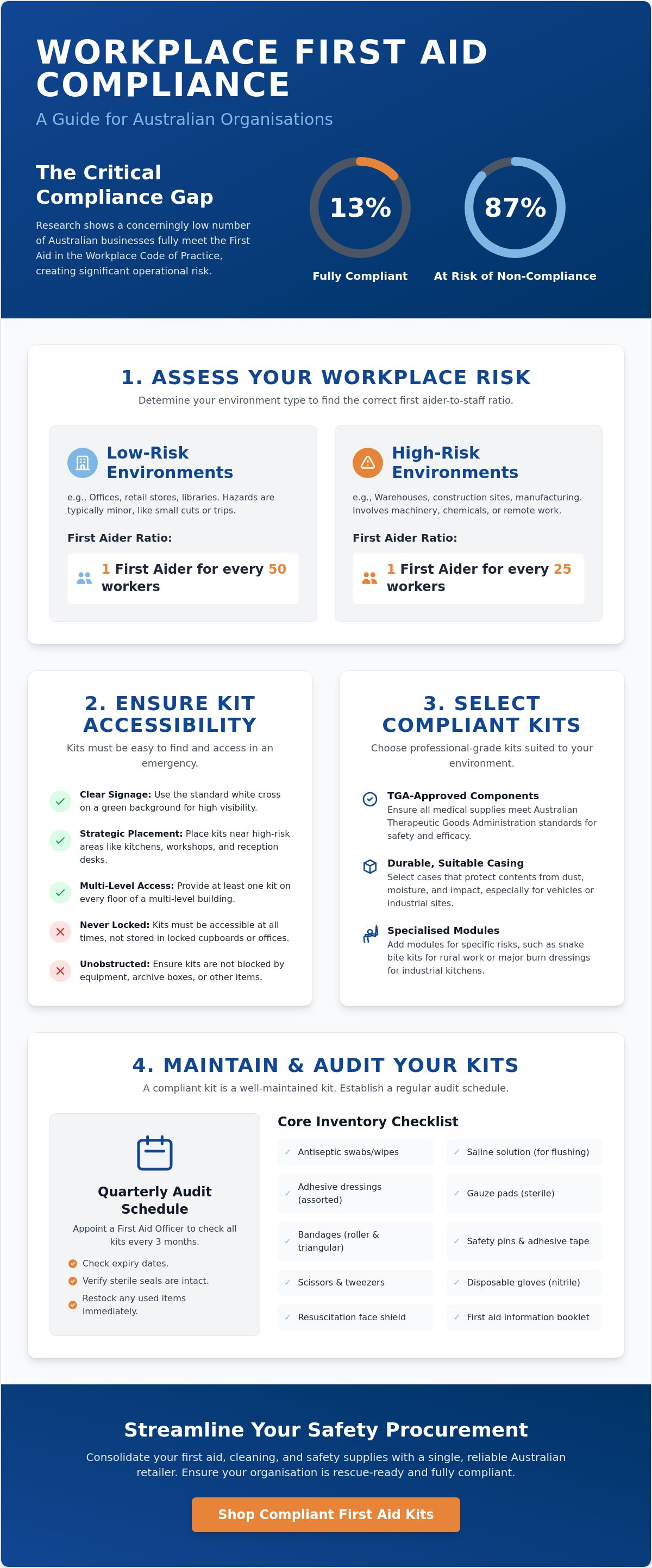
Research indicates that only 13% of Australian businesses are fully compliant with the three core elements of the First Aid in the Workplace Code of Practice. For many procurement officers and administrators, this statistic highlights a significant operational risk. We understand that managing workplace safety is often complicated by differing state regulations and the difficulty of tracking expiry dates across multiple first aid kits. It's a heavy responsibility to ensure every staff member is protected and every kit is ready for an emergency at a moment's notice.
This guide provides a clear, professional framework to help your organisation meet Australian compliance standards for 2026. We'll outline the essential contents required for various risk levels and provide a simple maintenance schedule to keep your supplies current. By following this checklist, you can move beyond the fear of safety audits and focus on maintaining a secure, rescue-ready environment for your team. We'll cover everything from staff-to-aider ratios to the specific contents needed for your unique workplace setting, ensuring your facility remains fully prepared.
Key Takeaways
- Learn to distinguish between low-risk and high-risk workplace requirements to ensure your organisation meets the Safe Work Australia Code of Practice.
- Use our selection checklist to choose first aid kits with TGA-approved components and durable casings suited for specific environments like warehouses or vehicles.
- Identify the essential core inventory items, including specialised dressings and antiseptics, that every standard kit must contain for effective wound management.
- Establish a robust quarterly audit schedule to track expiry dates and maintain the seal integrity of your medical supplies.
- Discover how to streamline your facility management by consolidating the procurement of first aid, cleaning chemicals, and safety supplies through a single Australian retailer.
Understanding Australian Workplace First Aid Compliance
Safe Work Australia establishes the national model Code of Practice for first aid, but the actual legal enforcement happens at the state and territory level. Every business owner and procurement officer must understand that while the model code is a standard, your specific jurisdiction dictates the exact legislative requirements. Adhering to these guidelines is the primary way an organisation meets its duty of care. Failing to maintain compliant first aid kits can result in significant penalties, which are indexed to increase annually across most Australian regions.
In addition to physical safety compliance, maintaining a secure business involves managing broader operational risks.
The scale of workplace safety in Australia is immense. Statistics reveal that roughly 2,000 workers die from work-related injuries or illnesses each year, while another 640,000 report injuries. This creates an annual cost to the economy of approximately $60.6 billion. Despite these figures, research shows only 13% of Australian businesses are fully compliant with the core elements of the first aid code. To better understand this concept, watch this helpful video:
Low-Risk vs. High-Risk Environment Audit
Determining your requirements starts with a site audit. Low-risk environments, such as retail shops or corporate offices, typically face hazards like minor trips, falls, or small burns in staff kitchens. High-risk environments involve heavy machinery, hazardous chemicals, or outdoor work in remote areas. While standard first aid kit contents provide a solid baseline, high-risk sites often require specialised modules. For example, a warehouse might need industrial-grade burn dressings, while a rural worksite must include snake bite kits to manage regional environmental threats.
The First Aid Kit to Staff Ratio
Your headcount determines the number of trained staff and physical kits required. In a low-risk workplace, the guideline suggests one trained first aider for every 50 workers. High-risk settings require a higher density of support, specifically one aider for every 25 workers. You should generally provide one kit for every 10 to 50 employees, but layout matters as much as numbers. Multi-level offices must have at least one kit on every floor. If your organisation manages a fleet, each vehicle-based staff member requires their own portable first aid kits to ensure they remain protected while away from the central facility.
Accessibility is a non-negotiable factor for compliance. Kits must be stored in prominent locations and identified with clear signage, typically featuring a white cross on a green background. Don't store them in locked cupboards or behind stacks of archive boxes. They should be positioned near high-risk zones, like workshops or staff kitchens, where they can be reached in seconds during an emergency.
The Essential First Aid Kit Selection Checklist
Selecting the right hardware is a critical procurement decision that directly impacts the efficacy of your emergency response. A kit that fails during a crisis due to poor housing or disorganised contents is a significant liability for any organisation. When evaluating your options, prioritise durability and functional design over low-cost alternatives. High-quality first aid kits must withstand the specific environmental pressures of your workplace, whether that involves the climate-controlled aisles of a retail centre or the vibration-heavy environment of a delivery vehicle.
Compliance is non-negotiable. Every medical component within your kit must hold Therapeutic Goods Administration (TGA) approval to ensure it meets rigorous Australian safety and efficacy standards. Aligning your selection with Safe Work Australia's first aid guidelines requires verifying that your supplier provides professional-grade hardware rather than consumer-level substitutes. For national organisations, standardising your kit selection across all branches simplifies the training process for designated first aid officers and streamlines the restocking cycle.
Choosing the Right Case and Housing
The physical housing of your supplies should match the site's risk profile. Central office locations and staff kitchens benefit from wall-mounted metal or hard plastic cabinets that provide high visibility and protection from dust. For construction sites or outdoor environments, weather-resistant cases with rubber seals are essential to prevent moisture ingress. Portable "grab-and-go" bags are mandatory for first aid officers who may need to evacuate the building or attend to an incident in a remote corner of the facility. These bags must be lightweight, durable, and feature reinforced handles for rapid deployment.
Industry-Specific Kit Considerations
Different sectors face unique hazards that require specialised configurations. Kitchens and cafes must utilise food-grade kits containing blue detectable dressings, which are easily identified if they accidentally enter the food chain. Conversely, remote worksites or forestry operations require kits with high-visibility markers and integrated space for satellite communication devices. Modern modular systems are the preferred choice for 2026; these use colour-coded internal pouches to help non-professionals locate specific items, such as "Major Bleeding" or "Burn Treatment," in seconds. Reviewing your current stock against these criteria is the first step toward total compliance. You can explore a compliant range of first aid kits to find the specific housing and module configuration required for your sector.
Core Inventory: What Every Standard Kit Must Contain
A standard workplace kit is only as effective as its most basic components. While specialised modules are necessary for high-risk sites, every facility requires a foundational inventory to manage common incidents. According to the First Aid in the Workplace Code of Practice, the goal is to provide immediate and effective treatment to preserve life and minimise further injury. This starts with wound cleaning and infection control. Antiseptic swabs and sprays are mandatory for removing contaminants from minor abrasions before they escalate into more serious health issues.
Adhesive dressings, commonly known as bandaids, must be stocked in various shapes and sizes to accommodate different injury locations, such as fingertips or joints. For more significant muscular or skeletal injuries, your inventory should feature compression bandages and triangular bandages. These are vital for stabilising sprains or securing splints for suspected fractures until professional medical help arrives. These items form the backbone of any rescue-ready setup.
Personal protection is equally critical for the first aider. Disposable nitrile gloves provide a barrier against blood-borne pathogens, while CPR face shields ensure resuscitation can be performed safely. These items protect the responder and maintain the hygienic integrity of the first aid process. Without these barriers, the risk of cross-contamination increases significantly during an emergency intervention.
Wound Care and Bandaging Essentials
Sterile gauze swabs and non-adherent dressings are necessary for managing larger wounds where standard adhesive strips are insufficient. Unlike basic cotton wool, these materials don't stick to the wound bed, which prevents further trauma during dressing changes. Secure these in place using hypoallergenic paper tape to minimise skin irritation, particularly for staff with sensitive skin or allergies. Saline ampoules are another staple; they provide a sterile solution for flushing debris from eyes or cleaning deep abrasions without the risk of tap water contaminants.
Essential Tools and PPE
High-quality tools ensure that first aid can be administered with precision and speed. Stainless steel shears are essential for cutting through clothing to expose an injury or for trimming heavy-duty tape. Fine-point tweezers are required for the precise removal of splinters or glass fragments. For more severe incidents, thermal emergency blankets are used to manage shock and maintain body temperature. Ensure your first aid kits include a basic instructional guide to assist staff in high-stress situations. This documentation provides clear, step-by-step prompts that can be followed even by those who aren't regular first aid practitioners.
The Maintenance Audit: Keeping Your Kits Rescue-Ready
Compliance is a cycle, not a transaction. Simply purchasing first aid kits is only the initial step in a professional safety strategy. To ensure your facility remains rescue-ready, you must implement a structured maintenance programme that treats medical supplies with the same rigour as industrial machinery. Designate a specific safety officer or procurement administrator to oversee this schedule. Quarterly inspections are the industry standard for maintaining high-capacity facilities, providing a consistent rhythm for identifying depleted stock before an emergency occurs.
During these audits, verify the physical condition of the housing. Wall-mounted cabinets and portable cases must be clean, dust-free, and fully functional. Check that hinges and latches operate without friction. Signage is another critical factor; the green and white first aid symbol must remain clearly visible and unobstructed by other workplace equipment, furniture, or stationery. If a kit is hidden behind a filing cabinet or obscured by a stack of copy paper, it's effectively non-existent during a crisis.
Every individual item requires a physical inspection for seal integrity. Sterile dressings and bandages are only compliant as long as their packaging remains airtight. If a seal is punctured or compromised by moisture, the item is no longer sterile and must be discarded. Restock the kit immediately after any incident, regardless of how minor the injury was. A single missing adhesive strip can compromise the kit's effectiveness during a larger emergency, so maintain a zero-tolerance policy for incomplete inventory.
Expiry Date Management
Managing the lifecycle of medical components is a logistical necessity that impacts both safety and financial efficiency. Saline solutions, antiseptic sprays, and sterile dressings all carry specific "use by" dates that must be tracked. Implement a "first-in, first-out" inventory system for your bulk supplies. This ensures that older stock is utilised before it reaches its expiry date, minimising waste and ensuring your investment in safety supplies remains sound. Use a simple spreadsheet or a dedicated logbook to record these dates across all kits in the building.
Post-Incident Procedures
A rescue-ready workplace relies on accurate documentation and rapid recovery. Every time a kit is accessed, record the details in a workplace incident log. This data helps identify recurring hazards in specific areas, such as the staff kitchen or warehouse, and determines if your current kit capacity is sufficient for the site's needs. Ensure all reusable tools, such as stainless steel tweezers or scissors, are thoroughly sanitised after use. If an incident revealed a shortage of specific items, evaluate whether a larger kit or additional modules are required to maintain safety standards. Maintain your compliance by browsing our professional range of first aid kits and refills to ensure your facility is never under-equipped.
Streamlining Your Safety Procurement with Mega Office Supplies
Procurement efficiency is the cornerstone of a well-run Australian organisation. When you consolidate your requirements for first aid kits, cleaning chemicals, and facility supplies through a single provider, you eliminate the friction of managing multiple vendor relationships. Mega Office Supplies positions itself as a dependable partner, offering the scale and logistical prowess needed to support businesses, schools, and government departments across the country.
National organisations with multiple branch locations benefit significantly from centralised procurement. Instead of fragmented purchasing across different regions, you can leverage volume-based pricing and standardised inventory lists. This ensures that a warehouse in Perth and an office in Sydney both adhere to the same safety protocols and stock levels. By integrating your safety requirements with your broader facility needs, you create a more resilient supply chain that stands up to the demands of a high-volume workplace.
This holistic approach to facility management is increasingly common in heavy industry.
Integrated Facility Management
Strategic buyers often bundle high-turnover items to maximise logistical efficiency and reduce the frequency of deliveries. It's highly practical to coordinate your coffee and tea supplies with your quarterly safety restocks. Using a single Australian supplier helps you reduce administrative overhead and lowers total shipping costs through consolidated fulfilment. Setting up recurring orders for high-turnover items like hand sanitiser, soap, and tissues ensures your facility never runs dry. This proactive inventory management allows your team to focus on core operations rather than addressing sudden supply shortages.
Reliable Support for Professional Buyers
Meeting the complexities of 2026 compliance requires a partner with genuine historical depth. Our team brings decades of combined industry experience to every enquiry, providing tailored procurement advice that suits your specific sector and risk profile. You have direct access to local support for rapid quoting and inventory enquiries, avoiding the delays associated with faceless global competitors. Ensuring your workplace supplies reflect a commitment to staff wellbeing is essential for modern organisational culture. Accessing professional-grade safety equipment alongside your standard stationery supplies simplifies the entire procurement cycle, leaving you better equipped to manage a safe and productive environment.
Securing Your Workplace Safety Standards for 2026
Maintaining a rescue-ready facility requires a disciplined approach to risk assessment and inventory management. By accurately distinguishing between low and high-risk environments, you ensure your first aid kits are equipped with the specific modules needed for your unique sector. Regular quarterly audits remain the most effective way to manage expiry dates and maintain the seal integrity of your medical supplies. These structured procedures protect your team and ensure your organisation remains fully compliant with current Australian WHS standards.
Mega Office Supplies has been a family-owned Australian private company since 2005, providing national delivery to corporate and government departments. We leverage decades of combined industry experience to support professional buyers with reliable workplace safety solutions. Consolidating your procurement through a single trusted partner reduces administrative overhead and ensures your facility is always prepared for an emergency. Browse our range of professional First Aid Kits and restock your workplace today.
Taking proactive steps today builds a safer environment for your staff tomorrow. We look forward to supporting your organisation's safety journey with practical, high-quality supplies and dependable regional expertise.
Frequently Asked Questions
How often should a workplace first aid kit be checked?
You should conduct a physical audit of your workplace first aid kit at least once every three months. This quarterly inspection ensures that all components are present and that sterile packaging hasn't been compromised by dust or moisture. You must also restock the kit immediately after any incident, regardless of how minor the injury was, to maintain a rescue-ready status for the next emergency.
What is the difference between a low-risk and high-risk first aid kit?
Low-risk kits are designed for environments like corporate offices or retail shops where hazards are limited to minor trips, falls, or small abrasions. High-risk first aid kits contain specialised modules for workplaces involving heavy machinery, hazardous chemicals, or outdoor work. These high-risk versions include additional supplies for major bleeding, severe burns, and eye irrigation to manage more significant industrial injuries.
Do first aid kits in Australia have an expiry date?
Yes, individual components within first aid kits in Australia carry specific expiry dates that must be monitored. Items such as saline solution, antiseptic liquids, and adhesive dressings lose their efficacy or sterility over time. Your designated safety officer should maintain a log of these dates to ensure replacements are ordered and installed before the components reach their "use by" limit.
Is it a legal requirement to have a first aid kit in a company car?
It is a legal requirement to provide a portable kit if the vehicle is considered a workplace for mobile staff. Workers such as sales representatives, delivery drivers, or field technicians must have access to first aid while off-site. These kits should be stored in a durable, portable case and secured within the vehicle to prevent them from becoming loose during transit.
Can I customise my first aid kit with extra items like painkillers?
You should not include painkillers or other medications in general workplace kits. Providing medication to staff poses a risk of allergic reactions or incorrect dosages, which can lead to significant liability. The primary purpose of your first aid equipment is to provide immediate trauma and wound care rather than dispensing pharmaceutical relief to employees.
Where is the best place to store a first aid kit in a large office?
Store kits in prominent, central locations such as staff kitchens, reception areas, or near emergency exits. In large or multi-level facilities, you must place at least one kit on every floor to ensure rapid access. Avoid storing kits inside locked cupboards or behind heavy stationery supplies, as they must be reachable within seconds during a crisis.
What signage is required for first aid stations in Australia?
Australian standards require first aid stations to be identified by a white cross on a green background. This signage must be positioned at a height and location that remains clearly visible from a distance. Using high-visibility, durable signs ensures that both permanent staff and visitors can locate medical assistance quickly during high-stress situations.
Who is responsible for maintaining the first aid kit in a shared office space?
Each individual employer (PCBU) is responsible for ensuring their staff have access to adequate first aid facilities. While a building manager might provide a central kit in a shared kitchen, individual organisations should verify that the supplies meet their specific risk profile. Coordination between tenants is essential to ensure that maintenance duties are clearly assigned and that all kits remain fully stocked.
Article by
Mega Office Supplies Team
The Mega Office Supplies Team provides practical guidance for Australian businesses, schools, government organisations, healthcare providers, hospitality venues, warehouses and home offices. Based in Tweed Heads South, Mega Office Supplies is a family-owned and operated Australian business offering office stationery, workplace furniture, technology products, labels, printers, cleaning and janitorial supplies, safety products, art materials, education resources and everyday business essentials from trusted brands.
General Information
This article is provided as general information only to help customers compare and choose office, workplace, school, cleaning, technology, furniture, safety and business supplies. Product details, specifications, compatibility, availability, pricing and suitability may vary. Always check the individual product page, manufacturer information, workplace requirements and relevant safety guidance before purchasing or using a product.


