

Most Australians now spend between six and ten hours a day seated at a desk, making the physical support of your furniture a primary health concern. Understanding the ergonomics of a chair is no longer a luxury for the few but a necessity for any productive organisation. You've likely felt the persistent ache of lower back pain after a long afternoon or found it difficult to justify higher furniture budgets when faced with contradictory marketing claims. It's frustrating when you're trying to protect your team's health without overspending on features that don't deliver real-world results.
This guide will help you cut through the confusion by explaining the essential mechanics of workplace support so you can reduce fatigue and make informed procurement decisions. We'll examine the technical specifications that define professional-grade seating, including the importance of AS/NZS 4438:1997 compliance and AFRDI certifications. You'll also find a practical checklist for evaluating chairs and a clear path toward reducing workplace injuries. By the end of this article, you'll have the knowledge to select durable, high-capacity solutions that provide genuine peace of mind for your entire workforce.
Key Takeaways
- Identify the core objective of ergonomic seating: maintaining a neutral spine position to prevent musculoskeletal disorders during long sedentary shifts.
- Understand the mechanical anatomy and the ergonomic of a chair to identify how specific components address your body's pressure points.
- Differentiate between standard office seating and professional-grade ergonomic chairs based on structural integrity, weight ratings, and precision adjustability.
- Develop a streamlined procurement strategy by conducting workplace audits tailored to the unique requirements of Australian healthcare, education, or corporate sectors.
- Leverage decades of industry expertise to secure durable furniture investments that support long-term staff health and operational efficiency.
Understanding the Ergonomics of a Chair: Beyond the Marketing
The term "ergonomic" is often applied loosely in retail showrooms, yet its true application is grounded in rigorous biomechanical principles. Chair ergonomics is a science-based approach to musculoskeletal support designed to align the human body with its workspace for maximum efficiency and health. In a professional Australian office, the primary objective is to facilitate a neutral spine position. This means the chair must support the natural "S" curve of the back, reducing the mechanical load on intervertebral discs and surrounding ligaments. When researching the history and technical development behind Understanding the Ergonomics of a Chair, it becomes clear that procurement officers should look past aesthetic trends and focus on measurable structural benefits.
To better understand this concept, watch this helpful video:
Misusing "ergonomic" as a marketing buzzword leads to poor investment decisions and increased risks of workplace injury. Authentic ergonomic design is directly linked to a reduction in WorkCover claims, as it addresses the root causes of strain before they escalate into chronic conditions. For organisations managing large teams, selecting high-quality office furniture is a strategic move to minimise long-term liabilities and protect the health of their workforce. Understanding the technical ergonomic of a chair involves more than just checking for a padded seat; it requires an analysis of how the unit supports the user’s physical health during sedentary tasks.
The High Cost of Poor Posture
Poor seating choices often result in "computer back" and repetitive strain injuries that hinder productivity across the country. When a chair fails to support the body, workers experience significant cognitive fatigue and a drop in focus by the early afternoon. This isn't just a comfort issue; it's a financial one. Absenteeism caused by preventable back pain costs Australian businesses millions in lost hours and disrupted workflows each year.
The Concept of Dynamic Support
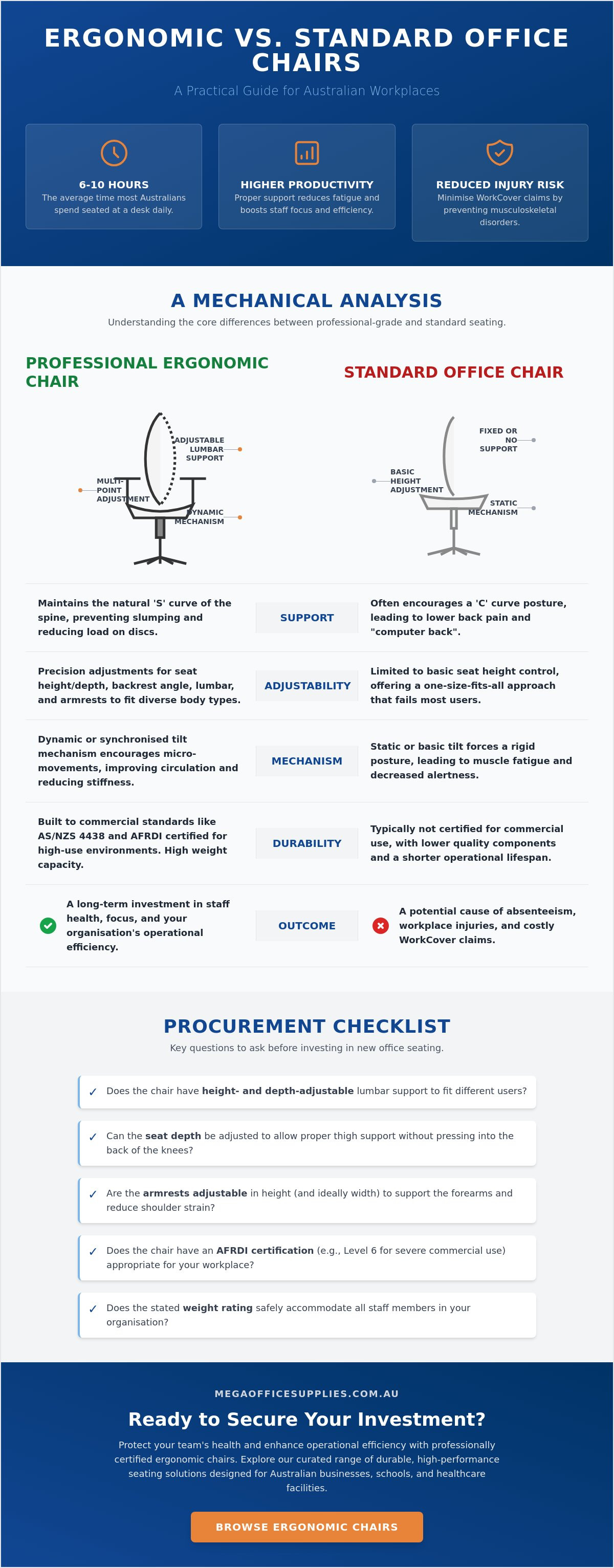
Modern ergonomics has shifted away from the idea of a rigid, static seat. Achieving the ideal ergonomic of a chair requires a shift toward dynamic support, which encourages micro-movements while the user is seated. These subtle shifts in position are vital for maintaining healthy blood circulation and preventing muscle stiffness during long shifts. By allowing the body to move naturally rather than forcing it into a fixed pose, dynamic seating solutions ensure that staff remain alert and physically supported from the start of the day to the finish.
The Anatomy of a High-Performance Ergonomic Chair
A high-performance chair is not a single piece of furniture but a precision-engineered system of five essential components designed to work in unison. Understanding the mechanical ergonomic of a chair requires looking beyond the upholstery to the hardware that manages your body's pressure points. Each adjustment point serves a specific biomechanical purpose, from distributing weight across the thighs to stabilising the pelvis. When these elements are poorly integrated, the user suffers from localised fatigue; when they are synchronised, the chair facilitates hours of focused, pain-free work. For those responsible for outfitting large-scale environments, evaluating these technical specifications is the only way to ensure long-term durability and staff wellbeing.
Lumbar Support and Backrest Contour
The backrest must mirror the natural S-curve of the human spine to prevent the vertebrae from slumping into a C-shape. Dedicated lumbar support is critical because the lower back bears the majority of the upper body's weight while seated. While fixed support works for some, adjustable lumbar systems are superior for diverse Australian workplaces where different staff members may share the same equipment. A height-adjustable backrest also ensures that support reaches the thoracic spine, which helps to open the chest and minimise tension across the shoulders and neck.
Seat Pan Mechanics and Depth
Seat depth is perhaps the most overlooked feature in professional seating. There should be a small gap, roughly the width of three fingers, between the edge of the seat and the back of your knees. This prevents pressure on the popliteal fossa, the sensitive area behind the knee where vital blood vessels and nerves reside. As highlighted in UCLA's guide to selecting an ergonomic chair, a "waterfall" front edge is essential for maintaining healthy circulation in the lower limbs. Additionally, adjustable seat tilt tension allows the user to recline with controlled resistance, ensuring the chair moves with the body rather than against it.
Armrest and Headrest Functionality
Effective armrests reduce the load on the trapezius muscles by supporting the weight of the arms. Professional-grade chairs often feature 3D or 4D armrests that adjust for height, width, and depth, allowing the user to maintain a 90-degree elbow angle regardless of their task. While headrests are beneficial for those who recline frequently to read or take calls, they must be positioned correctly to avoid pushing the head forward into a "text neck" posture. If you are currently reviewing your floor plan, choosing the right office furniture involves matching these adjustment capabilities to the specific daily tasks of your team.
The foundation of the chair is just as vital as the seat itself. A heavy-duty five-star base provides the stability needed for safe movement, while specialised castors should be selected based on your flooring type to prevent slipping or resistance. Finally, material science plays a significant role in comfort. Breathable mesh or high-density foam with moisture-wicking properties facilitates heat dissipation, which is particularly important in warmer Australian climates. By prioritising these structural elements, you can invest in seating that remains supportive and comfortable for years of heavy commercial use.
Standard Office Chairs vs. Ergonomic Chairs: A Mechanical Analysis
A chair isn't ergonomic simply because it looks modern or features a mesh backrest. The true distinction lies in the structural integrity and weight ratings of the internal components. Standard retail chairs are often built with lower-grade plastics and thinner steel frames, designed for light domestic use rather than the rigours of a 40-hour work week. When evaluating the mechanical ergonomic of a chair, you must look at the load-bearing capacity. While a budget model might suffice for an hour of life admin, a professional-grade chair is engineered to support weights up to 150kg over long durations without the frame warping or the mechanisms seizing.
The "universal" fit offered by mass-market seating is a common pitfall for procurement officers. These chairs rely on average dimensions that rarely accommodate the diverse physical profiles of an Australian workforce. Precision adjustability is what separates a high-performance tool from a piece of furniture. A budget chair often loses its supportive properties within six months as the tension springs weaken and the foam compresses. This creates a cycle of frequent, cheap replacements that ultimately costs more than investing in a single, high-quality unit with a ten-year lifespan.
Adjustability: The Key Differentiator
Many users fall into the "set and forget" trap, but ease of adjustment is vital in shared environments like hot-desking hubs or classrooms. High-end models feature synchronous tilt, where the backrest and seat move in a fixed 2:1 ratio. This keeps your feet flat on the floor and your eyes level with the screen even as you recline. According to the Canadian Centre for Occupational Health and Safety, a chair is only truly ergonomic when it fits the specific user's size and task requirements. Lower-tier models often use basic pneumatic gas lifts that can lose pressure or fail entirely, whereas commercial-grade Class 4 lifts provide years of consistent height adjustment and safety.
Commercial Durability and Warranties
Understanding "hours of use" ratings is essential for maintaining workplace safety. An 8-hour rated chair is the standard for most corporate offices, but 24-hour chairs are necessary for shift-based environments like hospitals or security centres. These heavy-duty models use high-density moulded foam that prevents "bottoming out", a common issue where the user eventually feels the hard seat pan through the padding. For a deeper look at how these categories differ, read our guide on Office Chairs vs. Desk Chairs. Selecting a chair with the correct structural ergonomic of a chair ensures your investment is protected by a commercial warranty that actually covers the demands of your specific industry.
Practical Procurement: Selecting Chairs for Australian Workplaces
Procurement for a modern Australian workplace involves a strategic assessment of risk, staff retention, and operational efficiency. Choosing a fleet of chairs is not merely a styling exercise; it is an investment in the long-term musculoskeletal health of your team. Different sectors require distinct solutions. Healthcare environments prioritise antimicrobial, wipeable fabrics and high-load capacities, while educational settings demand extreme durability to withstand high-traffic use by students. Conducting a workplace ergonomic audit before placing a bulk order allows you to identify specific needs, such as varying desk heights or specific flooring types that dictate castor selection. Evaluating the ergonomic of a chair during this phase ensures that the final fit-out supports every individual in the organisation.
Compliance with Australian/New Zealand Standards is the most reliable way to verify the safety and performance of commercial seating. AS/NZS 4438:1997 remains the benchmark for height-adjustable swivel chairs, providing a framework for stability, strength, and durability. Understanding the mechanical ergonomic of a chair is essential when selecting models that comply with these local standards, as it secures peace of mind and reduces the likelihood of future equipment failure. Balancing these functional requirements with the aesthetic goals of a modern office fit-out is possible when you choose professional-grade hardware that offers both visual appeal and mechanical precision.The Ergonomic Checklist for Buyers
- Stability: Ensure every unit features a heavy-duty five-star base to prevent tipping on standard Australian office carpets or hard floors.
- Weight Capacity: Verify that the chair is rated for your diverse workforce; commercial-grade models often support up to 110kg or 150kg depending on the specification.
- Intuitive Controls: Levers and dials must be accessible and easy to operate so staff can adjust their seating without needing a technical manual.
Buyers should always check for AFRDI Level 6 certification to ensure the product has passed rigorous testing for long-term commercial reliability.
Integrating Seating with Other Ergonomic Tools
A high-performance chair is most effective when it functions as part of a broader ergonomic system. Static sitting is increasingly replaced by dynamic movement, which is why an ergonomic chair works best in tandem with standing desks. This combination allows workers to alternate between sitting and standing, significantly reducing the pressure on the lower back. Monitor arms and footrests complete the "ergonomic triangle," ensuring the screen is at eye level and the feet are properly supported. For specialised environments like classrooms or lecture theatres, refer to our range of educational supplies to find seating specifically designed for younger users and high-traffic learning spaces.
Selecting the right hardware requires a partner who understands the logistical demands of high-volume orders and regional delivery. To explore our full range of professional-grade seating solutions, browse our collection of office furniture today.
Securing Your Investment with Mega Office Supplies
Mega Office Supplies leverages the combined decades of industry experience held by our team to provide more than just a product list. We act as a dependable partner in the e-commerce space, offering the scale required for major corporate upgrades while maintaining the grounded accessibility of an Australian operation. Our persona is that of a hardworking, consistent partner that values longevity over flashiness. When you evaluate the technical ergonomic of a chair, you need a supplier that understands the logistical reality of Australian shipping and the specific needs of local businesses. We project the image of a well-oiled operation capable of handling high-volume demands without the friction often found with global, faceless competitors.
Procurement officers often face the administrative burden of managing multiple vendors for a single fit-out. We simplify this workflow by providing a comprehensive catalogue that includes both professional-grade furniture and essential office supplies. This unified approach ensures that every element of your workspace, from the ergonomic of a chair to the stationery on the desk, arrives through a coordinated logistical stream. Our word choice reflects financial transparency, utilising industry-standard pricing and efficiency-focused labels to highlight competitive rates and ease of access for professional buyers.
Why Reliability Matters in Procurement
Peace of mind is the primary goal for administrators and business owners who value stability. As a family owned and operated business since 2008, we prioritise regional expertise and direct support. Our inventory is curated to meet strict safety benchmarks; this ensures your staff have the professional tools they need to perform at their peak. We've structured our communication rhythm to mirror the logical flow of a distribution centre, delivering information in a tiered sequence that suits a high-intent buyer who needs results quickly.
Next Steps for Your Workplace
High-volume orders and complex office fit-outs require precision and rapid execution. If you're planning an office upgrade, our team provides navigational options for rapid quoting to help you evaluate costs and quantities. We also offer specialised consulting for the unique requirements of healthcare and education sectors. For specific model recommendations and a deeper dive into current market options, consult our Professional Buying Guide to Ergonomic Office Chairs. Our commitment to reliable national delivery ensures that government departments and private enterprises across Australia receive their hardware on time and in perfect condition. We understand the practicalities of workplace maintenance and are ready to support your next project with the authority of a seasoned industry veteran.
Securing Future Productivity with Professional Seating
Investing in the physical health of your team is a strategic decision that pays dividends in productivity and staff retention. By understanding the technical ergonomic of a chair, you move beyond basic aesthetic choices to solutions that provide genuine musculoskeletal support. Professional-grade seating, verified by AS/NZS 4438:1997 and AFRDI standards, ensures that your organisation meets essential safety benchmarks while minimising the risk of chronic sedentary injuries.
Mega Office Supplies has been family owned and operated since 2008, serving the national market. We ensure that corporate and government sectors receive reliable hardware via our established national delivery network. We understand the logistical demands of high-volume office fit-outs and are committed to helping you find the right tools for your unique workspace.
Browse our range of professional ergonomic office chairs to secure the future of your workplace health. We look forward to supporting your next office upgrade and helping your team perform at their peak.
Frequently Asked Questions
What is the most important ergonomic feature of a chair?
Adjustable lumbar support is the most critical feature because it preserves the natural inward curve of the lower spine. Without this support, the pelvis tilts backward, leading to slumping and increased pressure on spinal discs. When evaluating the ergonomic of a chair, ensure the lumbar section is height-adjustable to match your specific proportions. This prevents the muscle fatigue that often leads to chronic back issues in sedentary environments.
How do I know if my current office chair is ergonomically correct?
A chair is ergonomically correct if it allows you to maintain a neutral posture with your feet flat on the floor and your thighs parallel to the ground. You should have a small gap, roughly three fingers wide, between the seat edge and the back of your knees. If you find yourself leaning forward or experiencing numbness in your legs, the chair likely lacks the necessary adjustment points for your body type.
Are mesh chairs better for ergonomics than fabric or leather?
Mesh chairs are highly effective in Australian climates due to their superior heat dissipation and breathability. While leather or fabric may offer a more traditional feel, mesh provides dynamic support by conforming to the user's back. The choice often comes down to the specific workplace environment; mesh is preferred for high-use workstations where airflow is a priority to maintain comfort throughout a long shift.
How high should my ergonomic chair be set?
Your chair height should be adjusted so that your forearms are parallel to the desk surface with your elbows at a 90-degree angle. This position prevents wrist strain and shoulder tension during typing and mouse use. If your feet don't reach the floor comfortably at this height, you must use a footrest to ensure your lower back remains supported and your circulation isn't restricted by the seat edge.
Do I really need a headrest on my office chair?
Headrests are optional and primarily benefit users who spend significant time reclining for reading or phone-based tasks. For standard computer work, a headrest isn't essential if the backrest provides proper thoracic support. However, it can provide a necessary rest point for the neck during breaks. It's vital to ensure the headrest doesn't push your head forward, as this can cause the very neck strain you're trying to avoid.
What does AFRDI certified mean when buying an office chair in Australia?
AFRDI certification indicates that a chair has been independently tested for safety, durability, and ergonomic function by the Australasian Furnishing Research and Development Institute. When buying a chair in Australia, look for an AFRDI Level 6 "Blue Tick" rating. This certification confirms the unit is suitable for heavy commercial use and meets the rigorous requirements of the AS/NZS 4438 standard for height-adjustable swivel chairs.
How often should an ergonomic office chair be replaced?
Commercial-grade ergonomic chairs typically require replacement every seven to ten years depending on the intensity of use. You'll know it's time for an upgrade when the pneumatic gas lift fails to hold its height or the seat foam loses its resilience and begins to bottom out. Maintaining the ergonomic of a chair involves regular inspections of the castors and adjustment levers to ensure the mechanical support remains intact over time.
Can an ergonomic chair help with existing neck and shoulder pain?
An ergonomic chair can significantly alleviate neck and shoulder pain by correcting the alignment of the entire spine. Most neck tension actually originates from a lack of lower back support, which causes the user to hunch forward. By using adjustable armrests to support the weight of your limbs, you reduce the constant load on your trapezius muscles, allowing your shoulders to relax into a natural, neutral position.
Article by
Mega Office Supplies Team
The Mega Office Supplies Team provides practical guidance for Australian businesses, schools, government organisations, healthcare providers, hospitality venues, warehouses and home offices. Based in Tweed Heads South, Mega Office Supplies has been family owned and operated since 2008, offering office stationery, workplace furniture, technology products, labels, printers, cleaning and janitorial supplies, safety products, art materials, education resources and everyday business essentials from trusted brands.
General Information
This article is provided as general information only to help customers compare and choose office, workplace, school, cleaning, technology, furniture, safety and business supplies. Product details, specifications, compatibility, availability, pricing and suitability may vary. Always check the individual product page, manufacturer information, workplace requirements and relevant safety guidance before purchasing or using a product.


