

What if the "ergonomic" label on your office chairs is actually just a marketing claim rather than a verified technical specification? It’s a recurring challenge for procurement officers and business owners who must distinguish between aesthetic design and genuine physiological support. You likely recognise that poor seating choices lead directly to increased workplace fatigue, reduced output, and potential WHS liability. Selecting the right hardware requires more than a cursory glance at a catalogue; it demands an understanding of the structural integrity and durability standards specific to the Australian market.
This guide provides a professional framework for identifying high-performance seating that complies with AS/NZS 4438:1997 and the latest AFRDI rated load updates from August 2023. We promise to move past vague marketing terms to deliver a technical resource that simplifies bulk purchasing decisions for schools, government departments, and corporate offices. Backed by decades of combined industry experience, we will examine the various AFRDI certification levels, from general office use to the "gold standard" Level 6, while outlining how to evaluate the long-term durability of your seating inventory to ensure a reliable return on investment.
Key Takeaways
- Understand how ergonomic support directly influences workplace productivity and reduces absenteeism across diverse Australian teams.
- Learn to decode AFRDI certification levels to ensure your office chairs meet the rigorous durability standards required for high-use commercial environments.
- Identify the functional differences between task and executive seating to select the most appropriate hardware for each sector of your organisation.
- Utilise a comprehensive procurement checklist to evaluate the total cost of ownership and verify the validity of professional-grade warranty periods.
- Discover how to streamline national fit-outs by leveraging decades of combined industry experience and a robust logistical network.
Selecting Office Chairs for Australian Workplace Productivity
Investing in high-quality office chairs is a strategic decision that impacts the bottom line through reduced absenteeism. When staff members use poorly designed seating, the physical strain often manifests as chronic back pain or repetitive strain injuries. These conditions are leading causes of lost workdays across Australian organisations. A "one size fits all" approach fails because the local workforce is diverse in height, weight, and physical requirements. Providing a chair that cannot be adjusted to the individual user increases the risk of long-term injury and cumulative fatigue.
There is a significant technical gap between domestic-use desk chairs and commercial-grade seating. While a domestic chair might suffice for a few hours of home use, it lacks the structural reinforcement and high-density foam required for an eight-hour workday. Commercial-grade hardware is built to withstand constant use in demanding environments like call centres or government departments. Understanding the history and types of office chairs reveals how design has evolved from simple wooden stools to complex mechanical systems intended to support the human frame throughout a professional shift.
To better understand the technical aspects of selection, watch this helpful video:
The Impact of Ergonomics on Professional Output
Lumbar support isn't just about comfort; it's about maintaining the natural curve of the spine to minimise cognitive fatigue. When the body is stressed by poor posture, the brain diverts energy to managing physical discomfort, which reduces focus on professional tasks. Seat pan depth is equally critical. If the seat is too deep, it presses against the back of the knees and restricts blood flow. If it's too shallow, it fails to provide enough surface area to support the thighs, leading to increased pressure on the hips. In the context of Australian office furniture standards, ergonomics refers to the scientific application of design principles to ensure seating promotes optimal posture and physiological safety for the user.
WHS Compliance and Duty of Care
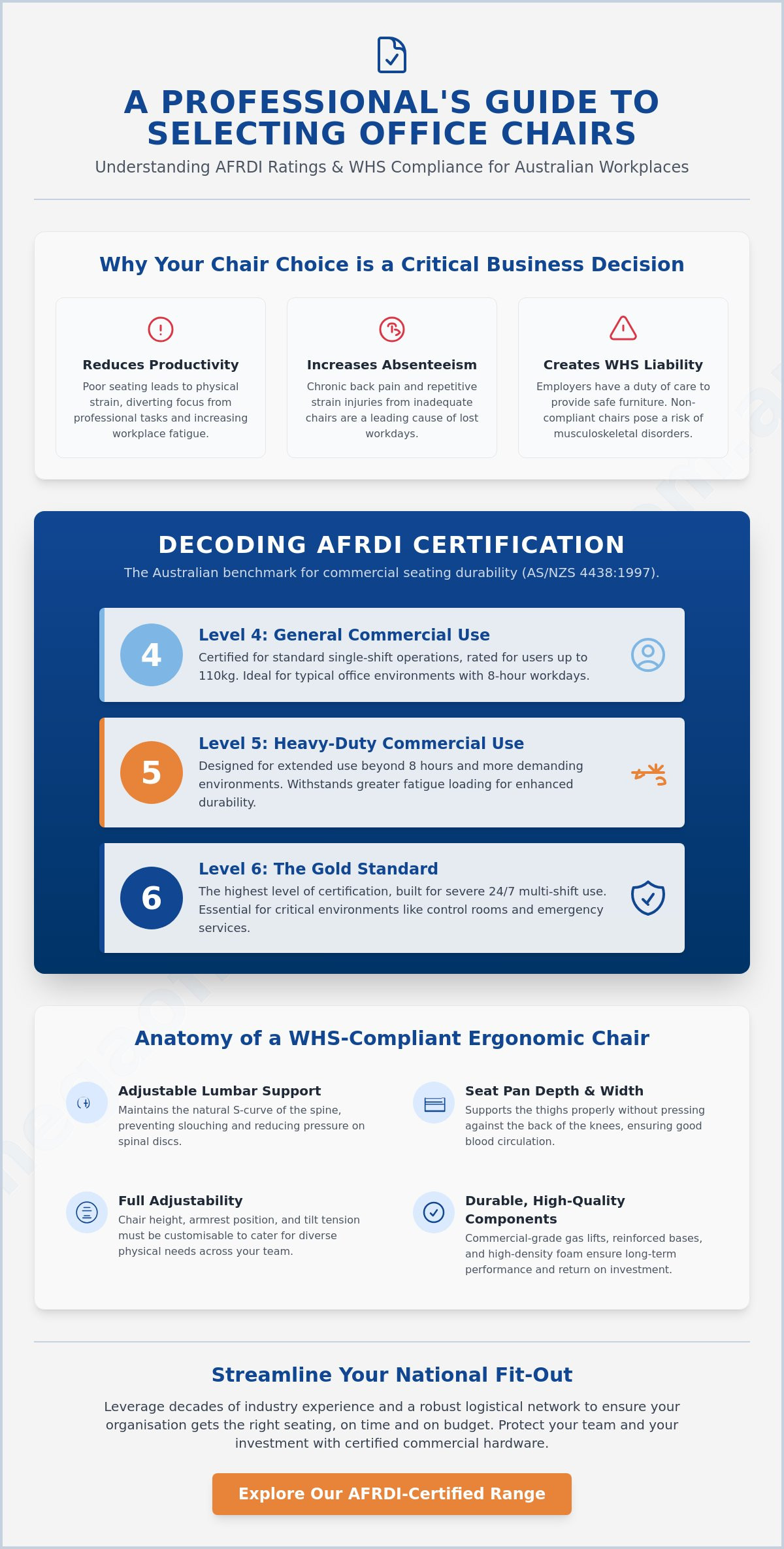
Under Australian Work Health and Safety (WHS) legislation, employers have a clear duty of care to provide a safe working environment. This includes supplying furniture that minimises the risk of musculoskeletal disorders. Standardised, adjustable seating ensures that every staff member can configure their station to their specific needs. Employers must recognise that providing "standard" seating isn't enough to meet compliance if that seating doesn't cater to the actual physical dimensions of the staff. For a deeper look into the physiological requirements of the modern workplace, refer to our Professional Buying Guide to Ergonomic Office Chairs. Choosing from a verified range of office furniture ensures your organisation meets these regulatory obligations while protecting your team's health.
Technical Standards and Durability: Understanding AFRDI Ratings
Procuring office chairs based on visual appeal alone is a common oversight that leads to premature equipment failure. In the Australian commercial sector, the benchmark for structural integrity is set by the Australasian Furnishing Research and Development Institute (AFRDI). This independent body tests furniture against AS/NZS 4438:1997 to ensure it withstands the rigours of professional use. Selecting certified hardware is a technical necessity because inferior components often succumb to the health risks of prolonged sitting by failing to provide consistent, stable support over time. A certified chair ensures that the gas lift, base, and tilt mechanism remain functional under constant load.
Weight capacity is a critical factor for maintaining an inclusive and safe workplace. While many standard models are rated for 135kg, the AFRDI 142 Rated Load standard was updated in August 2023 to include a 185kg test level. This update reflects the need for more robust seating options that accommodate a wider range of body types without compromising safety. Beyond the frame, you must evaluate the hardware for your specific environment. For example, hard floor castors are essential for polished concrete or timber to prevent skidding, while standard castors are suited for commercial-grade carpets found in most Australian offices.
AFRDI Levels Explained
The certification levels define the intended intensity of use for any given chair. Level 4 is the entry point for commercial environments, suitable for general office work and executive roles where the chair is used for roughly eight hours a day. Level 5 represents a significant step up in durability, designed for heavy-duty office environments. Level 6 is the "gold standard" in the industry. These chairs are engineered for severe conditions and 24/7 operational requirements, making them the mandatory choice for emergency services, police stations, and high-volume call centres where seating is never vacant.
For facilities that operate 24/7, durability is a requirement that extends beyond office furniture to the apparel worn by the facility's maintenance and painting teams.
Material Selection and Maintenance
Choosing between mesh and fabric involves balancing breathability with long-term wear resistance. Mesh allows for superior airflow, which is often preferred in warmer Australian climates, but it must be high-tension to prevent sagging. Conversely, commercial-grade fabrics paired with high-density moulded foam offer superior shape retention and comfort for long shifts. To extend the life of your office chairs, implement a basic maintenance schedule. This should include tightening bolts every six months and clearing debris from castor wheels to ensure smooth movement. If you are managing a large-scale facility, you can view our range of certified commercial seating to find hardware that matches your specific durability requirements.
Comparing Seating Types for Specific Australian Sectors
Different operational zones within an organisation demand specific mechanical features. While the open-plan floor relies on high-performance task chairs, a boardroom requires a different balance of aesthetic presence and short-term comfort. Selecting inappropriate hardware for a specific zone can lead to premature wear or user discomfort, regardless of the initial investment.
This principle of role-specific equipment extends beyond the office floor. Just as administrative staff require ergonomic support, your maintenance and painting teams need professional-grade apparel.
Task chairs function as the primary workhorses of the Australian office. These models prioritise dynamic movement and high adjustability to suit users who remain seated for most of their shift. In contrast, executive seating often incorporates premium materials and higher backrests to signal prestige. However, modern executive models must still incorporate ergonomic foundations to prevent the physical strain discussed in previous sections. Boardroom and visitor chairs focus on aesthetic impact for shorter durations, usually favouring sleek lines and simplified adjustment controls.
Task Chairs vs. Executive Models
Choosing between a high-back and mid-back model depends on the specific task. High-back office chairs provide full spinal support, which is essential for focused, long-duration work. Mid-back models offer greater upper-body mobility, making them suitable for collaborative spaces or roles requiring frequent movement. High-performance tasking requires a synchro-tilt mechanism. This hardware allows the seat and back to move in a fixed ratio, keeping the user's feet flat on the floor while reclining. For a detailed breakdown of these differences, see our Office Chairs vs. Desk Chairs comparison.
Specialist Environments: Education and Healthcare
Specialised sectors require hardware that meets stringent hygiene and durability criteria. In medical centres and clinics, seating must feature anti-microbial fabrics or high-grade vinyl that withstands rigorous cleaning protocols. For the classroom, durability is the primary metric. We provide stackable, impact-resistant seating for educational supplies and multi-purpose rooms where space management is critical. Laboratory and warehouse settings require industrial-grade drafting stools with foot rings and puncture-resistant upholstery to ensure safety in high-activity zones. These specialised office chairs are engineered to provide height-adjustable support for elevated work surfaces, ensuring ergonomic alignment even in non-traditional desk environments.
The Procurement Checklist: Considerations for Large-Scale Orders
Procuring office chairs for a national organisation requires a shift in perspective from individual comfort to operational efficiency. You must assess the total cost of ownership rather than just the upfront invoice. A budget-oriented chair often requires replacement within 24 to 36 months, whereas commercial-grade hardware typically delivers a decade of service. Evaluating the warranty is equally critical. A professional-grade guarantee should explicitly cover the mechanical components, gas lifts, and structural frame for a minimum of five years. If a manufacturer won't stand by their hardware for that duration, it's unlikely to survive the rigours of a high-use workplace.
Logistical coordination is the backbone of a successful fit-out. You must account for lead times, particularly when ordering hundreds of units for delivery across multiple state branches. Before finalising a large-scale order, implement a trial program. Testing a sample in your specific environment allows your team to provide feedback on the hardware before you commit significant capital. This step ensures the seating is compatible with your floor types and desk heights, preventing costly return logistics later.
Volume Procurement and Standardisation
Standardising your seating inventory across all locations simplifies long-term facilities management. When every branch uses the same model, your maintenance team can stock a single type of castor or gas lift, reducing downtime. This consistency also ensures a unified aesthetic across the organisation, regardless of the office location. To streamline this process, you can request a bulk quote for commercial furniture to benefit from volume pricing and coordinated delivery schedules across the country.
Integration with Other Ergonomic Furniture
Seating doesn't exist in a vacuum. You must ensure that the armrests on your chosen office chairs are compatible with the height ranges of your standing desk inventory. If armrests cannot be lowered sufficiently, they'll collide with the desktop, preventing the user from sitting close enough to their workstation. Additionally, consider the role of chair mats. These protect your flooring and reduce the physical effort required to move the chair on carpeted surfaces. Finally, ensure your seating choice complements your technology setup, specifically monitor arms, to maintain correct eye-level alignment and reduce neck strain.
Streamlining Your National Fit-out with Mega Office Supplies
Executing a national fit-out requires more than just a product catalogue; it demands a logistical partner capable of synchronising deliveries across every state and territory. Managing multiple vendors for different regions often leads to inconsistencies in hardware and fragmented maintenance schedules. By consolidating your procurement of office chairs and general office supplies through a single provider, you simplify the entire supply chain. This approach ensures that a branch in a remote location receives the same high-performance seating as your central corporate office, maintaining a uniform standard of ergonomic support across your entire organisation.
Our operation is structured like a well-oiled distribution centre, prioritising functional clarity and speed of fulfilment. We leverage decades of combined industry experience to help procurement officers navigate the technical specifications of commercial-grade furniture. This historical depth allows us to identify potential issues before they impact your timeline, such as lead-time variances or compatibility requirements for specific floor types. We don't just sell products; we provide a comprehensive logistical solution for the modern Australian workplace.
In addition to local logistics, many Australian firms are looking at global expansion into high-growth areas.
The Mega Office Supplies Advantage
Reliability is the foundation of our service. As a family owned and operated business since 2008, we offer a level of direct accountability that global competitors cannot match. You'll have direct access to expert support for complex commercial requirements, ensuring your technical questions are answered by seasoned professionals. Our focus remains on professional-grade hardware designed to withstand high-volume demand. We've curated a massive inventory that covers every corner of the workplace, from the front reception to the back-of-house warehouse.
Next Steps for Your Workplace
Moving from the planning phase to execution is straightforward with our structured procurement tools. You can utilise our rapid quoting system to evaluate costs and volume requirements for your next project, ensuring financial transparency from the outset. Our team is available to consult on customised furniture solutions if your workspace has unique architectural constraints or specific sector requirements. Beyond office chairs, we assist in ensuring your facility meets all regulatory safety standards. This includes providing essential first aid supplies and PPE to keep your team protected. Contact our local support line to begin coordinating your national rollout with a partner that values longevity and precision.
Establishing a Standard of Commercial Excellence
Selecting high-performance office chairs is a technical investment that directly impacts staff wellbeing and long-term operational costs. You now have the framework to distinguish between generic marketing and genuine AFRDI-certified durability. By prioritising hardware that meets Australian standards, you ensure your organisation fulfils its WHS obligations while minimising the frequency of equipment replacement. Professional procurement is about more than comfort; it's about structural integrity and structural longevity.
Mega Office Supplies provides a comprehensive range of AFRDI-rated seating with reliable national delivery to ensure your multi-site setup remains consistent and professional. Whether you're equipping a single boardroom or managing a national fit-out, we provide the logistical scale and technical expertise required for success. Browse our full range of commercial-grade office chairs to secure a durable, compliant seating solution for your team today.
We look forward to supporting your organisation's growth with hardware built for the rigours of the Australian workplace.
Frequently Asked Questions
What is the most important feature to look for in an ergonomic office chair?
Adjustable lumbar support is the most critical feature because it maintains the natural curvature of the spine and prevents slumping. You should look for a system that allows both height and depth adjustment to suit individual physiological requirements. This support ensures that the user's lower back remains properly aligned, which reduces the risk of musculoskeletal strain during long periods of focus.
How long should a commercial-grade office chair typically last?
A high-quality commercial chair should provide seven to ten years of service in a standard professional environment. This longevity is achieved through the use of high-density moulded foam and reinforced structural frames that don't degrade under constant use. In contrast, domestic-grade seating often fails within two to three years because the components aren't designed for the rigours of an eight-hour workday.
Is it worth investing in AFRDI-certified chairs for a small business?
Investing in certified seating is a prudent decision for small businesses as it reduces long-term replacement costs and minimises WHS liability. Even with a small team, equipment failure can lead to workplace injuries and lost productivity. Choosing hardware that has passed independent durability testing ensures you won't have to reinvest in new seating every few years.
What is the difference between a task chair and a computer chair?
Task chairs are engineered for high-intensity professional focus with multiple adjustment points, whereas computer chairs are typically designed for shorter periods of intermittent use. Professional office chairs in the task category feature synchro-tilt mechanisms and 3-lever adjustments to support dynamic movement. Computer chairs often lack these mechanical refinements and may only offer basic height adjustment.
How do I know if an office chair is suitable for 8+ hours of daily use?
Verify the AFRDI certification level to determine if a chair is rated for eight or more hours of daily use. A Level 5 rating is the standard for heavy commercial use during normal office hours. If your facility operates 24/7 or requires seating for extremely long shifts, you should select a Level 6 certified model to ensure the hardware withstands the constant load.
Can I get office chairs delivered to regional areas across Australia?
National delivery capabilities ensure that office chairs can be shipped to regional hubs and metropolitan centres across every Australian state. Our logistical network is designed to handle bulk orders for multi-site organisations, including those with branches in remote locations. This ensures that every member of your team receives the same high standard of ergonomic support regardless of their office location.
What weight capacity should I choose for a standard office environment?
A 135kg capacity is the industry standard for most professional environments, though inclusive workplaces should consider 160kg or 185kg ratings. Following the August 2023 AFRDI update, many commercial models are now tested to these higher load levels. Selecting a chair with a higher weight rating provides an extra margin of safety and ensures the gas lift remains functional for a diverse workforce.
Do your office chairs come with a commercial warranty?
Our commercial-grade seating range includes professional warranties that typically span five to ten years. This guarantee covers the structural frame, mechanical tilt components, and the gas lift under normal professional use. It's important to distinguish this from domestic warranties, which often exclude coverage if the chair is used in a commercial or high-volume environment.
Article by
Mega Office Supplies Team
The Mega Office Supplies Team provides practical guidance for Australian businesses, schools, government organisations, healthcare providers, hospitality venues, warehouses and home offices. Based in Tweed Heads South, Mega Office Supplies has been family owned and operated since 2008, offering office stationery, workplace furniture, technology products, labels, printers, cleaning and janitorial supplies, safety products, art materials, education resources and everyday business essentials from trusted brands.
General Information
This article is provided as general information only to help customers compare and choose office, workplace, school, cleaning, technology, furniture, safety and business supplies. Product details, specifications, compatibility, availability, pricing and suitability may vary. Always check the individual product page, manufacturer information, workplace requirements and relevant safety guidance before purchasing or using a product.


