


Your "protective" floor covering might be the silent culprit behind thousands of dollars in property damage. While many procurement officers view floor protection as a minor stationery expense, the wrong choice often leads to cracked PVC, unsightly "creeping" across plush piles, or irreversible scuffs on polished timber. It's a common frustration for Australian business owners who find that a cheap mat fails just when the casters start digging into the floorboards.
We understand that selecting an office chair mat for carpet vs hardwood is a strategic asset management decision rather than a simple aesthetic choice. This professional guide provides the technical clarity you need to safeguard your flooring and significantly reduce leg fatigue by improving chair mobility. You'll learn how to identify high-performance materials like polycarbonate, understand the importance of cleated versus smooth backings, and discover which options meet the rigorous demands of a modern Australian workplace.
Key Takeaways
- Learn how to distinguish between cleated and smooth-backed designs to select the ideal office chair mat for carpet vs hardwood surfaces.
- Identify the mechanical differences between PVC and polycarbonate materials to ensure your investment withstands heavy-duty daily use.
- Understand how proper floor protection enhances workplace ergonomics by minimising leg strain and improving chair mobility.
- Gain practical insights into pile depth and anti-skid coatings to prevent mats from sliding or damaging expensive flooring.
- Master simple maintenance and installation techniques to extend the lifespan of your mats and maintain a professional office aesthetic.
Protecting Your Workplace Assets: Why Floor Protection Matters
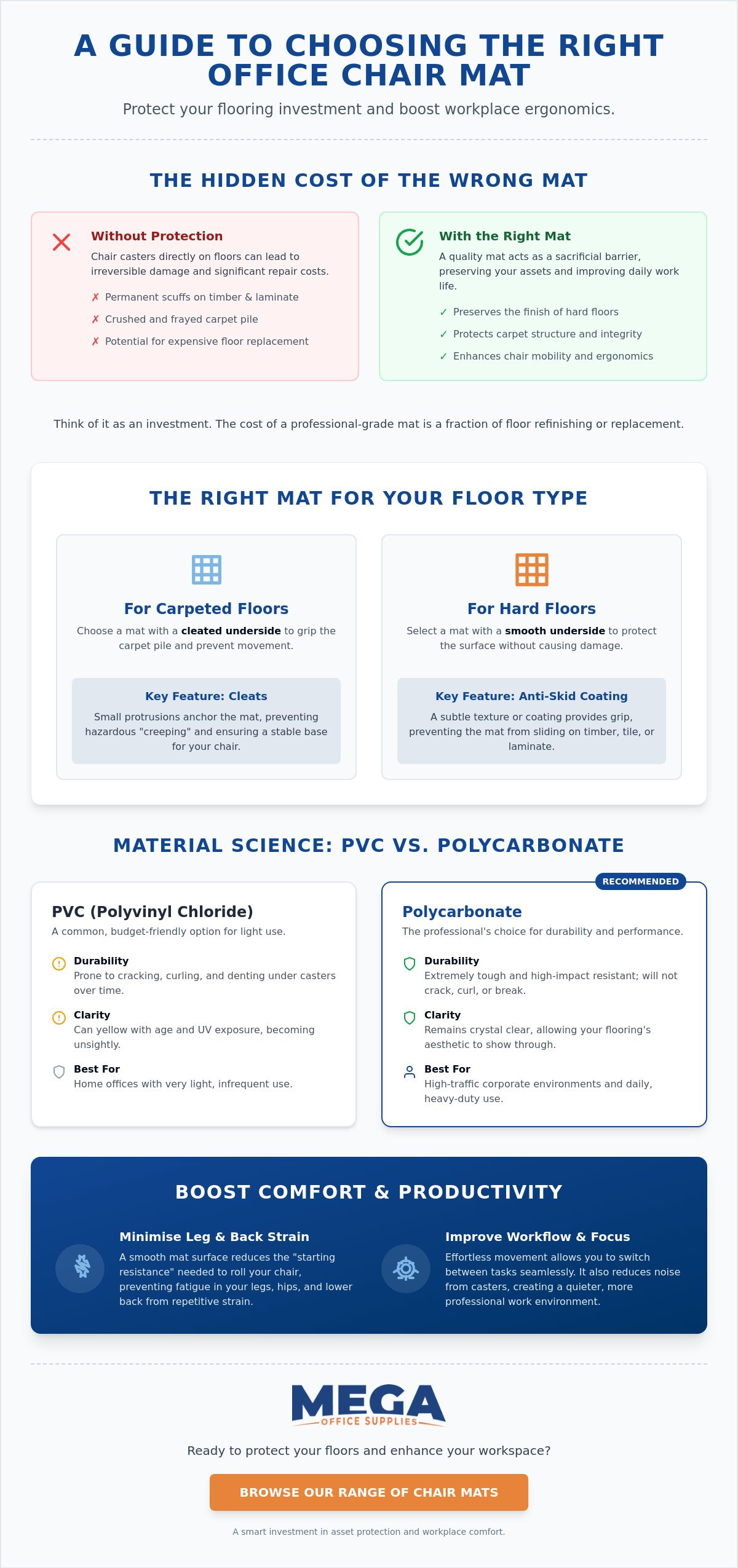
Floor protection is a fundamental component of facility management rather than a simple aesthetic addition. In high-traffic Australian workplaces, an office chair mat serves as a sacrificial barrier, absorbing the daily punishment that would otherwise degrade your primary flooring. Every time a user shifts their weight or rolls between desk zones, the point-load pressure concentrated through four or five small casters creates immense stress on the underlying surface. Without a dedicated shield, even the most durable commercial finishes will eventually fail.
The financial logic for this investment is clear when comparing the modest cost of a professional grade mat to the significant expense of floor refinishing or full-scale re-carpeting. In many corporate environments, Floor Protection Matters because it preserves the building's capital value and reduces long-term maintenance overheads. By installing a high-quality barrier, you ensure that the inevitable wear and tear of a busy office is contained within a replaceable accessory rather than the permanent structure of the room.
To better understand how these barriers function across different surfaces, watch this helpful video overview:
The Anatomy of Caster Wear and Tear
Standard chair wheels are often made of hard nylon, which acts like an industrial grinder on timber, laminate, or stone surfaces. As the wheels move, they trap microscopic grit and dust against the floor, effectively sanding down the protective sealant or grain. This leads to unsightly scuff marks and permanent "tracking" patterns that are difficult to repair. When choosing an office chair mat for carpet vs hardwood, it's vital to recognise that different surfaces face different threats. On carpeted floors, casters exert a crushing force that flattens the pile and stresses the underlay. Over time, this repetitive pressure breaks down the carpet fibres, leading to "bald spots" and structural thinning that compromises the floor's insulation and comfort properties.
Health and Productivity Benefits
Beyond asset protection, mats provide a critical ergonomic advantage by minimising "starting resistance." This is the physical force required to initiate chair movement from a stationary position. Rolling a chair over bare carpet requires significantly more muscular effort than rolling over a smooth, rigid surface. For employees in home offices or large-scale administrative centres, this repetitive strain can lead to fatigue in the lower back, hips, and legs. Integrating a mat with ergonomic office chairs allows for effortless movement between desk zones, which improves workflow and reduces workplace noise. A quieter office environment, free from the sound of casters scraping on timber or thudding on carpet, contributes to a more focused and professional atmosphere.
Carpet Chair Mats: Understanding Cleats and Pile Depth
Selecting the correct office chair mat for carpet vs hardwood requires an understanding of mechanical grip. While hard floor mats rely on friction, carpeted surfaces demand a specialised "cleated" or "studded" underside. These small protrusions act like anchors, sinking into the carpet pile to prevent the mat from "creeping" across the room as you move. Without these cleats, a mat will slide unpredictably, creating a tripping hazard and forcing the user to constantly reposition their workstation setup.
Using a smooth-back mat on a carpeted surface is ineffective and potentially dangerous. The lack of grip causes the mat to shift under the weight of the chair, which can lead to sudden instability. In professional Australian environments, particularly in high-traffic CBD offices using carpet tiles, matching the mat's underside to the floor texture is a critical safety requirement. A properly anchored mat ensures a stable platform for ergonomic office chairs, allowing for consistent, predictable movement throughout the workday.
Measuring Your Carpet Pile Height
Determining the correct mat thickness starts with the paperclip test. Straighten a standard metal paperclip and push it vertically into your carpet until you feel it hit the hard floor or underlay beneath. Mark the point where the clip meets the top of the carpet fibres and measure that length. This simple step prevents the most common cause of mat failure: using a low-pile mat on a plush surface. If the mat is too thin for the carpet's depth, it will flex excessively under the chair's weight, leading to structural fatigue and eventual cracking.
- Low Pile (Commercial): Generally less than 6mm thick. This is the standard for most Australian government and corporate offices, including heavy-duty carpet tiles.
- Medium Pile: Between 6mm and 12mm. Common in modern home offices and reception areas.
- Plush/High Pile: Anything exceeding 12mm. These require industrial-strength polycarbonate mats to prevent the casters from sinking and "dimpling" the plastic.
Cleat Design and Carpet Integrity
Cleat length must be proportional to the pile depth to ensure stability without piercing the carpet's primary backing. For those Implementing Ergonomic Solutions, bevelled edges are a mandatory feature. These tapered borders allow the chair casters to transition smoothly onto the mat without catching or jarring the user's spine. When choosing a shape, consider your desk configuration. A "Lip" style mat provides an extended tongue that fits under the desk cavity, protecting the floor where your feet and the front casters spend the most time. For L-shaped workstations or larger executive desks, a wide rectangular mat offers a broader range of motion. If you are fitting out a new workspace, exploring professional grade chair mats designed for specific pile depths will ensure your flooring remains protected for years to come.
Hardwood and Hard Floor Mats: Preventing Scuffs and Scratches
Protecting timber or stone requires a different mechanical approach than carpeted environments. When evaluating an office chair mat for carpet vs hardwood, the primary differentiator for hard surfaces is the "smooth-back" design. These mats feature a completely flat underside to maximise surface contact with the floor. Unlike carpet mats that use studs to anchor into fibres, hard floor versions rely on high-friction coatings or natural suction to remain stationary. This ensures that the mat does not shift during use, which could otherwise lead to the very scratches you are trying to prevent.
These mats are typically thinner than their carpeted counterparts, often ranging from 1.5mm to 2.5mm. This low profile is intentional; it minimises the "lip" that a chair must navigate and prevents the mat from becoming a trip hazard on firm surfaces. For specialised finishes like polished concrete or natural stone, a thinner, high-clarity polycarbonate mat provides a nearly invisible shield. This preserves the floor's aesthetic while preventing the micro-scratches caused by caster movement and trapped debris.
Timber, Laminate, and Vinyl Protection
One of the most significant risks to timber floors is the "grey ghosting" effect. This occurs when the protective polyurethane coating is worn away by repetitive caster friction, allowing dirt and moisture to penetrate the wood grain. A professional grade mat prevents this degradation by acting as a sacrificial wear layer. It also mitigates the risk of moisture trapping. Some low-quality vinyl mats can "sweat," leading to warped boards or discoloured laminate. High-quality polycarbonate options allow for better thermal stability and are compatible with modern luxury vinyl planks (LVP) and hybrid flooring common in Australian residential and commercial offices.
Stability on Smooth Surfaces
Stability on timber or tile is achieved through a balance of suction and friction. Many premium mats feature an anti-skid coating that grips the floor without the need for harmful adhesives that could leave a sticky residue. You must never use a cleated mat on a hard floor; the studs will cause immediate, permanent indentation and damage to the finish. Maintaining this grip requires a clean environment. Trapped dust beneath the mat acts like sandpaper under the weight of a user, so a regular wipe of the underside is essential to maintain transparency and grip. Following established ergonomic chair guidelines ensures that your chair glides effortlessly, reducing the physical strain on your joints while protecting your facility's assets. For those managing large-scale offices or commercial fit-outs, selecting the right material is the final step in ensuring long-term durability and safety.
Material Science: Choosing Between PVC, Polycarbonate, and Glass
Selecting an office chair mat for carpet vs hardwood is ultimately a decision about material longevity and workplace safety. While PVC (vinyl) remains a high-volume choice due to its lower entry cost, professional Australian environments increasingly favour polycarbonate for its superior structural integrity. In high-traffic zones like hospital nurse stations or school administration offices, the material must withstand constant pressure without losing its shape or clarity.
PVC mats are typically best suited for light-duty home offices where the chair is used for only a few hours a day. These mats are flexible and easy to ship, but they often contain phthalates and can emit volatile organic compounds (VOCs). This off-gassing can be a concern in enclosed or poorly ventilated workspaces. From a sustainability perspective, polycarbonate is often the preferred choice as it is more readily recyclable and has a significantly longer service life, reducing the frequency of replacement and land-fill contributions.
For executive suites and high-end boardrooms, tempered glass represents the premium "buy-it-once" solution. These mats offer unmatched clarity and a weight capacity that exceeds standard plastic alternatives. While the initial investment is higher, the durability of glass ensures it will not dimple, scratch, or lose its transparency over time, making it a sound long-term asset for any professional fit-out.
Durability and Lifespan Comparison
Australian conditions present unique challenges for office equipment. PVC tends to yellow and become brittle when exposed to the high UV levels and heat common in many local offices. Once the material loses its plasticisers, it will begin to crack under the weight of the chair, often leading to sharp edges that can damage the underlying floor. Polycarbonate is thermally stable and features "no-curl" properties, which is essential in large-scale warehouses or open-plan offices where temperature fluctuations occur. Matching the user's weight and chair type to the mat's load rating is vital; heavy-duty users should always opt for polycarbonate or glass to prevent structural fatigue.
Aesthetics and Workplace Design
Modern office design often emphasises the natural beauty of the flooring, whether it's polished spotted gum or high-spec commercial carpet tiles. High-clarity polycarbonate and glass mats allow the floor colour and texture to remain visible, maintaining the intended aesthetic of the room. In contrast, some PVC mats have a slightly tinted or "milky" appearance that can dull the look of the workspace. Pair your mat with our range of ergonomic office chairs for maximum floor protection and a cohesive professional look. Browse our collection of professional grade chair mats to find the right material for your specific facility requirements.
Implementing Ergonomic Solutions: Installation and Maintenance
Successful floor protection depends on correct setup and ongoing care. Whether you've selected a specific office chair mat for carpet vs hardwood, the initial unboxing and placement determine the product's long-term performance and safety. In professional Australian environments, where facility managers must oversee hundreds of workstations, standardising these installation and maintenance procedures is essential to maximise the lifespan of your workplace assets.
For national organisations managing large-scale fit-outs, coordinating the delivery and setup of hundreds of units requires a partner with significant logistical scale. Organising mats for government departments or corporate centres involves more than just a transaction; it requires a reliable supply chain that can handle high-volume demands without friction. Once the equipment arrives, following a structured implementation plan ensures that every workstation meets the required ergonomic and safety benchmarks from day one.
Installation and Initial Setup
Many professional grade mats are shipped rolled to minimise logistical costs and facilitate easier handling within busy office buildings. To ensure the mat lies perfectly flat, use the "warm room" technique. Leave the rolled mat in a heated room or a sunny area for at least 24 hours before unrolling. This makes the polymer more pliable and prevents the edges from curling, which is a common trip hazard. When placing the mat, orientation is critical for safety. Cleated mats must always be placed with the studs facing down into the carpet. For hard floor versions, the smooth, high-friction side must face the floor to ensure maximum grip. Ensure the mat fits deep into the desk well so that the chair's front casters don't roll off the edge when you're tucked into your workstation.
Long-term Care and Replacement
Maintaining the high-clarity appearance and functional grip of your mat requires a simple but consistent cleaning routine. Use warm water and a mild detergent rather than harsh industrial chemicals or ammonia-based cleaners. These aggressive substances can strip the protective coatings from polycarbonate, making it brittle and prone to premature cracking. A weekly wipe of both the top surface and the underside is vital to remove the microscopic grit that acts like sandpaper against your flooring.
Equally important is the condition of your chair wheels. Dirty or damaged casters will ruin even the most durable polycarbonate mat. Inspect your chair's wheels monthly for trapped hair, carpet fibres, or debris that might hinder smooth rotation. You should also inspect your mats quarterly for signs of structural fatigue. If you notice stress fractures, deep dimpling, or a loss of transparency, it's time to replace the unit before it loses its effectiveness. Explore our full range of office furniture supplies to complete your workspace setup and ensure your team remains productive and comfortable. By integrating these maintenance steps into your facility's routine, you'll ensure that your office chair mat for carpet vs hardwood continues to provide a safe, ergonomic, and professional environment for years to come.
Optimising Your Workplace Infrastructure
Selecting the correct office chair mat for carpet vs hardwood is a critical step in preserving your facility's assets and enhancing user comfort. By matching cleated designs to carpet pile depth and smooth-backed mats to timber finishes, you eliminate the risks of floor damage and workplace instability. Transitioning to professional grade polycarbonate or tempered glass ensures a durable, high-clarity solution that withstands the rigours of modern commercial environments.
Mega Office Supplies brings over 20 years of combined industry experience to every procurement request. We facilitate seamless national delivery across Australia and proudly accept Australian Government official purchase orders to support public sector requirements. Our team understands the logistical needs of large-scale operations and home offices alike, providing the stability and regional expertise your organisation requires.
Browse our extensive range of professional chair mats today to safeguard your flooring and improve workplace ergonomics. Investing in the right protection now will yield significant dividends in equipment longevity and staff productivity for years to come.
Frequently Asked Questions
Is it better to have a chair mat or rug for my office?
Chair mats are technically superior to rugs for workplace ergonomics and floor protection. While rugs often bunch up and create rolling resistance, a rigid mat provides a smooth surface that allows casters to glide effortlessly. This significantly reduces the physical effort required to move your chair, which helps prevent repetitive strain in your legs and lower back over a long workday.
Will a chair mat for carpet work on a hardwood floor?
No, you must never use a carpet mat on timber, laminate, or tile surfaces. The sharp cleats or studs on the underside are designed to bite into carpet fibres; on a hard floor, these will cause immediate and permanent indentations. When evaluating an office chair mat for carpet vs hardwood, always ensure the backing matches your specific floor type to avoid costly property damage.
How do I stop my chair mat from sliding on the carpet?
Ensuring your mat has the correct cleat length for your carpet's pile depth is the most effective way to prevent "creeping." If the studs are too short for a plush carpet, they won't reach the stable lower fibres required for a secure grip. Also, make sure the carpet is thoroughly vacuumed and dry before installation to ensure the mechanical anchors can seat themselves properly without interference.
What is the best material for a heavy-duty office chair mat?
Polycarbonate is the industrial standard for heavy-duty applications in Australian workplaces. It offers exceptional impact resistance and won't dimple or crack under the weight of a larger user or a heavy executive chair. While PVC is a common entry-level material, polycarbonate provides the structural integrity needed for high-traffic environments like hospital wards or busy administrative centres.
How do I measure my carpet pile height for a chair mat?
The most reliable method is the paperclip test. Straighten a standard metal paperclip and push it vertically through the carpet pile until you feel it hit the hard floor or underlay. Mark the clip at the top of the carpet fibres and measure that distance with a ruler. This measurement determines whether you require a low, medium, or high-pile mat for optimal performance.
Can I use a chair mat with an ergonomic standing desk?
Yes, using a mat with a standing desk is highly recommended for both safety and floor longevity. It provides a level, consistent surface for your feet while standing and ensures your chair can be moved aside easily without catching on the floor. For those using sit-stand workstations, a durable mat facilitates the frequent transitions required throughout the day without stressing the floor finish.
Do chair mats damage the floor underneath over time?
A mat's primary purpose is protection, but trapped grit can cause issues if the area isn't maintained. Microscopic dust that finds its way under the mat can act like sandpaper when pressured by a rolling chair. To prevent this, include a quick wipe of the mat's underside in your weekly cleaning routine. This simple step preserves the transparency of the mat and the integrity of your flooring.
How long should a professional-grade polycarbonate mat last?
A high-quality polycarbonate mat typically provides five to ten years of service in a standard professional environment. In contrast, cheaper PVC versions often begin to yellow, curl, or crack within eighteen to twenty-four months. The actual lifespan depends on factors like user weight, the frequency of movement, and whether the mat is correctly matched to the carpet pile or hard floor surface.

Article by
Mega Office Supplies Team
The Mega Office Supplies Team provides practical guidance for Australian businesses, schools, government organisations, healthcare providers, hospitality venues, warehouses and home offices. Based in Tweed Heads South, Mega Office Supplies is a family-owned and operated Australian business offering office stationery, workplace furniture, technology products, labels, printers, cleaning and janitorial supplies, safety products, art materials, education resources and everyday business essentials from trusted brands.
General Information
This article is provided as general information only to help customers compare and choose office, workplace, school, cleaning, technology, furniture, safety and business supplies. Product details, specifications, compatibility, availability, pricing and suitability may vary. Always check the individual product page, manufacturer information, workplace requirements and relevant safety guidance before purchasing or using a product.


