

Your office furniture isn't just a place for staff to sit; it's a primary driver of operational efficiency and a frontline defence against workplace health and safety risks. Most Australian procurement officers and managers understand the frustration of a "make-do" culture where sagging chairs and cramped workstations are ignored until they cause a tangible drop in morale or productivity. You know that justifying a significant spend to a board or director requires more than just a list of items; it requires a strategic argument. This guide will show you exactly how to write a business case for new office furniture that shifts the conversation from a simple expense to a long-term investment.
We'll help you master the art of justifying workplace upgrades with a structured, ROI-focused approach tailored for Australian procurement standards. You'll learn how to quantify the benefits of ergonomic desks and chairs while ensuring your proposal aligns with mandatory safety standards like the 2024 toppling furniture regulations. From leveraging the $20,000 instant asset write-off threshold for the 2025-2026 financial year to meeting AS/NZS 4442:2018 requirements, we've outlined the technical details needed to secure approval. This article provides a clear roadmap to help you navigate budget constraints and build a compelling case for a safer, more productive workplace.
Key Takeaways
- Define your furniture request as a strategic capital expenditure (CAPEX) to bridge the gap between operational needs and financial approval.
- Master how to write a business case for new office furniture using a professional structure that includes a high-impact executive summary and risk mitigation strategies.
- Learn to quantify the return on investment by calculating the total cost of ownership and linking ergonomic improvements to staff productivity gains.
- Evaluate multiple procurement options, ranging from partial upgrades to full office fit-outs, to find the most cost-effective solution for your organisation.
- Identify the strategic "why" by connecting outdated equipment to measurable business risks such as increased absenteeism and reduced employee morale.
What is a Business Case for Office Furniture?
A business case for office furniture is far more than a simple request for new desks or chairs. It's a formal document that provides the justification for capital expenditure (CAPEX), serving as the primary evidence for why a specific investment is necessary for the organisation. Understanding What is a Business Case involves looking past the price tag to the strategic value the hardware brings to the workplace. While a quote tells you how much a product costs, a business case explains why that cost is a sound investment for the company's future.
To better understand this concept, watch this helpful video:
Learning how to write a business case for new office furniture means building a bridge between daily operational struggles and the high-level financial goals of your company. It translates the physical discomfort of staff into a language of productivity loss and potential liability. Beyond securing immediate funds, this document acts as a critical record of the decision-making process. It ensures that if a future internal audit or financial review occurs, the rationale behind the procurement choice is clearly documented, defensible, and transparent.
When Do You Need a Formal Business Case?
Small purchases like a single box of pens don't require a formal proposal. However, you'll certainly need one for high-volume procurement or a full office fit-out. Formal requests are also essential when you're looking to invest in specialised ergonomic office chairs to address specific health concerns or high-intensity work environments. Compliance-driven upgrades, such as those required by the Consumer Goods (Toppling Furniture) Information Standard 2024, also demand a structured case to demonstrate that the organisation is meeting its legal obligations under Australian safety law.
The Key Stakeholders in Your Approval Process
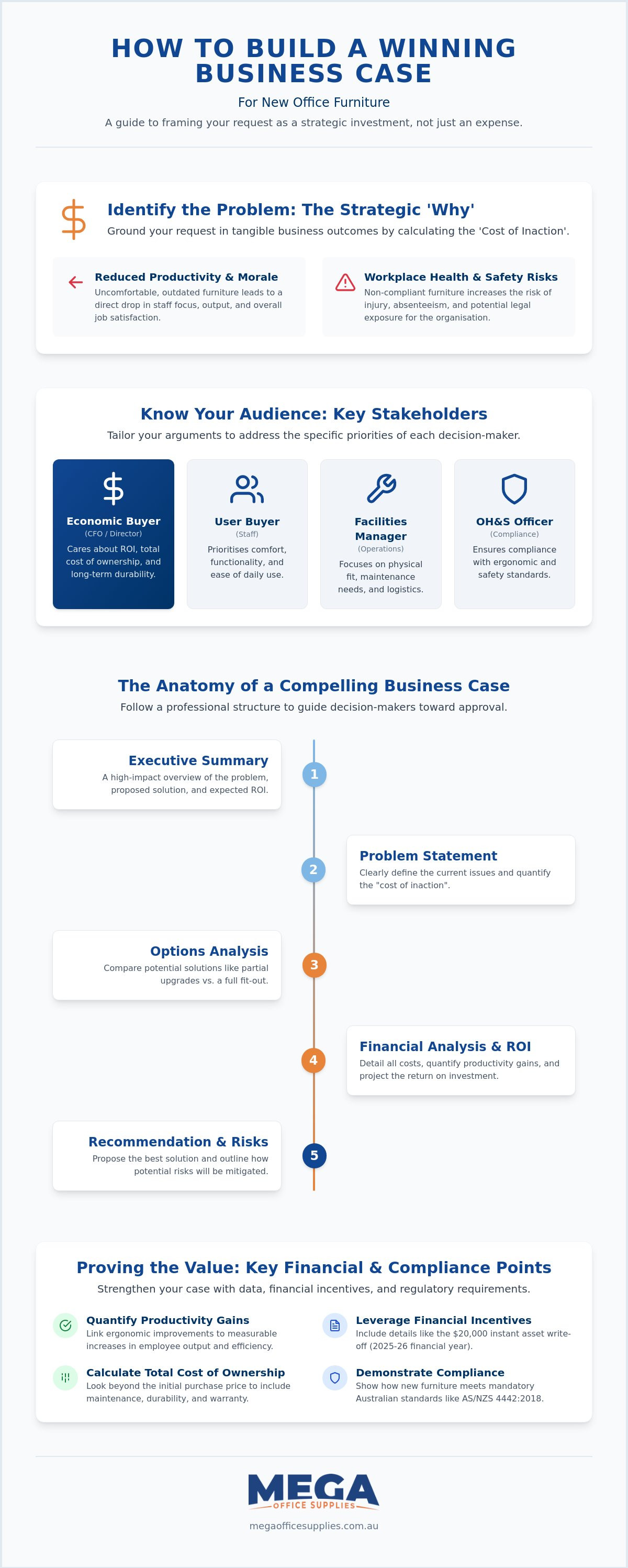
Successful approval depends on identifying who holds the keys to the budget. The "Economic Buyer", often a CFO or Director, cares about ROI and long-term durability. In contrast, the "User Buyer" consists of the staff who will actually use the furniture. Their priority is functionality and ease of use. You must also engage the Facilities Manager and the OH&S Officer early in the piece. They'll ensure the furniture fits the physical space and meets safety standards like AS/NZS 4442:2018. In large national organisations, the procurement department will also review the case to ensure it meets established vendor standards and logistical requirements.
Identifying the Problem: The Strategic "Why"
The most critical step in learning how to write a business case for new office furniture is identifying the specific business problem you intend to solve. Approving a budget for new equipment is rarely about the furniture itself; it's about mitigating a risk or capturing a lost opportunity. Whether your current workstations are physically falling apart or your office layout is a relic of a pre-hybrid era, you must ground your request in tangible business outcomes. A vague desire for a "modern look" will fail where a documented link to reduced staff absenteeism or improved output will succeed.
To move the needle with decision-makers, use a "Cost of Inaction" framework. This approach highlights the financial and operational penalties the organisation pays by maintaining the status quo. For example, if your current seating doesn't meet the AS/NZS 4438:1997 standard for ergonomic chairs, the cost isn't just the eventual replacement fee. The real cost includes the loss of focus from uncomfortable staff and the potential legal exposure to workplace health and safety breaches. A robust Financial Analysis and ROI framework demonstrates that the price of new assets is often lower than the cumulative cost of ignoring a failing workplace environment.
Ergonomics and Staff Wellness
Poorly designed workspaces are a primary cause of musculoskeletal disorders (MSDs) in Australian offices. When staff use equipment that lacks proper adjustability, the organisation risks a rise in fatigue and a drop in cognitive performance. Integrating standing desks into the floor plan allows for postural variation, which is essential for maintaining focus during long shifts. Providing fit-for-purpose ergonomic furniture is a proactive measure that directly correlates with a reduction in long-term WorkCover claims and associated insurance premiums. You might consider reviewing your current office furniture supplies to identify which items no longer meet modern health standards.
Space Utilisation and Changing Work Modes
With nearly half of all employed Australians working from home at least some of the time as of August 2025, the traditional "one desk per person" model is often an inefficient use of expensive CBD floor space. A business case should address how new furniture can facilitate hot-desking and collaborative zones. By replacing bulky, static desks with modular systems and utilising slimline filing cabinets, organisations can reclaim valuable square metres. This allows for a higher density of staff without sacrificing comfort, effectively lowering the "rent per head" and improving the overall utility of the physical office footprint.
Options Analysis: Comparing Furniture Solutions
A critical part of how to write a business case for new office furniture is presenting a range of viable alternatives. Decision-makers need to see that you've considered multiple paths rather than simply cherry-picking the most expensive solution. A standard analysis should include at least three specific options to provide a clear cost-benefit comparison:
- Option 1: The Base Case (Do Nothing). This serves as your benchmark. You must account for the ongoing costs of repairs, potential WorkCover claims, and the productivity drain identified in previous sections. It's often the most expensive choice in the long run.
- Option 2: Partial Upgrade. This targets high-impact areas, such as replacing only the most worn chairs or upgrading desks for the highest-utilised departments. It's a pragmatic choice for organisations with immediate budget constraints.
- Option 3: Full Fit-out. This represents a complete strategic overhaul. While the initial capital outlay is higher, it maximises floor space efficiency and ensures 100% compliance with modern safety standards.
Standardising furniture across these options is a smart move. It simplifies your inventory management and ensures that replacement parts or additional units are easy to source. Partnering with a reliable Australian retailer is vital here. Local suppliers understand the logistical challenges of domestic delivery and provide the direct support needed for long-term warranty claims. This reliability ensures your investment remains protected for years to come.
Evaluating Product Quality and Commercial Grade
Don't confuse "home office" retail items with commercial-grade furniture. Professional-grade equipment is built for constant use and high-volume environments. Look for AFRDI (Australasian Furnishing Research and Development Institute) ratings; a Level 6 certification is the gold standard for Australian office chairs. Material selection is equally important. Mesh backs are often preferred in warmer Australian climates for their breathability, whereas high-rub-count fabrics offer better durability in heavy-use public areas. Choosing the wrong material can lead to premature wear and a second business case much sooner than planned.
Specialised Needs by Sector
Your business case must reflect the unique demands of your industry. In healthcare, prioritise antimicrobial surfaces that withstand medical-grade cleaning chemicals. For schools, the focus shifts to the durability and stackability of classroom furniture to handle high-traffic student environments. Warehousing and industrial sites require heavy-duty workstations that can resist manual wear and tear while supporting facility management equipment. Tailoring your options to these specific environmental stressors proves you've done the necessary due diligence for your specific sector.
Financial Analysis and ROI: Proving the Value
Proving the value of a furniture upgrade requires a shift from viewing chairs and desks as consumables to seeing them as productive assets. When you're determining how to write a business case for new office furniture, your financial analysis must go beyond the initial invoice price. You need to calculate the Total Cost of Ownership (TCO). This includes the purchase price, delivery logistics, professional assembly, and the long-term maintenance costs over the item's effective life. High-quality commercial furniture might have a higher upfront cost, but its durability ensures you aren't repeating the procurement cycle every twenty-four months.
Quantifying productivity gains is the most persuasive part of a professional proposal. While it's difficult to measure the exact output of an individual, even a 1% increase in efficiency across a medium-sized team can justify a full fit-out. For instance, if better ergonomics and reduced workplace fatigue save just five minutes of lost focus per staff member each day, the cumulative annual gain often exceeds the cost of the hardware. Additionally, for the 2025-2026 financial year, Australian small businesses with an aggregated annual turnover of less than $10 million can immediately deduct the full cost of eligible assets costing less than $20,000. Utilising this instant asset write-off significantly improves your net ROI.
Calculating the Return on Investment (ROI)
To provide a clear financial picture, use the standard ROI formula: (Gains from Investment - Cost of Investment) / Cost of Investment. To monetise "soft" benefits, calculate the saved recruitment and training costs associated with a 5% or 10% reduction in staff turnover. A professional workplace environment strengthens your "Employer Brand", making it easier to attract top-tier talent in a competitive Australian market. When staff feel the organisation invests in their physical comfort, their loyalty and engagement levels naturally rise, which directly protects your bottom line from the high costs of employee churn.
Budgeting for Maintenance and Future Growth
A strategic business case accounts for the "whole-of-life" cost, ensuring there's a plan for minor repairs or adjustments after the initial installation. Modular furniture systems are particularly valuable here, as they allow your organisation to expand or reconfigure the layout as the team grows without requiring a completely new fit-out. Establishing a long-term relationship with a national office furniture supplier ensures you can source matching components and consistent quality across multiple sites. This consistency simplifies your facility management and ensures that your workplace remains functional and cohesive as your business scales. For a comprehensive range of commercial solutions, you can browse our full catalogue of office furniture supplies to find the right fit for your organisation's growth plans.
Structuring Your Business Case for Approval
The final phase of mastering how to write a business case for new office furniture involves assembling your data into a logical, persuasive structure. A disorganised proposal can bury even the strongest ROI argument under a mountain of irrelevant detail. Your document should follow a tiered sequence that mirrors a procurement professional's workflow: first the high-level summary, then the technical risks, and finally the execution plan. This ensures that a busy director can grasp the essential value in sixty seconds while a facilities manager can find the granular details they require for implementation.
Executive Summary and Project Definition
The executive summary is the most critical page of your proposal. It must be concise and focused on the primary business driver, such as the need to meet the May 2025 toppling furniture standards or a strategic "Year of Wellness" initiative. Avoid filler text. Clearly state the total requested budget and the expected project start date. Aligning the proposal with existing corporate goals makes it difficult for the board to dismiss, as the furniture becomes a tool for achieving broader organisational success rather than just a standalone cost. This section defines the project scope, ensuring everyone is clear on which departments or areas are included in the upgrade.
Risk Mitigation and Implementation
No capital project is without potential hurdles. A professional business case identifies these risks upfront and provides clear mitigation strategies to protect the organisation's investment. Common concerns include the logistical disruption of a fit-out and the risk of staff using new hardware incorrectly. Address the timeline for delivery and installation, perhaps suggesting a phased rollout or an after-hours assembly to minimise operational downtime. It's also vital to include a plan for staff training. Providing new ergonomic equipment is only half the battle; you must ensure employees understand how to adjust their chairs and workstations to reap the health benefits described in your earlier analysis.
Close your business case with a decisive recommendation. Summarise the "Cost of Inaction" one last time and call for immediate approval to secure current pricing or take advantage of the 2025-2026 financial year tax incentives. Use a clear, action-oriented closing statement that leaves no doubt about the next steps. By following this structured approach, you transform a simple request into a professional strategic proposal that stands up to the highest levels of corporate scrutiny and delivers a better workplace for your entire team.
Securing Approval for Your Workplace Upgrade
Moving your organisation away from a "make-do" culture requires a clear, data-driven strategy. You now have the tools to link ergonomic investments directly to productivity gains and OH&S compliance. By mastering how to write a business case for new office furniture, you can transform a simple request into a compelling capital expenditure proposal that stands up to corporate scrutiny. Focus on the long-term ROI and the risk mitigation strategies that protect both your staff and your bottom line.
Just as a professional office environment is vital for staff, a high-quality digital presence is essential for modern business growth.
Mega Office Supplies is an Australian company that's been family owned and operated since 2008. We help you select the right commercial-grade equipment for your specific sector. With our national delivery for all office and facility supplies, we ensure your project moves from approval to installation without friction. Browse our comprehensive range of commercial-grade office furniture today and take the first step toward a more efficient workplace. We look forward to supporting your next successful upgrade.
Frequently Asked Questions
What are the most important elements of an office furniture business case?
The primary components include an executive summary, a clear problem statement, an analysis of alternatives, a detailed financial ROI, and a risk mitigation plan. These sections ensure that your proposal for how to write a business case for new office furniture addresses both strategic goals and operational practicalities. Including a project timeline also helps decision makers understand the logistical impact on the organisation.
How do I calculate the ROI on ergonomic office chairs?
Calculate ROI by comparing the total purchase cost against the projected savings from reduced staff absenteeism and improved work output. You can use historical data on musculoskeletal related leave to estimate how much the organisation will save by providing better support. Factoring in a reduction in potential WorkCover premiums over a five year period provides a more accurate financial picture for the board.
Should I include the cost of old furniture disposal in my business case?
Yes, you must include disposal or recycling costs to ensure your Total Cost of Ownership (TCO) is accurate. Many Australian organisations now require sustainable disposal methods as part of their corporate social responsibility goals. Accounting for these logistical fees upfront prevents unexpected budget overruns and demonstrates that you've considered the entire lifecycle of the assets.
How long should a professional business case be for a small office fit-out?
A professional business case for a small fit-out should typically be between two and five pages. It needs to be concise enough for a director to review quickly while providing enough technical detail for the procurement department. Focus on high impact data and clear visual summaries to ensure your guide on how to write a business case for new office furniture leads to a fast approval.
What is the difference between a business case and a project proposal?
A business case justifies the strategic and financial "why" behind an investment, whereas a project proposal focuses on the technical "how" of the implementation. The business case is used to secure the initial budget by proving value to the organisation. Once the funds are approved, the proposal outlines the specific products, delivery schedules, and assembly requirements needed to complete the work.
How do I justify the cost of standing desks for the whole team?
Justify standing desks by linking postural variation to increased cognitive focus and reduced afternoon fatigue. Cite the health benefits of reducing sedentary behaviour, which is a key focus of modern Australian workplace safety guidelines. You can also highlight how height adjustable workstations accommodate a more diverse range of body types, ensuring the entire team can work comfortably and safely.
Can I use a business case to request a specific brand of furniture?
You can request a specific brand if you can prove it offers superior long term value through better warranties or local support. Mentioning that you are standardising on a trusted Australian retailer can simplify future maintenance and inventory management. If a specific brand is the only one that meets a required Australian standard, this becomes a powerful compliance argument for your request.
What Australian standards should I reference in my business case?
Essential references include AS/NZS 4442:2018 for workstations and AS/NZS 4438:1997 for height adjustable swivel chairs. You should also cite the Consumer Goods (Toppling Furniture) Information Standard 2024 to demonstrate compliance with current Australian safety laws. Referencing these standards proves that your chosen furniture is fit for purpose and meets the rigorous durability and safety requirements of a professional environment.
Article by
Mega Office Supplies Team
The Mega Office Supplies Team provides practical guidance for Australian businesses, schools, government organisations, healthcare providers, hospitality venues, warehouses and home offices. Based in Tweed Heads South, Mega Office Supplies is an Australian business, family owned and operated since 2008, offering office stationery, workplace furniture, technology products, labels, printers, cleaning and janitorial supplies, safety products, art materials, education resources and everyday business essentials from trusted brands.
General Information
This article is provided as general information only to help customers compare and choose office, workplace, school, cleaning, technology, furniture, safety and business supplies. Product details, specifications, compatibility, availability, pricing and suitability may vary. Always check the individual product page, manufacturer information, workplace requirements and relevant safety guidance before purchasing or using a product.


