

Your stationery cupboard is likely the most overlooked source of financial waste in your entire organisation. Whether you are managing a school, a government department, or a busy corporate office, uncontrolled spending on non-essential items and frequent stockouts of A4 paper or toner can stall productivity. Learning how to manage office stationery inventory is a vital procurement strategy rather than a simple cleaning task. It requires a structured approach to ensure your team has the tools they need without the hidden costs of overstocking.
We understand that maintaining a balance between availability and cost is a constant challenge for administrators who value efficiency. You need a system that ensures critical supplies are always on hand while establishing clear accountability for workplace consumables. This professional guide provides a roadmap to master your procurement and organisation. We will detail how to establish a logical storage system, implement reordering triggers, and utilise data-driven strategies to reduce your annual spend. By the end of this article, you will have the knowledge to transform your storage area into a well-oiled distribution centre that supports your workplace goals.
Key Takeaways
- Understand why strict inventory control is critical for maintaining business cash flow and ensuring operational uptime across Australian workplaces.
- Learn how to categorise supplies using the "ABC Analysis" method to prioritse high-value and high-frequency items like A4 paper and toner.
- Discover how to manage office stationery inventory by evaluating the benefits of manual log sheets versus customisable digital tracking systems.
- Establish clear workplace rules and request systems to minimise waste and increase staff accountability for shared office consumables.
- Streamline your procurement process by consolidating orders with a national provider to leverage bulk unit pricing on essential staples.
The Fundamentals of Office Stationery Inventory Management
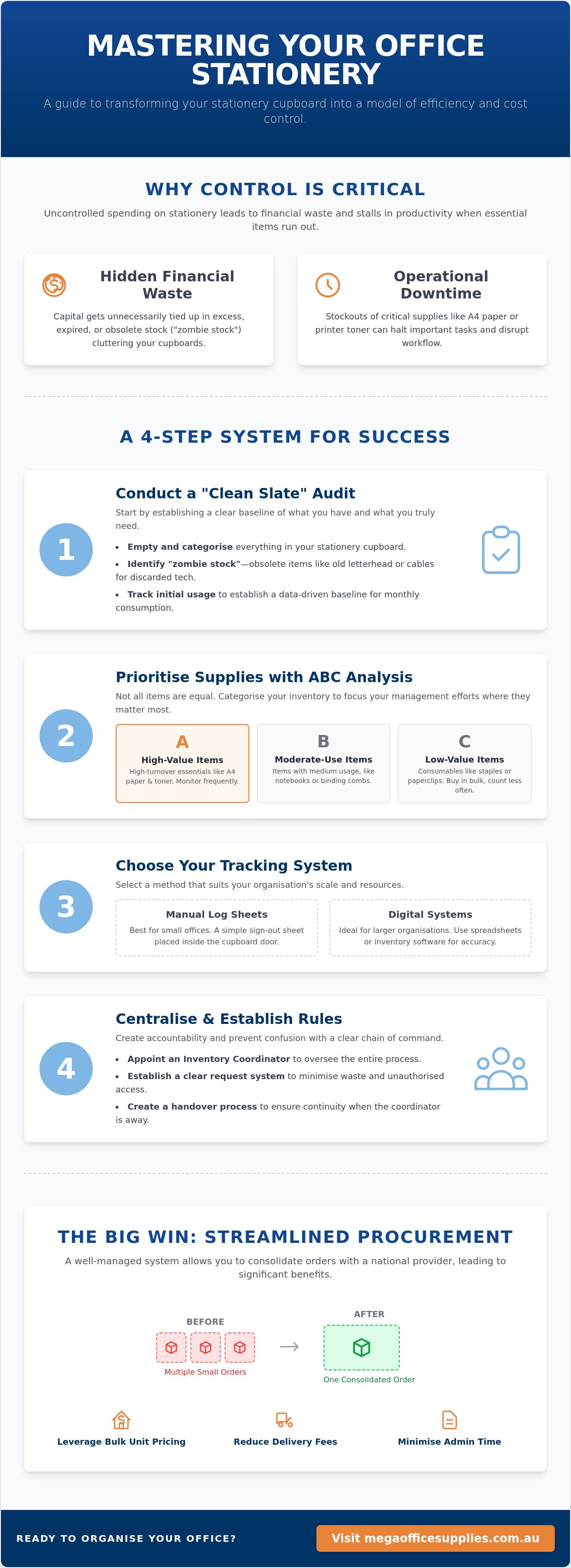
Stationery inventory management in an Australian workplace isn't just about tidying shelves. It is the strategic oversight of the inventory management lifecycle for essential goods. This includes everything from procurement to distribution. Effective control ensures that capital isn't unnecessarily tied up in excess stock, which directly impacts business cash flow. When critical items like A4 paper or toner cartridges run out, the resulting downtime can be costly for schools or government departments. Knowing how to manage office stationery inventory allows you to maintain operational uptime without inflating your overheads.
To succeed, you must distinguish between your assets. Consumable supplies, such as notebooks, staples, and general office stationery, are intended for short-term use and require regular replenishment. Durable equipment, like ergonomic office chairs or paper shredders, represents a long-term investment. Your primary objective is to balance high stock availability with the need to minimise annual expenditure. A well-managed system prevents the "just in case" over-ordering that leads to cluttered cupboards and expired products.
To better understand this concept, watch this helpful video:
Conducting Your Initial Stationery Audit
Start with a "clean slate" audit to assess your current holdings. Empty the cupboards and categorise every item. You'll likely find "zombie stock" during this process. These are obsolete items, such as specific cables for discarded hardware or old letterhead, that take up valuable real estate. Identifying these allows you to reclaim space and stop ordering redundant items. Use this audit to establish a baseline for monthly consumption. Tracking how many boxes of pens your team actually uses in 30 days provides the data needed for accurate reordering.
The Role of the Inventory Coordinator
Centralising responsibility is the most effective way to prevent duplicate ordering and confusion. In a small Australian office, this might be the receptionist or office manager. In larger corporate or healthcare environments, it's often a dedicated procurement officer. The coordinator oversees the entire flow of goods, ensuring that orders are consolidated to reduce delivery fees. They must also create a robust handover process. If the primary coordinator is away, a secondary staff member should know the reordering triggers and supplier contact details to prevent a break in supply.
Categorising Your Supplies for Maximum Efficiency
Efficiency in a professional distribution-style office setup begins with logical grouping. When you determine how to manage office stationery inventory, you must categorise every item by its functional role. This simplifies the picking process for staff and makes monthly stocktakes significantly faster. A chaotic cupboard leads to accidental over-ordering because items are often hidden behind bulkier goods. By separating your inventory into distinct zones, you gain immediate visual clarity over your stock levels and procurement needs.
We recommend using the "ABC Analysis" method to prioritse your procurement efforts. "A" items are high-turnover essentials such as A4 copy paper and toner cartridges. These represent a significant portion of your annual spend and require the most frequent monitoring to prevent stockouts. "B" items, like notebooks or binding combs, have moderate usage. "C" items are low-value goods such as staples or paperclips that can be purchased in bulk and counted less frequently. This tiered approach ensures you never run out of critical hardware while minimising the administrative time spent on trivial items.
General Stationery and Writing Instruments
Organise pens, markers, and highlighters by colour and ink type to prevent confusion during restocking. Store these in clear bins or drawers where labels are easily visible to all staff members. Desktop accessories, including staplers, scissors, and adhesives, should be grouped together to facilitate quick access and easier counting. This systematic arrangement reduces the time staff spend searching for basic tools in high-traffic areas. You can explore our range of professional office supplies to find durable organisers that suit your specific workplace requirements.
Filing, Storage, and Paper Products
Paper supplies accounted for the largest share of the Australian office supplies market in 2024, at 33.36%. This makes managing A4 copy paper and specialty media a priority for any procurement officer. Stack lever arch files and document wallets vertically to prevent damage and allow for easier identification of spine labels. For more storage tips, see our comprehensive guide to lever arch files. Keeping these heavier, bulky items on lower shelves improves safety and accessibility for your team.
Facilities and Tea Room Essentials
A common mistake in Australian workplaces is treating the tea room and cleaning cupboard as separate entities. For true operational efficiency, cleaning chemicals, first aid kits, and kitchen consumables must be integrated into your primary inventory plan. Tracking tea, coffee, and milk alongside your pens ensures a single, streamlined procurement point. This reduces delivery friction and simplifies your monthly accounting. Consolidating these needs through our facilities and breakroom supplies section allows for efficient bulk ordering across all departments.
Manual vs Digital: Choosing Your Tracking System
Selecting the right tracking mechanism is a pivotal decision when determining how to manage office stationery inventory. For smaller Australian workplaces, a traditional 'Pen and Paper' log sheet attached to the cupboard door offers immediate accessibility. It requires no technical training and functions without power or internet. However, manual logs are susceptible to human error and lack the data processing capabilities needed for cost analysis. A superior physical alternative for low-tech environments is the 'Two-Bin' system. You store items in two separate containers; once the first bin is depleted, it acts as a visual trigger to reorder while the team consumes stock from the second bin.
Transitioning to a digital spreadsheet provides a scalable middle ground for most professional offices. Excel or Google Sheets allow for granular tracking that manual systems cannot match. These platforms facilitate easier reporting on annual spend and help identify usage patterns across different departments. When your organisation reaches a scale where manual entry becomes a bottleneck, typically in large government or healthcare settings, dedicated inventory software becomes a necessary investment to maintain accuracy.
Building an Inventory Spreadsheet That Works
Every effective stationery tracker should include specific columns: the SKU, the Minimum Stock Level, and the Lead Time. The Minimum Stock Level acts as your safety net, while the Lead Time accounts for how long a supplier takes to deliver. You can automate 'Low Stock' alerts using conditional formatting to highlight cells in red when quantities dip below your threshold. To calculate the reorder point for pens, multiply the average daily usage by the delivery lead time and add a safety stock buffer to ensure you never face a stockout.
Implementing Barcode and QR Code Systems
Mobile scanning reduces manual entry errors by allowing staff to check items in or out using a smartphone. This technology is particularly effective for tracking high-value items like toner and ink cartridges, where model numbers are often confusingly similar. Integrating a barcode system with your procurement platform ensures that your digital records mirror the physical reality of your storage area. While dedicated inventory software offers advanced features, many Australian businesses find that a well-structured QR code system linked to a central spreadsheet provides the best balance of efficiency and cost control.
Establishing Workplace Rules to Minimise Waste
The stationery cupboard often falls victim to a "tragedy of the commons" mentality where staff perceive pens and highlighters as infinite, cost-free resources. This psychology leads to hoarding at desks and significant annual waste. Learning how to manage office stationery inventory effectively involves more than just counting stock; it requires establishing clear social contracts within the workplace. You must transition from a "help yourself" model to a structured system that creates accountability without making the coordinator feel like the office police. Clear communication regarding the true cost of consumables often encourages more mindful usage across the team.
Implementing a formal stationery request system allows you to track consumption patterns by department or individual. This is not about micromanagement. It is about data. If one department consumes three times more toner than others, you can investigate the underlying cause, such as inefficient printing habits or outdated hardware. This level of transparency naturally discourages the "desk hoarding" of premium items and ensures that stock remains available for those with an immediate need.
High-quality workplace ergonomics also play a role in reducing stationery waste. For instance, providing proper ergonomic office chairs and monitor arms prevents staff from using reams of A4 paper as makeshift risers. Investing in durable, fit-for-purpose hardware reduces the reliance on "quick-fix" stationery solutions that eventually end up in the bin. When the workspace is organised correctly, the demand for miscellaneous "clutter" stationery decreases significantly.
Creating a Stationery Cupboard Code of Conduct
A successful storage system relies on clear guidelines for every staff member. Encourage your team to return unused items to the correct bins rather than leaving them in desk drawers to collect dust. For high-value items like scientific calculators or electronic label makers, implement a "one-out, one-in" policy. This ensures that expensive hardware is tracked and returned to the central hub after use. Promoting refillable options, such as whiteboard markers with replaceable ink cartridges, further minimises workplace waste and supports long-term cost reduction.
Standardising Your Supply List
Complexity is the enemy of efficient inventory management. Limiting your selection of pens, notebooks, and binders to two or three standard types simplifies the reordering process. Standardisation reduces your storage footprint and allows you to buy in bulk more effectively. You can read our procurement guide for detailed standardisation tips. By narrowing the catalogue, you ensure that every item in the cupboard has a clear, functional purpose and a predictable replacement cycle.
Ready to streamline your workplace? Browse our full range of professional office supplies to find the essentials for your new standardised system.
Streamlining Procurement with a National Supplier
Transitioning from internal cupboard organisation to a robust procurement strategy is the final stage of professional inventory control. Consolidating your requirements with a single Australian provider eliminates the logistical friction inherent in managing multiple vendors. When you establish how to manage office stationery inventory on a national scale, you gain a clear overview of total consumption across all branches. This data allows you to leverage volume for better unit pricing on high-turnover staples like A4 paper, which accounted for over 33% of the Australian office supplies market share in 2024.
Managing delivery schedules across a national office network requires a partner with a deep logistical footprint. Local lead times vary between metropolitan hubs and regional centres. A centralised procurement platform provides the visibility needed to adjust reorder points based on these regional delivery windows. Utilising digital tools like "Favourites" lists and order history significantly reduces the administrative burden of rapid replenishment. Professional buyers can create custom lists for specific departments, such as reception or the staff kitchen, ensuring that the correct items are ordered every time without manual errors.
Consolidating for Cost Savings
Small, frequent orders carry a high "hidden cost" that often escapes the initial budget. Every separate delivery incurs individual shipping fees and requires administrative time to process through accounts payable. Aligning your stationery orders with other workplace essentials, such as first aid kit refills or cleaning chemicals, creates significant efficiency. A single invoice system simplifies your internal accounting processes and provides a transparent audit trail for GST reporting and annual spend reviews. This approach minimises the number of transactions and lowers the overall administrative cost of procurement.
Partnering with Mega Office Supplies
Professional buyers require a dependable partner capable of supporting diverse workplace needs without friction. Partnering with Mega Office Supplies provides access to a massive catalogue that spans from basic pens and notebooks to ergonomic office chairs and technology accessories. Our established national distribution network ensures consistent supply and reliable delivery across all Australian states and territories. This logistical prowess acts as a trust signal for procurement officers, administrators, and business owners who value stability and regional expertise over flashy marketing.
Streamline your office procurement today with Mega Office Supplies and experience the efficiency of a well-oiled distribution partner with decades of combined industry experience.
Master Your Workplace Procurement Strategy
Transitioning from a chaotic stationery cupboard to a streamlined inventory system requires a commitment to both logical organisation and accurate data. By implementing a tiered ABC analysis and choosing a tracking method that suits your specific office scale, you can eliminate critical stockouts and reclaim lost budget. Learning how to manage office stationery inventory is a continuous process of refinement. It relies on standardising your supplies and establishing clear workplace accountability for every consumable item.
Consolidating these logistical efforts with a dependable partner ensures your team always has the tools required to maintain operational uptime. Mega Office Supplies has been family owned and operated since 2008. Every order is supported by a robust national delivery network that reaches every corner of Australia. This logistical stability provides the peace of mind needed to focus on your core business operations and long-term goals.
Browse our full range of professional office and educational supplies to start optimising your procurement today. Taking control of your workplace consumables is a practical step toward a more efficient and waste-free environment.
Frequently Asked Questions
What is the best way to organise a small office stationery cupboard?
Utilise clear, stackable containers with prominent labels to ensure every item has a designated home. Grouping by function, such as writing, filing, and adhesives, prevents staff from rummaging and displacing stock. Place high-turnover items like A4 paper at waist height for easy access, while keeping lighter, infrequently used goods on higher shelves to maximise vertical space and improve safety.
How often should we perform a full stationery inventory count?
Conduct a full physical count of high-turnover items every month to maintain accuracy. For lower-value goods, a quarterly audit is usually sufficient to identify discrepancies. Regular cycles help you understand how to manage office stationery inventory more effectively by highlighting seasonal usage trends and preventing the accumulation of obsolete stock or dried-out writing instruments.
What are the most commonly wasted office supplies in Australia?
Pens and highlighters are the most frequently wasted items because they are easily lost or left to dry out in desk drawers. Specialty printer paper and partially used toner cartridges also contribute significantly to workplace waste. Implementing a "one-out, one-in" policy for premium items can help reduce these losses and encourage more mindful consumption among your team.
How do I calculate the reorder point for my office supplies?
Calculate your reorder point by multiplying the average daily usage of an item by the supplier's delivery lead time, then adding a small safety stock buffer. For example, if you use two reams of paper daily and delivery takes three days, your reorder point should be at least eight reams. This formula ensures you never face a total stockout during unexpected delivery delays.
Should I use a spreadsheet or software to manage my inventory?
Spreadsheets are ideal for small to medium Australian workplaces due to their customisability and low cost. They provide sufficient tracking for most administrative needs without complex training. However, large organisations or multi-site networks should invest in dedicated inventory software to benefit from automated reordering, barcode scanning, and advanced reporting that spreadsheets cannot practically provide at scale.
How can I reduce stationery theft or "accidental" hoarding by staff?
Minimise hoarding by centralising the storage area and implementing a formal request system for all supplies. When staff must ask for items, they are less likely to take more than they need for immediate tasks. Transparency regarding the true cost of items like toner or ergonomic accessories often shifts the workplace culture from one of "infinite supplies" to shared responsibility.
What items should a professional office always keep on hand?
Maintain a consistent stock of A4 copy paper, black and blue pens, toner cartridges, and lever arch files for daily operations. You should also include facilities essentials like toilet paper, hand sanitiser, and fully stocked first aid kits. These items are critical for both productivity and workplace safety, making them the non-negotiable core of any professional inventory plan.
Is it cheaper to buy stationery in bulk or as needed?
Buying in bulk is generally more cost-effective for high-volume staples like paper and envelopes due to lower unit pricing and reduced shipping fees. For specialty items or goods with a shelf life, such as certain adhesives or cleaning chemicals, purchasing as needed prevents waste. Balancing bulk orders for essentials with targeted purchases for niche items optimises your annual office spend.
Article by
Mega Office Supplies Team
The Mega Office Supplies Team provides practical guidance for Australian businesses, schools, government organisations, healthcare providers, hospitality venues, warehouses and home offices. Based in Tweed Heads South, Mega Office Supplies is an Australian business, family owned and operated since 2008, offering office stationery, workplace furniture, technology products, labels, printers, cleaning and janitorial supplies, safety products, art materials, education resources and everyday business essentials from trusted brands.
General Information
This article is provided as general information only to help customers compare and choose office, workplace, school, cleaning, technology, furniture, safety and business supplies. Product details, specifications, compatibility, availability, pricing and suitability may vary. Always check the individual product page, manufacturer information, workplace requirements and relevant safety guidance before purchasing or using a product.


