


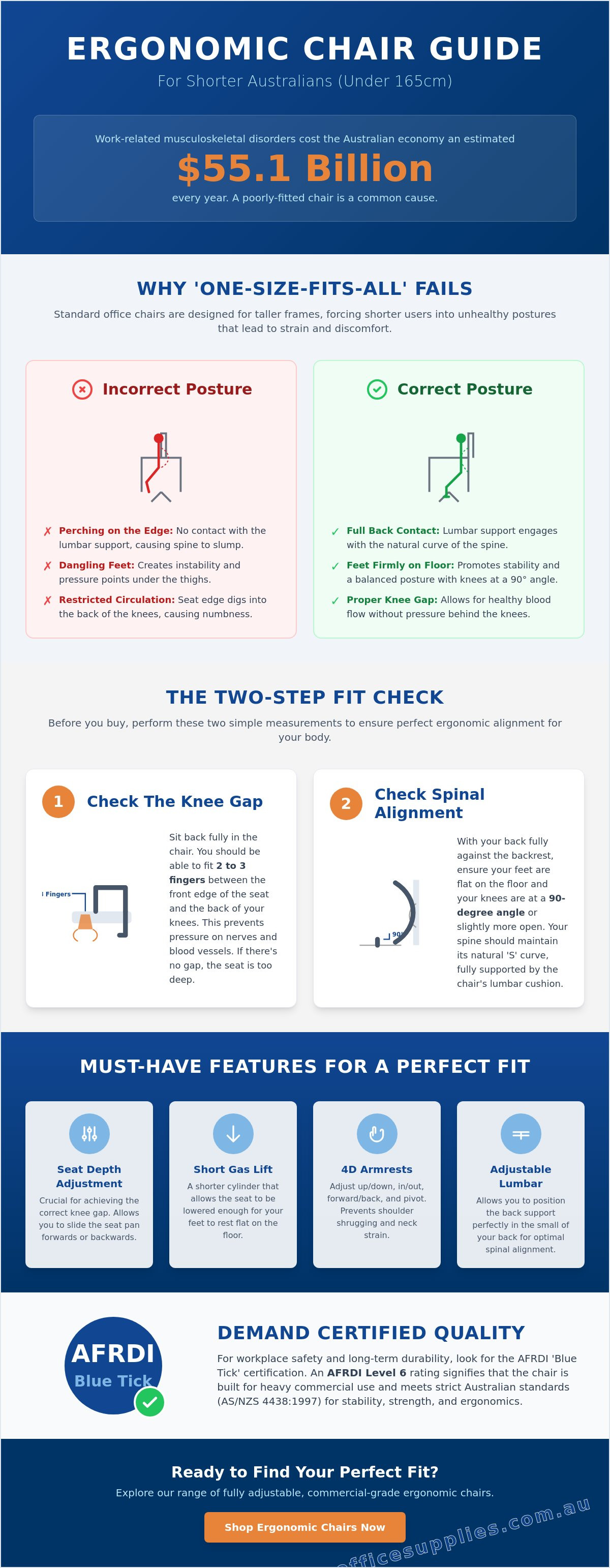
Did you know that work-related musculoskeletal disorders cost the Australian economy an estimated $55.1 billion every year? For many professionals under 165cm, these health issues often start with a seat that simply doesn't fit. You've likely experienced the frustration of feet dangling above the carpet or lumbar support that hits your spine in all the wrong places. Finding a genuine ergonomic chair for short person is a measurement game, not just a matter of looking for a small label.
We understand that a chair with a seat pan that's too deep isn't just uncomfortable; it's a long-term risk to your physical health. This guide will help you identify the specific technical specs, such as seat pan depth and gas lift range, required to provide proper ergonomic support for shorter frames. You'll learn how to navigate Australian standards and AFRDI certifications to find a solution that reduces neck strain and fits your body perfectly. We've compiled the essential data to ensure your next office furniture purchase provides the stability and comfort your workplace requires.
Key Takeaways
- Understand why seat pan depth is the most critical measurement for proper support and learn how to calculate your popliteal height for a perfect fit.
- Identify the technical specifications required in an ergonomic chair for short person, including short gas lifts and 4D armrests that ensure correct elbow-to-desk alignment.
- Discover how to eliminate the "perching" habit by selecting a chair that allows full back contact while keeping your feet firmly on the floor.
- Master a simple two-step evaluation process to check the knee gap and spinal alignment when testing new office furniture for your workspace.
- Learn how to select commercial-grade seating with substantial warranties that meet Australian standards for long-term durability and workplace safety.
Beyond "Small": Why Standard Ergonomics Fail Shorter Australians
Most commercial office chairs are engineered to accommodate the 5th to 95th percentile of adult males. This design bias creates a significant gap for shorter Australians, particularly women and smaller-framed men. When a chair is too large, the user is forced into a "perching" posture. This occurs when you sit forward on the seat to ensure your feet touch the floor, which immediately disconnects your back from the lumbar support. Without that contact, the spine loses its natural curve and the muscles must work twice as hard to keep you upright.
This lack of support isn't just a comfort issue; it's a physiological risk. Sitting on the edge of a chair for hours leads to a collapse in posture. While many manufacturers include a "waterfall" seat edge to reduce pressure, this feature fails if the seat pan is too deep. The edge still presses against the popliteal fossa, the sensitive area behind your knees. This pressure can restrict circulation and cause numbness or "pins and needles" during long shifts in the office or classroom.
To better understand how a properly adjusted chair should function for different frames, watch this helpful video:
You might think a footrest solves the problem, but it's often just a band-aid solution. While it brings the floor to your feet, it doesn't fix a seat pan that's too deep or armrests that are too wide. A genuine ergonomic chair for short person must address the interaction between all these components rather than relying on external accessories. Selecting the right office furniture requires looking beyond the "small" label and focusing on specific adjustability ranges.
The Physiological Impact of an Oversized Chair
An oversized chair causes the pelvis to tilt posteriorly, leading to a "slumped" spine. This position places immense pressure on the intervertebral discs. Recent surveys indicate that 81% of Australian workers have experienced low back pain, and much of this can be attributed to poor spinal alignment. Additionally, armrests on standard chairs are often spaced too far apart. This forces a constant "shoulder shrug" to reach the supports, which eventually manifests as chronic tension in the neck and trapezius muscles.
AFRDI and BIFMA Standards for Smaller Frames
In the Australian market, the Australasian Furnishing Research and Development Institute (AFRDI) provides the "Blue Tick" certification. An AFRDI Level 6 rating is the gold standard, indicating the chair is fit for heavy commercial use. When sourcing an ergonomic chair for short person, look for models tested to AS/NZS 4438:1997. This standard ensures the chair meets strict adjustability and stability criteria, specifically catering to diverse body types and ensuring long-term durability in high-traffic environments like government departments or healthcare facilities.
Critical Measurements: Seat Height and Depth for Shorter Frames
Selecting an ergonomic chair for short person is a measurement game that requires more than just looking for a "compact" model. Seat depth is the single most critical factor in this process. If the seat pan is too deep, you cannot sit back far enough to engage the lumbar support without the front edge digging into the back of your legs. This creates a constant conflict between spinal alignment and lower limb circulation. Proper ergonomics relies on the ability to utilise the full backrest while keeping your feet firmly planted on the floor.
To identify your ideal dimensions, you must first determine your popliteal height. This is the distance from the floor to the crease behind your knee while sitting with your feet flat. Many standard office chairs have a minimum seat height that exceeds this measurement, especially when you factor in the thickness of the seat cushioning. Additionally, seat pan width is often overlooked. A seat that is too wide forces the armrests out too far, causing you to "wing" your elbows. This posture leads to significant strain on the shoulders and neck during repetitive tasks.
A technical solution often required for smaller frames is a "short gas lift" or low-range cylinder. These components allow the chair to drop below the standard minimum height, ensuring the user isn't left with dangling feet. If you are outfitting a professional workspace, reviewing the technical specifications of commercial ergonomic chairs can help ensure your team avoids the chronic strain associated with ill-fitting furniture.
Measuring Seat Depth (The Popliteal Gap)
When you sit fully back in a chair, there should be a gap of approximately two to three fingers, or roughly 30mm to 50mm, between the front edge of the seat and the back of your knee. This is the popliteal gap. Adjustable seat sliders are essential features for multi-user workstations because they allow the seat depth to be customised for different thigh lengths. Fixed seat pans are rarely suitable for diverse teams as they lack the manual precision required to accommodate shorter users correctly.
Gas Lift Ranges and Minimum Seat Height
Most Australian desks are manufactured at a fixed height of 720mm. Shorter users often require a chair that can descend lower than the standard 450mm minimum to maintain a neutral posture. A chair that goes "too low" is a safer investment than one that stays "too high"; you can always raise a seat, but you cannot force a standard cylinder below its mechanical limit. Always check the stroke length of the gas lift cylinder before purchasing to ensure it facilitates the necessary range of motion for your specific body type.
Essential Features: From Short Gas Lifts to 4D Armrests
Identifying a functional ergonomic chair for short person requires a focus on mechanical versatility rather than just overall size. While standard chairs offer basic height adjustment, a professional-grade solution must include 4D armrests. These components allow for manual precision in four directions: height, width, depth, and angle. For shorter users, the "width" adjustment is particularly vital. Most competitors fail to mention that armrests need to slide inwards toward the body to support narrow shoulders, preventing the strain associated with reaching outwards to rest your elbows.
Support for lighter body weights is another area where standard office furniture often falls short. Many chairs feature a tilt tension mechanism designed for an average male weight of 85kg to 100kg. If you weigh significantly less, you might find the backrest almost impossible to recline, or it may "snap" back too aggressively. Look for chairs with a high-sensitivity tilt tension control that can be loosened sufficiently to respond to lower body weights. Pairing this with high-density seat foam ensures the cushion maintains its structural integrity without bottoming out against the seat pan over time.
When outfitting a professional environment, ensuring your office furniture meets AFRDI Level 6 standards is essential. This certification confirms the chair has been tested for severe commercial use, including the durability of its adjustable components. It's a hallmark of reliability for procurement officers in government and healthcare sectors who need to minimise the risk of workplace injuries.
Lumbar Support Positioning
A "one-size-fits-all" lumbar curve often hits a shorter person in the middle of the back rather than the lower spine. This misalignment causes the user to slump, leading to long-term disc pressure. To avoid this, choose a chair with an independent height-adjustable backrest or a lumbar pad that moves vertically. You can test this by sitting fully back; the apex of the support should nestle directly into your natural lordosis, which is the inward curve just above your belt line.
Armrest Width and Shoulder Alignment
Standard armrests are often set too wide, leading to a posture known as "chicken winging." This forces the shoulders into a constant state of abduction, which is a primary cause of neck tension in the workplace. Armrests should be narrow enough to allow your elbows to hang naturally under your shoulders. Additionally, ensure they can drop low enough to clear the underside of your desk. This allows you to pull the chair in close, preventing the need to lean forward and lose contact with the backrest.
How to Evaluate Your Workspace: A Practical Fit Guide
Evaluating an ergonomic chair for short person requires a systematic approach rather than a quick test sit. You should follow a logical sequence to ensure every component of the chair supports your frame correctly in relation to your existing desk. Start by sitting fully back in the chair; your tailbone should make firm contact with the backrest. Once seated, follow these four steps to verify the fit.
- Step 1: Check the Knee Gap. Ensure there is a gap of 30mm to 50mm between the front of the seat and the back of your knees. If the seat pan is pressing against your legs, the chair is too deep.
- Step 2: Align Feet and Elbows. Adjust the seat height until your feet are flat on the floor. Now, check your elbow position. Your forearms should be parallel to the desk surface with your shoulders relaxed.
- Step 3: Verify Lumbar Contact. Ensure the lumbar support sits in the small of your back. If the curve is too high, it will push your shoulders forward, causing strain.
- Step 4: Audit the Headrest. Many headrests are designed for taller frames. If the headrest pushes your chin toward your chest or hits the back of your head instead of your neck, it is better to remove it or choose a model without one.
Identifying these issues early prevents long-term musculoskeletal strain. If you are responsible for outfitting a professional team, you can browse our full range of ergonomic office chairs to find models that offer the necessary adjustability for diverse body types.
The "Desk Height Gap" Problem
Standard Australian desks are typically fixed at a height of 720mm. This height often forces shorter individuals into a compromise: sitting at the correct height for their feet but too low for the desk, or sitting at the correct height for the desk while their feet dangle. If you cannot lower your desk, you must sit higher and utilise a footrest to maintain circulation. A more permanent solution is to invest in height-adjustable furniture. You can read our standing desk guide to learn how these workstations accommodate users of all heights.
Testing the Tilt Tension
Lighter users frequently find standard "synchro-tilt" mechanisms too stiff to use effectively. If the tension is set for a heavier individual, you will struggle to recline, leading to a static, rigid posture. Locate the tension knob underneath the seat and loosen it until the chair responds to your body weight without requiring a push-off from the desk. The movement should feel fluid and supported, allowing you to change positions easily throughout the day. For tailored advice on outfitting your office with the correct ergonomic solutions, contact our team today at Mega Office Supplies.
Selecting the Right Ergonomic Solution for Your Office
When outfitting a professional workspace, the focus must shift from individual comfort to long-term operational reliability. Selecting a commercial-grade ergonomic chair for short person is an investment in workplace health and safety. You should prioritse chairs that carry a minimum 5-year warranty, as this indicates the manufacturer's confidence in the durability of the gas lift, castors, and adjustment mechanisms. Mega Office Supplies serves as a dependable partner for national business and government procurement, providing the logistical scale required to handle high-volume orders without friction.
For larger organisations, the procurement process should include the provision of "trial chairs." This allows staff to test the manual precision of the 4D armrests and seat sliders in their actual work environment before a final commitment is made. Beyond the seating itself, a productive workspace requires a range of office supplies to maintain daily efficiency. Ensuring your team has the right tools, from monitor arms to stationery, creates a cohesive and supportive environment. To find the right fit for your team, explore our full range of ergonomic office chairs today.
Commercial Procurement for Diverse Teams
A common error in office fit-outs is the "standardised" order, where every desk receives the same chair model. Because human frames vary significantly, a mix of chair sizes (Small, Medium, and Large) is often the most effective strategy. You can organise a workplace ergonomic sweep to audit the specific needs of your staff. This proactive approach has a tangible return on investment. With body stressing injuries accounting for 34.5% of all serious workers' compensation claims in Australia, providing a tailored ergonomic chair for short person can significantly reduce the risk of costly WorkCover claims and long-term absenteeism.
Maintenance and Longevity
Maintaining the structural integrity of your office furniture ensures it remains "fit for purpose" throughout its lifecycle. Mesh upholstery is ideal for the Australian climate due to its breathability, but it requires regular vacuuming to prevent dust buildup within the weave. Fabric options may require occasional spot cleaning with professional-grade chemicals to maintain their appearance in high-traffic reception areas or staff rooms. You should also monitor the performance of the gas lift; if a chair begins to descend slowly during use, the cylinder seal has likely failed. Replacing these components promptly ensures the chair continues to provide the necessary height range for shorter users, protecting your initial investment for years to come.
Optimising Your Workplace for Long-Term Health
Finding the right ergonomic chair for short person is a matter of precision measurements rather than compromise. You've seen how success depends on the interaction between seat pan depth and gas lift range to ensure your feet remain flat while your spine stays supported. By prioritising AFRDI and BIFMA compliant models, you ensure that your office furniture meets the highest Australian standards for durability and commercial use.
Mega Office Supplies draws on over 20 years of combined industry experience to support national delivery for corporate and government sectors. We understand the logistical requirements of outfitting diverse teams and offer the regional expertise needed to streamline your procurement process. Whether you're upgrading a home office or a large-scale department, our range is designed to provide stability and peace of mind.
Browse Ergonomic Chairs for Shorter Frames to find a professional solution tailored to your needs. Taking these practical steps today protects your physical health and enhances your daily focus in the workplace.
Frequently Asked Questions
What is the best seat height for someone 150cm tall?
A person who is 150cm tall typically requires a seat height between 380mm and 420mm to maintain a neutral posture. This range ensures your feet remain flat on the floor while your knees are positioned at a 90-degree angle. Because individual body proportions vary, you should measure your popliteal height while wearing your usual work shoes. Finding an ergonomic chair for short person with a low-range gas lift is essential to achieve this specific measurement.
Can I replace the gas lift on my current chair with a shorter one?
You can often replace a standard gas lift with a low-stroke version if the chair utilises a universal tapered fitting. Most professional office chairs are modular, which allows for these specific modifications to suit smaller frames. However, you should check your warranty terms first, as self-servicing the internal mechanism may void your coverage. It's often safer to consult a workplace furniture specialist to ensure the new cylinder is compatible with your chair's base.
Are footrests a good substitute for a chair that is too high?
Footrests are a practical secondary support, but they don't fix a seat pan that's too deep. If your chair is too high for your desk, a footrest brings the floor to you, which helps maintain circulation in the lower limbs. However, if the seat depth prevents you from reaching the backrest, you'll still experience significant spinal strain. Use a footrest as a temporary measure while you source a chair that provides the correct interaction between seat depth and height.
Why does my back hurt even though I have an ergonomic chair?
Back pain often persists if the chair's adjustable features aren't aligned with your specific anatomy. If the lumbar support is positioned too high or the seat depth forces you to sit at the edge, the ergonomic benefits are effectively lost. Proper setup is just as vital as the hardware itself. Ensure you've adjusted the tilt tension and backrest height to support your natural spinal curve rather than sitting in the factory-default position.
What is a seat slider and do I need one?
A seat slider is a manual control that allows you to move the seat pan forward or backward independently of the backrest. You definitely need one if multiple people use the same workstation or if you have shorter thighs. It allows you to set the precise gap between the seat edge and your knees. This is the most critical adjustment for any ergonomic chair for short person to prevent restricted blood flow behind the legs.
How do I know if a chair is AFRDI Level 6 certified?
You can identify AFRDI Level 6 certified chairs by looking for the distinctive "Blue Tick" logo on the product's technical specification sheet. This certification confirms the chair has passed rigorous testing for strength, durability, and stability in severe commercial environments. For total certainty, you can search the Australasian Furnishing Research and Development Institute's online database to verify the current status of a specific model before making a procurement decision for your organisation.
Should I choose a mesh or fabric chair for a home office?
Mesh is generally preferred for the Australian climate because it facilitates air circulation and prevents heat buildup during long shifts. It's a utilitarian choice that is easy to maintain and clean. Fabric upholstery offers a more traditional feel and can provide slightly more tactile cushioning, which some home office users prefer. Both materials are durable, so your choice should depend on your personal preference for temperature regulation versus cushioned support.
Are armrests necessary for a short person?
Armrests aren't strictly necessary, and many shorter users find that removing them allows for better proximity to the desk surface. If you do choose a chair with armrests, they must be 4D adjustable to ensure they don't force your shoulders into an unnatural shrug. If the armrests are set too wide or high, they will cause more harm than good. In many compact Australian workspaces, a chair without armrests provides better mobility and easier desk access.
Article by
Mega Office Supplies Team
The Mega Office Supplies Team provides practical guidance for Australian businesses, schools, government organisations, healthcare providers, hospitality venues, warehouses and home offices. Based in Tweed Heads South, Mega Office Supplies is a family-owned and operated Australian business offering office stationery, workplace furniture, technology products, labels, printers, cleaning and janitorial supplies, safety products, art materials, education resources and everyday business essentials from trusted brands.
General Information
This article is provided as general information only to help customers compare and choose office, workplace, school, cleaning, technology, furniture, safety and business supplies. Product details, specifications, compatibility, availability, pricing and suitability may vary. Always check the individual product page, manufacturer information, workplace requirements and relevant safety guidance before purchasing or using a product.


