


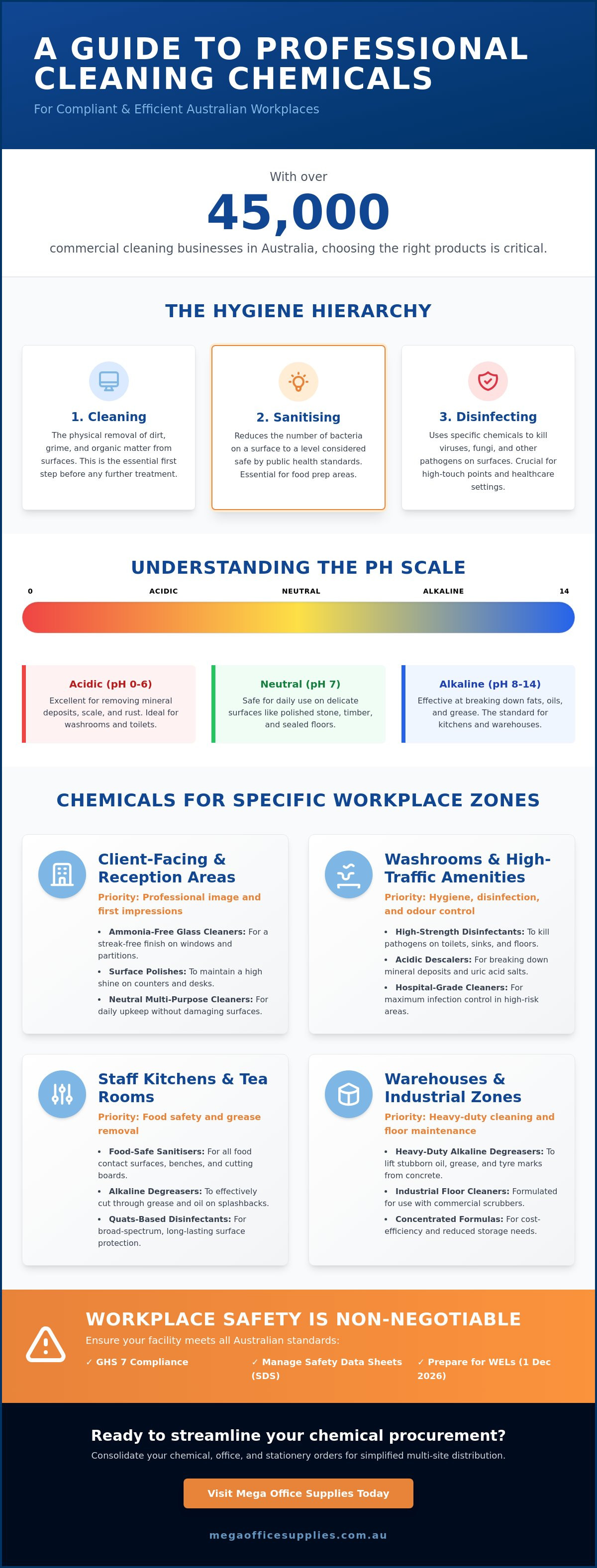
With 45,014 commercial cleaning businesses now operating across Australia, the scale of workplace maintenance has never been more demanding. You likely recognise the pressure of maintaining a hygienic environment while the regulatory landscape shifts, particularly with the mandatory transition to Workplace Exposure Limits (WELs) taking effect on 1 December 2026. It's a common struggle to balance the efficacy of professional cleaning chemicals against the administrative weight of managing Safety Data Sheets and controlling bulk procurement costs.
This guide provides the technical clarity needed to master your chemical selection, ensuring your organisation remains compliant with GHS 7 standards and national safety laws. At Mega Office Supplies, we use our extensive industry experience to help you streamline your inventory for warehouses, staff kitchens, and healthcare settings. You'll learn how to distinguish professional-grade solutions from domestic alternatives and how to implement a procurement strategy that reduces overheads without compromising on performance. We will preview the essential safety requirements and practical factors that lead to a cleaner, safer, and more efficient Australian workplace.
Key Takeaways
- Learn how to distinguish between domestic and professional-grade cleaning chemicals to ensure your facility meets Australian hygiene and performance standards.
- Identify the most effective products for specific zones, such as food-safe degreasers for tea rooms and high-shine finishes for client-facing reception areas.
- Evaluate the cost-efficiency of concentrated formulas versus ready-to-use solutions to maximise your budget and reduce storage requirements.
- Ensure full compliance with GHS 7 and Australian workplace safety laws by implementing a robust system for managing Safety Data Sheets and chemical labels.
- Simplify your procurement process by consolidating chemical orders with your broader office and stationery requirements for streamlined multi-site distribution.
Understanding Cleaning Chemical Categories for Australian Workplaces
Professional facility management requires a disciplined approach to hygiene that goes beyond the capabilities of domestic products. While supermarket brands are designed for light, occasional use, professional-grade cleaning chemicals are formulated with higher concentrations of active ingredients to handle the constant foot traffic and soil accumulation found in commercial environments. Selecting the correct category is a core component of risk management and surface preservation. Effective procurement begins with Understanding Cleaning Chemical Categories, ensuring that each product is fit for its intended purpose and environment.
One of the most critical distinctions in workplace maintenance is the difference between cleaning, sanitising, and disinfecting. Cleaning involves the physical removal of dirt and organic matter from surfaces, usually with the help of detergents. Sanitising reduces the number of bacteria to a level deemed safe by public health standards. Disinfecting uses specific chemicals to kill pathogens, including viruses and fungi, on surfaces. Professional cleaners also categorise agents by their pH value. Acidic cleaners (pH 0-6) are essential for removing mineral deposits and scale in staff bathrooms. Alkaline cleaners (pH 8-14) are the standard for staff kitchens and warehouses where grease and oils are prevalent. Neutral cleaners (pH 7) are the safest choice for delicate surfaces like stone or polished timber where harsh chemicals might cause damage.
Surface-Specific Cleaners and Their Roles
Daily maintenance relies on targeted formulas that protect assets while ensuring a professional appearance. For high-traffic reception areas, ammonia-free glass and window cleaners are essential to achieve a streak-free finish on entrance doors and partitions without damaging tinted films. Floor and carpet cleaners must be selected based on the substrate; polished concrete requires a different chemical profile than commercial-grade office tiles to prevent stripping the sealant. Multi-purpose surface cleaners act as the daily workhorse, providing a versatile solution for desks, shelving, and common touchpoints. To maintain a consistent supply of these essentials, many organisations manage their inventory through our facilities and breakroom supplies category.
Disinfectants and Sanitisers
In environments where infection control is paramount, such as healthcare settings or shared staff kitchens, the choice of disinfectant is vital. Many commercial disinfectants utilise Quaternary Ammonium Compounds, often called Quats, which provide broad-spectrum efficacy and stay active on surfaces longer than alcohol-based alternatives. It is important to remember that a sanitiser is a chemical that reduces bacteria to safe levels without necessarily killing all viruses. For general workplace safety, ensuring your team understands when to sanitise and when to disinfect is a key part of your WHS compliance and staff wellbeing strategy.
Selecting Chemicals for Specific Office Environments
Effective procurement requires matching cleaning chemicals to the specific demands of different workplace zones. A one-size-fits-all approach often leads to poor results or surface damage. In client-facing reception areas, the priority is a combination of visual finish and subtle fragrance. You need high-performance glass cleaners and surface polishes that leave zero residue, ensuring entrance doors and counters reflect a professional image. These areas benefit from "signature" scents that signal cleanliness to visitors without being overbearing.
Washrooms and high-traffic amenities demand a more aggressive chemical profile. Here, procurement officers should focus on high-strength disinfectants and acidic descalers. These products are essential for breaking down mineral deposits and uric acid salts that accumulate on porcelain and tiles. For industrial zones like warehouses and loading docks, the requirements shift again. Heavy-duty alkaline degreasers are necessary to lift oil, grease, and rubber tyre marks from industrial concrete flooring. Using a domestic floor cleaner in these environments is generally ineffective and a waste of resources.
The Staff Kitchen and Tea Room
Managing hygiene in communal eating areas involves strict adherence to food safety protocols. High-touch surfaces such as coffee station handles, microwave buttons, and fridge doors are primary sites for cross-contamination. It's vital to use food-safe sanitisers that don't leave harmful chemical residues on preparation benches. Employers must also maintain strict Storage and Safety Compliance to protect staff from accidental exposure in these shared spaces. Stocking the correct dishwashing detergents and surface sprays from our facilities and breakroom category ensures your tea room remains both hygienic and compliant with national health standards.
Classrooms and Educational Spaces
Educational environments require a balance between efficacy and student safety. Selecting low-irritant cleaning chemicals helps to minimise respiratory triggers and skin sensitivities in the classroom. Beyond floor and desk maintenance, schools have unique requirements for specialised solvents. Whiteboard cleaners must be powerful enough to remove "ghosting" without stripping the board's protective coating. Art rooms also require specific agents to handle paint, ink, and adhesive spills on varied surfaces. You can find these specialised products alongside our broader range of educational supplies to keep your learning spaces in top condition. Browsing our comprehensive selection of workplace solutions can help you identify the specific formulas your organisation needs to maintain a high standard of care.
Key Features to Compare: Concentration, Dilution, and Value
Efficiency in procurement begins with understanding the logistical footprint of your inventory. When selecting cleaning chemicals, the primary decision for any facility manager is whether to invest in Ready-to-Use (RTU) products or concentrated formulas. While the shelf price of a 5L concentrate appears higher, the cost-per-litre of the final solution is significantly lower. Large-scale operations, such as multi-storey office blocks or government departments, often rely on automated dilution systems to ensure consistency and safety. These systems eliminate human error and reduce the risk of chemical splashes during mixing. Adhering to the model Code of Practice for Managing risks of hazardous chemicals is essential when handling these high-strength concentrates; it provides a framework for safe storage and emergency planning.
Sustainability and waste reduction are also key considerations for the modern Australian workplace. Bulk containers, typically in 5L or 20L sizes, significantly minimise plastic waste compared to dozens of smaller trigger packs. By consolidating your orders, you reduce the carbon footprint associated with multiple deliveries. Procurement officers should look for containers that are compatible with standardised pumps and dispensers to maximise chemical yield and prevent accidental spills in the storage room.
Ready-to-Use (RTU) Solutions
RTU products are the standard choice for small offices or low-traffic areas where convenience is the priority. These solutions come pre-diluted in 500ml or 750ml trigger packs, allowing staff to perform quick spot cleans without the need for mixing stations. They're ideal for reception desks, home offices, or small boutique retail spaces. Because they require no preparation, they eliminate the training requirements associated with chemical mixing, making them a safe and immediate solution for general workplace maintenance.
Concentrated Chemicals for High-Volume Use
Bulk 5L and 20L containers allow you to store a vast amount of cleaning power in a relatively small footprint, which is vital for sites with limited storage space. Concentrated chemicals can offer up to 90% cost savings compared to RTU equivalents when diluted correctly. This approach requires a disciplined system of decanting into labelled trigger bottles, ensuring that every litre of concentrate is utilised to its full potential.
To maintain these efficiencies across your organisation, you can easily manage your high-volume requirements through our facilities and breakroom supplies section. This allows you to track usage and set up recurring orders for your most frequently used bulk concentrates, ensuring your cleaning team never runs short of essential supplies.
Storage and Safety Compliance: The Procurement Checklist
Procuring professional cleaning chemicals carries a significant responsibility for workplace safety. Compliance with Australian standards isn't just a recommendation; it's a legal requirement under Work Health and Safety (WHS) laws. Every chemical on your site must be accompanied by a current Safety Data Sheet (SDS). This document provides critical information on hazard identification, first aid measures, and emergency procedures. You must ensure these sheets are easily accessible to all staff, ideally stored in a dedicated folder near the chemical storage area rather than locked in a remote administrative office.
When you transition to bulk procurement to reduce costs, as discussed in our previous section on concentrates, the risks associated with decanting increase. Any secondary container, such as a trigger spray bottle, must be clearly labelled with the product name and its primary hazards. Proper storage practices are equally vital. Your storage area needs adequate ventilation to prevent the buildup of fumes. You should also implement bunding, which involves using secondary containment trays to catch leaks or spills before they reach the floor. Segregation is another critical safety pillar; never store incompatible chemicals, like bleach and acidic cleaners, together, as accidental mixing can create toxic gases.
Workplace Health and Safety (WHS) Obligations
A safe workplace relies on informed employees. You're responsible for ensuring all staff are trained in the safe handling and application of the cleaning chemicals they use daily. This training should cover the correct use of Personal Protective Equipment (PPE), including chemical-resistant gloves, safety goggles, and aprons. Accidents can happen even in the most organised environments, so maintaining fully stocked first aid kits is a fundamental part of your safety infrastructure. These kits should be located within easy reach of your chemical mixing and storage zones to ensure immediate response in the event of skin or eye exposure.
Organising Your Cleaning Cupboard
Efficiency and safety go hand in hand when organising your facility's cleaning cupboard. Implementing a colour-coding system is an effective way to prevent cross-contamination between different zones, such as using red for washrooms and green for food preparation areas. Use sturdy, chemical-resistant shelving to keep containers off the floor and organised by category. Finally, you must maintain an up-to-date chemical register that lists every product on-site. This register is a key document for compliance audits and helps you track expiry dates to minimise waste. To ensure your facility meets these rigorous standards, you can browse our full range of workplace safety and cleaning supplies to find the equipment that fits your specific needs.
Streamlining Your Facility Management with Mega Office Supplies
Managing multiple vendors for cleaning chemicals, office furniture, and technology creates unnecessary administrative friction and hidden logistical costs. Consolidating these requirements into a single procurement stream allows your organisation to focus on core operations rather than processing dozens of individual invoices. Mega Office Supplies provides access to a vast catalogue of professional brands and industrial sizes, ranging from 500ml trigger sprays to 20L bulk containers. As a family owned and operated business since 2008, we understand the specific logistical demands of local facility management. Our established distribution network ensures reliable national delivery for multi-site organisations, providing a consistent supply chain from metropolitan centres to regional branches.
Working with a seasoned industry veteran offers a level of stability that trendy, marketing-heavy providers cannot match. We prioritise functional clarity and efficiency, ensuring you have the right hardware and chemical solutions to maintain a safe workplace. By leveraging our scale, you gain the benefits of a massive operation while maintaining the direct support of a local partner. This balance is essential for procurement officers who value security, regional expertise, and a straightforward "problem-solution-action" workflow.
The One-Stop Procurement Advantage
Reducing administrative overhead is a primary goal for modern facility managers. When you source your stationery supplies Australia wide from the same partner providing your cleaning chemicals, you significantly simplify your accounts payable and inventory tracking. This unified approach ensures consistent stock levels for critical facility supplies. It eliminates the need for "emergency" retail purchases that often result in higher costs and inconsistent product quality. Our platform is designed for professional buyers who need to evaluate costs and quantities quickly, facilitating a fast and transparent purchase process.
Holistic Workplace Wellness
A clean workplace is a fundamental component of staff wellbeing and operational safety. Integrating your hygiene strategy with your coffee and tea supplies allows for a more holistic approach to managing your breakroom and communal areas. This coordination ensures that food-safe sanitisers and dishwashing detergents are always available alongside your tea room essentials. We operate as a dependable partner, providing the logistical prowess needed to keep your workplace running smoothly and safely every day.
Optimising Your Workplace Hygiene Strategy
Effective workplace hygiene is a strategic asset that requires a precise balance of chemical efficacy and regulatory compliance. You now have the technical foundation to distinguish between surface-specific agents and high-strength disinfectants while preparing for the 2026 transition to Workplace Exposure Limits. By prioritising concentrated formulas and maintaining a rigorous chemical register, your organisation can achieve significant cost efficiencies and meet its legal WHS obligations. These practical steps ensure a professional finish in client areas and a safe environment for your staff.
Mega Office Supplies stands as a dependable partner in the Australian market. As a family owned and operated business since 2008, we provide the logistical scale and regional expertise required to support complex multi-site operations. We offer reliable national delivery across all Australian states and territories, ensuring your team has consistent access to professional-grade cleaning chemicals alongside your broader facility requirements. Our team is ready to assist with bulk quoting and inventory consolidation to streamline your procurement workflow. We look forward to supporting your facility management goals with practical solutions and reliable service.
Browse our full range of professional cleaning chemicals and equip your facility with confidence.
Frequently Asked Questions
What is the difference between a disinfectant and a sanitiser for office use?
Sanitisers reduce bacteria to safe levels, while disinfectants kill a wider range of pathogens, including viruses and fungi. In a standard office, sanitisers are suitable for food preparation areas like staff kitchens. Disinfectants are required for high-risk zones like washrooms or during illness outbreaks to stop the spread of germs. Using the correct product ensures you aren't over-using harsh chemicals where a milder sanitiser is sufficient.
Do I need a Safety Data Sheet (SDS) for every cleaning chemical in my office?
Yes, you must maintain a current SDS for every hazardous chemical stored or used on your premises to comply with Australian WHS laws. These documents must be readily accessible to any employee who might be exposed to the substance. Suppliers are legally required to provide an SDS that's less than five years old, and you should store them in a central register for easy access during audits.
How long do professional cleaning chemicals typically last once opened?
Most professional-grade formulas have a shelf life of 12 to 24 months after opening, provided they're stored correctly. Concentrated products often last longer than ready-to-use sprays because they aren't diluted with water, which can introduce contaminants over time. You should always check the manufacturer's label for a specific expiry date and monitor for changes in colour or consistency that might indicate the product has lost its efficacy.
Can I use industrial-strength degreasers on standard office carpets?
No, you should avoid using heavy-duty degreasers on office carpets as they can strip the protective coating and damage the fibres. These alkaline-heavy cleaning chemicals are designed for industrial concrete or tiles in warehouses. Instead, use a pH-neutral carpet shampoo or a specialised spot cleaner specifically formulated for commercial textiles to prevent permanent discolouration or fibre degradation during the maintenance process.
What are the essential cleaning chemicals for a school staff kitchen?
A school staff kitchen requires a combination of food-safe sanitisers, professional-grade dishwashing detergents, and glass cleaners for partitions. You should prioritise low-irritant formulas to minimise the risk to students with sensitivities. It's also vital to stock a supply of multi-purpose surface sprays that are effective against common grease buildup around microwaves and coffee stations while remaining safe for use on communal food-contact surfaces.
How should I store bulk cleaning chemicals to comply with Australian safety standards?
Bulk chemicals must be stored in a cool, well-ventilated area away from direct sunlight and incompatible substances. You should use secondary containment trays, known as bunding, to capture potential leaks or spills from 5L or 20L containers. Ensure all storage areas are clearly marked with safety signage and that the floor is impervious to chemical spills to prevent environmental contamination and slip hazards in the workplace.
Is it more cost-effective to buy concentrated cleaning chemicals or ready-to-use sprays?
Concentrated cleaning chemicals are significantly more cost-effective for high-volume facilities because you aren't paying for the transport of water. While the initial purchase price is higher, the cost-per-litre of the diluted solution is much lower than pre-mixed trigger packs. This approach also reduces plastic waste and storage requirements, making it the preferred choice for professional cleaning crews and large organisations looking to maximise their budget.
Are there specific cleaning chemicals recommended for high-touch electronics like keyboards?
You should use isopropyl alcohol-based wipes or specialised electronic cleaners that evaporate quickly without leaving moisture behind. Standard liquid cleaners can seep into the circuitry and cause permanent damage to keyboards and mice. Always apply the cleaner to a microfibre cloth first rather than spraying the device directly to ensure you don't saturate the sensitive internal components of your office technology or damage the screen coatings.
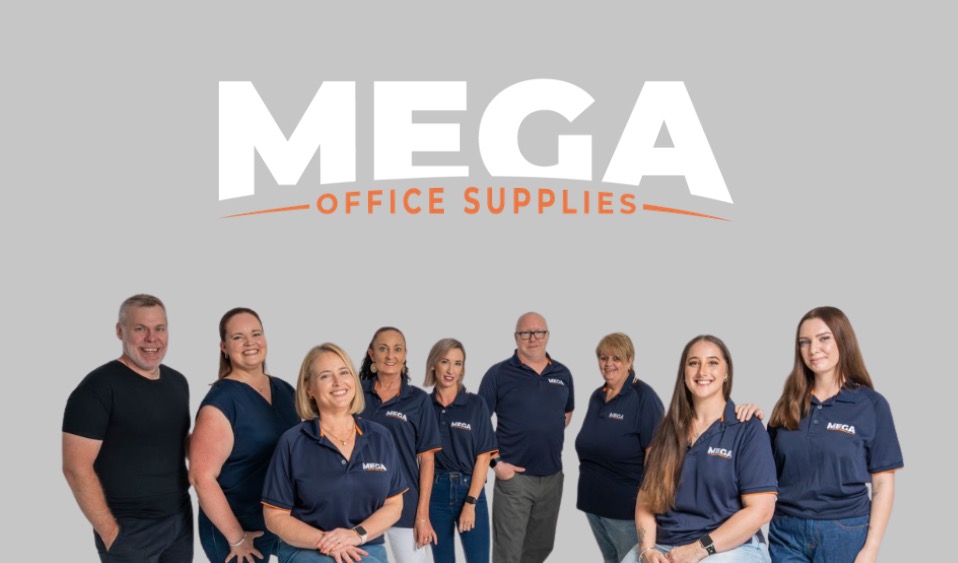
Article by
Mega Office Supplies Team
The Mega Office Supplies Team provides practical guidance for Australian businesses, schools, government organisations, healthcare providers, hospitality venues, warehouses and home offices. Based in Tweed Heads South, Mega Office Supplies has been family owned and operated since 2008, offering office stationery, workplace furniture, technology products, labels, printers, cleaning and janitorial supplies, safety products, art materials, education resources and everyday business essentials from trusted brands.
General Information
This article is provided as general information only to help customers compare and choose office, workplace, school, cleaning, technology, furniture, safety and business supplies. Product details, specifications, compatibility, availability, pricing and suitability may vary. Always check the individual product page, manufacturer information, workplace requirements and relevant safety guidance before purchasing or using a product.


