


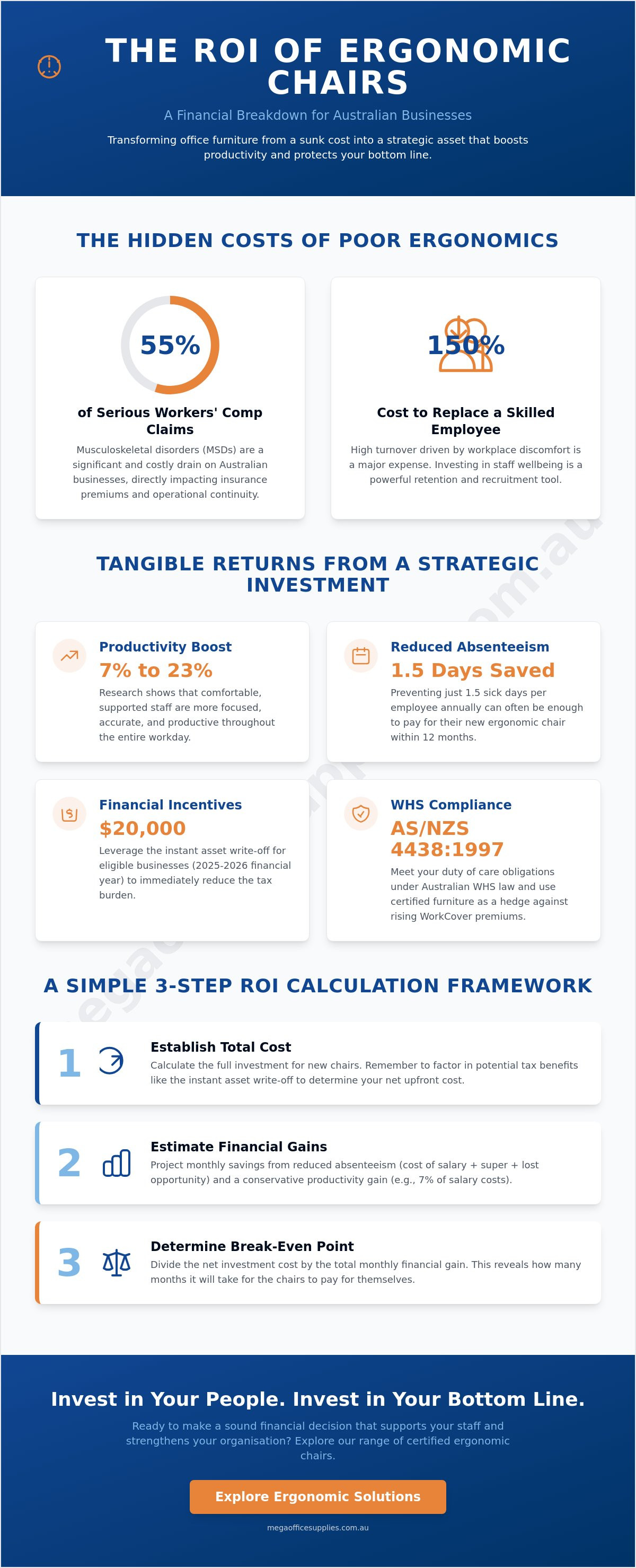
Did you know that musculoskeletal disorders account for 55% of all serious workers' compensation claims across Australia? For procurement officers and administrators, the upfront cost of premium seating often feels like a sunk expense rather than a strategic investment. You likely recognise that a comfortable team is a more focused one, yet the difficulty of quantifying "soft" benefits like employee wellbeing often stalls efforts to minimise workplace injury. This guide provides a direct framework for calculating ROI on ergonomic office chairs by focusing on tangible financial data.
We'll demonstrate how to measure productivity gains, which research indicates can range from 7% to 23%, and how to factor in the $20,000 instant asset write-off available for the 2025-2026 financial year. Drawing on our team's decades of combined industry experience, we'll show you how to convert reduced absenteeism and lower turnover into a clear business case. You'll learn to evaluate the total cost of ownership against long-term savings to ensure your next furniture procurement is a sound financial decision that protects both your staff and your bottom line.
Key Takeaways
- Understand how ergonomic seating helps meet Australian WHS obligations while shifting office furniture from a sunk cost to a strategic asset.
- Identify the "Big Three" metrics—absenteeism, productivity, and lifecycle—to quantify how many workdays are lost to preventable back and neck strain.
- Avoid the "budget trap" by calculating ROI on ergonomic office chairs using total cost of ownership rather than just the initial purchase price.
- Follow a clear, three-step process to estimate potential productivity improvements and determine the break-even point for your investment.
- Learn how to match specific chair features to job roles to maximise durability and employee comfort across diverse Australian workplace environments.
Understanding the Financial Impact of Workplace Ergonomics
ROI in a commercial setting is often viewed through the narrow lens of immediate cash flow. When calculating ROI on ergonomic office chairs, Australian business owners must look beyond the invoice price. Real returns are split into direct financial recoveries, such as lower insurance premiums, and indirect gains like improved output. While the history of ergonomic chairs began with simple comfort, modern 2026 standards treat these items as critical performance equipment rather than mere furniture.
Under Australian WHS legislation, employers hold a primary duty of care to provide a safe working environment. This isn't just a compliance box to tick; it's a financial safeguard. High-quality office furniture that meets AS/NZS 4438:1997 standards acts as a hedge against rising WorkCover premiums. By proactively reducing injury risks, organisations protect their bottom line from the compounding costs of claims and legal liabilities.
To better understand the methodology behind these financial assessments, watch this helpful video:
The Direct Costs of Poor Ergonomics
Musculoskeletal disorders (MSDs) are a significant drain on the Australian economy. They account for 55% of all serious workers' compensation claims. A single claim can cost a business tens of thousands in direct payouts and increased future premiums. Beyond the obvious claims, "presenteeism" creates a hidden leak in the budget. This occurs when staff members are physically present but their productivity is throttled by chronic back or neck pain. Poorly designed seating ensures your team spends more time shifting for comfort than completing tasks.
Ergonomics as a Recruitment and Retention Tool
Replacing a skilled employee in the Australian professional sector can cost up to 150% of their annual salary. Providing professional-grade ergonomic seating signals that an organisation values its workforce. It's a tangible benefit that aids retention and attracts top talent who expect a high standard of workplace care. Reducing the "fatigue factor" also extends the productive work day. When a chair supports the body correctly, cognitive resources aren't wasted on managing physical discomfort. This leads to higher accuracy and fewer errors during the final hours of a shift.
Key Metrics for Measuring Ergonomic Returns
Quantifying the financial recovery of a furniture investment requires a shift from viewing chairs as "office supplies" to viewing them as "productivity tools." When calculating ROI on ergonomic office chairs, administrators must track three primary pillars: absenteeism, productivity gains, and the asset's lifecycle. By establishing a baseline using internal HR and operational data, businesses can move beyond guesswork to see exactly how professional-grade seating impacts the ledger.
According to the Canadian Centre for Occupational Health and Safety, a chair is only truly ergonomic if it suits the worker's size, their specific tasks, and the workstation itself. This precision is what drives the "Big Three" metrics. If a chair lacks adjustability, the body compensates through muscular tension, which eventually leads to the "micro-breaks" and lost days that drain corporate resources.
Absenteeism and the Bottom Line
The daily cost of an absent employee is significantly higher than their base salary. To find the true cost, you must add 11.5% superannuation and a "lost opportunity" factor, which represents the revenue that staff member would have generated or supported. In many Australian professional environments, reducing sick leave by just 1.5 days per year per person is enough to pay for a high-quality chair upgrade within the first twelve months. HR departments should analyse leave patterns to find "hot spots" where back and neck strain are frequently cited as reasons for absence.
The Productivity Multiplier Effect
There is a direct link between spinal support and cognitive endurance. When a worker isn't distracted by lower back throb or shoulder tension, they maintain focus for longer periods. Research indicates that ergonomic improvements can lead to productivity gains ranging from 7% to 23%. These gains are found in the reduction of micro-breaks, such as standing up to stretch or readjusting a seat every ten minutes. Furthermore, studies suggest that ergonomic chairs can boost focus enough to reduce error rates by up to 56%, providing a massive boost to quality control in data-heavy roles.
To ensure your team has the right tools to maintain this level of output, you can explore a wide range of ergonomic office furniture designed for Australian commercial standards. Matching the chair to the specific job role is the most effective way to secure these productivity multipliers.
Comparing Initial Purchase Price vs Total Cost of Ownership
Procurement officers often fall into the "Budget Trap" by prioritising the lowest initial quote. While a $150 chair seems like a saving, it frequently costs upwards of $600 over five years when replacement cycles and lost productivity are factored in. calculating ROI on ergonomic office chairs involves assessing the Total Cost of Ownership (TCO) over the asset's entire life. This approach reveals that durability is a financial strategy rather than just a comfort preference. High-quality materials reduce the frequency of equipment failure and the administrative burden of constant re-ordering.
Commercial-grade materials, such as reinforced nylon and high-density moulded foam, are designed to withstand the rigours of an eight-hour workday. In contrast, domestic-use plastics used in budget seating often fail under professional stress. Choosing professional-grade office furniture provides the financial security of a 5-to-10-year Australian warranty, ensuring that your capital remains protected against manufacturing defects and premature wear.
The 5-Year Lifecycle Comparison
Frequency of replacement is the most significant variable in the TCO equation. Budget chairs typically require replacement every one to two years in a high-use office environment. Professional seating is engineered to last seven to ten years. Beyond the purchase price, you must consider the hidden costs of "fast furniture," including assembly time, delivery fees, and the rising price of commercial waste disposal. For a deeper dive into making these selections, read The Professional Buying Guide to Ergonomic Office Chairs in Australia (2026). Investing once in a decade-long asset is always more efficient than managing a constant cycle of breakage.
Features that Drive Long-Term Value
Specific technical specifications ensure that a chair remains a viable asset as your workforce changes. Synchronised mechanisms and seat sliders prevent future equipment obsolescence by allowing the chair to adapt to various body types and tasks. Breathable mesh is particularly effective in the Australian climate, as it maintains user comfort and resists the material degradation often seen with cheap vinyl or leatherette. These versatile chairs also maintain their value when integrated with other ergonomic solutions, such as standing desks. By selecting hardware that supports a wide range of movement, you minimise the risk of needing to replace specialised equipment as workplace health standards evolve.
How to Calculate the ROI on Your Office Chair Investment
Moving from theoretical benefits to a hard-data business case requires a structured mathematical approach. When calculating ROI on ergonomic office chairs, you must account for both the immediate capital outlay and the recurring operational savings. By following these five steps, procurement officers can provide a defensible financial model to senior management that justifies the shift toward higher-quality seating.
- Step 1: Determine the total investment cost. This includes the unit purchase price, freight charges, and the internal labour cost for assembly. This is your "Total Cost of Acquisition."
- Step 2: Estimate the reduction in absenteeism. Aim for a conservative 10% to 20% improvement in leave related to musculoskeletal discomfort. Use your internal HR data to find the current average cost of sick leave per employee.
- Step 3: Calculate productivity value. Multiply the total annual salary of the user by a conservative 2% productivity gain (0.02). This accounts for fewer micro-breaks and improved cognitive endurance.
- Step 4: Factor in the replacement cycle. Divide the cost of a budget chair by its two-year lifespan and compare it to the cost of a professional chair over its ten-year lifespan to find the annual TCO saving.
- Step 5: Apply the ROI formula. Use the calculation: (Total Annual Savings / Initial Investment) x 100.
A Practical Calculation Example
Consider an employee with a standard Australian average salary of $85,000. Applying a modest 2% productivity increase results in a $1,700 annual gain in output value. If a professional-grade chair costs $500 to acquire and assemble, the investment pays for itself in less than four months based on productivity alone. The payback period is the specific point in time where the cumulative financial savings generated by the new equipment equal the initial cost of the investment. Even when excluding the savings from reduced sick leave or lower insurance risks, the return on investment exceeds 300% in the first year.
Presenting the Business Case to Stakeholders
To secure budget approval, translate ergonomic features into the language of the C-suite. Focus on operational efficiency, risk mitigation, and the impact on EBIT (Earnings Before Interest and Taxes). Decision-makers value stability and evidence-based procurement. If a full-floor upgrade is met with resistance, suggest a pilot program for a single department to gather internal data on comfort and output. You can leverage furniture experts to provide technical specifications and bulk quoting to support your proposal. This data-driven approach ensures the organisation views the purchase as a strategic asset rather than a discretionary expense.
If you are ready to build your business case with accurate figures, you can request a bulk quote for ergonomic seating to determine your exact investment costs.
Strategic Procurement: Maximising Your Return with Mega Office Supplies
Strategic procurement is the final step in calculating ROI on ergonomic office chairs, as the vendor you choose directly impacts the lifecycle and maintenance variables of your financial formula. Mega Office Supplies operates as a high-capacity partner, leveraging cumulative decades of industry experience to help organisations select hardware that matches specific operational roles. A call centre environment requires different adjustability specifications than a reception area or a school administration office. By matching the chair to the task, you minimise the risk of equipment failure and maximise the productivity gains identified in your business case.
Working with a local Australian retailer provides distinct logistical advantages that global e-commerce platforms cannot replicate. Direct access to domestic support and a regional contact line ensures that warranty claims or technical queries are resolved without friction. Standardising your fit-out through bulk ordering also simplifies long-term maintenance. When every workstation utilises the same professional-grade components, your internal facilities team can manage repairs and adjustments with greater speed and efficiency.
A holistic ergonomic strategy extends beyond seating. Integrating office supplies such as document holders, footrests, and ergonomic stationery can further reduce the physical strain that leads to absenteeism. This collective approach ensures that every element of the workstation supports the user, reinforcing the financial returns of your primary furniture investment.
The Mega Office Supplies Advantage
Our team brings a wealth of knowledge to every procurement project, backed by decades of combined industry experience. We understand the specific requirements of government, education, and healthcare sectors, where durability and compliance are non-negotiable. Our catalogue features professional-grade brands with proven performance records in high-use Australian environments. This stability provides procurement officers with the peace of mind that their chosen assets will outlast their projected depreciation cycles.
Next Steps for Your Workplace Fit-out
To move from calculation to implementation, request a rapid quote for your bulk ergonomic seating requirements to lock in current pricing. Our specialists can assist in evaluating chair-to-desk compatibility to ensure your new seating works seamlessly with existing workstations. Consider reviewing our range of technology, including monitor arms and adjustable keyboards, to complete the ergonomic circuit. These final additions ensure your organisation captures the full 23% productivity potential of a modern, health-focused office layout.
Securing Your Workplace Investment for 2026
Transitioning from basic seating to professional-grade equipment is a strategic move that protects your organisation's most valuable asset: its people. By calculating ROI on ergonomic office chairs using the metrics of productivity, absenteeism, and total cost of ownership, you can turn a necessary expense into a high-yield investment. The data confirms that high-quality seating pays for itself through increased output and reduced injury risk, providing a clear path to improved bottom-line performance.
Mega Office Supplies is a family-owned Australian company founded in 2005. We bring decades of combined industry expertise to every workplace solution. As national delivery and bulk procurement specialists, we provide the logistical scale and regional support required for large-scale fit-outs across government, education, and commercial sectors. Our focus remains on providing durable hardware that stands up to the rigours of the modern Australian office.
View our range of professional-grade ergonomic office chairs and begin optimising your workplace efficiency today. Investing in the right foundation ensures your team remains focused, healthy, and productive for years to come.
Frequently Asked Questions
What is a realistic ROI percentage for ergonomic office chairs?
A realistic return can vary, but many Australian organisations report an ROI exceeding 300% within the first year of implementation. This figure is reached by combining the value of increased staff output with the reduction in overheads like sick leave and insurance premiums. When calculating ROI on ergonomic office chairs, businesses should look at the total annual savings relative to the initial acquisition cost to find their specific recovery rate.
How does an ergonomic chair specifically increase employee productivity?
Ergonomic chairs increase productivity by minimising the "discomfort distraction" that leads to frequent micro-breaks and loss of focus. When a chair provides proper lumbar support and adjustable armrests, the body doesn't need to exert constant energy on maintaining posture. This physical stability allows for higher cognitive endurance throughout the day. Employees spend more time engaged with their tasks and less time shifting in their seats to find temporary relief from pain.
Is there a difference in ROI between home office and corporate office chairs?
The ROI for home office chairs is often higher due to the increased risk of poor posture in unsupervised remote environments. In a corporate setting, workstations are typically standardised, but home offices frequently lack professional-grade equipment. Providing ergonomic seating for remote staff helps prevent domestic-related injury claims. It also ensures that the productivity gains seen in the office are maintained across a hybrid workforce, protecting the organisation's overall output.
Can I claim a tax deduction for ergonomic chairs in Australia?
Australian businesses can generally claim a tax deduction for ergonomic chairs as a legitimate business expense. For the 2025-2026 financial year, small businesses with an aggregated turnover of less than $10 million can utilise the $20,000 instant asset write-off. This allows for the immediate deduction of the full cost of eligible assets like office furniture. You should always consult with a qualified tax professional to confirm how these ATO rules apply to your specific organisation.
How long does it take for an ergonomic chair to pay for itself?
Most professional-grade ergonomic chairs pay for themselves in less than six months. This rapid payback period occurs because the cost of the chair is relatively low compared to the value of a worker's time. Even a minor 2% gain in efficiency for a staff member on a standard salary far outweighs the purchase price. When you factor in the extended lifecycle of commercial-grade materials, the chair becomes profit-positive well before its first year of service ends.
Should I buy the same chair for every employee to maximise ROI?
Standardising on a single, highly adjustable model is usually the most efficient path to a high ROI. A versatile chair that meets AS/NZS 4438:1997 standards can be reassigned to different staff members as your team structure changes. This flexibility prevents equipment obsolescence and simplifies your internal maintenance processes. Choosing a model with a wide range of adjustment points ensures it can accommodate the vast majority of body types within your workforce.
What are the risks of ignoring ergonomic investments in a professional office?
Ignoring ergonomic investments leads to higher WorkCover premiums and increased staff turnover. Chronic pain is a primary driver of employee dissatisfaction, which can cause you to lose skilled talent to competitors who prioritise workplace wellbeing. There is also a significant legal risk associated with failing to meet mandatory WHS duty of care requirements. Over time, the cost of managing preventable injuries and recruitment far exceeds the investment in professional-grade seating.
Article by
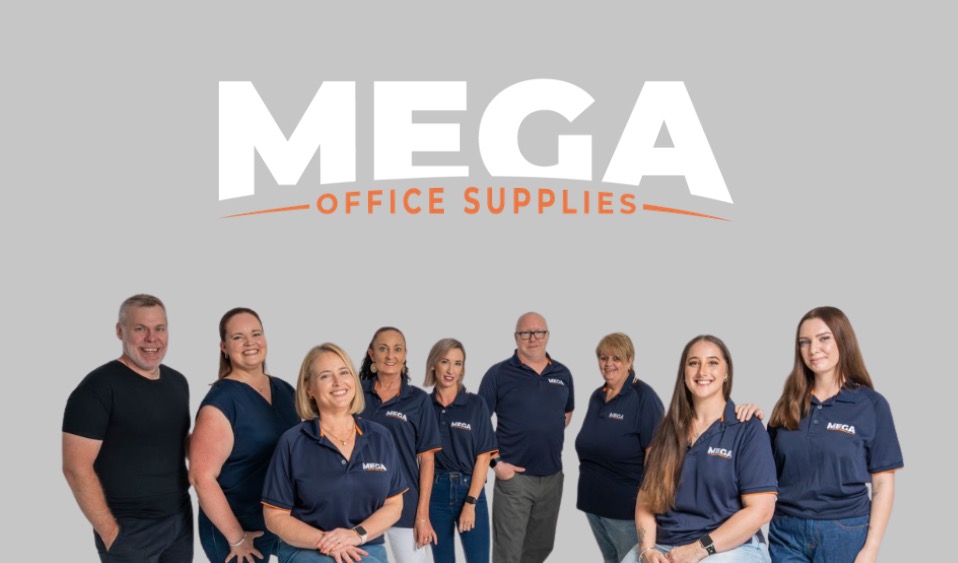
Mega Office Supplies Team
The Mega Office Supplies Team provides practical guidance for Australian businesses, schools, government organisations, healthcare providers, hospitality venues, warehouses and home offices. Based in Tweed Heads South, Mega Office Supplies is a family-owned and operated Australian business offering office stationery, workplace furniture, technology products, labels, printers, cleaning and janitorial supplies, safety products, art materials, education resources and everyday business essentials from trusted brands.
General Information
This article is provided as general information only to help customers compare and choose office, workplace, school, cleaning, technology, furniture, safety and business supplies. Product details, specifications, compatibility, availability, pricing and suitability may vary. Always check the individual product page, manufacturer information, workplace requirements and relevant safety guidance before purchasing or using a product.


