


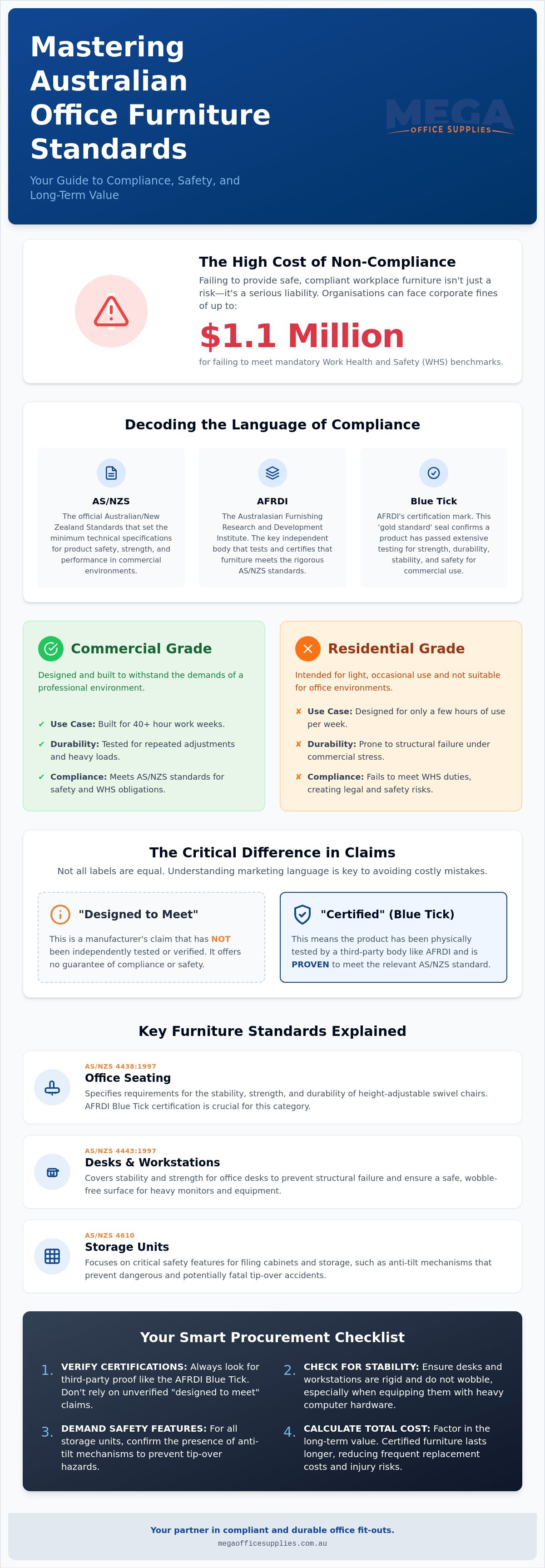
Investing in office furniture based on aesthetics alone isn't just a design risk; it's a serious liability that could cost your organisation up to $1.1 million in corporate fines if equipment fails to meet mandatory safety benchmarks. It is a common frustration for procurement officers who find themselves drowning in an alphabet soup of acronyms like AFRDI, AS/NZS, and BIFMA, often wondering if the higher price tag for certified gear is truly justified. You want a workplace that protects your staff from injury while ensuring every desk and chair remains functional for a decade or more.
This guide will help you master the complexities of Australian standards for office furniture, ensuring your workplace remains compliant, safe, and equipped for long-term durability. We will provide a clear breakdown of the essential 2026 certifications for seating and workstations, explain how to verify "Blue Tick" claims through official channels, and offer the technical specifications you need to justify quality investments to management. By the end of this article, you will have the confidence to select furniture that meets the highest benchmarks for performance, ergonomics, and safety.
Key Takeaways
- Learn the critical differences between AS and AS/NZS classifications to ensure your workplace equipment meets the legal requirements set by Australian regulatory bodies.
- Navigate the complexity of Australian standards for office furniture by understanding AFRDI Blue Tick levels, from standard office use to heavy-duty commercial applications.
- Identify the stability requirements for desks and workstations to prevent structural failure and ensure a safe, wobble-free environment for heavy hardware and monitors.
- Minimise workplace hazards by identifying essential safety features in storage units, such as anti-tilt mechanisms that prevent dangerous tip-over accidents.
- Optimise your procurement strategy by calculating the total cost of ownership and verifying certifications before purchase to avoid costly replacement cycles.
Understanding the Australian Standards Framework for Workplace Furniture
Australian Standards (AS) and joint Australian/New Zealand Standards (AS/NZS) are technical specifications that establish the minimum safety and performance criteria for products used in commercial environments. While some procurement officers view these as optional suggestions, they are critical blueprints for risk management. For any business owner, following Standards Australia guidelines is the most effective way to meet Work Health and Safety (WHS) obligations. Compliance ensures that the equipment you provide won't fail under normal use, protecting both your staff and your bottom line.
Residential grade furniture is built for occasional use, typically only a few hours a week. In contrast, commercial Australian standards for office furniture require equipment to withstand the physical stress of a 40-hour work week, repeated adjustments, and varying weight loads. Choosing domestic furniture for a professional setting often leads to structural failure, increased injury claims, and frequent replacement costs. This is why understanding the framework is the first step toward a durable fit-out.
To help you visualise the practical application of these benchmarks, watch this video on sourcing furniture in Australia:
The Difference Between Mandatory and Voluntary Standards
Most Australian standards for office furniture are technically voluntary. However, this distinction is often misunderstood. In the event of a workplace injury or a WorkSafe audit, these standards become the legal benchmark for what is considered "reasonably practicable" safety measures. Implementing certified furniture demonstrates due diligence. If you install non-compliant office furniture in a high-traffic zone and a staff member suffers a musculoskeletal injury, your organisation faces significant legal exposure. Fines for corporate bodies failing to meet safety benchmarks can reach $1.1 million, making compliance a financial necessity.
Key Regulatory Bodies: Standards Australia and AFRDI
Standards Australia develops the technical protocols, but they don't test the products themselves. This is where the Australasian Furnishing Research and Development Institute (AFRDI) becomes essential. AFRDI is the primary independent testing body that verifies whether a product actually survives the rigours of a commercial environment. They provide the "Blue Tick" certification, which is the industry's gold standard for performance and safety.
- Blue Tick Certification: Signifies a specific model has undergone mechanical testing for strength, durability, and stability.
- Designed to Meet: A manufacturer claim that has not been independently verified.
- Certified: A product that has been physically tested by a third party like AFRDI to confirm it meets the standard.
Be cautious of marketing language. A product "designed to meet" a standard is not the same as a "certified" product. Always look for independent verification to ensure your investment is protected for the long term.
Seating Standards: AS/NZS 4438 and the AFRDI Blue Tick
AS/NZS 4438:1997 is the technical foundation for any professional workstation setup. It specifies the requirements for stability, strength, and durability for height-adjustable swivel chairs. When you browse office chairs, you will frequently see the AFRDI Blue Tick logo. This isn't just a marketing sticker; it confirms that a specific model has been tested to meet rigorous Australian furniture standards. These tests involve mechanical stress cycles, such as 200,000 repetitions on the seat and backrest, to simulate years of heavy use. Adhering to these Australian standards for office furniture ensures your seating isn't just comfortable but structurally sound for the long haul.
The AFRDI certification is divided into three distinct levels to help procurement officers choose the right gear for their specific environment. Level 4 is the base commercial standard, designed for normal office use of roughly 8 hours per day. Level 5 is heavy-duty, suitable for environments where chairs face high-frequency use or larger weight loads. Level 6 represents the severe commercial standard, engineered for the most demanding conditions. Beyond structural integrity, these standards also evaluate ergonomic factors like seat depth, backrest height, and lumbar support, which are vital for reducing workplace fatigue and chronic back pain.
Why Level 6 AFRDI Certification Matters for 24/7 Operations
For high-intensity environments like hospitals, police stations, and 24-hour call centres, standard seating will fail prematurely. Level 6 chairs are engineered to handle continuous use across multiple shifts without structural degradation. They feature reinforced tilt mechanisms and high-tensile bases that withstand constant adjustment. If you're managing a facility that never sleeps, check our Professional Buying Guide to Ergonomic Office Chairs to identify models that meet these severe commercial requirements. Investing in Level 6 ensures you won't be replacing broken gas lifts or cracked bases every 12 months.
Visitor and Fixed-Base Seating Standards
Reception areas and meeting rooms require a different set of benchmarks, specifically AS/NZS 4688. While these chairs don't swivel or adjust in height, they must meet strict stability requirements to prevent tipping when a visitor leans or shifts their weight. Australian standards for office furniture also dictate that fixed-base seating in public zones must use materials with high fire resistance and abrasion durability. This ensures your reception area remains safe and professional even under high foot traffic, protecting your organisation from liability while providing a welcoming environment for guests.
Workstations and Desks: AS/NZS 4443 and Ergonomic Stability
AS/NZS 4443:1997 is the primary benchmark governing the performance and safety of office desks and workstations. While seating often receives the bulk of ergonomic attention, the structural integrity of the desk surface is equally vital for a safe workplace. This standard ensures that a desk can withstand the rigours of a professional environment, focusing on strength, durability, and stability. Australian standards for office furniture dictate that a workstation must remain stable even when subjected to uneven weight distribution, preventing dangerous wobbles or total structural collapse under the weight of modern hardware.
Stability is often compromised when workstations are fitted with heavy dual-monitor arms or large format screens. If a desk lacks the necessary frame reinforcement required by AS/NZS 4443, the torque from these attachments can cause the desktop to bow or the entire unit to tip. Beyond structural strength, the standard also addresses "safe edges." This requires all accessible corners and edges to have a radius or bevelled finish, which helps to minimise impact injuries and prevents clothing from snagging during daily movement. Effective cable management is another critical safety factor, as untamed cords create significant trip hazards and increase the risk of electrical fires.
The rapid adoption of sit-stand workstations has introduced new safety considerations for electric height-adjustable frames. These units must operate smoothly without jarring, as sudden movements can cause equipment to slide or fall. Modern electric desks should incorporate anti-collision technology, which acts as a safety sensor to stop and reverse the motor if the desk hits an obstruction like a chair arm or a windowsill. This technology is now a standard expectation for high-quality office furniture intended for multi-user environments.
Ergonomic Layout and Tertiary Space Requirements
Effective spatial planning is just as important as the hardware itself. Following WorkSafe Victoria guidance, organisations should aim for approximately 6m2 of floor space per person. This "tertiary space" includes the desk, chair, and the immediate circulation area required for safe movement. Desk depth is another critical ergonomic factor; a depth of 750mm to 800mm is typically required to maintain an appropriate focal length between the user and their monitors. This distance helps to minimise eye strain and allows for the proper placement of keyboards and mice. For more detailed advice on optimising your setup, refer to our Standing Desk Solutions guide.
Weight Capacity and Motor Safety for Adjustable Desks
Procurement officers must distinguish between "static load" and "dynamic load" when evaluating workstations. Static load refers to the maximum weight the desk can hold while stationary, whereas dynamic load is the capacity the motor can safely lift while in motion. Overloading a motor beyond its dynamic rating will lead to premature mechanical failure and void warranties. AS/NZS 4443 provides the essential framework for structural integrity, ensuring that workstations can withstand both the vertical pressure of hardware and the lateral forces of daily use. Ensuring your Australian standards for office furniture are met at the point of purchase protects your staff and ensures the longevity of your assets.
Storage and Filing Cabinet Safety: AS/NZS 4610 and Beyond
Storage units and filing cabinets are often the heaviest assets in a workplace, yet their safety benchmarks are frequently overlooked during the procurement process. Non-compliant units present a severe tip-over hazard, particularly when top drawers are fully extended while loaded with heavy files. Research indicates that between 2000 and 2015, at least 14 children in Australia died due to toppling furniture; while the office environment is different, the risk of crush injuries remains a significant WHS concern for staff. Adhering to Australian standards for office furniture, specifically AS/NZS 4610.3, ensures that storage units meet the necessary requirements for stability and structural durability in commercial and educational settings.
The most critical safety feature to look for is the anti-tilt mechanism. This mechanical interlock ensures that only one drawer can be opened at a time, preventing the centre of gravity from shifting forward and causing the entire unit to topple. For any organisation, installing cabinets without this feature is a direct failure of safety due diligence. Modern standards also focus on robust locking mechanisms. These aren't just for general security; they're essential for meeting document privacy obligations under the Australian Privacy Act, particularly when storing sensitive personnel records or client information in open-plan offices.
Choosing Filing Cabinets for High-Density Storage
Lateral filing cabinets distribute weight across a wider footprint compared to traditional vertical units, which generally increases stability but requires a larger floor area. When planning for high-density storage, you must consider the floor load-bearing capacity of your building. A standard four-drawer cabinet filled with lever arch files can weigh well over 150kg, which can stress older floor structures or mezzanine levels in warehouse offices. Choosing the right configuration is essential for both accessibility and long-term structural safety.
Durability Standards for Commercial Shelving
Commercial shelving must meet strict deflection standards to prevent "bowing" or permanent deformation under load. A single shelf stacked with boxes of A4 copy paper is surprisingly heavy, and non-compliant shelving will sag or fail over time. Ensure your chosen units feature a powder-coated finish; this provides superior resistance to corrosion and mechanical wear, which is vital in humid Australian coastal climates or industrial environments. For any storage unit over 1.5 metres in height, safety standards dictate that the frame should be anchored to a wall or floor to eliminate the risk of accidental tipping during a 40-hour work week.
Secure your workplace by browsing our range of commercial filing cabinets and storage solutions that meet rigorous safety benchmarks.
Procurement Strategy: How to Source Certified Furniture for Your Fit-out
Executing a national-scale fit-out requires a procurement strategy that prioritises long-term asset value over initial savings. When evaluating tenders, the primary verification step is requesting official AFRDI certificates rather than accepting general marketing claims. A manufacturer might state their product is "built to Australian standards for office furniture," but without third-party validation, your organisation carries the risk of premature equipment failure. When reviewing a specification sheet, look for the specific AS/NZS number and the testing date. If a sheet only mentions compliance without a certificate number, treat it as an unverified claim. A true professional-grade spec sheet will list the dynamic load rating and the specific AFRDI level achieved.
The "Total Cost of Ownership" is a critical metric for any business. While non-certified furniture might appear cost-effective on a quote, these items often require replacement every 24 to 36 months due to mechanical degradation. In contrast, furniture certified to AS/NZS benchmarks typically offers a service life exceeding 10 years. By investing in professional-grade equipment, you effectively reduce your long-term capital expenditure and minimise the logistical disruption of constant repairs and replacements. Mega Office Supplies acts as a reliable partner in this process, providing the logistical prowess needed to manage high-volume demands without friction.
The Role of Commercial Warranties
A robust commercial warranty is one of the most reliable indicators of quality. Unlike domestic-grade items that carry a basic 12-month guarantee, professional office furniture usually features a 5-year, 7-year, or even 10-year warranty. This reflects the manufacturer's confidence in the product's ability to survive heavy use. During the quoting process, always ask for the specific AFRDI certificate number to verify that the warranty covers the intended commercial application. This provides the peace of mind that your investment is protected against structural defects for the duration of its intended use.
Streamlining Bulk Orders with Mega Office Supplies
Mega Office Supplies understands the specific workflow of professional buyers who need to evaluate costs and quantities quickly. We offer specialised accounts to simplify the acquisition of high-volume workplace assets across all sectors. You can streamline your procurement by completing our Business Application Form, which provides access to tailored pricing and efficient order management. We also provide dedicated support for public sector departments, as Australian Government Official Purchase Orders are accepted to facilitate a friction-free transaction process.
If you're planning a new facility or upgrading an existing floorplate to meet 2026 Australian standards for office furniture, Contact our team today to discuss your compliant office fit-out needs. Our experience in national logistics ensures your furniture is delivered on time and meets every required safety standard.
Securing Long-Term Value Through Certified Procurement
Mastering the technical requirements for workplace furniture is a critical step in mitigating corporate liability and ensuring operational stability. By prioritising Australian standards for office furniture, you protect your staff from ergonomic hazards and safeguard your organisation from the high costs of premature equipment failure. Whether you're outfitting a high-traffic government department or a regional school, independent certifications like the AFRDI Blue Tick remain the most reliable benchmark for durability and safety in 2026.
At Mega Office Supplies, we've been supporting the corporate, healthcare, and education sectors since 2005. Our team brings over 20 years of combined industry experience to every fit-out, providing national delivery across Australia to ensure your workstations arrive on time and ready for heavy-duty use. We understand the logistical demands of professional buyers and provide the technical documentation needed to justify your investment to management.
Explore our range of AFRDI-certified office furniture to find solutions that meet the highest benchmarks for performance and safety. Taking the time to verify compliance today ensures a more productive, ergonomic workplace for years to come.
Frequently Asked Questions
What is the most important Australian Standard for office chairs?
AS/NZS 4438:1997 is the primary benchmark for height-adjustable swivel chairs in Australia. This standard sets the technical requirements for stability, structural strength, and ergonomic adjustability. When you source seating for a commercial environment, ensuring compliance with this standard is the best way to minimise musculoskeletal injuries and ensure the equipment survives heavy daily use over a long-term period.
Is it illegal to use non-certified furniture in an Australian office?
While most Australian standards for office furniture are technically voluntary, failing to use them is a significant legal risk. Under Work Health and Safety (WHS) legislation, employers must provide a safe work environment. If an injury occurs due to non-compliant equipment, the lack of certification can be used as evidence of negligence. This makes following these benchmarks a functional necessity for effective risk management.
What does the AFRDI Blue Tick actually test for?
The AFRDI Blue Tick signifies that a product has undergone rigorous mechanical testing for durability, safety, and function. Testing involves robotic simulations of thousands of use cycles, including seat and backrest impacts, swivel mechanism endurance, and base strength under heavy loads. It provides independent verification that a product will actually perform as claimed in a demanding commercial or educational setting rather than relying on manufacturer promises.
How much floor space is required per employee under Australian guidelines?
Australian guidelines generally recommend approximately 6m2 of floor space per employee for an effective office layout. This "tertiary space" calculation includes the area occupied by the workstation and chair, plus the immediate circulation space needed for safe movement. Maintaining this density helps prevent overcrowding and ensures that staff can move freely without creating trip hazards or obstructing emergency exit paths during a 40-hour work week.
Do standing desks have specific Australian Standards?
Standing desks and sit-stand workstations fall under AS/NZS 4442:2018, which covers office desks and tables. This standard focuses on structural stability at maximum height and the safety of the adjustment mechanisms. For electric models, it's also vital to check for anti-collision sensors and weight capacity ratings to ensure the desk can safely lift monitors and hardware without mechanical failure or jarring movements.
How can I verify if a filing cabinet is safe from tipping?
You can verify filing cabinet safety by checking for an integrated anti-tilt mechanism that restricts users to opening only one drawer at a time. This feature is a requirement of AS/NZS 4610.3 for commercial storage units. Without this interlock, the centre of gravity shifts forward when multiple drawers are extended, creating a severe toppling hazard that can lead to serious crush injuries in the workplace.
What is the difference between AS/NZS 4438 Level 5 and Level 6?
The primary difference lies in the intended intensity of use and the duration of the work shift. Level 5 is rated for heavy-duty office use, typically up to 40 hours per week in a standard commercial setting. Level 6 is the "severe commercial" standard, engineered for 24-hour operations like hospitals, police stations, and call centres where chairs are used across multiple shifts without any break period.
Why should I avoid residential furniture for a commercial office fit-out?
Residential furniture is designed for occasional use and lacks the structural reinforcement required for a professional environment. Commercial-grade equipment is built to withstand constant adjustments and higher weight loads over many years. Using domestic items in a business environment typically leads to rapid mechanical failure, voided warranties, and increased injury claims, ultimately costing more in frequent replacement cycles and potential legal fees.
Article by
Mega Office Supplies Team
The Mega Office Supplies Team provides practical guidance for Australian businesses, schools, government organisations, healthcare providers, hospitality venues, warehouses and home offices. Based in Tweed Heads South, Mega Office Supplies is a family-owned and operated Australian business offering office stationery, workplace furniture, technology products, labels, printers, cleaning and janitorial supplies, safety products, art materials, education resources and everyday business essentials from trusted brands.
General Information
This article is provided as general information only to help customers compare and choose office, workplace, school, cleaning, technology, furniture, safety and business supplies. Product details, specifications, compatibility, availability, pricing and suitability may vary. Always check the individual product page, manufacturer information, workplace requirements and relevant safety guidance before purchasing or using a product.


