



Did you know that by 1 December 2026, every Australian workplace must comply with strict new Workplace Exposure Limits (WELs) for airborne contaminants? Relying on household-grade sprays in a professional environment isn't just ineffective; it's a liability that can lead to non-compliance with GHS 7 standards. This commercial cleaning chemicals guide addresses the common confusion surrounding safety data sheets (SDS) and chemical storage protocols in high-traffic environments like schools, warehouses, and healthcare centres.
We understand that procurement officers and facility managers often feel overwhelmed by the technical specifications of professional-grade solutions. At Mega Office Supplies, our team draws on decades of combined industry experience to help you simplify these complex requirements. This article will empower you to master the complexities of workplace hygiene to ensure your facility remains compliant, safe, and cost-effective. We will preview the essential chemicals your site requires, explain the upcoming Australian WHS changes, and demonstrate how bulk ordering can significantly reduce your operational overheads.
Key Takeaways
- Understand the critical performance differences between high-concentration commercial formulas and standard retail products to ensure effective sanitisation in high-traffic professional environments.
- Use this commercial cleaning chemicals guide to navigate the transition to GHS 7 standards and ensure every hazardous substance on-site has a compliant Safety Data Sheet (SDS).
- Identify specific chemical compatibilities for various workplace surfaces, from natural stone to modern ergonomic furniture, to prevent accidental material damage and maximise asset longevity.
- Optimise your facility budget by calculating the true cost-per-litre through the strategic use of high-performance concentrates and automated dilution systems.
- Streamline your procurement by sourcing both office essentials and heavy-duty cleaning supplies from a single Australian provider that's been family owned and operated since 2008.
Navigating the Essentials: Why a Commercial Cleaning Chemicals Guide is Critical
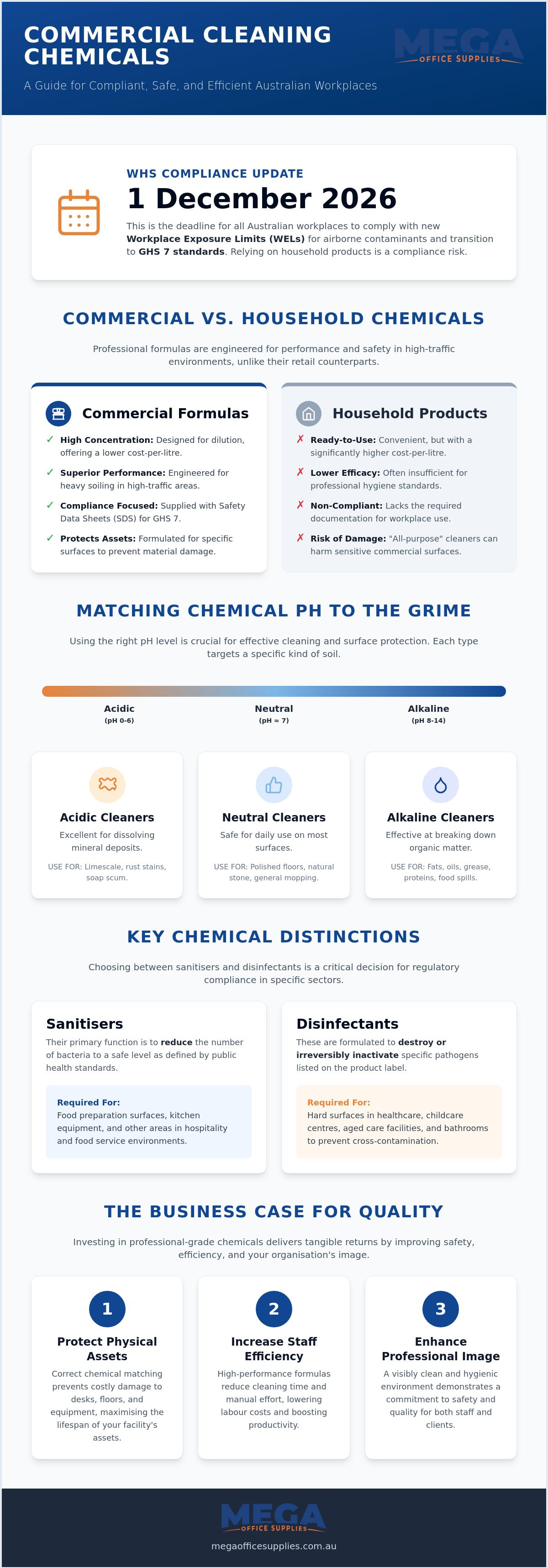
Commercial cleaning chemicals are high-concentration formulas engineered for the specific demands of high-traffic professional environments. While household products suffice for a domestic kitchen, they lack the chemical density required to maintain industrial warehouses or busy school corridors. This commercial cleaning chemicals guide identifies the critical differences between retail sprays and professional solutions. Using ineffective retail products often leads to "ghosting" on surfaces and insufficient microbial control, which compromises workplace safety and hygiene standards.
Selecting the correct solution involves understanding the different types of cleaning agents and their specific pH levels. Acidic solutions are typically used for mineral deposits like lime or rust, while alkaline formulas are the standard for breaking down organic fats, oils, and proteins. Neutral cleaners provide a safe, reliable option for daily maintenance on sensitive surfaces like natural stone or polished timber floors. Matching the pH of the chemical to the soil type is the first step in professional facility management.
To better understand these chemical fundamentals, watch this helpful video:
Identifying Core Chemical Categories
Surfactants are the workhorses of the cleaning industry. These molecules break down the surface tension of water, allowing it to penetrate and lift dirt effectively in high-traffic areas. Without high-quality surfactants, cleaning becomes a mechanical struggle rather than an efficient chemical process. Specialty agents like descalers or enzyme-based products are reserved for specific challenges, such as uric acid removal in washrooms or protein breakdown in food processing areas.
Choosing between disinfectants and sanitisers is vital for Australian facilities. Sanitisers reduce bacterial populations to levels deemed safe by public health standards, which is the requirement for food preparation surfaces. Disinfectants are formulated to destroy or irreversibly inactivate specific pathogens on hard surfaces. In healthcare or childcare sectors, making the correct distinction is a matter of strict regulatory compliance.
Why Quality Matters for Australian Businesses
Investing in professional-grade chemicals protects your facility's physical assets. Harsh, incorrect chemicals can strip the finish from expensive ergonomic desks or cause permanent discolouration on commercial-grade carpets. By matching the chemical to the substrate, you maximise the lifespan of your office furniture and flooring. This commercial cleaning chemicals guide helps you avoid the hidden costs of surface damage caused by "all-purpose" retail alternatives.
Efficiency is the primary driver for most procurement officers. Professional-grade chemicals significantly reduce the manual scrubbing time required, allowing your maintenance team to achieve a superior result with less physical effort. This directly impacts your bottom line by lowering labour costs and increasing staff productivity. Finally, a high standard of hygiene projects a professional image to staff and clients. A well-maintained reception area or staff kitchen serves as a silent testament to your organisation's attention to detail and commitment to safety.
Matching Solutions to Surfaces: Choosing the Right Chemical for Your Environment
Effective facility maintenance requires more than just picking a bottle off a shelf. This commercial cleaning chemicals guide emphasises that surface compatibility is the foundation of asset protection. Using a high-pH alkaline degreaser on a polished timber desk or natural stone reception counter can cause irreversible etching and stripping of protective sealants. High-touch points, such as door handles, lift buttons, and shared printers, require rapid-acting disinfectants that don't leave sticky residues or damage sensitive electronic components.
Implement a colour-coded system for both chemicals and tools. This simple organisational strategy prevents cross-contamination between high-risk areas like washrooms and low-risk areas like reception desks. For example, red is typically reserved for toilets, while blue is used for general office dusting. Adhering to Australian handling and storage standards ensures that these protocols are documented and consistent across your entire cleaning team, reducing the risk of accidental chemical misuse.
The Staff Tea Room and Kitchen
Staff tea rooms require specific chemistry. Food-safe sanitisers are non-negotiable for benches where meals are prepared. These formulas must be effective against common pathogens without leaving toxic chemical traces. For communal kitchenettes, a dedicated degreaser helps manage oily residues around microwaves and sinks. When stocking your kitchen, ensure you also have the right coffee and tea supplies to keep the team productive and the environment hygienic.
Educational and Office Environments
In classrooms and open-plan offices, air quality is a priority. Choose low-VOC (Volatile Organic Compound) cleaners to minimise respiratory irritation for students and staff. Office furniture also needs specialised care. Harsh abrasives can damage the upholstery of ergonomic office chairs or the laminate finish of standing desks. For collaborative spaces, use specific whiteboard cleaners to prevent "ghosting" and maintain the surface's longevity. If you're managing multiple zones, you can find a comprehensive range of facility supplies to suit every surface in your organisation.
Warehouses and Industrial Spaces
Industrial spaces present heavy-duty challenges. Concrete floors in distribution centres often accumulate forklift tyre marks and dense oil spills. These require powerful degreasers that are compatible with your janitorial equipment, such as floor scrubbers and pressure washers. Using the wrong formula in an automated scrubber can cause excessive foaming or damage internal seals. Large-scale sanitation in these environments demands high-volume efficiency, where the chemical must lift industrial grime quickly to maintain operational flow without compromising safety standards.
Regulatory Compliance: Australian Standards for Handling and Storage
Compliance isn't a suggestion; it's a legal mandate. This commercial cleaning chemicals guide highlights that Australian workplaces currently operate under GHS Revision 7 for the classification and labelling of chemicals. However, significant changes are approaching. On 1 December 2026, new Workplace Exposure Limits (WELs) will replace the previous standards. This shift requires a rigorous review of your chemical inventory to ensure airborne contaminants remain within strict new limits. Adhering to professional cleaning industry standards ensures your organisation avoids the heavy penalties associated with non-compliance and protects the long-term health of your workforce.
Understanding SDS and Labelling
Every hazardous chemical on your site must have a corresponding Safety Data Sheet (SDS). These documents are essential tools for hazard identification, first aid measures, and emergency handling. You must ensure your SDS register is current and easily accessible to all staff members, whether through a physical folder in the cleaning cupboard or a centralised digital database. Section 4 of the SDS provides immediate first aid instructions, while Section 8 outlines the necessary Personal Protective Equipment (PPE).
Decanting chemicals into secondary containers, such as spray bottles, is a common practice that carries high regulatory risk. Safe Work Australia regulations mandate that any decanted chemical must be clearly labelled with the product name and basic hazard statements according to GHS 7. Using a permanent marker or a generic, non-compliant label is insufficient. Accurate, compliant labelling ensures that staff members know exactly what they're handling and how to respond if an accidental exposure occurs.
Safe Storage and Disposal
Safe storage involves more than just keeping chemicals out of reach. You must implement proper segregation to prevent dangerous reactions; for instance, never store acidic descalers alongside alkaline degreasers. Storage areas require adequate ventilation to prevent the build-up of fumes and secondary containment, known as bunding, to capture leaks or spills before they reach the floor. A workplace spill kit is a critical component of your safety infrastructure. It should include absorbent materials, neutralising agents, and the specific PPE required for your chemical inventory.
When chemicals reach their expiry or are no longer needed, they must be disposed of according to local environmental regulations. Pouring commercial-grade concentrates down the sink is often illegal and environmentally damaging. Using hazardous waste collection points is the standard for responsible Australian businesses. Proper disposal prevents groundwater contamination and ensures your facility maintains its environmental obligations. Matching your PPE, such as nitrile gloves or vapour-resistant masks, to your inventory is the final step in creating a truly safe handling environment.
Procurement Strategy: Maximising Efficiency with Bulk Chemicals and Concentrates
Efficiency in facility management is a numbers game. Procurement officers often overlook the hidden costs associated with ready-to-use (RTU) products, which typically carry a premium for water and packaging. This commercial cleaning chemicals guide argues that the transition to high-performance concentrates is the single most effective way to lower operational overheads. While a professional-grade concentrate has a higher upfront price, the cost-per-litre of the diluted solution is significantly lower than any retail equivalent. You aren't just buying a product; you're buying the ability to produce hundreds of litres of effective cleaner on-site.
Automated dilution systems are the cornerstone of a modern procurement strategy. These wall-mounted units remove human error from the mixing process, preventing the "glug-glug" method of manual pouring that leads to chemical waste. Consistent dilution ensures that every spray bottle contains the exact ratio required to meet the microbial control standards discussed earlier. This level of precision is also vital for staying within the new Workplace Exposure Limits that become mandatory in December 2026. Precise dosing protects your staff from unnecessary chemical exposure and ensures your surfaces aren't damaged by over-concentrated formulas.
The Economics of Concentrated Formulas
The financial benefits of concentrates extend beyond the unit price. A single 5-litre container of high-concentration chemical can replace dozens of standard 500ml spray bottles. This shift reduces your physical storage footprint by up to 80 per cent, which is a critical advantage for schools or warehouses where storage space is at a premium. Bulk ordering also minimises delivery frequency, effectively lowering your delivery costs and administrative burden. From an environmental perspective, using bulk containers and reusable dispensers significantly reduces single-use plastic waste, helping your organisation meet its sustainability targets without sacrificing performance.
Inventory Management for National Facilities
National facility managers must standardise their chemical inventory to ensure consistent hygiene across every site. Standardisation allows for more accurate usage tracking, making it easier to identify locations where chemical consumption is unusually high. These anomalies often signal a need for staff retraining or a review of local cleaning protocols. Consolidating your vendors is another proven method for streamlining procurement. Sourcing your heavy-duty cleaners alongside your stationery supplies reduces the time spent on multiple purchase orders and simplifies your accounts payable workflow.
To facilitate large-scale orders and access competitive rates for your organisation, use our business application forms for efficient procurement. This streamlined process is designed for professional buyers who need to manage high-volume demands across multiple Australian locations. You can browse our full range of facility supplies to begin consolidating your workplace requirements today.
Consolidating Your Workplace Supplies with Mega Office Supplies
Mega Office Supplies positions itself as a dependable partner for procurement officers who value stability and regional expertise. Founded in 2005, our organisation draws on decades of combined industry experience to support the complex logistical needs of Australian businesses. This commercial cleaning chemicals guide has outlined the technical and regulatory requirements for workplace hygiene, but the practical execution relies on a robust supply chain. We provide national logistical coverage, delivering high-volume demands to offices, schools, and warehouses across Australia with the efficiency of a well-oiled distribution centre.
Our broad catalogue allows you to consolidate your workplace requirements into a single, manageable stream. You can source everything from lever arch files and stationery to heavy-duty floor cleaners and industrial degreasers in one order. This consolidation reduces administrative friction and simplifies your accounts payable process. For those in the public sector, we specifically support government and education departments by accepting official purchase orders, ensuring a streamlined procurement path that meets strict departmental protocols.
Your Partner in Facility Management
Next Steps for Your Facility
To ensure your workplace remains compliant with the upcoming 2026 Workplace Exposure Limits, we recommend taking immediate action to review your current protocols. Proactive management today prevents the risk of non-compliance and ensures the safety of your staff and visitors. Consider the following steps to optimise your facility:
- Conduct a comprehensive chemical audit to identify gaps in your current inventory and Safety Data Sheet (SDS) register.
- Register for a business account via our business application form to access rapid quoting, volume pricing, and simplified order tracking.
- Contact our team directly for personalised guidance on large-scale facility fit-outs or national supply contracts.
By choosing a hardworking, consistent partner, you gain the security of a reliable Australian supply chain. Browse our full range of facility supplies to begin optimising your workplace maintenance and consolidating your procurement requirements today.
Optimising Your Facility Hygiene for the Future
Mastering workplace hygiene involves more than just selecting products; it requires a strategic alignment of chemistry, safety, and procurement. By matching solution pH to specific surfaces and preparing for the December 2026 Workplace Exposure Limit updates, you protect both your physical assets and your workforce. This commercial cleaning chemicals guide has demonstrated that transitioning to high-performance concentrates and automated dilution systems provides the most reliable path to reducing overheads while maintaining professional standards.
Family owned and operated since 2008, Mega Office Supplies supports your facility management workflow. We understand the logistical demands of national organisations and offer reliable delivery across Australia to ensure your cupboards are always stocked. Our team is ready to assist you in consolidating your supply chain, from heavy-duty degreasers to essential tea room supplies. Explore our comprehensive range of commercial facility supplies and take the first step toward a safer, more efficient workplace today. We look forward to supporting your organisation's long-term success.
Frequently Asked Questions
What is the difference between a sanitiser and a disinfectant in a commercial setting?
Sanitisers are formulated to reduce bacterial populations to levels deemed safe by public health standards, typically for food contact surfaces. Disinfectants are more powerful agents designed to destroy or irreversibly inactivate specific pathogens on hard surfaces. In a professional environment, you must select the product based on the specific risk level; for instance, choosing TGA-listed disinfectants for aged care or clinical areas where infection control is a priority.
Are Safety Data Sheets (SDS) legally required for all cleaning chemicals in Australia?
Every hazardous chemical in an Australian workplace must have a current Safety Data Sheet (SDS) accessible to all staff members. This is a strict legal requirement under national Work Health and Safety (WHS) regulations. You must ensure the SDS is provided by the manufacturer or supplier and is no more than five years old. Maintaining a centralised register for these documents is a cornerstone of compliant facility management.
How should I store flammable cleaning chemicals in an office environment?
Flammable chemicals must be stored in a dedicated, well-ventilated safety cabinet that meets Australian Standard AS 1940. In an office environment, you must keep these substances away from ignition sources, heat, and direct sunlight. It's also vital to store them separately from oxidising agents to prevent dangerous chemical reactions. Ensure the storage area is clearly marked with the correct GHS 7 hazard signage to alert staff and emergency services.
Can I use household cleaning chemicals in a commercial kitchen or school?
You shouldn't rely on household cleaning chemicals in commercial kitchens or schools because they lack the concentration required for high-traffic sanitation. Retail products are not typically formulated to meet the rigorous microbial control standards needed in professional environments. Using commercial-grade solutions ensures your facility remains compliant with health regulations and provides a superior level of hygiene for staff, students, and the general public.
What are the benefits of using concentrated cleaning chemicals over ready-to-use products?
Concentrated chemicals offer significant cost-per-use savings by reducing the premium paid for water and packaging in ready-to-use products. This commercial cleaning chemicals guide notes that concentrates also minimise your storage footprint and reduce single-use plastic waste. When paired with automated dilution systems, they ensure consistent cleaning results while significantly lowering your facility's long-term operational overheads and the frequency of bulk deliveries.
How do I ensure my cleaning chemical labels are GHS compliant?
To ensure your labels are GHS compliant, you must include the product identifier, signal words like "Warning" or "Danger", and the correct hazard pictograms. Any chemical decanted into a secondary container, such as a spray bottle, must be clearly labelled with this information. Following the commercial cleaning chemicals guide protocols for secondary labelling prevents accidental misuse and ensures your organisation meets the mandatory Safe Work Australia standards for chemical communication.
What should be included in a workplace chemical spill kit?
A workplace chemical spill kit should include absorbent pads, socks, or granulated floor sweep to contain the liquid quickly. You must also include the specific PPE required for your inventory, such as nitrile gloves and safety goggles, alongside neutralising agents for acids or bases. Finally, ensure the kit contains heavy-duty disposal bags and ties to secure contaminated materials for responsible hazardous waste collection at a designated point.
How often should I review my facility's cleaning chemical inventory?
You should review your facility's cleaning chemical inventory at least once every twelve months to identify expired products and update your SDS register. More frequent reviews are necessary if you introduce new chemicals or if there are updates to Australian WHS regulations. Regular audits help you maintain optimal stock levels, prevent chemical waste, and ensure your maintenance team is always using the most effective and compliant solutions.
Article by
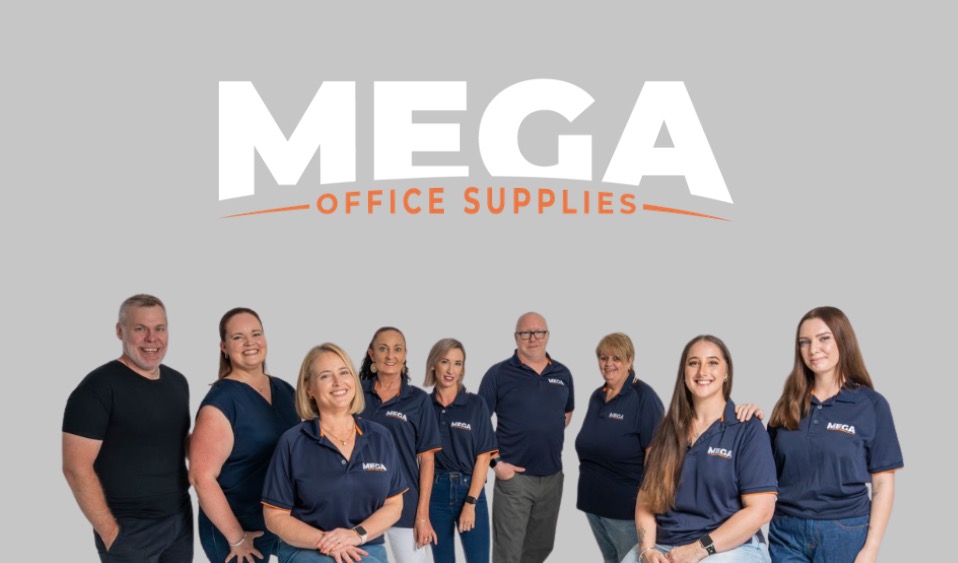
Mega Office Supplies Team
The Mega Office Supplies Team provides practical guidance for Australian businesses, schools, government organisations, healthcare providers, hospitality venues, warehouses and home offices. Based in Tweed Heads South, Mega Office Supplies is an Australian business, family owned and operated since 2008, offering office stationery, workplace furniture, technology products, labels, printers, cleaning and janitorial supplies, safety products, art materials, education resources and everyday business essentials from trusted brands.
General Information
This article is provided as general information only to help customers compare and choose office, workplace, school, cleaning, technology, furniture, safety and business supplies. Product details, specifications, compatibility, availability, pricing and suitability may vary. Always check the individual product page, manufacturer information, workplace requirements and relevant safety guidance before purchasing or using a product.


