

What if the most overlooked factor in your office's productivity is the physical hardware sitting on your shelves? Many Australian administrators and procurement officers have experienced the frustration of lever arch files that buckle under the weight of heavy documents or mechanisms that fail during a critical retrieval. It's a common pain point that disrupts the flow of a professional environment and leads to a cluttered, inconsistent workspace.
We understand that a reliable filing system is the backbone of any well-run business, school, or government department. This guide will help you master the technical specifications and material choices required to build a durable archive that lasts for years. We'll examine the differences between various board weights, explain why the 70mm capacity remains the industry standard for high-volume storage, and provide practical strategies for maintaining a uniform appearance across your shelves.
Key Takeaways
- Understand the technical distinction between heavy-duty lever arch files and standard binders to ensure your chosen system handles high-volume document retrieval without failure.
- Compare the durability and environmental impact of board, polypropylene, and PVC options to select the most appropriate material for your specific workplace environment.
- Learn how to accurately calculate sheet capacity by balancing spine width with paper weight (GSM) to prevent overfilling and file collapse.
- Implement professional indexing and colour-coding strategies to minimise retrieval times and maintain a uniform, organised appearance on your office shelves.
- Discover the logistical benefits of bulk procurement for large-scale operations in schools, medical centres, and corporate offices through reliable Australian suppliers.
What is a Lever Arch File? Defining the Standard for Document Archiving
A lever arch file is a professional grade, heavy duty binder specifically engineered for high volume document archiving. While standard O-ring or D-ring binders are suitable for light everyday use, lever arch files are built for the rigours of long term storage and frequent access. They are defined by a precision metal lever mechanism that eliminates the need to manually pull rings apart. This mechanical advantage makes them a staple within the broader range of office supplies found in Australian corporate, government, and medical environments.
To better understand the mechanical differences between these filing options, watch this helpful comparison:
The Lever Mechanism and Compressor Bar
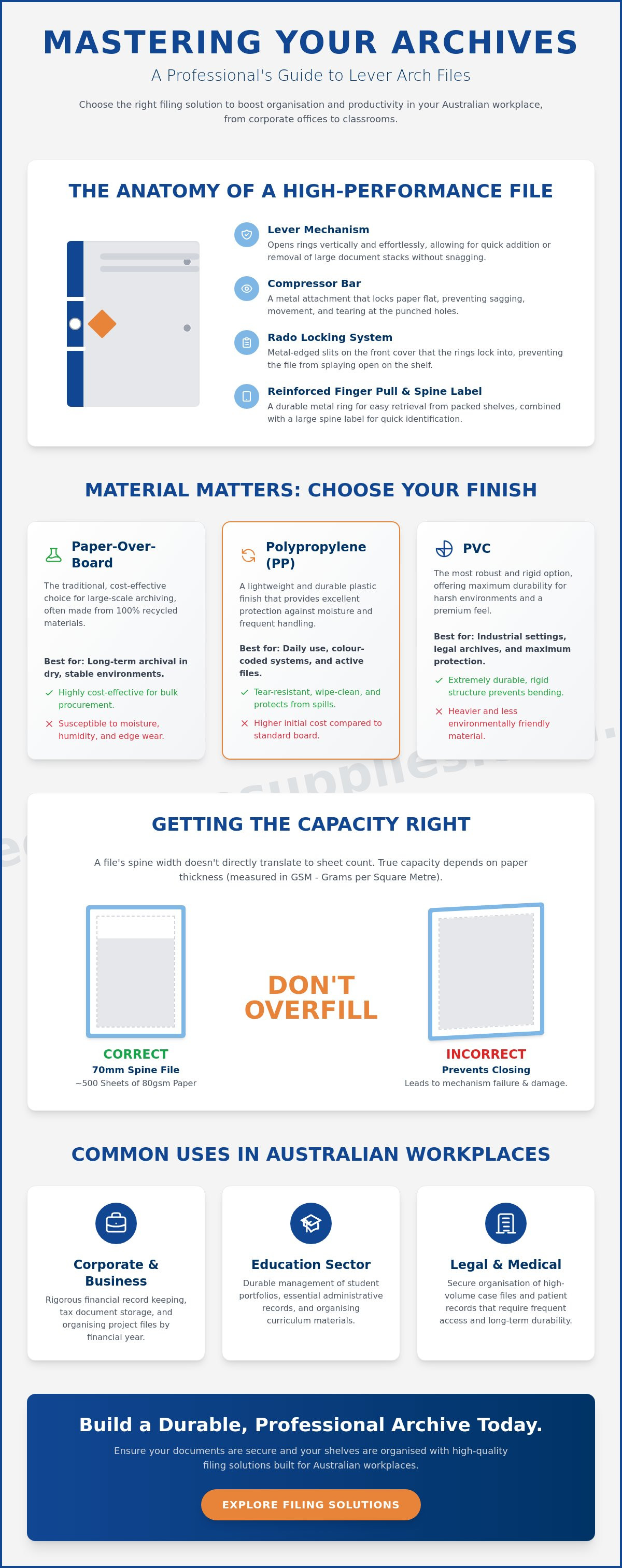
The core strength of these files lies in the internal hardware. The lever acts as a mechanical lift, opening the rings vertically to allow for large stacks of paper to be added or removed without snagging. A critical component is the compressor bar. This metal attachment slides over the rings and locks down onto the paper stack. It ensures documents remain flat and prevents them from sagging or tearing at the punched holes when the file is stored upright on a shelf.
Stability is further enhanced by the Rado locking system. These are the two metal-edged slits on the front cover that allow the rings to "lock" through the cover when the file is closed. This prevents the file from splaying open under its own weight. Additionally, the finger pull hole on the spine is a reinforced metal ring that allows you to easily slide a heavy file from a packed shelf. When combined with a large spine label for clear identification, these elements create a reliable system for any professional archive.
Common Use Cases in Australian Workplaces
These files are indispensable across various sectors. Small businesses rely on them for rigorous financial record keeping and tax document storage, usually organised by financial year. Within the educational supplies sector, teachers use them for student portfolio management where durability is essential for year-long use. Legal and medical professionals also prefer this format for case file organisation. The robust mechanism handles the frequent page turning and high paper volume required during daily consultations or court preparations. They provide a level of document security that lightweight binders simply cannot match.
Material Selection: Comparing Board, Polypropylene, and PVC Durability
Selecting the right material for your lever arch files is a logistical decision that directly impacts the longevity of your records. Australian offices typically choose between three primary finishes: paper-over-board, polypropylene (PP), and PVC. Each material serves a specific functional purpose, ranging from static archival storage to high-frequency document retrieval in industrial settings. While the initial procurement cost varies, the true value is found in matching the material to the frequency of use and the storage environment.
Paper Over Board and Mottle Files
Traditional mottle files remain a cornerstone of Australian record-keeping. These are easily identified by their distinct grey and black marbled pattern, often referred to as a "mottle" finish. They are the most cost-effective solution for bulk procurement, particularly for large-scale archives that must adhere to Australian Government standards for information management.
These files are often manufactured from 100% recycled board, making them a preferred choice for organisations prioritising recyclability. However, board-based files have limitations. They are susceptible to moisture and edge wear. In high-humidity regions such as Far North Queensland or the Northern Territory, untreated board can soften or warp over time. These are best reserved for archival storage where files are not handled on a daily basis.
Polypropylene (PP) and PVC Coated Files
For active files handled frequently, PP or PVC coated options offer superior structural integrity. These materials provide a wipe-clean surface, which is essential for healthcare settings, school staff rooms, or industrial environments where hygiene and spill-resistance are required. The coating acts as a barrier against dust and moisture, significantly extending the life of the file.
Professional grade coated files often include additional hardware features to prevent damage.
- Reinforced Metal Edges: A metal strip along the bottom edge prevents the board from splitting or scuffing when the file is pulled from a metal shelf.
- Tear Resistance: The plastic coating prevents the "dog-earing" of corners common in standard board files.
- Colour Coordination: Unlike mottle files, coated versions come in a broad spectrum of colours, facilitating more complex indexing systems.
While the upfront investment for polypropylene or PVC is higher than basic board, the long-term durability reduces the frequency of replacement. For teams managing high-volume archives, reviewing our range of professional grade filing solutions ensures your documents remain protected in any environment.
Calculating Capacity: Sizing Your Files for Efficient Storage
Achieving an efficient document archive requires more than just high quality hardware. It requires a technical understanding of volume and capacity. Procurement officers and office managers must calculate exactly how many lever arch files are required to house their documentation to avoid wasted shelf space or overstuffed mechanisms. While A4 is the standard format for most Australian business records, specialised sizes like A3 landscape for architectural plans or A5 for medical dockets serve specific niche requirements. Precision in sizing ensures your archive remains accessible and your documents stay pristine.
The primary variable in any capacity calculation is the weight of the paper being stored. Most manufacturers base their sheet counts on standard 80gsm stock. If your office utilises premium 100gsm or 120gsm A4 copy paper, you must reduce your expected sheet capacity by approximately 20% to 30%. Using thicker paper stock without adjusting your file count puts unnecessary pressure on the compressor bar and can lead to the rings misaligning over time.
Spine Width vs. Sheet Count
Understanding the relationship between spine width and sheet count is essential for logistical planning. A standard 70mm spine lever arch file typically holds between 375 and 450 sheets of 80gsm paper. This is the most common size for departmental filing. For high volume archives, an 80mm spine is the professional grade standard. These larger files can accommodate up to 500 or 600 sheets. You must never overfill these units. Forcing extra pages into a file prevents the Rado locking system from engaging properly, which causes the file to splay and damages the internal mechanism.
Standardising Your Shelf Space
Consistency is the key to a professional, uniform aesthetic. When setting up a new archive, standardise on a single spine width across each shelf. This prevents an uneven appearance and makes indexing much simpler. Before ordering, measure your shelf depth. Standard A4 lever arch files are approximately 285mm deep. Ensure your shelving can accommodate this without the files overhanging, which can lead to accidental damage in high traffic areas like warehouses or staff kitchens.
To calculate the total linear metres of shelving required for your project, divide your total estimated sheet count by the capacity of your chosen file, then multiply by the spine width. Many government and corporate departments refer to records management resources to help determine these storage requirements. This structured approach ensures you have sufficient office supplies on hand to complete your archiving project without interruption.
Organisational Strategies: How to Index and Colour-Code Your Archive
Establishing a systematic filing structure is the final step in creating a high functioning workplace archive. While the physical durability of your lever arch files protects the documents, the logical framework you implement determines how quickly that information can be retrieved. A disorganised shelf, even one filled with premium hardware, leads to lost time and administrative friction. By applying industrial grade indexing logic, you transform a simple row of binders into a precision information management tool.
Internal order is just as critical as external identification. Utilising heavy duty dividers allows you to sub-categorise large volumes of data within a single file. For documents that require frequent handling or must be kept in pristine condition, such as original contracts or certificates, sheet protectors are essential. These prevent the punched holes from wearing and protect the paper from oils and dust. When combined with a sturdy compressor bar, these accessories ensure your documents remain secure and orderly during every consultation.
Implementing a Colour-Coded System
Colour-coding is a powerful psychological tool that significantly reduces misfiling errors. By assigning specific colours to different departments, such as blue for Finance, red for HR, and green for Sales, you create an immediate visual map of your archive. This system allows staff to identify the correct section of the shelving from a distance, speeding up retrieval times in busy environments like medical centres or school administration offices.
For long term efficiency, consider using bright, high visibility colours for active files that require daily access. Conversely, neutral tones like black or grey mottle are ideal for closed archives or previous financial years. This visual distinction helps staff prioritise their search and ensures that current records aren't accidentally archived with legacy data. It’s a simple yet effective way to maintain a professional, organised appearance across high volume shelving units.
Indexing and Labelling Best Practices
The optimal labelling hierarchy for a professional archive follows the sequence: Year > Category > Sub-category. Using this structured approach ensures that any team member can locate a specific document without needing prior knowledge of the filing history. To maintain a uniform and authoritative look, always opt for printable spine labels rather than hand-written inserts. Printed labels offer superior legibility and don't fade or smudge over time, which is vital for records that must be kept for seven years or more.
Within the file itself, numerical or alphabetical dividers provide a secondary layer of organisation. In legal or medical environments, numerical indexing often corresponds to case or patient numbers, while alphabetical dividers suit client lists or supplier records. This tiered approach to organisation minimises the time spent leafing through pages and protects the integrity of the document stack. View our complete range of professional indexing and filing accessories to finalise your organisational system.
Procurement for Australian Workplaces: Sourcing Reliable Filing Solutions
Managing high-volume document archives requires a supply partner capable of matching your logistical demands with consistent product quality. Mega Office Supplies serves as a dependable partner for the professional stationery supplies Australia needs to maintain efficient, well-oiled workplaces. Whether you're outfitting a new medical centre or refreshing a departmental archive, sourcing the correct lever arch files in bulk ensures your system remains uniform and functional over the long term.
Bulk Ordering for Schools and Government
Large-scale rollouts, particularly for the start of the school year or the end of the financial year, require precise timing and logistical precision. Schools and government departments often need hundreds of matching files to maintain established organisational standards. Inconsistent supply from multiple vendors leads to mismatched spine widths and varying board qualities, which compromises the integrity of the archive. By centralising your procurement, you secure a consistent structural standard across all departments. Professional buyers can access rapid quoting for commercial-scale requirements, ensuring that project budgets are managed with full financial transparency and speed.
The Mega Office Supplies Advantage
The Mega Office Supplies advantage is built upon the decades of combined industry expertise held by our Australian team. We aren't a faceless global marketplace; we're a regional provider that understands the specific workflow and procurement cycles of Australian businesses. Our logistical prowess allows us to manage high-volume demands without friction, providing a single source for everything from technology and office stationery to breakroom supplies. We prioritise functional clarity and reliability, ensuring you receive professional-grade hardware that stands up to the rigours of a busy workplace.
A complete archiving solution often extends beyond the binders themselves. We provide a broad range of filing cabinets and high-capacity shelving units designed to house your lever arch files securely. This single-source approach minimises administrative overhead and ensures that your furniture and stationery are perfectly compatible. Our commitment is to provide hardworking, consistent solutions that value longevity, giving business owners the peace of mind that their physical records are protected by industrial-quality equipment and supported by local expertise.
Future-Proofing Your Professional Records
Mastering your physical archive requires a precise balance of technical hardware selection and logical organisation. By choosing the right materials, such as durable polypropylene for high-use files, and accurately calculating sheet capacity, you protect your documents from mechanical failure and splaying. A systematic approach to colour-coding and indexing ensures that your team can retrieve critical information without delay, maintaining the functional flow of your workspace.
Mega Office Supplies has been family owned and operated since 2008, dedicated to providing national delivery for the corporate, education, and government sectors. Our team ensures you receive the expert support needed for high-volume logistical demands. Whether you are outfitting a single home office or a multi-departmental government facility, we provide the stability and regional expertise you require.
Browse our full range of professional lever arch files to find the durable solution that fits your specific workplace environment. We look forward to helping you build a more efficient and organised workspace that stands the test of time.
Frequently Asked Questions
How many sheets of paper fit in a standard 70mm lever arch file?
A standard 70mm lever arch file typically accommodates between 375 and 450 sheets of 80gsm paper. This capacity varies depending on the thickness of the paper used. If you utilise heavier 100gsm stock, the sheet count will decrease accordingly. It's essential to avoid overfilling the file to ensure the compressor bar can lock securely and the rings remain aligned for long term use.
What is the difference between a lever arch file and a ring binder?
The primary difference lies in the opening mechanism and the overall capacity. Lever arch files use a metal lever to lift the rings, whereas ring binders require you to pull the rings apart manually. Additionally, lever arch files offer a much higher sheet capacity, often holding up to 500 sheets compared to the 100 to 200 sheet limit of standard O-ring or D-ring binders used in Australian offices.
Are lever arch files recyclable in Australia?
Recyclability depends on the materials used in construction. Standard mottle or board-based files are generally recyclable once the metal lever mechanism and any plastic components are removed. However, polypropylene and PVC coated files are more difficult to process through standard kerbside recycling. Many Australian businesses utilise specialised office waste programs to ensure these durable materials are disposed of according to local environmental guidelines.
What is the most durable material for a file used daily?
Polypropylene (PP) is the most durable material for files subjected to high-frequency handling. It provides a wipe-clean surface that resists moisture and tearing, making it superior to traditional board for daily use. For maximum longevity in industrial or healthcare settings, look for lever arch files with reinforced metal bottom edges. These prevent the board from splitting when the file is pulled from metal shelving repeatedly.
How do I stop papers from sagging or tearing at the holes?
Utilising the compressor bar is the most effective way to prevent document sagging. This metal attachment locks the paper stack flat against the rings, which minimises the weight placed on the punched holes when the file is stored vertically. For critical documents, using plastic sheet protectors provides an additional layer of reinforcement. These prevent the paper from tearing during frequent page turning and keep records in pristine condition.
Can I use A4 lever arch files for landscape documents?
Standard A4 lever arch files are designed for portrait documents. While you can punch the top edge of a landscape document to fit, the paper may overhang or sag if not properly supported. For large volumes of landscape records, it is better to source specialised A3 landscape files or A4 landscape variants. These are specifically engineered to house wider documents like architectural plans or spreadsheets without damaging the paper edges.
What is the Rado locking system on a lever arch folder?
The Rado locking system consists of two metal-edged slits on the front cover of the file. When the file is closed, the rings pass through these slits and lock into place. This mechanical feature provides structural stability, preventing the file from splaying open when it is full. It also ensures the file remains upright on the shelf, even when subjected to the weight of a heavy document stack.
How do I choose between a 2-ring and 4-ring filing system?
Lever arch files almost exclusively utilise a 2-ring system, which is the standard for high-volume archiving in Australia. This format allows for rapid document insertion and removal using standard two-hole punches. A 4-ring system is typically reserved for standard ring binders where extra security is needed to keep pages from shifting. For most professional archives, the 2-ring lever mechanism provides the best balance of speed and capacity.
Article by
Mega Office Supplies Team
The Mega Office Supplies Team provides practical guidance for Australian businesses, schools, government organisations, healthcare providers, hospitality venues, warehouses and home offices. Based in Tweed Heads South, Mega Office Supplies has been family owned and operated since 2008, offering office stationery, workplace furniture, technology products, labels, printers, cleaning and janitorial supplies, safety products, art materials, education resources and everyday business essentials from trusted brands.
General Information
This article is provided as general information only to help customers compare and choose office, workplace, school, cleaning, technology, furniture, safety and business supplies. Product details, specifications, compatibility, availability, pricing and suitability may vary. Always check the individual product page, manufacturer information, workplace requirements and relevant safety guidance before purchasing or using a product.


