

What happens to your operational flow when a depleted first aid kit or a lack of professional-grade cleaning chemicals brings a high-traffic warehouse to a sudden halt? It's often the smallest items on your facilities management supply checklist that cause the most significant friction when they're forgotten. Managing a complex site requires more than just a reactive approach; it demands a structured inventory that accounts for everything from stationery and toner to the latest WHS compliance standards. At Mega Office Supplies, family owned and operated since 2008, we help Australian organisations maintain the logistical flow necessary for peak performance.
You've likely felt the pressure of coordinating multiple vendors while trying to stay ahead of updated Workplace Exposure Limits or the mandated 1:50 first aider ratio for low-risk offices. We understand that maintaining a safe, organised environment shouldn't be a constant struggle against stockouts and procurement delays. This guide provides a comprehensive framework for auditing your current stores and establishing a standardised inventory list for every department. We'll examine the essential categories you need to monitor, including janitorial equipment, tea room supplies, and the specific PPE required to meet modern safety obligations.
Key Takeaways
- Learn to distinguish between hard and soft facilities management to ensure your daily operational consumables are never overlooked.
- Ensure your workplace remains compliant with current Australian WHS standards, including updated first aid kit requirements and safety ratios.
- Implement a comprehensive facilities management supply checklist to audit janitorial, safety, and kitchen inventory across all departments.
- Reduce administrative friction and procurement costs by consolidating your national supply chain through a single-source Australian partner.
- Optimise your storage and budget by selecting professional-grade cleaning concentrates and high-capacity paper products tailored for high-traffic environments.
Essential Facilities Management Supply Categories for Australian Workplaces
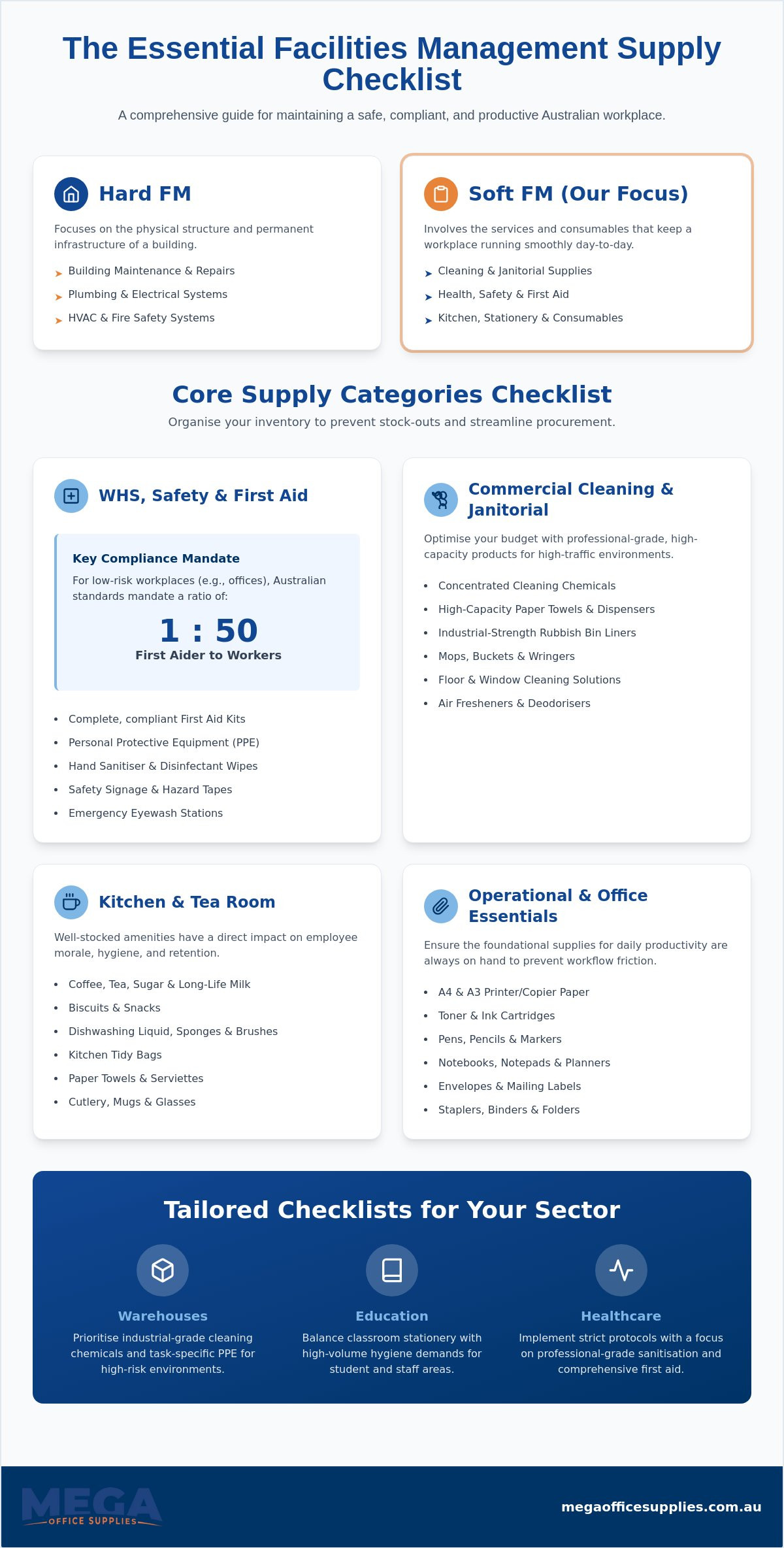
Effective Facility management in Australia requires a precise balance between maintaining physical assets and managing the daily needs of the workforce. While "hard FM" focuses on the physical structure and permanent infrastructure of a building, "soft FM" involves the services and consumables that keep a workplace running. A robust facilities management supply checklist acts as the blueprint for this soft FM layer. It ensures that procurement officers aren't constantly reacting to shortages, but rather maintaining a steady flow of essential goods. Centralising this process prevents "emergency" local purchases, which are often more expensive and lack the professional grade quality required for commercial use.
Organising your inventory into distinct categories is the most efficient way to manage high-volume demands. By grouping supplies into Safety, Hygiene, Kitchen, and Operational Stationery pillars, you can better track consumption rates and identify where budget leaks occur. This structured approach allows you to leverage a single-source partner for all your facility supplies, reducing the administrative burden of managing dozens of individual vendors. It's a method built on logistical clarity and the decades of experience we bring to the Australian market.
To better understand how to manage these inventories effectively, watch this helpful video:
The Role of Soft FM in Workplace Productivity
Consumable availability has a direct impact on employee morale and retention. When a staff kitchen lacks basic hygiene products or a receptionist runs out of toner, the resulting friction creates a ripple effect of inefficiency. Stock-outs in high-traffic environments like schools or medical clinics aren't just inconveniences; they disrupt essential services and can even compromise safety standards. Transitioning from a reactive ordering habit to a proactive, checklist-based system ensures that your facility remains a well-oiled operation. It provides peace of mind for administrators who value stability and regional expertise over flashy, unreliable marketing.
Sector-Specific Supply Considerations
Every Australian workplace has unique logistical requirements. In contrast, educational environments must balance classroom stationery needs with the high-volume hygiene demands of hundreds of students. Healthcare and hospitality sectors require even stricter protocols, with a focus on professional-grade sanitisation and comprehensive first aid supplies. Using a tailored facilities management supply checklist allows you to customise your inventory levels based on these specific environmental pressures, ensuring you always meet your compliance obligations without overstocking unnecessary items.
Workplace Health, Safety, and First Aid Compliance Supplies
Workplace Health and Safety (WHS) obligations in Australia have never carried more weight. With the first conviction for industrial manslaughter recorded in Queensland in March 2026, the necessity for a rigorous facilities management supply checklist extends far beyond simple housekeeping. It's a critical component of risk mitigation. Compliance requires a proactive procurement strategy that ensures safety hardware is always functional and accessible. Mega Office Supplies has been family owned and operated since 2008, supplying professional-grade workplace equipment.
Current Australian standards dictate specific first aider ratios that your inventory must support. For low-risk environments like standard offices or retail spaces, the mandated ratio is one first aider for every 50 workers. High-risk sectors like manufacturing, warehousing, or construction require one for every 25 workers. Your checklist must reflect these numbers, ensuring you have enough kits to cover every shift and every floor of your facility without compromise.
First Aid Kit Audit and Replenishment
A compliant first aid kit is only effective if its contents are sterile and within their use-by dates. We recommend a monthly audit for high-traffic sites and a quarterly check for smaller offices. Pay close attention to sterile items like bandages, eyewash solutions, and burn treatments, as these often have shorter shelf lives. You can streamline this process by sourcing pre-configured office first aid supplies that meet current Australian Standards. This ensures your organisation remains prepared for emergencies while maintaining a clear audit trail for WHS inspectors.
Safety Signage and Hazard Communication
Visibility is the cornerstone of hazard prevention. All signage should adhere to AS 1319, which defines the standard colours and symbols for Australian workplace safety. Faded or damaged signs don't just look unprofessional; they're a liability. For warehouses or outdoor areas, durability is essential. Many organisations now use high-quality laminating machines to create custom, heavy-duty safety notices that resist moisture and industrial wear. Keeping a stock of laminating pouches and specialised safety labels ensures you can update hazard communication the moment a new risk is identified.
PPE for maintenance staff must also align with the latest regulatory updates. From 1 December 2026, new Workplace Exposure Limits (WELs) for airborne contaminants will be adopted across Australia. This means your facilities management supply checklist must now account for higher-specification respiratory protection and industrial gloves. Floor safety also remains a priority. It's about more than just the "wet floor" sign; it requires a consistent stock of high-visibility hazard tape and professional-grade spill kits to manage risks in real time. To ensure your team is fully equipped for any hazard, consider reviewing our range of facility supplies designed for Australian industrial standards.
Commercial Cleaning and Janitorial Inventory Requirements
Maintaining a hygienic workplace is a high-volume logistical challenge. While many managers focus on the schedule of cleaning, the actual inventory required to execute those tasks is where most budgets fail. A comprehensive facilities management supply checklist must account for the specific chemical properties and physical durability of janitorial stock. This isn't just about surface-level appearance; it's about building health and operational efficiency. In Australia, the commercial cleaning sector generated $15.8 billion in 2023, with office cleaning making up 45% of that revenue. This scale demands a professional approach to procurement.
Selecting Cleaning Chemicals for Professional Use
Professional environments require more than domestic-grade solutions. Every chemical stored on-site must be accompanied by a current Safety Data Sheet (SDS) to comply with Australian WHS regulations. We're seeing a rapid adoption of integrated systems that use concentrated cleaning chemicals. These systems are significantly more cost-effective per litre than ready-to-use formulas and reduce the storage footprint in your facility. Whether you're managing a school or a high-traffic warehouse, sourcing commercial cleaning supplies in bulk ensures you maintain professional-grade standards without the friction of frequent stock-outs.
High-Volume Paper and Hygiene Consumables
Balancing cost-per-sheet with user experience is a primary concern for procurement officers. While 3-ply toilet paper offers superior comfort, many high-volume facilities find that 2-ply provides the necessary durability at a more sustainable price point. The key is the dispensing system; high-capacity dispensers reduce the frequency of refills and minimise waste. Hand sanitiser station placement is equally critical. To ensure maximum compliance, stations should be positioned at all entry points, near lift banks, and within common breakout areas. For soap and hand wash, bulk refill systems often provide better value for money, though sealed cartridge systems are preferred in healthcare settings to prevent cross-contamination.
Don't overlook the hardware that supports these consumables. A functional facilities management supply checklist includes heavy-duty bin liners, recycling separators, and dedicated sanitary disposal units. Janitorial hardware like ergonomic mops and multi-purpose trolleys are professional-grade tools that improve labour efficiency. Considering that labour costs account for 52% of total business expenses in the cleaning sector, providing the right hardware is a direct investment in reducing operational overhead. This structured approach to janitorial inventory ensures your facility remains safe, compliant, and cost-effective.
Kitchen, Tea Room, and General Office Operational Supplies
The kitchen and tea room are frequently dismissed as secondary concerns in facility management, yet they are essential for maintaining employee morale and the daily operational rhythm. A comprehensive facilities management supply checklist must integrate these areas alongside safety and janitorial categories to ensure a truly friction-free workplace. At Mega Office Supplies, we've observed that a well-stocked kitchen is often the difference between a productive team and one frustrated by minor, avoidable stock-outs. Managing this inventory requires a logistical mindset focused on volume and consistency.
Workplace Tea Room Essentials
Staff amenities are more than just a perk; they're a functional requirement for high-traffic environments. Bulk ordering coffee, tea, and long-life milk ensures that the administrative engine doesn't stall during peak periods. Beyond the beverages, hygiene in shared kitchen spaces is paramount. You need a steady supply of professional-grade dishwashing liquids, surface sprays, and paper towels to prevent the spread of illness and maintain a professional appearance. For a deeper dive into these requirements, consult our Coffee and Tea Supplies Guide.
Operational Stationery and Document Management
While hygiene and safety are critical, the administrative side of a facility requires its own dedicated inventory. A4 copy paper and toner cartridges are the high-volume staples that keep communications flowing. For organisations managing compliance documentation, document management is equally vital. High-quality lever arch files are indispensable for archiving WHS reports and audit trails in a way that remains accessible during inspections. You can learn more about optimising your filing systems in The Comprehensive Guide to Lever Arch Files.
Ergonomic basics also fall under the facility manager's remit. Ensuring that workstations are supported by appropriate chair mats and footrests helps prevent long-term physical strain, which is a key part of managing workplace hazards. By centralising these diverse categories into a single procurement stream, you reduce administrative overhead and ensure that no department is left wanting. It's about maintaining stability through regional expertise and reliable supply chains. To streamline your procurement today, explore our full range of office supplies and kitchen consumables.
Streamlining Your FM Procurement Strategy with Mega Office Supplies
Effective facility management is defined by the reliability of your supply chain. While software solutions can track maintenance tasks, they cannot deliver the physical hardware required to maintain a safe and productive environment. By aligning your facilities management supply checklist with a single-source provider, you eliminate the logistical friction of managing dozens of disparate vendors. At Mega Office Supplies, family owned and operated since 2008, we offer procurement advice grounded in the practicalities of Australian workplace maintenance. This regional expertise ensures that whether you're managing a single warehouse or a national network of clinics, your inventory remains consistent and compliant.
Government and Corporate Procurement Solutions
We understand the specific administrative requirements of the public sector and large-scale corporate entities. As a business that's been family owned and operated since 2008, we've built our operation to facilitate high-volume demands without the complexities of global competitors. We accept official Australian Government purchase orders, providing a streamlined path for schools and departments to secure essential supplies. For multi-site operations, we help develop customised supply lists that standardise inventory across every location, ensuring that a staff kitchen in Perth meets the same high standard as one in Brisbane.
Bulk ordering isn't just about financial transparency; it's about operational security. Establishing a business account through our business application form allows for rapid quoting and viewing. This is essential for professional buyers who need to evaluate costs and quantities quickly. This proactive approach reduces the administrative overhead associated with "emergency" local purchases and ensures that high-use consumables like A4 paper, cleaning chemicals, and first aid refills are always available when they're needed most.
Next Steps: Auditing Your Current Inventory
The first step toward a more organised workplace is a thorough audit of your current stores. Use your facilities management supply checklist to conduct your first facility audit, paying close attention to the updated WHS standards discussed in previous sections. Once your baseline is established, you can determine reorder points for every category:
- Safety: Check expiry dates on sterile first aid items and the condition of all AS 1319 signage.
- Hygiene: Evaluate the cost-efficiency of chemical concentrates versus ready-to-use formulas for high-traffic areas.
- Operational: Audit high-volume staples like toner and copy paper to prevent administrative downtime.
If you're unsure where to start, our specialists are available to assist with a comprehensive workplace supply audit. We provide the logistical prowess and volume required to keep your facility running like a well-oiled operation. Contact us today to discuss how we can support your national operations with stability and professional-grade precision.
Optimising Your Workplace Inventory for Long-Term Success
Maintaining a compliant and efficient workplace requires more than just reactive ordering; it demands a structured approach to every consumable. By implementing a robust facilities management supply checklist, you ensure that safety standards are met and operational downtime is minimised. We've explored how professional-grade cleaning concentrates, compliant first aid kits, and essential kitchen supplies form the foundation of a well-run facility. Transitioning to a proactive procurement model doesn't just save time; it provides the stability needed for high-volume demands.
Mega Office Supplies has been family owned and operated since 2008 and is a dependable partner for Australian organisations. We provide national delivery across all workplace sectors and are proud to be trusted by Australian Government departments. Our logistical scale and deep industry knowledge allow you to consolidate your procurement into one reliable stream, ensuring every department stays fully equipped. Establishing clear reorder points and professional standards now will provide security and peace of mind for your team.
Ready to optimise your stores? Download our full range of facility supplies and start your audit today. Taking control of your inventory is the most effective way to guarantee a safer, more organised workplace environment.
Frequently Asked Questions
What are the five main categories of a facilities management supply checklist?
The five primary categories for a comprehensive facilities management supply checklist include workplace safety, commercial hygiene, kitchen consumables, operational stationery, and ergonomic furniture. Each category addresses a specific layer of facility maintenance, from meeting WHS first aid requirements to ensuring the administrative engine has enough toner and paper. By grouping your inventory this way, you can better track consumption rates and streamline your procurement through a single-source Australian provider.
How often should a facility manager audit their first aid kits in Australia?
Facility managers should audit their first aid kits at least once every three months for standard offices, though monthly checks are recommended for high-risk environments like warehouses. These audits ensure that sterile items such as bandages and eyewash solutions haven't reached their expiry dates. Regular inspections also confirm that the kit contents still align with the mandated first aider ratios for your specific workforce size as required by Australian standards.
Is it better to buy cleaning chemicals in bulk or ready-to-use bottles?
Buying cleaning chemicals in concentrated bulk formats is generally more cost-effective and space-efficient than purchasing ready-to-use bottles. Concentrates allow your cleaning team to dilute the product as needed, significantly reducing the cost-per-litre and minimising plastic waste. This approach is particularly beneficial for high-traffic facilities like schools or clinics where chemical consumption is high and storage space in janitorial cupboards is often limited.
What safety signage is legally required for a commercial office in Australia?
Commercial offices must display standardised safety signs that comply with AS 1319 to denote fire exits, first aid locations, and potential hazards. These include green and white signs for emergency information and red and white signs for fire equipment or prohibition notices. It's essential to maintain high visibility by replacing faded or damaged signs immediately, as clear hazard communication is a foundational requirement of Australian workplace health and safety laws.
Do Australian Government departments need a specific account to order FM supplies?
Australian Government departments don't require a unique account type but can leverage official purchase orders for a streamlined procurement process. At Mega Office Supplies, family owned and operated since 2008, we facilitate these transactions, allowing schools and government agencies to secure facilities supplies without complex credit applications. This system supports financial transparency and ensures that essential inventory, from classroom stationery to bulk janitorial equipment, is delivered through a trusted domestic supply chain.
What are the essential kitchen supplies for a high-traffic staff tea room?
Essential supplies for a high-traffic tea room include bulk coffee and tea, long-life milk, professional-grade dishwashing liquid, and surface sanitisers. You should also maintain a steady stock of catering consumables like paper towels, napkins, and cutlery to support daily staff needs. Integrating these items into your facilities management supply checklist prevents the minor stock-outs that can negatively impact employee morale and disrupt the general flow of the workday.
How can I reduce the cost of high-volume consumables like A4 copy paper?
Reducing costs on high-volume consumables like A4 copy paper is best achieved through bulk procurement and standardising on a single paper weight for the entire facility. Ordering by the pallet or half-pallet reduces the individual ream price and minimises the administrative costs associated with frequent, smaller orders. Additionally, using high-capacity toner cartridges and setting printers to double-sided defaults can further lower your total cost of ownership for document management supplies.
What is the difference between domestic and commercial-grade office furniture?
Commercial-grade office furniture is engineered for constant use and features higher weight ratings and longer warranties than standard domestic products. While domestic furniture is suited for light home use, commercial chairs and desks must withstand the rigours of a professional environment where they're used for eight or more hours daily. Investing in commercial-grade equipment ensures better ergonomic support for your team and reduces the frequency of replacements, providing better long-term value for money.
Article by
Mega Office Supplies Team
The Mega Office Supplies Team provides practical guidance for Australian businesses, schools, government organisations, healthcare providers, hospitality venues, warehouses and home offices. Based in Tweed Heads South, Mega Office Supplies is an Australian business, family owned and operated since 2008, offering office stationery, workplace furniture, technology products, labels, printers, cleaning and janitorial supplies, safety products, art materials, education resources and everyday business essentials from trusted brands.
General Information
This article is provided as general information only to help customers compare and choose office, workplace, school, cleaning, technology, furniture, safety and business supplies. Product details, specifications, compatibility, availability, pricing and suitability may vary. Always check the individual product page, manufacturer information, workplace requirements and relevant safety guidance before purchasing or using a product.


