


What if the most expensive paper in your stationery cupboard is actually the primary cause of your office's recurring printer maintenance costs? It's a common frustration for procurement officers who want the best for their organisation but end up facing constant paper jams and ink bleed-through on double-sided reports. This paper gsm guide is designed to eliminate that guesswork, drawing on decades of industry experience to help you navigate the technical specifications required for a high-functioning Australian workplace.
This guide empowers you to master the technical standards of paper weight to ensure every document reflects professional quality and operational efficiency. By understanding the specific needs of different workplace environments, you can stop wasting budget on premium stock for internal drafts and start choosing the right weight for every task. We'll provide a clear framework for bulk ordering, detailed use cases for various gsm ranges, and practical tips to keep your office hardware running without friction.
Key Takeaways
- Understand that GSM stands for grams per square metre, a technical measurement that determines the weight and density of your office stationery.
- Use this paper gsm guide to differentiate between standard 80gsm copy paper for internal drafts and premium 300gsm stock for high-impact professional proposals.
- Learn how to select specific paper weights for diverse Australian workplaces, from durable stocks for warehouse manifests to elegant finishes for healthcare reception desks.
- Optimise your procurement strategy by standardising paper weights across your organisation to minimise budget waste and reduce common printer maintenance issues.
- Discover why surface finish and paper density are just as critical as the GSM rating when evaluating professional-grade documents for bulk procurement.
Understanding Paper GSM: The Professional Standard for Australian Workplaces
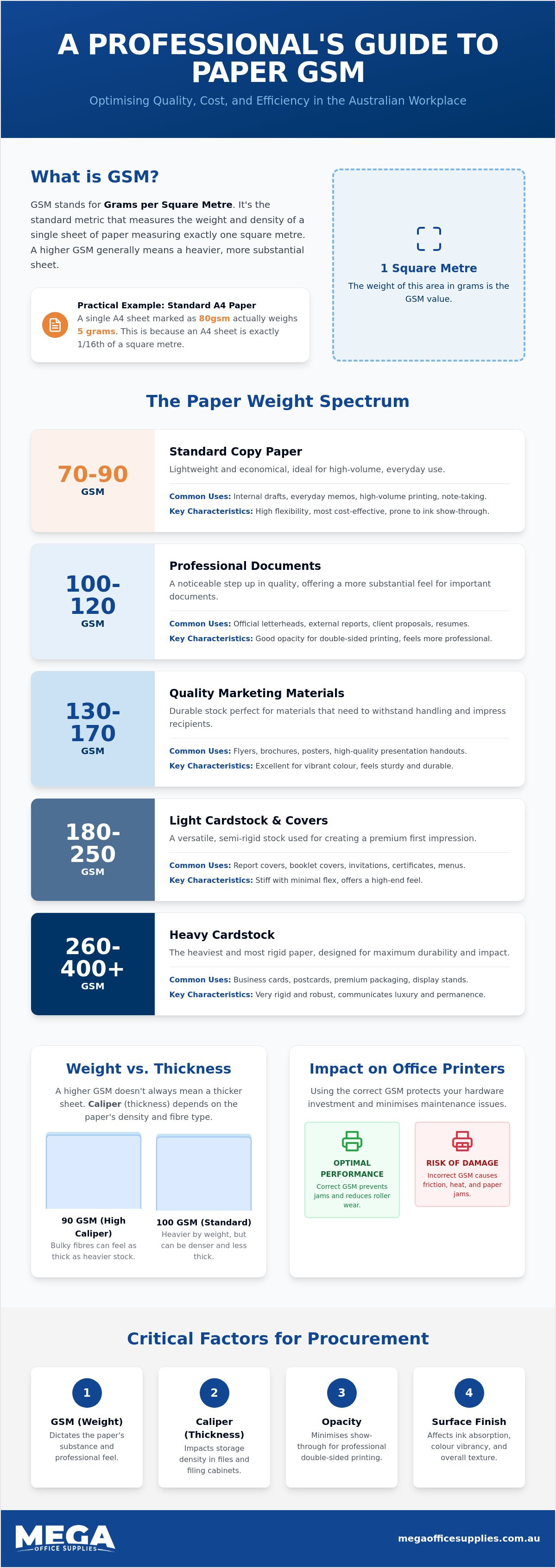
GSM is the standard metric used across the Australian paper industry to define the weight and density of a sheet. This paper gsm guide provides the technical foundation needed to make informed purchasing decisions for any professional environment. GSM stands for Grams per Square Metre, a measurement that refers to the weight of a single sheet of paper measuring exactly one square metre. When you see a ream of standard A4 copy paper marked as 80gsm, it doesn't mean the individual sheet weighs 80 grams. Instead, it indicates that if you were to assemble enough A4 sheets to cover a one square metre area, that total mass would equal 80 grams.
Since an A4 sheet is exactly 1/16th of a square metre, a single 80gsm sheet actually weighs approximately 5 grams. This distinction is important for logistics and procurement. Understanding this metric allows you to calculate the total weight of bulk shipments or the stress placed on shelving units. For high-volume environments, this knowledge prevents infrastructure damage and ensures workplace safety during stock handling.
To better understand this concept, watch this helpful video:
For procurement officers and business administrators, Understanding Paper GSM is vital for maintaining a consistent corporate image. Higher GSM values generally equate to a more opaque and substantial sheet, which prevents the unprofessional see-through effect often found in budget internal drafts. Standardising your office on specific weights, such as 80gsm for general use and 100gsm for external correspondence, simplifies the inventory process. This approach is particularly effective for those managing Australian Government official purchase orders, where consistency and transparency in stationery spend are mandatory.
GSM vs. Caliper: Weight Does Not Always Equal Thickness
While GSM measures weight, caliper refers to the actual thickness of the paper in microns. It's a common misconception that a higher weight always produces a thicker sheet. Some manufacturers use specific pulping processes to create bulky fibres, allowing a 90gsm sheet to feel as thick as a standard 100gsm alternative. This distinction is critical when managing storage; thicker paper reduces the capacity of your lever arch files and filing cabinets, potentially increasing your spend on storage solutions. Always check both specifications if your primary concern is filing density rather than sheet weight.
Why GSM Matters for Modern Office Machinery
The Paper Weight Spectrum: From Standard Copy to Heavy Cardstock
Selecting the correct stock requires more than just a cursory glance at the price per ream. This paper gsm guide identifies the specific thresholds where paper transitions from a flexible sheet to a rigid board. As weight increases, flexibility decreases while opacity improves. This relationship is fundamental for double-sided printing; lower weights often suffer from "show-through" where text from the reverse side interferes with legibility.
Everyday Office Weights: 80gsm to 100gsm
The 80gsm sheet is the workhorse of the Australian office. It provides the ideal balance for high-volume copying and internal drafting where cost-per-page is the primary metric. Stepping up to 90gsm offers a noticeably smoother surface, making it the professional choice for external correspondence and standard reports that require a cleaner finish. For premium letterheads and client-facing documents, 100gsm is the preferred standard. It provides a substantial hand-feel that signals quality without adding excessive bulk to your filing systems.
Premium Presentation and Marketing: 120gsm to 200gsm
When your output moves beyond standard documentation into marketing collateral, the weight must increase to match the intent. Paper in the 120gsm to 150gsm range is ideal for brochures, flyers, and professional presentation covers. These weights offer excellent durability and a high level of opacity. Once you reach 170gsm to 200gsm, you're dealing with heavyweight paper that resists creasing. If you plan on folding paper over 150gsm, you must score the sheet first. Scoring creates a precise indentation that prevents the paper fibres from cracking, ensuring your marketing materials maintain a professional appearance.
Heavy Duty Card and Covers: 210gsm to 400gsm
The transition to cardstock begins around 210gsm. This range, extending up to 300gsm, is the standard for invitations, menu covers, and sturdy dividers. For premium business cards, 350gsm is the industry "go-to" weight in Australia, providing the rigidity expected in professional networking. Luxury branding may even require 400gsm stock. Before procurement, verify your hardware specifications. Most standard office multifunction devices can handle up to 250gsm through the manual bypass tray, but heavier stocks may require specialised office technology supplies designed for high-capacity media handling. High-volume environments benefit from standardising these weights to ensure consistent output quality across all departments.
Selecting the Right GSM for Your Specific Industry and Use Case
Selecting the correct paper weight is a strategic decision that directly impacts operational efficiency and professional perception. Different Australian sectors have unique requirements that dictate which GSM is most appropriate for their daily workflows. These requirements are underpinned by the ISO 536: international paper weight standard, which ensures that procurement officers receive a consistent product regardless of the manufacturer. By applying this paper gsm guide to your specific industry, you can ensure that your documentation is both fit for purpose and cost-effective.
Corporate and Government Documentation
Consistency is the primary goal for administrative hubs. Most organisations standardise on 80gsm for bulk A4 copy paper to ensure reliable performance in high-volume multifunction devices. This weight is ideal for internal drafts and general memos. However, for official government purchase orders or legal contracts, a shift to 100gsm is often necessary. This heavier stock provides the durability required for frequent handling and long-term archival storage. When these documents are eventually stored in lever arch files, a higher GSM prevents the punch holes from tearing over time, maintaining the integrity of your records.
Educational and School Environments
In high-traffic learning environments, paper must withstand significant wear and tear. One of the most common issues in schools is ink bleed-through on double-sided worksheets. Selecting educational supplies such as exercise books with a minimum of 70-80gsm helps prevent student pens from marking the reverse side. Classroom posters and teaching aids require even more substance, typically falling into the 200gsm+ category for better longevity. For the art room, standard copy paper is insufficient. Students working with watercolours or heavy ink require 120gsm or higher to prevent the paper from warping or disintegrating when wet.
Logistics, Warehousing, and Facility Management
Industrial settings prioritise durability over aesthetic finish. Warehouse bin labels and safety signage need to remain legible in harsh conditions, making 160gsm+ cardstock the preferred choice. While standard 80gsm paper is perfectly adequate for picking slips and high-volume dispatch notes that are discarded after use, permanent signage requires more protection. You can further enhance the durability of your printed materials by using facility supplies like laminating machines. This combination of the correct GSM and a protective finish ensures that safety protocols and location markers remain intact in busy warehouse environments. This targeted approach to procurement ensures that every department has the right tools without overspending on unnecessary premium stocks.
Critical Factors to Evaluate When Comparing Paper Specifications
While this paper gsm guide establishes weight as a primary metric, it isn't the sole indicator of document quality. Professional clarity also depends on whiteness and brightness ratings, which determine how sharply text contrasts against the page. Whiteness is typically measured using the CIE (Commission Internationale de l'Éclairage) scale; a higher number indicates a "whiter" appearance. For premium reports, look for CIE ratings above 160 to ensure your graphics and text appear crisp and authoritative. When evaluating different brands within the office technology supplies category, you must consider how these technical specs interact with your specific printer hardware.
Coated vs. Uncoated Stocks
Most Australian offices standardise on uncoated stocks because they're the most versatile for daily tasks. Uncoated paper has a porous surface that's easy to write on with professional pens, as the ink absorbs directly into the fibres. Conversely, coated stocks like silk or gloss have a surface layer that prevents ink absorption, which is excellent for high-resolution images but difficult for standard ballpoint pens. Coating adds weight (GSM) without necessarily adding thickness; a coated 130gsm sheet might feel thinner than an uncoated 100gsm sheet due to the density of the clay layer.
Opacity and Double-Sided Printing
Opacity is the critical factor for organisations looking to reduce paper consumption through double-sided printing. Many budget 80gsm "economy" reams have low opacity, leading to "ghosting" where text from the reverse side is visible. This compromises the professional look of your reports. Moving to a 90gsm or 100gsm stock significantly improves opacity, allowing for clean double-sided output. From a procurement perspective, investing in a slightly higher GSM for double-sided use often proves more cost-effective than continuing to print single-sided on cheaper, thinner paper. This approach reduces the total number of sheets used while improving the final document's hand-feel.
Sustainability and Recycled Content
Recycled paper has evolved significantly, and modern stocks now match the performance of virgin fibre in high-speed laser printers. While recycled fibres can sometimes result in a slightly lower whiteness rating or a unique texture, high-grade options maintain excellent consistency. For Australian procurement policies, look for Forest Stewardship Council (FSC) or Program for the Endorsement of Forest Certification (PEFC) logos. These certifications ensure the paper meets strict environmental and social standards. To ensure your office hardware is compatible with your chosen stock, browse our comprehensive range of office technology supplies to find the right match for your printer's specifications.
Use this checklist when comparing bulk paper options:
- GSM Rating: Match the weight to the document's intended use.
- CIE Whiteness: Aim for higher numbers for external correspondence.
- Opacity Percentage: Ensure it's high enough for double-sided printing.
- Surface Finish: Choose uncoated for writing and coated for image-heavy flyers.
- Environmental Certification: Verify FSC or PEFC status for sustainable procurement.
Ready to upgrade your document quality? Select the ideal paper weight for your next project.
Procurement Strategies for High-Volume Office Paper Supplies
Managing high-volume paper procurement requires a balance of logistical precision and technical understanding. While earlier sections of this paper gsm guide focused on the physical properties of the sheet, the efficiency of your supply chain depends on how you manage acquisition and inventory. For most Australian businesses, calculating annual needs starts with a baseline of approximately 10,000 sheets per employee, though this figure often doubles in the legal, healthcare, and education sectors. Standardising your organisation on two primary weights, such as 80gsm for general tasks and 100gsm for external documents, simplifies the ordering process and ensures a consistent professional image across all departments.
To streamline your procurement and access volume-based rates, consider completing a business application form to establish a corporate account. This allows for more structured budgeting and provides a clear audit trail for administrative staff. Standardising your stationery also reduces the risk of incorrect media being loaded into high-speed machines, which is a frequent cause of preventable service calls.
Bulk Ordering and Cost Management
Large Australian offices must evaluate the logistics of pallet versus carton ordering. A standard pallet typically contains 40 to 48 cartons, offering the lowest price-per-ream for high-volume users. When evaluating value for money, look beyond the initial purchase price. Cheaper, low-GSM paper often lacks the structural integrity required for high-speed laser printing, leading to increased machine downtime and wasted staff hours. Investing in a reliable 80gsm sheet that meets international standards often proves more cost-effective than the cheapest available alternative once maintenance costs are factored in.
Storage and Environmental Control
Paper is a hygroscopic material, meaning it absorbs moisture from the surrounding air. In humid Australian climates, incorrect storage leads to "curling," which is a primary cause of paper jams. Always store reams in their original moisture-barrier wrappers until the moment they're needed. Best practice dictates that paper should be stored off the floor in a temperature-controlled environment. For optimal performance, acclimatise your paper by moving it to the printer room at least 24 hours before use. This allows the fibres to stabilise to the specific temperature and humidity of the printing environment.
Streamlining Your Supply Chain
Consolidating your paper orders with other office supplies reduces delivery overheads and simplifies the accounts payable process. For public sector entities, using Australian Government purchase orders ensures compliance with procurement regulations while speeding up fulfilment. Relying on a single-source supplier ensures that national office fit-outs maintain a uniform standard of quality and logistical efficiency across every regional branch. This integrated approach to procurement allows you to focus on core operations while maintaining a well-stocked and efficient workplace.
Optimising Your Workplace Stationery Procurement
Mastering the technical specifications of your office paper is a direct investment in your organisation's operational efficiency. By implementing the standards outlined in this paper gsm guide, you can eliminate common workplace pains like recurring printer jams and unprofessional document ghosting. Standardising your inventory on specific weights for internal drafts and client-facing proposals ensures a consistent brand image while significantly reducing budgetary waste. Proper environmental control and strategic bulk ordering further protect your assets and streamline your daily workflow.
Mega Office Supplies brings over two decades of combined industry expertise to every order. As an Australian family-owned and operated business, we provide reliable national delivery for corporate and government sectors across the country. Whether you're managing a local home office or high-volume government procurement, our team is equipped to handle your demands without friction.
Take the next step in professionalising your document output. Browse our comprehensive range of professional office paper stocks to find the perfect weight for your specific workplace needs. Equip your office with the reliable materials required for consistent, high-quality results every day.
Frequently Asked Questions
What is the most common paper GSM for Australian offices?
The industry standard for high-volume Australian office environments is 80gsm. This weight provides the most reliable performance for standard laser printers and photocopiers while remaining the most cost-effective option for bulk procurement. It's the primary choice for internal drafting, memos, and general documentation across the corporate and government sectors.
Can my standard office printer handle 300gsm cardstock?
Most standard office multifunction devices cannot process 300gsm cardstock through internal paper trays. These machines are typically rated for a maximum of 220gsm to 250gsm, usually requiring the use of a manual bypass tray. Attempting to run 300gsm through standard rollers often leads to severe mechanical jams or long-term damage to the fuser unit.
Does a higher GSM always mean the paper is better quality?
Higher GSM indicates greater weight and density, but it doesn't automatically equate to superior quality. Professional document clarity depends on a combination of weight, brightness, whiteness, and surface finish. A 100gsm sheet with a low whiteness rating may appear less professional than a high-grade 80gsm sheet with a crisp, clean finish.
Why does my 80gsm paper jam more often in winter?
Paper jams increase during winter due to static electricity and humidity fluctuations in the workplace. Cold, dry air creates static between sheets, causing them to feed into the machine in multiples. Additionally, paper stored in unheated areas absorbs moisture; when this damp paper hits the hot rollers of a laser printer, it curls and causes an immediate obstruction.
Which GSM should I use for professional business cards?
350gsm is the standard weight for premium business cards in Australia. This weight provides the rigidity and durability expected in professional networking environments. While 300gsm is a functional alternative for temporary cards, it lacks the substantial hand-feel and professional authority that a 350gsm cardstock delivers.
What is the best GSM for double-sided colour printing?
The ideal range for double-sided colour printing is 100gsm to 120gsm. These weights offer the high opacity required to prevent "ghosting" where images or text from the reverse side are visible through the sheet. This paper gsm guide recommends 120gsm for high-stakes proposals to ensure your graphics maintain their impact without interference from the back of the page.
Is there a difference between GSM and paper thickness?
There is a distinct technical difference between weight and thickness. GSM measures the mass of the paper, while thickness, known as caliper, measures the height of a single sheet in microns. Two different paper brands can share the same 100gsm rating but have different thicknesses because of variations in fibre density and the specific manufacturing process used.
How many sheets are typically in a ream of 80gsm A4 paper?
A standard ream of 80gsm A4 copy paper contains exactly 500 sheets. For bulk procurement and logistics planning, a standard carton typically holds five reams, totalling 2,500 sheets. Knowing these quantities allows procurement officers to calculate annual usage precisely based on staff headcount and sector-specific document volume.
Article by
Mega Office Supplies Team
The Mega Office Supplies Team provides practical guidance for Australian businesses, schools, government organisations, healthcare providers, hospitality venues, warehouses and home offices. Based in Tweed Heads South, Mega Office Supplies is a family-owned and operated Australian business offering office stationery, workplace furniture, technology products, labels, printers, cleaning and janitorial supplies, safety products, art materials, education resources and everyday business essentials from trusted brands.
General Information
This article is provided as general information only to help customers compare and choose office, workplace, school, cleaning, technology, furniture, safety and business supplies. Product details, specifications, compatibility, availability, pricing and suitability may vary. Always check the individual product page, manufacturer information, workplace requirements and relevant safety guidance before purchasing or using a product.


