

Could your choice of stationery be undermining your professional reputation before a client even reads the first sentence? It's a common frustration for procurement officers and business owners to find that a "premium" document looks translucent and cheap, or that a heavy-duty stock has caused another expensive jam in the office photocopier. Understanding exactly what is gsm paper is the first step toward eliminating these logistical headaches and ensuring your printed materials reflect the quality and stability of your organisation.
We agree that selecting the right paper shouldn't feel like a guessing game or a drain on your budget. This professional guide provides the functional clarity you need to select the perfect weight for every workplace application. You'll discover exactly how grams per square metre affects opacity and durability, allowing you to balance cost-efficiency with high-impact communication. We will examine standard industry weights, clarify the technical distinction between thickness and density, and provide a clear framework for choosing the right grade for everything from internal drafts to external corporate reports.
Key Takeaways
- Learn the technical definition of what is gsm paper and how this standard metric determines the weight and density of every sheet in your stationery cupboard.
- Identify the ideal applications for standard 80gsm copy paper versus premium 120gsm stocks to ensure your documents always project the right professional image.
- Understand how surface finishes and coatings alter the perceived thickness and texture of paper, even when the grams per square metre remain identical.
- Protect your office hardware by matching paper weights to printer specifications and using the correct bypass tray for heavier specialty stocks.
- Streamline your procurement process by standardising paper weights across your organisation to minimise waste and simplify bulk ordering.
Defining GSM: The Universal Metric for Paper Weight
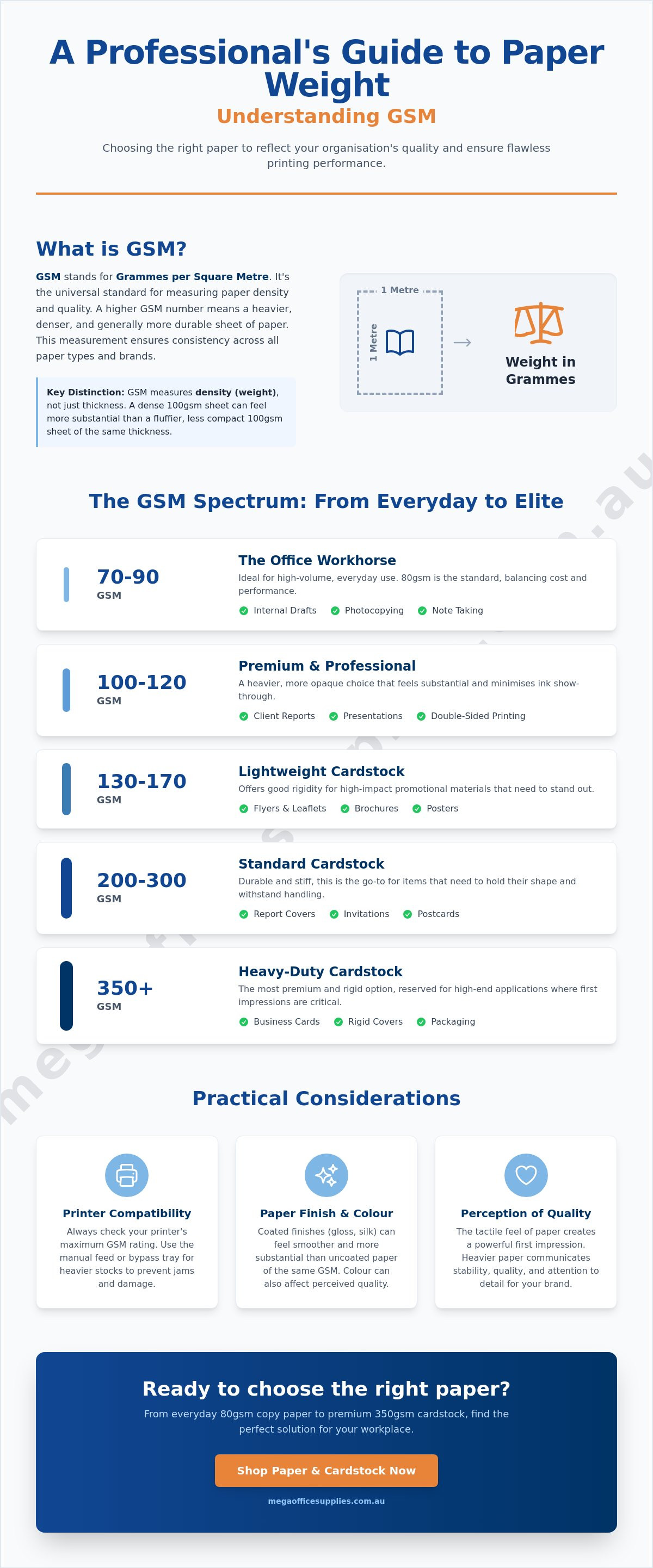
When procurement officers or office managers ask what is gsm paper, they're looking for a reliable way to standardise their stationery orders. GSM is the industry standard acronym for grammes per square metre. This metric provides a consistent measurement by calculating the weight of a single sheet of paper if it were cut to exactly one square metre. While many people confuse weight with thickness, the industry relies on Grammage (GSM) because it accounts for the actual density of the paper fibres rather than just the physical height of the sheet. This distinction is critical because two sheets can have the same thickness but different weights based on how tightly the fibres are packed during manufacturing.
To gain a clearer visual understanding of these measurements, watch this helpful video:
Using weight instead of caliper (thickness) ensures that a ream of paper will perform predictably in your office equipment. A higher GSM indicates a denser sheet with greater opacity, which is essential for preventing ink from bleeding through to the reverse side. For high-volume environments like government departments or large schools, sourcing reliable office supplies means understanding this correlation to minimise paper waste and prevent the frustration of poor-quality print jobs.
The Science of Grammage
In a laboratory setting, technicians weigh paper under controlled humidity and temperature to ensure every batch meets exact specifications. This consistency is vital for high-speed commercial printing and folding machines found in modern Australian mailrooms. Unlike the North American "Basis Weight" system, which varies significantly depending on the original sheet size, the GSM system is universal and logical. This allows local businesses to compare products accurately across different brands and suppliers, ensuring that a 100gsm sheet from one manufacturer performs identically to a 100gsm sheet from another. Consistent grammage prevents the mechanical errors that occur when machinery expects a specific resistance that the paper fails to provide.
Perception of Quality in Professional Correspondence
The tactile "snap" of a document often provides the first impression of your organisation's attention to detail. Heavier paper feels more substantial and carries an inherent sense of authority that thin, flimsy sheets lack. In professional environments, GSM serves as a silent brand ambassador that communicates stability and reliability through a simple physical touch. When you select a higher weight for double-sided reports in a law firm or medical clinic, you also reduce "show-through." This ensures that text on the back doesn't interfere with the readability of the front, maintaining a clean and professional appearance. Choosing the right weight for your daily stationery ultimately protects your brand's reputation for quality and precision.
The GSM Spectrum: From Daily Drafts to Premium Cardstock
Understanding the full spectrum of available weights is just as critical as knowing what is gsm paper. Paper weights typically range from a thin 60gsm used for newsprint up to a rigid 450gsm for heavy-duty covers. For the average Australian workplace, most requirements fall within the 80gsm to 350gsm range. Selecting the correct point on this spectrum allows you to control the tactile quality of your communication while managing the logistical practicalities of printing and storage.
Standard Office Paper (70gsm - 90gsm)
The 80gsm sheet is the undisputed workhorse of the Australian office. It's the global standard for high-volume photocopying and laser printing because it offers the best balance between cost, opacity, and mechanical reliability. While 70gsm "economy" paper exists, it often presents trade-offs that can increase long-term costs. These thinner sheets are more prone to double-feeding and paper jams in modern high-speed machines. They also suffer from significant show-through, making them unsuitable for double-sided printing. Stick to 80gsm for your everyday internal drafts, basic filing, and note-taking to ensure your equipment runs without friction.
Commercial and Marketing Weights (100gsm - 200gsm)
When documents leave your office to face a client, the weight should increase. 100gsm is widely considered the "professional feel" threshold for external letterheads and formal reports. This slight increase in density provides a noticeable improvement in whiteness and smoothness. For brochures and high-quality marketing collateral, mid-weight stocks between 150gsm and 200gsm are ideal. These heavier sheets provide the durability required for long-term storage in lever arch files and presentation folders. They offer excellent opacity, ensuring that full-colour graphics don't bleed through and ruin the professional aesthetic of your layout.
Cardstock and Heavy Media (210gsm - 400gsm)
Cardstock is defined by its rigidity and is essential for free-standing marketing materials like menus or table tents. Business cards require a minimum of 300gsm to avoid feeling flimsy or unprofessional in a recipient's hand. When working with these heavier grades, you must consider the physical limitations of your hardware. Commercial printers often have specific limits, so checking printer compatibility for different paper weights is a necessary step before starting a large production run. It's also vital to score heavy paper before folding. Scoring creates a controlled indentation that prevents the paper fibres from cracking and creating unsightly jagged edges along the fold line.
Evaluating your specific needs against this spectrum ensures you don't overspend on internal drafts while maintaining a high standard for client work. You can source all these varieties through our comprehensive range of office supplies.
Coated vs Uncoated: How Finishes Affect Perceived Weight
While we have established that The Universal Metric for Paper Weight is the standard for measurement, the surface finish of a sheet drastically changes how that weight is perceived in the hand. A common point of confusion for procurement officers is why two different reams with the same grammage feel nothing alike. When you ask what is gsm paper in a professional context, you must also account for the physical compression of the fibres. Coated papers are compressed more tightly during the manufacturing process to create a smooth surface. Consequently, a 150gsm coated sheet will often feel significantly thinner and less rigid than a 150gsm uncoated sheet of the exact same weight. This distinction is vital for ensuring your finished documents match your expectations for "heaviness" and quality.
The Uncoated Advantage
Uncoated paper is the standard for stationery supplies Australia uses for daily correspondence and administrative tasks. Because the fibres remain raw and untreated, the paper retains a slightly textured, organic feel that many organisations associate with prestige and authenticity. The primary benefit of uncoated stock is its superior writability. The porous surface allows ink from pens and stamps to soak into the fibres and dry almost instantly. This makes it the essential choice for letterheads, forms, and any documents that require a physical signature or manual notes in a busy office or school environment.
Coated Stocks: Gloss, Silk, and Matte
Coated stocks involve the application of a clay or polymer layer to fill the microscopic gaps between the paper fibres. This creates a non-porous surface where ink and toner sit on top of the sheet rather than being absorbed. This results in sharper images and more vibrant colours, which is why coated stocks are the preferred choice for marketing materials. Gloss finishes provide the most striking visual impact, but they can be difficult to read under bright office fluorescent lights due to glare. Silk or satin finishes offer a smoother touch without the high reflection, providing a modern and sophisticated aesthetic.
Matte coating serves as the professional compromise for high-end corporate reports and catalogues. It provides the ink-holdout benefits of a coated sheet while maintaining a non-reflective surface that is easy on the eyes during long periods of reading. When selecting your paper, remember that the finish doesn't just change the look; it alters the tactile density. If you want the thickness of a 150gsm uncoated sheet but prefer a coated finish, you may need to increase your order to 170gsm or 200gsm to achieve a similar level of rigidity. Balancing these factors ensures your printed materials feel as substantial as they look.
Practical Considerations: Printer Compatibility and Machinery
Selecting the right stock involves more than just tactile preference. It requires a technical understanding of your hardware's limitations. Every office printer and photocopier has a maximum grammage rating specified by the manufacturer. Exceeding this limit leads to mechanical strain and immediate operational downtime. When procurement teams ask what is gsm paper, they should also be asking what their specific machines can actually digest. Loading 300gsm cardstock into a tray designed for 80gsm copy paper is a recipe for expensive repair bills.
A fundamental rule for any workplace is the "bypass tray" requirement. Standard paper drawers use a complex series of tight internal rollers to flip and guide sheets. Heavy stock is too rigid for these curved paths. Using the bypass tray provides a flatter, more direct route through the machine, which is essential for anything over 120gsm. Additionally, environmental factors like moisture play a significant role. Paper is hygroscopic, meaning it absorbs water from the air. In humid Australian climates, stored paper can increase in effective weight and become limp, leading to misfeeds even if the original GSM was correct.
Avoiding the Dreaded Paper Jam
Thick paper struggles to navigate the internal architecture of standard desktop units. If the sheet is too dense, the rollers cannot grip it effectively, or the leading edge catches on internal sensors. Grain direction is another overlooked factor. Paper is easier to bend along the grain than against it. When printing on high-GSM cardstock, ensuring the grain runs parallel to the rollers can be the difference between a successful run and a catastrophic jam. Signs of struggle include loud grinding noises, frequent "clear paper path" errors, or visible "dog-ears" on the corners of finished sheets.
Specialty Paper and Technology Consumables
Successful printing on specialty media requires precise synchronisation between the paper and your technology settings. High-GSM photo paper or textured linen stocks require more heat from the fuser unit to bond the toner correctly. If you don't adjust the printer driver to the "Heavy" or "Cardstock" setting, the fuser won't reach the necessary temperature. This results in toner that smudges or flakes off the page. Ink saturation also varies between weights; 80gsm paper absorbs more liquid, while 200gsm coated stock allows the ink to sit on the surface for sharper detail. Using high-quality toner is imperative for these dense materials to ensure consistent coverage and long-term fuser health.
Protect your investment by matching your media to your machine's capabilities. You can find a full range of compatible printer consumables and premium stocks at Mega Office Supplies.
Procurement Strategy: Bulk Buying Paper for Australian Offices
Effective procurement begins with a clear understanding of what is gsm paper and how it impacts your bottom line. Standardising your organisation on two primary weights, 80gsm for high-volume tasks and 120gsm for client-facing documents, minimises decision fatigue and reduces inventory waste. Calculating the cost-to-impact ratio is essential for any budget-conscious manager. While a premium 120gsm stock involves a higher initial outlay, the professional perception gained during a high-stakes tender often justifies the investment. Bulk orders of A4 copy paper require a dedicated, climate-controlled space. In many Australian regions, high humidity causes paper to curl, which leads to misfeeds and jams in high-speed machines. Keep stock off the floor and away from external walls to maintain the integrity of the fibres.
Inventory Management for Stationery
Set par levels based on actual usage patterns across your departments. High-volume 80gsm reams should be stored in organised furniture like heavy-duty steel cabinets that protect against dust and environmental moisture. You can identify high-quality reams by their packaging. Premium brands use specialised moisture-barrier wrappers to keep the paper at a stable moisture content. Don't open these wrappers until the paper is ready to be loaded into the machine. This simple practice prevents the paper from expanding or contracting in response to local weather changes. It's a small step that significantly reduces the risk of operational downtime in busy staff kitchens or reception areas.
The Mega Office Supplies Advantage
We provide access to a comprehensive national range of paper weights from trusted Australian brands. Our team leverages decades of combined industry experience to help you select the right stock for your specific workplace machinery. This ensures that you get the best performance from your equipment without risking the mechanical damage that often comes from using incorrect weights. When you understand what is gsm paper, you can make more informed decisions about your logistical needs. Streamline your workplace procurement with a single, reliable source for all office supplies. We focus on logistical efficiency and functional clarity, helping you maintain a well-oiled operation without the friction of managing multiple vendors.
Master Your Workplace Stationery Strategy
Understanding the technicalities of what is gsm paper allows your organisation to operate with greater precision and logistical efficiency. By standardising your stock and respecting the mechanical limits of your office hardware, you eliminate the hidden costs of frequent paper jams and poor-quality print runs. Whether you're preparing a formal report on 120gsm premium stock or managing high-volume administrative tasks with standard 80gsm reams, your choice of media acts as a silent foundation for your professional reputation.
Mega Office Supplies has been family owned and operated since 2008. We understand the specific logistical demands of domestic workplaces and provide national delivery for all your essential supplies. Browse our full range of professional paper and cardstock at Mega Office Supplies to find the perfect match for your machinery and communication needs. Making the right choice today ensures your documents carry the authority and durability your work deserves.
Frequently Asked Questions
Is 100 GSM paper better than 80 GSM for my home office?
Selecting 100gsm paper is better if you require a more professional finish for external correspondence or double-sided documents. It provides superior opacity, which reduces show-through compared to standard 80gsm sheets. However, 80gsm remains the most cost-effective choice for high-volume internal drafts and daily note-taking. Your choice should depend on whether the document stays within your organisation or represents your brand to a client.
Can I use 300 GSM card in a standard office photocopier?
Most standard office photocopiers cannot process 300gsm card through their main internal trays. These machines typically have a maximum limit between 160gsm and 220gsm for their standard paper paths. Attempting to feed 300gsm stock through curved rollers often results in a catastrophic jam. You should always consult your hardware manual and use the bypass tray for any specialty media over 120gsm.
Does a higher GSM mean the paper is thicker?
A higher GSM doesn't always result in a thicker sheet. While they often correlate, what is gsm paper actually measures is the weight of the sheet rather than its physical height or caliper. A highly compressed 150gsm coated sheet is frequently thinner than a bulky 150gsm uncoated sheet. Density and manufacturing compression play a significant role in how thick the paper feels in your hand.
What is the best GSM for printing professional business cards?
Professional business cards require a weight between 300gsm and 350gsm to ensure they don't feel flimsy or unprofessional. Premium corporate cards often go as high as 400gsm for maximum rigidity. Using a weight lower than 300gsm often leaves a poor impression on recipients. Always verify that your printing equipment is rated for these heavy stocks before you begin a large-scale production run.
Why does my 150 GSM paper keep jamming in the printer?
Your 150gsm paper is likely jamming because the printer's internal settings haven't been adjusted for heavy stock. Standard office machines need to slow down their feed rate and increase fuser temperature to handle denser paper. You should also ensure you're using the bypass tray. This provides a straighter path for the rigid sheet, preventing it from getting stuck in the tight curves of the internal rollers.
What GSM is standard for most Australian school exercise books?
Most Australian school exercise books use 70gsm or 80gsm paper as their standard weight. This range is durable enough for everyday writing with pens and pencils while remaining light enough for students to carry multiple books. Premium educational exercise books might utilise 90gsm paper. This extra density helps minimise ink bleed and prevents the pages from tearing during heavy erasing in a busy classroom environment.
How does paper finish affect the weight of the sheet?
The finish doesn't change the weight, but it changes the perceived density of the sheet. Coated papers like gloss or matte have clay layers added to their surface, which are then compressed during the manufacturing process. This means a 200gsm coated sheet will feel thinner and more compact than a 200gsm uncoated sheet. The weight remains exactly the same because it's still measured by grammes per square metre.
Can I write on coated high-GSM paper with a standard ballpoint pen?
You can write on coated stock with a ballpoint pen, but the ink is much more likely to smudge. Coated surfaces are non-porous, meaning the ink sits on top of the sheet rather than soaking into the fibres. This is why uncoated paper is the industry standard for forms and letterheads. If you must use coated paper for signatures, you'll need to allow extra drying time to prevent smears.
Article by
Mega Office Supplies Team
The Mega Office Supplies Team provides practical guidance for Australian businesses, schools, government organisations, healthcare providers, hospitality venues, warehouses and home offices. Based in Tweed Heads South, Mega Office Supplies is an Australian business, family owned and operated since 2008, offering office stationery, workplace furniture, technology products, labels, printers, cleaning and janitorial supplies, safety products, art materials, education resources and everyday business essentials from trusted brands.
General Information
This article is provided as general information only to help customers compare and choose office, workplace, school, cleaning, technology, furniture, safety and business supplies. Product details, specifications, compatibility, availability, pricing and suitability may vary. Always check the individual product page, manufacturer information, workplace requirements and relevant safety guidance before purchasing or using a product.


