

What if the reason your latest board report looks "cheap" has nothing to do with the graphic design and everything to do with the light reflecting off the page? It's a common frustration for procurement officers and administrators who see budgets wasted on paper that smudges in the office printer or proves impossible to read under bright lights. Understanding what are the different types of paper finishes is a functional calculation that balances visual vibrancy with tactile authority and machine compatibility. This professional Australian guide promises to clarify these technical differences so you can confidently select the right stock for any corporate document.
You likely recognise that the right stationery defines your organisation's professional standing, yet the breadth of coating options available today can be overwhelming. We will examine the specific benefits of matte, gloss, and uncoated finishes; we'll also explain how to ensure your chosen GSM and coating work seamlessly with laser or inkjet hardware to maximise your budget. By the end of this guide, you'll be better equipped to choose high-end materials that align with your specific workplace requirements, from the reception area to the boardroom.
Key Takeaways
- Differentiate between coated stocks for vibrant, high-impact imagery and uncoated stocks for superior readability in long-form reports.
- Understand what are the different types of paper finishes, from high-gloss to non-reflective matte, to ensure your materials align with your brand's professional standards.
- Match specific paper coatings to your office machinery to prevent common technical issues such as ink smudging or toner fusion failure.
- Select appropriate textured finishes, such as linen or wove, to add tactile authority and a premium feel to your professional office stationery.
- Utilise a structured procurement checklist to verify printer compatibility and document purpose before committing to high-volume paper orders.
Understanding the Core: Coated vs Uncoated Paper
Selecting the right stock begins with understanding the fundamental architecture of the sheet. Every piece of paper starts as a collection of pressed wood fibres, but when determining what are the different types of paper finishes, the primary distinction lies in whether those fibres remain exposed or are sealed behind a surface treatment. This choice dictates how your printer interacts with the page and how your final document is perceived by the reader.
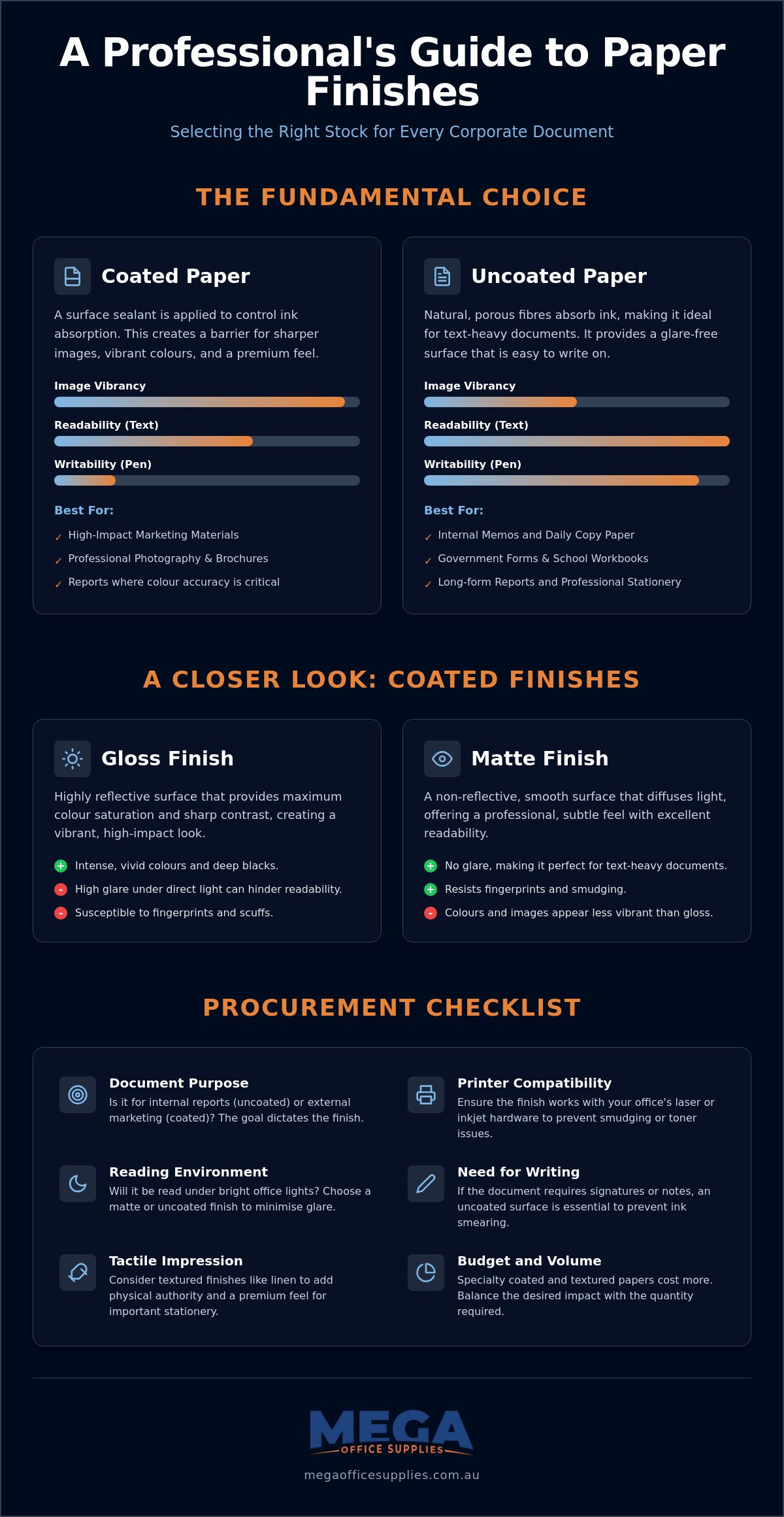
Coated paper is stock that has been treated with a surface sealant, typically consisting of clay or polymers. This layer acts as a barrier, controlling exactly how much ink or toner is absorbed into the sheet. In professional printing circles, this is referred to as "ink holdout". Because the ink sits on top of the coating rather than soaking into the porous fibres, images appear significantly sharper and colours remain more vibrant. This makes coated surfaces the standard for high-impact visual communication.
To better understand this concept, watch this helpful video:
In the Australian market, we measure paper weight using GSM, or grams per square metre. While GSM indicates the density and thickness of the sheet, the finish determines its functional performance. A high GSM coated sheet will feel substantial and premium, whereas an uncoated sheet of the same weight will feel bulkier and more textured. Understanding this relationship helps procurement officers balance the physical weight of a document with its visual finish to achieve the desired professional impression.
When to Choose Uncoated Surfaces
Uncoated paper is the natural, porous state of the medium, making it the most versatile option for high-volume text documents. It's the ideal choice for internal memos, government forms, or school exercise books where readability is the priority. Because there's no sealant, the surface easily accepts ink from ballpoint pens or highlighters without the risk of smudging. This is why standard A4 copy paper used in most Australian workplaces is almost always uncoated. It provides a reliable, glare-free surface that's essential for daily office stationery and long-form reading.
The Logic Behind Coated Stocks
Coated Paper Finishes: From High Gloss to Subtle Matte
Once you've decided on a coated stock, the next technical decision involves surface texture. Understanding what are the different types of paper finishes within the coated category is essential for matching the document's purpose to its environment. These finishes range from highly reflective gloss to non-reflective matte, each offering distinct levels of light diffusion and colour depth for your workplace materials.
Gloss finish provides the highest level of light reflection. It creates intense colour saturation and sharp contrast, which is why it remains the industry standard for high-impact photography. However, this vibrancy comes with a practical trade-off. The surface is highly susceptible to fingerprints and requires careful handling to maintain its pristine appearance, especially in high-traffic reception areas or during client presentations.
Matte finish offers a coated surface with zero glare. It provides a smooth, professional feel that diffuses light rather than reflecting it. This makes it an excellent choice for documents meant to be read under harsh office fluorescent lighting. Silk or satin finishes occupy the middle ground; they offer a subtle sheen that enhances imagery without the extreme reflectivity of gloss. It's often the most reliable choice for high-end brochures that contain both vivid photos and significant amounts of text.
For environments where durability is paramount, such as warehouses or busy staff kitchens, UV and aqueous coatings provide an additional protective layer. These aren't just finishes but liquid-based sealants applied during the printing process to prevent scuffing, moisture damage, and fading. When planning your next bulk order, you can browse our full range of specialty paper to find the exact finish required for your project.
Gloss and High-Gloss for Visual Impact
High-gloss stocks are best used for real estate brochures, photography portfolios, and premium product catalogues. The mirror-like surface makes colours "pop," creating a sense of luxury and precision. However, procurement officers should be wary of using high-gloss for long-form text. Reflectivity can make reading difficult under bright lights, leading to reader fatigue. If your project involves high-volume distribution, consider the logistical need for protective packaging to avoid surface scratches during transit.
Matte and Silk for Professional Authority
Matte is frequently the preferred choice for corporate reports and annual reviews. It conveys a sense of understated authority and sophistication. The primary advantage of silk or matte surfaces is the significant reduction of eye strain in well-lit office environments. Silk, in particular, balances the tactile quality of matte with a slight colour boost, ensuring that charts, graphs, and financial data remain legible and professional for stakeholders.
Uncoated and Textured Finishes for Professional Stationery
While coated stocks dominate the world of high-impact marketing, the nuances of uncoated and textured finishes define the identity of established Australian organisations. When evaluating what are the different types of paper finishes for corporate branding, the focus shifts from light reflection to tactile authority. These finishes are not just about visual aesthetics; they dictate how a document feels in a client's hand and how it accepts ink from a fountain pen or a high-speed office printer.
Wove finish is the industry standard for high-quality office stationery. It provides a smooth, uniform surface without any visible texture, ensuring consistent results for daily correspondence. Linen finish offers a more distinct cross-hatch texture that mimics the look and feel of fine woven fabric, providing an immediate sense of prestige. Laid finish features prominent horizontal and vertical lines, a traditional style that references the historical handmade papermaking process. Vellum finish is characterised by a slightly "toothy" or eggshell-like texture, which offers high ink absorption and a raw, organic feel.
Tactile Branding with Linen and Laid
Textured finishes like linen and laid are strategic choices for business cards and executive letterheads. They convey a sense of heritage and stability that smooth stocks often lack. These surfaces interact beautifully with premium pens, as the slight texture provides a satisfying level of friction for the writer. In the Australian legal and accounting sectors, "Bond" paper remains the essential workhorse. It is a durable, high-quality uncoated stock originally designed for government bonds and legal documents, valued for its longevity and professional weight.
Specialty Finishes: Parchment and Metallic
Specialty finishes allow for creative expression in specific corporate contexts. Parchment finish is engineered to achieve an aged, prestigious look, making it the standard choice for university certificates, long-service awards, and historical replicas. Metallic and pearlescent finishes add a sophisticated shimmer to event invitations or high-end retail signage without the need for expensive foil stamping. When ordering these specialty uncoated stocks for double-sided printing, always verify the opacity levels. Because these fibres are more porous, you must ensure the stock is thick enough to prevent text from "show-through," which can compromise the professional appearance of your materials.
Matching Finishes to Workplace Applications and Machinery
Selecting a paper finish is not merely a design choice; it is a technical requirement dictated by your office hardware. When procurement officers ask what are the different types of paper finishes, the answer must account for how a specific surface interacts with heat, ink, and mechanical rollers. Using a finish incompatible with your machinery can lead to costly maintenance issues, from fuser damage in laser printers to persistent ink smudging in high-speed inkjet units.
Laser printers operate using high-heat toner fusion. This process requires specific heat-resistant coated papers. If you attempt to run standard gloss paper designed for offset presses through a laser printer, the coating may blister or melt onto the fuser unit, causing significant hardware failure. Conversely, inkjet printers rely on liquid ink that requires a porous surface or a specialised "inkjet-ready" coating. Without this, the ink sits on the surface, leading to smearing and illegible documents. For high-volume photocopiers, avoiding thick gloss coatings is essential; these surfaces often create excessive friction, resulting in paper jams and feed errors during large document runs.
Surface texture also dictates how well secondary processes perform. For instance, the adhesion of laminating pouches is significantly improved when applied to uncoated or matte surfaces. The laminating film bonds more effectively to the exposed fibres of uncoated stock than to the sealed surface of a high-gloss finish. To ensure your office remains productive, shop our range of printer-compatible specialty papers to match your specific hardware requirements.
The Right Finish for the Right Sector
Different Australian sectors have distinct functional needs. In healthcare, matte or uncoated finishes are the standard for patient forms and records. These surfaces eliminate glare from clinical lighting and allow for rapid manual notation with ballpoint pens. The hospitality industry prioritises durability, often opting for gloss or laminated finishes for menus and staff instructions to resist moisture and frequent handling. In warehousing and logistics, high-visibility uncoated bond paper remains the preferred choice for picking slips and manifestos, ensuring text remains crisp and readable under industrial lighting.
Environmental and Durability Factors
Long-term document integrity depends heavily on the chosen finish. Documents stored in archive boxes or filing cabinets require acid-free uncoated finishes to resist yellowing over decades. For outdoor signage or kitchen environments, a coated finish is necessary to provide basic moisture resistance. Recyclability is another critical consideration; while uncoated paper is easily processed, some heavy polymer coatings can complicate the recycling stream. As federal regulations in 2026 require increased percentages of recycled fibre, choosing finishes that align with your organisation's sustainability targets is increasingly important for professional buyers.
Procurement Checklist: What to Consider Before Ordering Bulk Paper
Before finalising a high-volume order, procurement officers must systematise their selection process. While you now understand what are the different types of paper finishes available, the final decision requires a practical audit of your specific workplace requirements. Start by categorising the document's destination; internal records suit cost-effective uncoated stocks, whereas client-facing proposals demand the visual weight of matte or silk coatings. You must also cross-reference your chosen finish with the GSM to ensure the sheet remains rigid enough for its intended use, particularly if the document requires manual signatures or handwritten annotations.
Printer compatibility remains the most critical technical hurdle in the procurement cycle. As established in previous sections, the heat of a laser fuser or the liquid application of an inkjet head dictates which surface treatments are viable. Verifying these specifications with your facilities manager prevents hardware downtime and wasted stock. A structured approach to these variables ensures that every ream of paper contributes to a professional, efficient workplace environment.
Maximising Value in High-Volume Orders
Efficiency in procurement is often achieved through standardisation. By limiting your inventory to a few versatile finishes, you can reduce unit costs through bulk volume and simplify office storage logistics. For public sector entities, schools, and departments, utilising Australian Government official purchase orders facilitates a streamlined acquisition process for high-capacity stock. You should also assess lead times early; specialty textured finishes, such as linen or laid, often require longer fulfilment windows compared to standard uncoated bond paper. Planning your inventory cycles around these logistical realities prevents stockouts during critical project delivery dates.
Final Quality Check
A final quality check ensures the paper meets your specific brightness and contrast standards. Brightness is measured by the CIE index; higher values provide better contrast for black text, which is vital for accessibility in long-form reports. We recommend requesting sample packs to physically verify the ink absorption and tactile feel before committing to a pallet-sized delivery. This manual check confirms that the finish performs as expected under your specific office lighting. If you require technical assistance or a rapid quote for your organisation, contact Mega Office Supplies for expert guidance on matching paper finishes to your commercial hardware and operational budget.
Optimising Your Workplace Documentation Strategy
Selecting the correct paper finish is a functional decision that directly impacts both your machinery's lifespan and your organisation's professional image. By aligning surface coatings with your specific printer hardware and considering the tactile needs of your sector, you eliminate common issues like ink smearing or fuser failure. Identifying what are the different types of paper finishes is the first step toward reducing workplace waste and improving the visual clarity of your client-facing materials.
Mega Office Supplies has been family owned and operated since 2008. As an authorised supplier for government and educational sectors, we provide reliable national delivery across Australia to ensure your facility remains fully stocked with high-grade essentials. Browse our comprehensive range of professional paper and office supplies at Mega Office Supplies to find the exact stock required for your next project. Equip your team with the right materials today to ensure every document makes a lasting, professional impression.
Frequently Asked Questions
What is the difference between matte and gloss paper finishes?
Gloss finishes provide high light reflection and vibrant colour saturation, whereas matte finishes diffuse light to eliminate glare. Gloss is typically reserved for photography or high-impact marketing where visual "pop" is required. Matte is the professional standard for text-heavy documents, as the non-reflective surface makes long reports much easier to read under bright office lights.
Can I write on coated paper with a standard ballpoint pen?
Standard ballpoint pens often struggle with coated paper because the surface sealant prevents the ink from absorbing into the fibres. This usually results in persistent smearing and illegible handwriting. If your document requires manual notation, such as a patient form or a signed contract, you should always select an uncoated stock to ensure the ink bonds correctly.
Which paper finish is best for printing professional business reports?
Matte or silk finishes are the most effective choices for professional business reports. These options provide a premium, smooth texture that conveys authority without the distracting reflections found on high-gloss coatings. This reduces eye strain for stakeholders who need to review long-form data or financial charts in well-lit boardrooms or offices.
What does GSM mean and how does it relate to paper finish?
GSM stands for "grams per square metre", which is the standard Australian metric for paper weight and density. While GSM measures how heavy the sheet is, the finish dictates its surface performance. When evaluating what are the different types of paper finishes, remember that a coated 100 GSM sheet will often feel thinner and less bulky than an uncoated sheet of the same weight.
Is satin finish the same as silk finish?
Satin and silk are essentially interchangeable terms for the same mid-range paper finish. Both offer a subtle sheen that enhances colour vibrancy while maintaining high readability for text. They are considered the versatile "middle ground" for procurement officers who want the professional feel of a coating without the extreme reflectivity of a full gloss finish.
What type of paper finish should I use for my office laser printer?
Laser printers require either standard uncoated bond paper or specific heat-resistant coated papers. Because laser technology uses high-heat fuser rollers to bond toner to the page, using standard gloss paper not rated for laser use can be disastrous. The coating can melt or blister, potentially causing permanent damage to your printer's internal fuser unit.
Why do my photos look dull on uncoated paper?
Photos look dull on uncoated paper because the porous fibres absorb the ink, causing it to "sink" into the page and lose its saturation. Coated stocks keep the ink on the surface, which maintains sharpness and vibrancy. This distinction is vital when deciding what are the different types of paper finishes for documents that rely on high-resolution corporate photography.
Are certain paper finishes better for archiving documents in filing cabinets?
Acid-free uncoated papers are the most reliable choice for long-term archiving in filing cabinets or storage boxes. These stocks are designed to resist yellowing over several decades. They also lack the heavy chemical coatings found on some gloss papers, which can occasionally cause pages to stick together in humid Australian environments or under the pressure of high-volume filing.
Article by
Mega Office Supplies Team
The Mega Office Supplies Team provides practical guidance for Australian businesses, schools, government organisations, healthcare providers, hospitality venues, warehouses and home offices. Based in Tweed Heads South, Mega Office Supplies is an Australian business, family owned and operated since 2008, offering office stationery, workplace furniture, technology products, labels, printers, cleaning and janitorial supplies, safety products, art materials, education resources and everyday business essentials from trusted brands.
General Information
This article is provided as general information only to help customers compare and choose office, workplace, school, cleaning, technology, furniture, safety and business supplies. Product details, specifications, compatibility, availability, pricing and suitability may vary. Always check the individual product page, manufacturer information, workplace requirements and relevant safety guidance before purchasing or using a product.


