


Selecting a whiteboard based solely on available wall space is a common mistake that often leads to poor visibility and wasted resources. You need a solution that fits the functional scale of your meetings, not just the physical dimensions of the plasterboard. Knowing how to choose the right whiteboard size for a room requires a professional approach that considers sightlines, mounting heights, and the distance to the furthest participant.
It's frustrating to invest in office equipment only to find it's too small for your team to use effectively or that it interferes with existing power points and air conditioning units. We understand that procurement officers and facility managers need reliable, practical data to make these decisions with confidence. This guide provides a masterclass in whiteboard logistics for Australian workplaces, covering standard commercial dimensions and room-specific requirements. We will walk you through essential viewability standards, such as the 1/200th readability rule, and installation factors to ensure your new board is perfectly suited to your professional environment.
Key Takeaways
- Aligning whiteboard dimensions with room scale facilitates active problem-solving while preventing visual clutter in professional environments.
- Accurately map your installation zone by identifying "dead zones" caused by light switches, windows, and door swings.
- Apply the 1/200th viewability standard to determine how to choose the right whiteboard size for a room based on the distance to your furthest viewer.
- Match board selection to specific Australian workplace functions, ranging from high-intensity huddle rooms to large-scale corporate training centres.
- Optimise your fit-out by selecting durable materials like porcelain for high-use areas and ensuring sizing is compatible with professional maintenance tools.
Scaling for Success: Why Whiteboard Size Matters in the Modern Australian Workplace
The whiteboard remains the central hub for visual communication in the modern office. It's where abstract ideas become actionable plans and team members engage in collaborative problem-solving. Selecting the correct scale is critical; a board that is too small limits the flow of information, while one that is excessively large can overwhelm the room. Understanding how to choose the right whiteboard size for a room is about more than just filling a gap on the wall. It's about ensuring the scale of the board matches the intensity of the collaboration and the physical constraints of your professional environment.
To better understand this concept, watch this helpful video:
Visual Dominance vs. Room Clutter
A whiteboard that is too small for a large boardroom looks unprofessional and makes it difficult for participants at the far end of the table to see the content. Conversely, installing a massive board in a compact home office can make the space feel cramped and cluttered. Professional designers often balance the board size with other wall-mounted assets. If your wall already features large monitors or acoustic panels, the whiteboard size must be chosen to complement these elements rather than compete with them. Achieving this balance ensures your office furniture fit-out looks intentional and organised. Proper scaling encourages active participation because users don't feel restricted by a lack of writing surface.
Standard Australian Whiteboard Dimensions
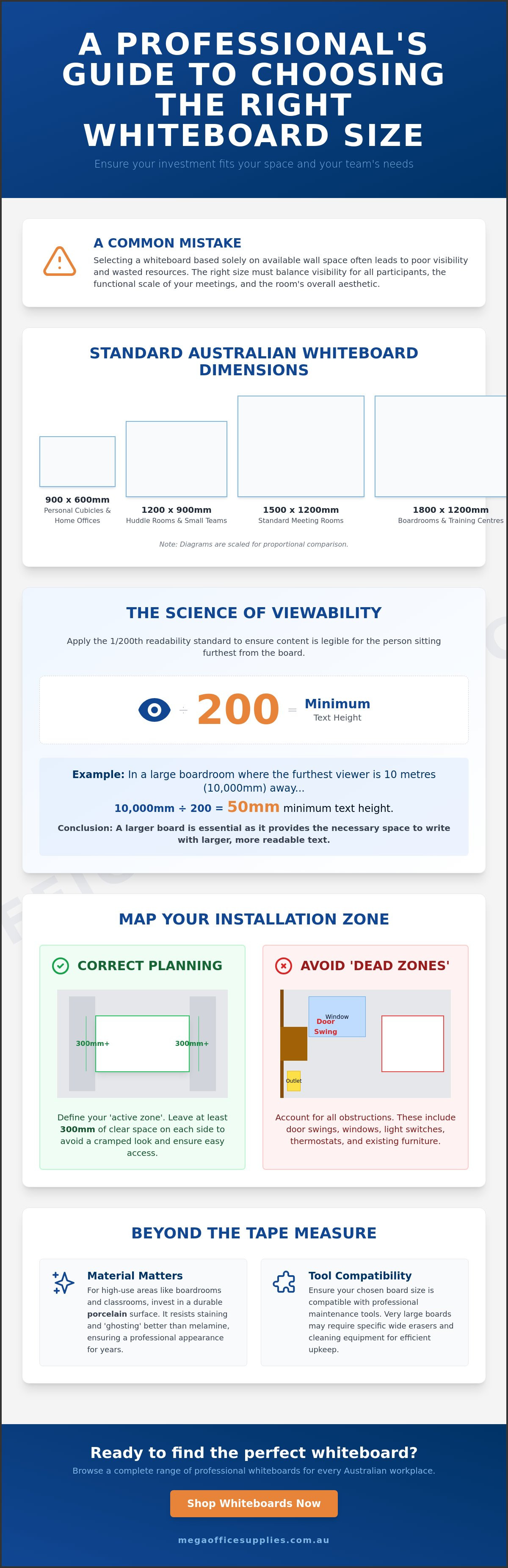
Australian commercial boards follow metric sizing conventions. This is a key distinction for procurement officers who might be used to viewing international guides that use imperial units. Learning how to choose the right whiteboard size for a room involves familiarising yourself with these common dimensions. Standard sizes available in the Australian market include:
- 900 x 600mm (Ideal for personal cubicles or small home offices)
- 1200 x 900mm (Suited for huddle rooms or small team zones)
- 1500 x 1200mm (A versatile mid-range option for standard meeting rooms)
- 1800 x 1200mm (The go-to choice for boardrooms and training centres)
- 2400 x 1200mm (Maximum scale for large-format collaborative spaces)
The 1200mm height is the industry standard for maximum reach and visibility. This height allows for a significant amount of vertical information while remaining within the comfortable reach of most users. Whether you are selecting from common whiteboard materials like porcelain or commercial-grade melamine, adhering to these standard dimensions ensures your board is compatible with standard Australian mounting hardware and cleaning accessories.
Calculating the Ideal Dimensions: Room Layout and Wall Space Logistics
Determining the physical footprint of your board involves more than a quick tape measure across an empty wall. You must define the specific active zone where writing will actually occur. Start by measuring the wall width from corner to corner, then subtract at least 300mm on each side to avoid a cramped appearance. This calculation is a vital step in learning how to choose the right whiteboard size for a room, as it prevents the board from overlapping with architraves or obstructing light switches. Accounting for dead zones is equally critical. These are areas where door swings, windows, or fixed storage cabinets make the wall unusable for collaborative work.
The height of the board must integrate with your existing workplace setup. Consider the profile of your ergonomic office chairs and standing desks. If a board is mounted too low, it will be obscured by seated participants or the monitors on sit-stand workstations. In educational settings, applying practical classroom design principles ensures the board remains visible above the heads of students while staying within reach for the instructor. For those managing a complete office fit-out, browsing our extensive range of office furniture can help you visualise how your new board will integrate with existing desks and storage units.
Identifying Electrical and Structural Obstacles
Power points and data ports often dictate the maximum width of a fixed board. You cannot safely mount a board over active electrical outlets without professional modification. Check for internal wall studs and cabling before committing to a size. A 2400mm porcelain board is heavy; it requires secure mounting into studs to ensure long-term safety. Air-conditioning vents also play a role. Placing a board directly under a high-velocity vent can cause markers to dry out prematurely, reducing the lifespan of your stationery.
Fixed vs. Mobile Boards: Choosing Based on Flexibility
When wall space is limited by glass partitions or floor-to-ceiling windows, a mobile pivoting board is the logical choice. These units provide the same writing surface area as a fixed 1800mm board but offer the flexibility to be moved as needed. Ensure your chosen size can actually navigate your office. Moving an 1800mm mobile board through standard Australian office doorways requires careful measurement of both the board height and the door frame. In open-plan offices, these larger mobile units can double as temporary room dividers to create semi-private huddle zones.
The Science of Viewability: Ensuring Every Participant Can Read the Board
Effective visual communication depends on the legibility of the information presented. When considering how to choose the right whiteboard size for a room, you must prioritise the furthest viewer in the space. If participants at the back of a training centre can't decipher the text, the board fails its primary purpose. Legibility is a direct result of board surface area; larger boards allow for larger character heights without sacrificing the amount of content displayed. A 1200x1800mm board is generally required for legibility beyond 5 metres to ensure that both text and complex diagrams remain clear for all attendees.
The 1/200 Rule and Board Surface Area
The industry standard for viewability is the 1/200 rule. This means the smallest writing on the board should be at least 1/200th of the distance to the furthest participant. For example, if your boardroom is six metres long, the text must be at least 30mm high to be readable. Maintaining this text size on a small board quickly leads to a lack of white space. This results in cognitive overload, where the brain struggles to process crowded information. For "Agile" or "Lean" project management, where teams track numerous small details, a 2400mm board provides the necessary real estate to keep data points distinct and legible. You should also ensure the board is mounted so the centre sits at eye level for a standing presenter, which typically keeps the bottom edge visible for seated viewers.
Viewing Angles in Boardrooms and Classrooms
Visibility isn't just about distance. It's also about the angle of the viewer. The 45-degree rule suggests that participants seated at an angle greater than 45 degrees from the centre of the board will experience significant distortion and reduced legibility. You should position your board and office furniture to keep all viewers within this optimal arc. Glare from windows or overhead fluorescent lights can also obscure parts of the surface. In high-glare environments, a matte-finish porcelain board or a non-reflective glass board is often superior to standard melamine. These materials minimise reflections, ensuring that your whiteboard markers remain visible from every seat in the room. Careful placement helps maintain focus during long sessions and prevents eye strain for your team.
Application-Specific Sizing: From Huddle Rooms to Large Lecture Centres
Every Australian workplace has unique collaborative needs. A small huddle room in a Sydney tech startup requires a different spatial strategy than a large government training facility in Canberra. Understanding how to choose the right whiteboard size for a room means matching the board's dimensions to the specific activity performed in that space. Procurement officers should aim for consistency across similar room types to streamline the management of workplace assets and simplify the replacement of accessories.
Small Pods and Private Offices
For personal task management or one-on-one brainstorming, compact boards are the most efficient choice. We recommend sizes like 900 x 600mm or 1200 x 900mm for these environments. These dimensions fit comfortably above a standard desk without dominating the wall. In a home office, a 900 x 600mm board provides enough space for daily to-do lists and project milestones while maintaining a professional, uncluttered aesthetic. These smaller boards are also easier to install in residential settings where wall studs might be spaced differently than in commercial builds. They offer a utilitarian solution for tracking individual output without occupying the primary focus of the room.
For schools and universities, selecting the right educational supplies involves looking at standard classroom layouts. Most Australian classrooms are designed for 25 to 30 students. This makes a 2400 x 1200mm board the minimum standard for front-of-room instruction. In these settings, durability is as important as size, as the boards face constant use throughout the school day. Large-format boards ensure that students at the back of the room can follow the lesson without visual obstruction.
Boardrooms and Training Facilities
Large-scale facilities require boards that can handle complex information and multiple presenters. Standard sizes for these rooms range from 1800 x 1200mm up to 3600 x 1200mm. In many training sessions, using multiple banked boards is superior to a single massive unit. This allows trainers to keep key information visible on one board while using the second for active group work or temporary notes. Modern fit-outs often integrate these boards with technology such as interactive projectors or flat-panel displays. When planning these spaces, ensure the whiteboard placement doesn't interfere with the throw distance of the projector or the viewing angles of the digital screen.
If you are outfitting a new facility or upgrading your current collaborative spaces, view our full range of professional whiteboards to find the exact dimensions for your project. This tailored approach is the most reliable way to learn how to choose the right whiteboard size for a room that supports your team’s specific workflow.
Beyond the Tape Measure: Final Considerations for a Professional Fit-out
Selecting the correct dimensions is a significant part of the process, but the long-term success of your installation depends on material quality and logistical planning. A board that fits the wall perfectly but fails after six months of heavy use is a poor investment for any organisation. When you are finalising how to choose the right whiteboard size for a room, you must also consider the frequency of use and the specific maintenance requirements of the surface material. Procurement officers for national organisations should prioritise standardisation to simplify the ongoing supply of cleaning chemicals and stationery across multiple sites.
Porcelain vs. Melamine: The Durability Factor
The intensity of use in your workspace should dictate the material choice for your chosen size. High-use environments, such as corporate training rooms or busy staff kitchens, require porcelain surfaces. Porcelain is fired at high temperatures to create a hard, non-porous finish that resists "ghosting," which is the faint remnant of previous writing. While a 2400mm melamine board might be more cost-effective initially, it is better suited for low-frequency use in private offices or home setups. You must also account for weight. Porcelain is significantly heavier than melamine, meaning that larger boards in this material require verified mounting into internal wall studs to ensure workplace safety.
Installation and National Delivery Logistics
The logistics of receiving a large-format board are often overlooked during the initial planning phase. A 2400mm or 3600mm board is a substantial piece of hardware that requires professional handling. Ensuring your chosen Australian office supplies partner has the capacity for national delivery and safe on-site handling is essential for large-scale furniture fit-outs. Standardising your board sizes across different office locations allows your facilities team to manage inventory more efficiently, as cleaning accessories and replacement parts will be uniform across the entire organisation.
Before you commit to a purchase, use this final procurement checklist to ensure a professional result:
- Verify the "active writing zone" by subtracting at least 300mm from each side of the wall.
- Confirm that the mounting location is clear of electrical cabling, data ports, and air-conditioning vents.
- Apply the 1/200th rule to ensure the board height supports legible text for the furthest viewer.
- Select porcelain for any board larger than 1500mm that will see daily use.
- Check that delivery access, including lift dimensions and doorways, can accommodate the board size.
By following these steps, you can move beyond simple measurements and implement a collaborative solution that enhances productivity. Mastering how to choose the right whiteboard size for a room ensures your workplace remains functional, professional, and ready for high-intensity problem-solving.
Optimise Your Collaborative Space with Precision
Selecting the right hardware is the foundation of a productive workplace. You now have the technical framework to balance room aesthetics with the 1/200th viewability rule and structural wall requirements. By applying these logistics, you can confidently determine how to choose the right whiteboard size for a room while avoiding common installation pitfalls like obscured power points or poor sightlines. Proper scaling ensures your team has the surface area needed for complex problem-solving without making the environment feel cluttered.
Mega Office Supplies has been family owned and operated since 2008. We provide reliable national delivery across Australia to support your workplace maintenance and fit-out needs. Whether you are outfitting a single home office or a multi-storey government facility, our team understands the practicalities of professional equipment procurement and durability standards.
View our full range of professional whiteboards and office furniture to find the perfect fit for your specific environment. We look forward to helping you create a space where your team can collaborate without limits and achieve their professional objectives with ease.
Frequently Asked Questions
What is the most common whiteboard size for a standard Australian office?
The 1200 x 900mm board is the most common size for individual workstations and small team zones in standard Australian offices. For dedicated meeting rooms, the 1800 x 1200mm size is the industry standard. These dimensions provide sufficient space for brainstorming while fitting within typical commercial wall zones. Understanding these standards is a helpful starting point when deciding how to choose the right whiteboard size for a room.
How high should I mount my whiteboard for the best visibility?
You should mount your whiteboard so the centre of the board sits between 1.4 and 1.5 metres from the floor. This height ensures that the surface is accessible for most standing presenters while remaining visible to seated participants in a boardroom or classroom. In educational settings, you might adjust this slightly lower to accommodate younger students, but the 1.4 metre mark remains the professional benchmark for adult environments.
Can I use a whiteboard as a projection surface, and does that affect the size I need?
You can use specific low-glare whiteboards as projection surfaces, but you must ensure the board's aspect ratio matches your digital equipment. Standard projectors typically require a 16:9 or 16:10 ratio to prevent the image from spilling over the aluminium frame. If you intend to use the board for both writing and projecting, select a matte-finish porcelain surface to minimise hot spots and light reflections.
What is the difference between porcelain and melamine whiteboards?
Porcelain boards feature a vitreous enamel surface that is non-porous and highly resistant to ghosting, stains, and scratches. Melamine boards are a more cost-effective entry-level option but consist of a plastic-coated surface that can wear down with heavy use. For high-traffic areas like training centres or school classrooms, porcelain is the superior choice due to its industrial durability and professional-grade finish.
How do I measure my wall space if I have power points in the way?
Measure the "clear wall zone" by identifying the largest rectangle of space that doesn't overlap with light switches, data ports, or power points. You should allow at least 50mm of clearance around electrical sockets to ensure safe access for plugs and cables. If these obstacles severely limit your fixed options, it might be better to consider a mobile board or a custom-sized glass board to fit the specific available area.
What size whiteboard is best for a small home office?
A 900 x 600mm whiteboard is usually the best size for a small home office or study nook. This compact dimension allows you to track daily tasks and project milestones without overwhelming a residential room or interfering with home furniture. If your desk is wider than 1500mm, a 1200 x 900mm board can also work well if it's mounted in a landscape orientation to align with the desk's profile.
Are mobile whiteboards better than wall-mounted boards for small rooms?
Mobile whiteboards are often superior for small rooms with limited wall space or glass partitions. They provide the flexibility to move the writing surface out of the way when it's not in use or to reposition it for better viewing angles during a meeting. This is a practical alternative when learning how to choose the right whiteboard size for a room where permanent wall mounting isn't structurally possible.
How do I clean a large whiteboard to prevent ghosting over time?
You should clean your board using a high-quality microfibre cloth and a dedicated whiteboard cleaning solvent at least once a week. Avoid using abrasive sponges or harsh household chemicals, as these can strip the protective coating and cause permanent ghosting. Removing ink at the end of each day and using professional-grade markers will also significantly extend the life of large-format boards in busy workplaces.

Article by
Mega Office Supplies Team
The Mega Office Supplies Team provides practical guidance for Australian businesses, schools, government organisations, healthcare providers, hospitality venues, warehouses and home offices. Based in Tweed Heads South, Mega Office Supplies is an Australian business, family owned and operated since 2008, offering office stationery, workplace furniture, technology products, labels, printers, cleaning and janitorial supplies, safety products, art materials, education resources and everyday business essentials from trusted brands.
General Information
This article is provided as general information only to help customers compare and choose office, workplace, school, cleaning, technology, furniture, safety and business supplies. Product details, specifications, compatibility, availability, pricing and suitability may vary. Always check the individual product page, manufacturer information, workplace requirements and relevant safety guidance before purchasing or using a product.


