

Selecting the wrong packaging for your business mail is more than a minor administrative error; it's a direct drain on your operating budget. With the standard letter rate increasing to $1.60 on 1 July 2026, failing to understand how to choose the right size envelope can lead to substantial cumulative costs. You've likely experienced the frustration of a document arriving creased or the irritation of unexpected surcharges because a C4 envelope exceeded the 20mm thickness threshold that triggers parcel rates.
We agree that the technical distinctions between C4, C5, and DL sizes often feel unnecessarily complex for a busy workplace. This guide leverages decades of collective industry experience to simplify these standards, ensuring your correspondence reflects the professional grade of your organisation. You'll learn to match A4 documents with the correct folding methods to protect your contents and maintain Australia Post compliance. We'll examine C-series dimensions in detail and provide practical strategies to reduce your mailing overheads through precise, informed selection.
Key Takeaways
- Understand the direct relationship between ISO C-series envelopes and A-series paper to ensure your documents fit perfectly and remain professional.
- Master how to choose the right size envelope by matching your selection to specific folding methods, such as using C4 for flat sheets or DL for tri-folded A4 paper.
- Avoid unexpected postage surcharges by staying within Australia Post's 5mm thickness limit for standard letters to keep your mailing costs efficient.
- Select the appropriate paper weight (GSM) for your envelopes to ensure durability and a high-quality feel for premium business correspondence.
- Streamline your workplace mailroom by identifying the core sizes required for your specific sector, whether you are managing a school, government office, or warehouse.
Understanding the ISO Standard: The C-Series Envelope Chart
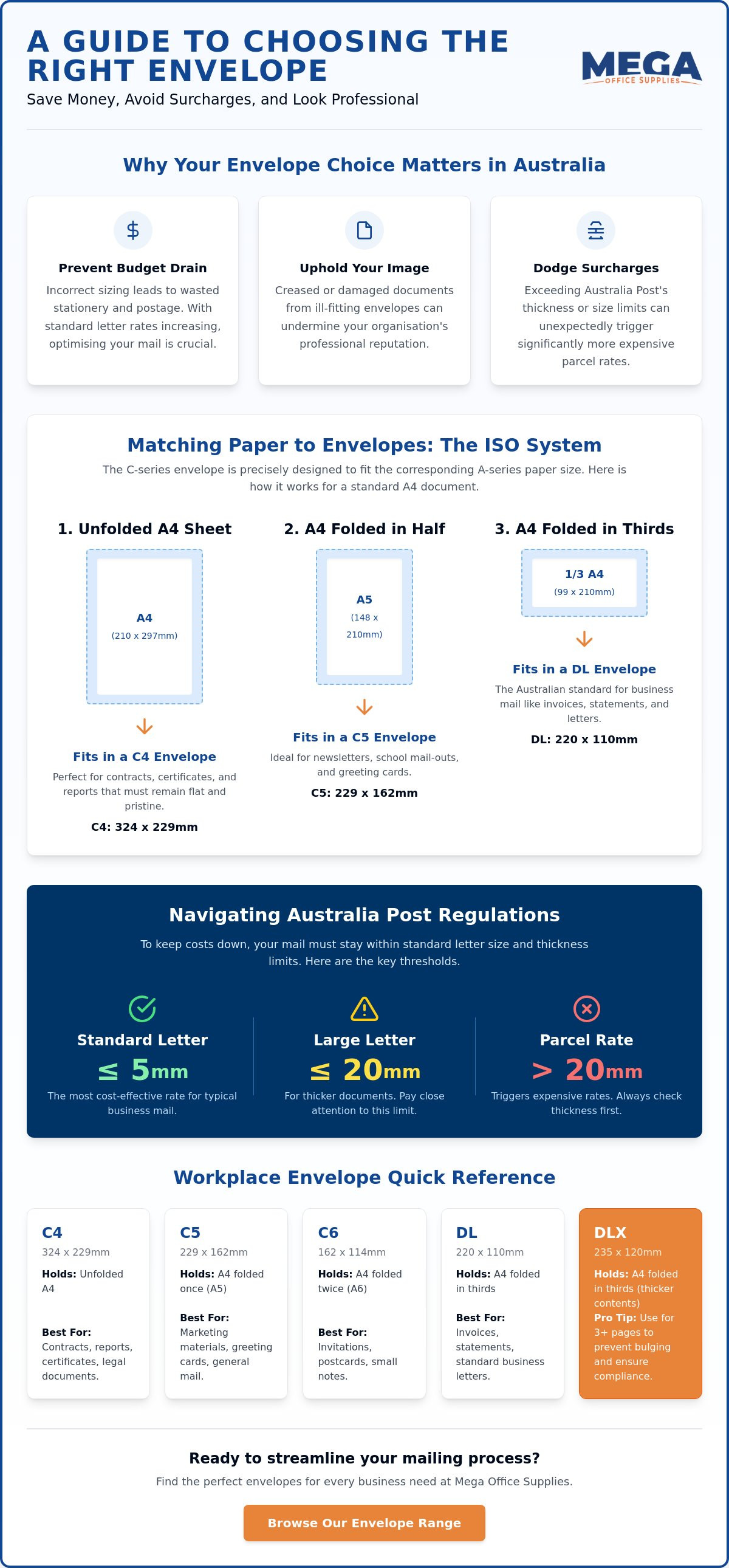
To determine how to choose the right size envelope, you must first understand the geometric logic behind international packaging standards. Envelopes aren't designed in isolation; they are precision-engineered to accommodate ISO standard paper sizes. This system ensures that a document of a specific "A" size fits into the corresponding "C" size envelope with just enough clearance to prevent damage while maintaining a professional appearance. For instance, a C4 envelope is specifically designed to house an unfolded A4 sheet of paper. This is the preferred choice for legal contracts, certificates, and high-stakes reports where creasing the document would undermine its authority.
Precision matters in logistics. If you select an envelope that's too large, the contents will shift during transit, potentially leading to dog-eared corners or damaged edges. Conversely, an envelope that's too small forces the sender to cram the paper inside, which often results in a torn envelope or a frustrated recipient. By standardising your office stationery around the ISO C-series, you eliminate the guesswork for your administrative staff and ensure a consistent brand image across all physical correspondence.
The Logic of ISO 269
The C-series dimensions are defined by ISO 269. The mathematics are based on the geometric mean between the A-series and B-series of the same number. This technical foundation is why the system works so reliably across global supply chains. Standardising your procurement to these sizes reduces inventory errors and ensures compatibility with automated folding machines. Below is a quick reference for the most common dimensions used in Australian workplaces:
- C4 (324 x 229mm): Fits an unfolded A4 sheet.
- C5 (229 x 162mm): Fits an A5 sheet or an A4 sheet folded once.
- C6 (162 x 114mm): Fits an A6 sheet or an A4 sheet folded twice into quarters.
- DL (220 x 110mm): Fits an A4 sheet folded twice into thirds.
Envelope size chart (Australia)
| Size | Dimensions (mm) | Fits | Shop |
|---|---|---|---|
| C4 | 324 x 229 | A4 sheet, unfolded | C4 envelopes |
| C5 | 229 x 162 | A5 sheet, or A4 folded once | C5 envelopes |
| C6 | 162 x 114 | A6 sheet, or A4 folded into quarters | C6 envelopes |
| DL | 220 x 110 | A4 folded into thirds | DL envelopes |
Need a mix of sizes? See the full mailing envelopes range.
DL Envelopes: The Business Standard
DL stands for "Dimension Lengthwise". At 110 x 220mm, it's the undisputed workhorse of Australian business mail. Most invoices, statements, and general letters are produced on A4 paper and folded into thirds to fit this specific format. It's often the most cost-effective choice because it typically falls within the "Small Letter" postage category, provided the thickness remains under 5mm.
However, professionals should distinguish between standard DL and the slightly larger DLX (235 x 120mm). If you're sending more than three sheets of paper, or including a small brochure, the DLX provides the necessary extra volume. This prevents the envelope from bulging, which is a common cause of mechanical sorting errors at mail centres. Choosing DLX for thicker mailings ensures the envelope remains flat, maintaining compliance with Australia Post regulations and protecting your professional reputation.
Matching Envelopes to Your Content: Folding and Presentation
Effective document presentation hinges on the strategic relationship between paper size and the number of folds applied. While the previous section established the geometric logic of the C-series, the practical application in a busy office environment requires a nuanced understanding of content types. Deciding how to choose the right size envelope depends largely on the impression you wish to make upon the recipient and the nature of the documentation itself. High-stakes items such as legal contracts, professional certificates, or audited reports should ideally remain flat. For these instances, the C4 envelope is the industry standard. Using a C4 envelope preserves the document's integrity and signals a level of respect for the contents that a folded sheet simply cannot convey.
For more routine correspondence, folding is a practical necessity to manage bulk and postage costs. C5 envelopes (229 x 162mm) are the primary choice for A4 sheets folded once, creating an A5 profile. These are frequently utilised in school mail-outs, medical correspondence, and for sending A5 greeting cards. Smaller still are C6 envelopes (162 x 114mm), which accommodate A4 sheets folded twice into quarters. While less common for formal business letters, they remain a staple for A6 postcards or smaller invitations where a compact format is desired.
The A4 Content Guide
To maintain efficiency in your mailroom, follow these standard folding protocols for A4 documents:
- Unfolded A4: Always use a C4 envelope (324 x 229mm) to prevent creasing.
- Folded once: This creates an A5 size; use a C5 envelope (229 x 162mm).
- Folded twice (Tri-fold): This is the standard for business letters; use a DL envelope (220 x 110mm).
Professional Presentation Standards
Beyond size, the physical configuration of the envelope impacts your workflow. Window envelopes are a vital tool for organisations looking to automate their mailing processes. By aligning the address block on your A4 copy paper with the transparent window, you eliminate the need for separate labels and reduce the risk of delivery errors. This is particularly effective for high-volume invoicing or government mailings where accuracy is paramount.
You must also consider the opening style: 'Wallet' or 'Pocket'. Wallet envelopes open along the longer edge and are generally preferred for high-speed automated inserters. Pocket envelopes open on the shorter edge; they provide greater structural security for heavier manuscripts or thick reports that might otherwise burst a side seam. Matching the envelope's quality and style to the importance of the documentation inside is a hallmark of professional administrative management. Investing in the correct office stationery ensures your business mail remains both efficient and authoritative.
Beyond Dimensions: Material, Weight, and Protection
While dimensions establish the frame, the material properties of the envelope determine its survival in the logistics chain. When considering how to choose the right size envelope, you've got to account for the volume and sensitivity of the contents. Standard 80gsm (Grams per Square Metre) paper is the baseline for most office stationery. It provides a reliable balance between cost and performance for standard letters. However, for documents that carry significant weight or professional importance, increasing the paper weight to 100gsm or 120gsm is a professional necessity. This extra thickness provides a tactile sense of quality and prevents the contents from being visible through the paper.
Security is another critical factor for Australian businesses, particularly in legal, healthcare, and government sectors. Security tint, often a blue or grey pattern printed on the inside of the envelope, ensures that sensitive information remains confidential even when held up to a bright light. For those managing bulkier contents that might typically be stored in lever arch files, a standard flat envelope won't suffice. Gusset envelopes feature expandable sides that allow the packaging to "grow" with the document stack. This prevents the seams from bursting under pressure and ensures your professional documentation arrives intact.
Selecting the Right Paper Weight
Selecting the correct GSM ensures your mail arrives in the same condition it left your desk. For daily administrative tasks and high-volume invoicing, 80gsm to 90gsm is the most cost-efficient choice. Executive correspondence or legal filings require 100gsm or higher to project authority and ensure durability. In warehouse or industrial environments, Manila or Kraft paper is the superior option. These materials are engineered for manual precision and high durability. They offer a level of resistance to tearing that standard white paper can't match, which is essential for heavy-duty mailing.
Closure Types for Efficiency
The method used to seal your mail impacts both the speed of your workflow and the security of the contents. Peel and Seal closures are widely regarded as the most reliable for long-term storage. The adhesive is protected by a removable strip until the moment of use, which prevents the glue from drying out over time. Self-Seal options are faster for immediate, manual packing in smaller offices. For high-speed automatic inserting machines used by large-scale organisations, gummed or "moisturise" envelopes are the standard. These require moisture to activate the glue, ensuring a permanent bond that withstands the rigours of mechanical sorting. Understanding these technical specifications is essential when learning how to choose the right size envelope for your specific operational needs.
Mailing Efficiency and Australia Post Regulations
Effective 1 July 2026, the standard letter rate in Australia will increase to $1.60. For organisations managing high-volume correspondence, understanding how to choose the right size envelope is no longer just an administrative task; it's a critical cost-control measure. The most frequent error in mailrooms is selecting a format that inadvertently triggers the 'Large Letter' rate. While a standard letter is cost-effective, a large letter up to 250g will cost $3.25 from July 2026. If your mail exceeds 250g but stays under 500g, that cost jumps to $6.10. These price points demonstrate why dimensional precision is vital for your bottom line.
To qualify for the Small Letter rate, your envelope must not exceed 130mm x 240mm. Crucially, it must be no thicker than 5mm. This thickness rule is where many businesses fail. As soon as an item exceeds the 5mm threshold, it's reclassified, regardless of its length or width. For larger documents that must remain flat, the Large Letter category allows for dimensions up to 260mm x 360mm and a maximum thickness of 20mm. Anything beyond these measurements, or weighing over 500g, is classified as a parcel, which carries significantly higher costs and involves a average price increase of 4.95% starting in mid-2026.
Optimising for Postage Costs
The DL envelope remains the most economical vehicle for business mail. It comfortably fits A4 sheets folded into thirds while staying well within the Small Letter dimensional limits. However, you must be wary of the 'Thickness Trap'. A stack of ten sheets of standard 80gsm paper, plus the envelope itself, can quickly approach that 5mm limit. If your contents are bulky, consider using a lighter paper stock or split the contents into two DL envelopes to maintain the lower postage tier. Maximising your budget requires this level of manual precision during the packing process.
Addressing for Australian Standards
Australia Post uses high-speed optical character recognition (OCR) technology to sort mail. If your addressing doesn't meet specific standards, your mail may be delayed or rejected. Ensure the address block is placed in the centre of the envelope, leaving at least 15mm from the bottom edge and 10mm from the sides. You also need to leave clear space in the top right corner for the postage stamp or franking machine mark. High contrast is essential; always use dark ink on a light-coloured envelope. Avoid using red ink or decorative fonts that might confuse the sorting sensors. For reliable results, ensure your mailroom is stocked with high-quality Envelopes and Mailing Supplies that meet these rigorous technical requirements.
Sourcing Envelopes for Professional Workplaces
Maintaining operational continuity in a high-volume mailroom requires more than just technical knowledge of dimensions; it demands a robust procurement strategy. Understanding how to choose the right size envelope is the first step toward efficiency, but the second is ensuring your team has immediate access to that inventory without the risk of stockouts. For schools, government departments, and large corporate offices, bulk procurement is the only viable way to manage costs and ensure a uniform standard of professional presentation. A reliable supply chain prevents the last-minute scramble for substandard alternatives that could compromise your brand or lead to postage surcharges.
Integrating your envelope selection into a broader stationery supplies Australia strategy allows for better inventory control and financial transparency. When you treat mailing supplies as a core component of your workplace maintenance, you can align your purchases with other essential items like A4 copy paper and filing solutions. This holistic approach simplifies the procurement cycle and ensures that every department, from the warehouse to the reception area, is equipped with the correct professional-grade materials.
Procurement for High-Volume Environments
In large-scale organisations, inventory management is essential for avoiding administrative friction. We recommend setting 'par levels' for your most frequently used items, typically DL and C4 envelopes. A par level is the minimum amount of stock required to meet your needs until your next delivery arrives. By monitoring these levels, you ensure you never run out during critical mailing periods, such as end-of-financial-year reporting or school enrolment windows. Standardising sizes across all departments also simplifies the ordering process and reduces the likelihood of procurement errors. To streamline your purchasing, many organisations utilise business application forms to establish dedicated accounts that facilitate rapid quoting and fulfilment.
The Mega Office Supplies Advantage
When you partner with a reliable Australian retailer, you gain access to a national inventory of professional-grade products. We provide expert advice on how to choose the right size envelope and other essential workplace hardware. Our team understands the specific logistical challenges faced by Australian businesses and provides the regional expertise necessary to navigate them. As a trusted business, family owned and operated since 2008, we prioritise functional clarity and speed of fulfilment to keep your workplace running smoothly. You can order your envelopes and mailing supplies with confidence, knowing you're supported by a partner that values longevity and manual precision in every transaction.
Optimising Your Professional Mailing Strategy
Mastering the technical standards of postal logistics ensures your organisation remains both professional and fiscally responsible. By applying the ISO C-series logic and respecting Australia Post's 5mm thickness limits, you eliminate the risk of unexpected surcharges and damaged documentation. Understanding how to choose the right size envelope is a foundational skill for any efficient administrative or procurement team. It's about balancing the tactile quality of high-GSM paper with the logistical reality of automated sorting machines to protect your professional reputation.
Mega Office Supplies has been family owned and operated since 2008. We provide national delivery for businesses, schools, and government departments across the country. Our team understands the practicalities of workplace maintenance and the importance of reliable hardware that stands up to high-volume use. Shop our full range of professional Envelopes and Mailing Supplies here. We're ready to help you streamline your mailroom with precision and confidence so you can stay focused on your core operations.
Frequently Asked Questions
What is the most common envelope size for business use in Australia?
The DL (Dimension Lengthwise) envelope is the most common size for Australian business correspondence. Measuring 110 x 220mm, it's specifically designed to house a standard A4 sheet folded twice into thirds. This format is the preferred standard for invoices, statements, and general letters because it typically qualifies for the Small Letter postage rate. It's the most efficient choice for high-volume mailing, provided the total thickness remains under 5mm.
Will an A4 sheet of paper fit in a C5 envelope?
An A4 sheet will fit in a C5 envelope only if it is folded once in half along the longest edge. This creates an A5 profile, which matches the 229 x 162mm internal dimensions of the C5 format. It's a professional choice for medical certificates or short reports that require more presence than a standard tri-folded DL letter but don't need to remain completely flat in a larger C4 envelope.
What is the difference between a DL and a DLX envelope?
The primary difference is the physical dimension and the capacity for thicker contents. A standard DL envelope measures 110 x 220mm, whereas a DLX envelope is slightly larger at 120 x 235mm. Professionals often use the DLX when sending multiple sheets of paper or documents with attachments. The extra space prevents the envelope from bulging and ensures it remains within Australia Post's machine-readability standards for the Small Letter rate.
How many sheets of A4 paper can I fit in a standard C4 envelope?
A standard C4 envelope can comfortably hold approximately 15 to 20 sheets of 80gsm A4 paper while remaining flat. However, you must monitor the total thickness to avoid triggering higher postage tiers. To stay within the Large Letter category, the maximum thickness is 20mm. Understanding how to choose the right size envelope for thick reports is essential to prevent the seams from bursting during mechanical sorting at mail centres.
Does the weight of the envelope affect the postage price?
The total weight of the envelope and its contents directly impacts your postage costs. Australia Post calculates rates based on weight tiers, such as up to 125g, 250g, and 500g for large letters. Heavier 100gsm or 120gsm envelopes provide better protection and a more premium feel, but they add to the total mass. This extra weight might push your item into a more expensive postage category if your contents are already close to a threshold.
What size envelope do I need for a standard invitation?
Standard invitations typically require a C6 envelope (114 x 162mm) or a 130 x 184mm format. The C6 size is designed to fit an A6 card or an A4 sheet folded into quarters. For more formal corporate events, the 130 x 184mm size is common for 5x7 inch cards. Always measure your card stock before purchasing to ensure a professional fit that prevents the invitation from shifting or getting damaged during transit.
Are window envelopes standard across all C-series sizes?
Window envelopes are widely available in DL, C5, and C4 sizes, but they aren't considered the default for every C-series format. They are most prevalent in business environments where automated addressing from printed documents is required to save time. Window placement is generally standardised for DL envelopes, but you should verify that your document's address block aligns correctly with the specific window position of the C5 or C4 variant you select.
Can I send a square envelope through Australia Post?
You can send square envelopes through Australia Post, but they are often subject to higher postage rates. Because square envelopes don't meet the aspect ratio requirements for high-speed automated sorting machines, they must be processed manually. This classification often results in a "non-standard" surcharge. For the most cost-effective mailing, we recommend sticking to rectangular ISO C-series formats that meet standard machine-readability criteria and keep your overheads low.
Article by
Mega Office Supplies Team
The Mega Office Supplies Team provides practical guidance for Australian businesses, schools, government organisations, healthcare providers, hospitality venues, warehouses and home offices. Based in Tweed Heads South, Mega Office Supplies is an Australian business, family owned and operated since 2008, offering office stationery, workplace furniture, technology products, labels, printers, cleaning and janitorial supplies, safety products, art materials, education resources and everyday business essentials from trusted brands.
General Information
This article is provided as general information only to help customers compare and choose office, workplace, school, cleaning, technology, furniture, safety and business supplies. Product details, specifications, compatibility, availability, pricing and suitability may vary. Always check the individual product page, manufacturer information, workplace requirements and relevant safety guidance before purchasing or using a product.


