


A single mislabelled bottle or an outdated Safety Data Sheet can compromise your entire workplace's compliance under the strict 2026 standards. Managing a facility’s hygiene requirements often feels like a constant battle against rising costs and shifting regulations. You likely feel the pressure to maintain a pristine environment while navigating the complexities of chemical compatibility and staff safety. Selecting the right cleaning chemicals isn't just about finding the strongest formula; it's about building a compliant, cost-effective system that protects your team and your assets.
We understand that procurement officers and business owners need reliability and functional clarity above all else. This guide will empower you to master your procurement strategy by simplifying your inventory and ensuring full alignment with Australian WHS standards. We'll examine the transition to new Workplace Exposure Limits (WELs) taking effect this December and show you how to reduce your cost-per-use through strategic bulk sourcing. From identifying high-performance concentrates to managing GHS 7 requirements, you'll learn exactly how to optimise your facility's maintenance programme for maximum efficiency and peace of mind.
Key Takeaways
- Understand the critical performance differences between domestic products and high-active commercial formulations designed for high-traffic Australian environments.
- Protect your facility assets by selecting specific cleaning chemicals tailored to material compatibility to prevent permanent surface damage.
- Ensure full compliance with Australian WHS regulations by maintaining an up-to-date SDS register and adhering to GHS 7 labelling requirements.
- Maximise your procurement budget by implementing usage audits and standardising your chemical range across all operational sites.
- Streamline facility management by consolidating your cleaning, stationery, and technology requirements into a single, efficient national delivery.
Understanding Cleaning Chemicals for the Australian Workplace
Commercial environments demand a level of hygiene that standard domestic products simply cannot provide. While a supermarket spray might suffice for a home kitchen, high-traffic Australian workplaces like schools, medical centres, and warehouses require industrial-strength formulations. Professional cleaning chemicals are engineered with higher concentrations of active ingredients to emulsify grease, neutralise pathogens, and lift stubborn soils quickly. This efficiency is vital in a commercial setting where time is a direct labour cost. Using the wrong product doesn't just result in a poor finish; it often leads to accelerated wear on expensive office assets.
The science behind professional results lies in the balance of surfactants and pH levels. Surfactants reduce the surface tension of water, allowing the solution to penetrate deep into porous surfaces. Depending on the task, you might require different common types of cleaning agents such as alkaline degreasers for kitchen zones or acidic descalers for washrooms. Selecting a pH-neutral cleaner for high-gloss flooring or ergonomic office furniture is essential to prevent stripping protective coatings or causing material brittleness over time.
To better understand the essential items for your facility, watch this helpful video:
Commercial vs. Domestic Formulations
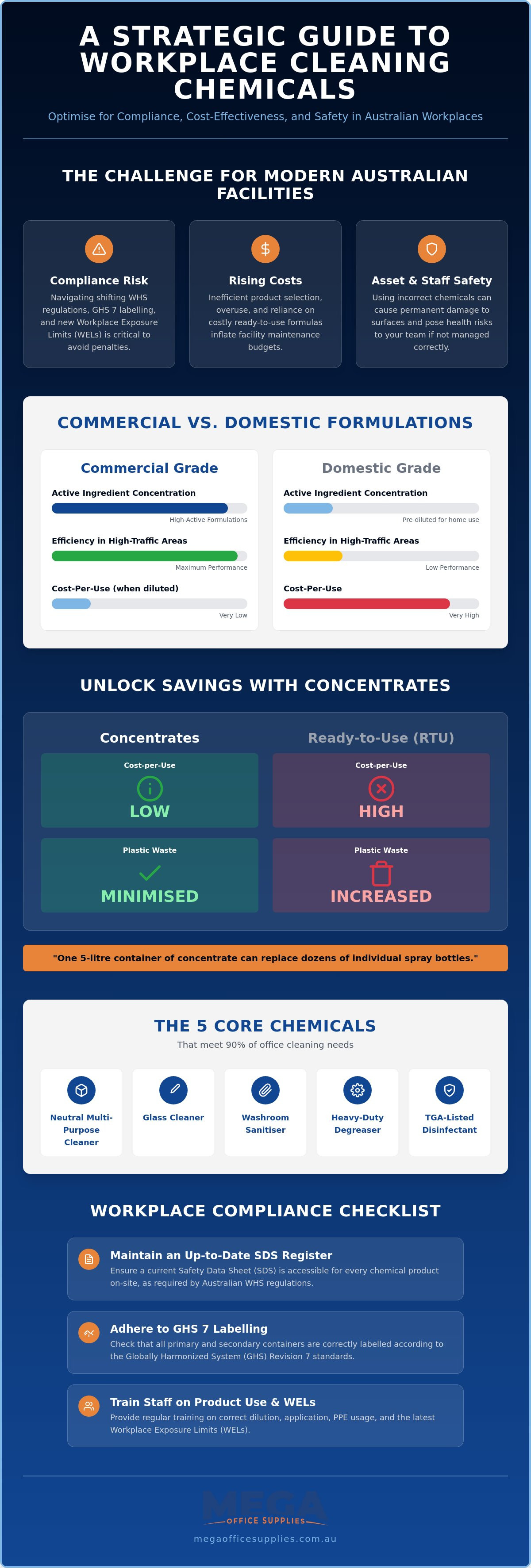
The primary difference between these grades is the "active matter" content. Domestic cleaners are typically pre-diluted for safety and ease of use, which makes them inefficient for large-scale operations. In a commercial kitchen or a busy reception area, these "supermarket" options often fail to break down heavy carbon deposits or high-volume foot traffic grime. Professional formulations reduce cleaning frequency by leaving surfaces cleaner for longer. This shift in quality directly impacts your bottom line; when a chemical works faster, your staff spend less time scrubbing and more time on high-value tasks.
The Role of Concentrates in Cost Management
Switching from ready-to-use (RTU) trigger sprays to concentrated systems is one of the most effective ways to manage your facility supplies budget. While an RTU bottle offers convenience, you're essentially paying for the transport and packaging of water. Concentrated cleaning chemicals allow you to control the dilution ratio based on the specific soil level. This approach significantly reduces the cost-per-use and minimises plastic waste, as one five-litre container of concentrate can often replace dozens of individual spray bottles. For maximum efficacy and safety, always use calibrated dispensing equipment or marked decanting bottles to ensure your team achieves the correct chemical balance every time.
Selecting Cleaning Chemicals by Surface and Application
Procurement success depends on matching the chemical formulation to the specific material and soil type of your environment. A one-size-fits-all approach often leads to poor hygiene outcomes or, worse, permanent damage to facility assets. In a high-traffic Australian primary school, your priority might be low-toxicity multi-purpose cleaners. Conversely, a heavy-duty warehouse requires industrial-grade degreasers capable of lifting tyre marks and oil spills. Establishing a core range of cleaning chemicals simplifies staff training and ensures that every surface is treated with the correct level of chemical intensity. Most office environments can meet 90% of their needs with five key categories: a neutral multi-purpose cleaner, a glass cleaner, a washroom sanitiser, a heavy-duty degreaser, and a TGA-listed disinfectant.
When building this range, you must ensure every selection aligns with current Safety Data Sheet (SDS) requirements to maintain workplace compliance. This is particularly critical in the healthcare and hospitality sectors, where regulatory scrutiny is highest. In these environments, using the wrong chemical doesn't just risk surface damage; it can lead to significant health and safety breaches. If you are managing multiple sites, standardising these products across your organisation reduces the risk of accidental chemical mixing and simplifies inventory management. You can browse a curated selection of professional formulations in our facility supplies department to find the right fit for your specific sector.
Kitchen and Food-Safe Sanitisers
Staff kitchens and tea rooms require a tiered approach to hygiene. Cleaning removes visible dirt, but sanitising is what reduces bacteria to safe levels. Under the updated 2026 food safety standards, sanitisers used on food-contact surfaces must now demonstrate a 5-log reduction in pathogens. It's essential to source "food-grade" chemicals that are fragrance-free to prevent tainting. For high-volume environments, high-active dishwashing detergents and alkaline degreasers are necessary to break down stubborn fats and proteins that domestic liquids simply cannot touch.
Floor Care and Heavy-Duty Degreasers
Flooring is often the most expensive asset in a facility. Timber, vinyl, stone, and polished concrete each require a specific chemical profile to maintain their integrity. Using a high-pH cleaner on a sealed timber floor will eventually strip the finish, leaving the wood vulnerable to moisture. For Australian warehouses and workshops, heavy-duty degreasers are the standard for maintaining safety and cleanliness on concrete. However, for daily maintenance of polished surfaces in reception areas or corridors, a pH-neutral cleaner is the best choice to preserve the shine without leaving a dulling residue.
Safety and Compliance: Navigating SDS and Labelling
Compliance in the Australian workplace is more than just a box-ticking exercise; it's a legal safeguard for your staff and your business. Under current WHS regulations, every facility manager is responsible for the safe handling and storage of cleaning chemicals. This includes adhering to the mandatory GHS 7 classification system and preparing for the new Workplace Exposure Limits (WELs) coming into effect on 1 December 2026. Failure to maintain a compliant environment can lead to severe penalties and, more importantly, workplace injuries. Secure procurement involves ensuring that every product arrives with the necessary documentation to protect your team from the health and environmental impact of hazardous substances.
Understanding Safety Data Sheets (SDS)
An SDS is the definitive technical document for any industrial-grade cleaner. It's not enough to simply have these on file; they must be current, compliant with GHS 7, and easily accessible to all staff during an emergency. When reviewing an SDS, prioritise section 4 for first aid measures, section 8 for required Personal Protective Equipment (PPE), and section 13 for safe disposal. Organise your SDS folder logically, perhaps by chemical category or area of use, to ensure safety audits proceed without friction. Training your team to interpret these documents is a critical step in reducing the risk of chemical burns or respiratory issues.
Proper Storage and Colour-Coded Systems
Safe storage requires more than just a locked cupboard. You must account for ventilation, bunding to contain spills, and the physical separation of incompatible substances, such as acids and bleaches. Following Australian Standards like AS 3780 for corrosives is essential for high-volume storage. Implementing a colour-coded system is a proven method to prevent cross-contamination and misuse. For example, using red for washrooms and blue for general office areas ensures that high-strength disinfectants aren't accidentally used on sensitive surfaces.
Secondary bottle labelling is another non-negotiable requirement. When decanting concentrates into smaller spray bottles, the label must clearly state the product name, hazards, and basic safety instructions. Unlabelled bottles are a primary cause of workplace accidents and a major red flag during safety inspections. To ensure your facility meets these rigorous standards, you can browse our full range of facility supplies for safe storage solutions, including compliant decanting equipment and safety signage.
Procurement Strategy: Bulk Buying and Inventory Control
Strategic procurement of cleaning chemicals requires a shift from reactive buying to data-driven inventory management. Efficiency isn't accidental. It begins with a comprehensive usage audit to identify where products are being wasted or applied incorrectly. Many facilities suffer from "glug-glug" pouring, where staff use far more concentrate than required, leading to chemical residue on surfaces and unnecessary expenditure. By standardising your range across multiple sites, you reduce the training burden on your janitorial staff and minimise the risk of chemical accidents caused by product confusion. This uniformity ensures that whether a cleaner is in a Brisbane warehouse or a Melbourne reception area, they are using the same compliant formulations and following the same safety protocols.
Establishing par levels is the next critical step in maintaining a consistent supply chain. A par level is the minimum amount of stock required to meet your needs until the next delivery arrives. Setting these levels prevents "emergency" high-cost purchases from local retailers when stock runs dry unexpectedly. When evaluating a supplier, prioritise those with national delivery capabilities and a proven track record of reliability. You need a partner that understands the logistical flow of high-volume distribution and can provide the scale necessary to support your entire organisation without friction.
The Economics of Bulk Chemical Purchasing
Labour typically accounts for about 80% to 90% of a total cleaning budget. While the price per litre of a chemical is important, the true cost is measured by how much labour it saves. A high-performance degreaser that works in one pass is far more valuable than a cheaper alternative that requires three applications. Volume discounts offer a significant advantage, especially when you consolidate your facility needs with your broader office requirements. To simplify this process and access competitive commercial rates, you can apply for a Mega Office Supplies business account to streamline your procurement.
Streamlining Supplies for Schools and Government
The Australian education and government sectors have unique procurement workflows that demand high levels of transparency and administrative ease. Continuity of supply is paramount, particularly during high-demand periods such as end-of-term deep cleans or pre-audit facility refreshes. We understand the necessity of a friction-free ordering process for administrators. To support this, official purchase orders are accepted for Australian Government departments and educational institutions nationwide. This ensures you can secure your essential cleaning chemicals and janitorial equipment while adhering to strict departmental budget cycles and reporting requirements.
Ready to optimise your facility's supply chain? Browse our comprehensive range of professional facility supplies to start building your standardised core range today.
Sourcing Quality Cleaning Chemicals from Mega Office Supplies
Managing a complex facility requires more than just a list of products; it requires a supply partner that understands the logistical demands of a high-volume operation. Mega Office Supplies has spent decades supporting diverse Australian sectors, from the high-sanitation requirements of healthcare and hospitality to the heavy-duty needs of national warehouses and government departments. Our role is to act as a dependable industry veteran, providing the professional-grade cleaning chemicals and janitorial equipment you need to maintain compliance and efficiency. By choosing a partner with deep regional expertise, you gain the security of knowing your supply chain is managed by a team that values reliability and functional clarity over flashiness.
The strength of our operation lies in the cumulative decades of experience held by our team. We don't just ship boxes; we provide a foundation for workplace stability. Thousands of Australian businesses trust us because we understand the practicalities of facility maintenance and the administrative burden of procurement.
One-Stop Facility Management
Efficiency in procurement is often found in consolidation. Rather than managing multiple accounts for different needs, you can source your paper towels, bin liners, and janitorial hardware from a single provider. This approach reduces delivery friction and simplifies your accounts payable process. For a complete tea room solution, check our professional guide to coffee and tea supplies for a complete tea room solution. Combining your stationery, technology, and cleaning chemicals into one delivery doesn't just save time; it maximises your logistical efficiency and reduces the total number of shipments entering your loading dock.
National Logistics and Support
As an Australian family-owned and operated business, we prioritise direct support and regional accessibility. Our national shipping network is designed for speed and reliability, ensuring metro and regional Australia receive the same high level of service. We don't hide behind automated systems; we provide clear, descriptive solutions grounded in practical knowledge. If you're unsure about chemical compatibility or need help navigating the 2026 WHS updates discussed in this guide, contact our expert team for personalised cleaning chemical recommendations. Our seasoned professionals are available to help you evaluate costs and quantities quickly, ensuring your workplace remains safe, clean, and fully compliant.
Optimising Your Facility Hygiene Strategy for 2026
Success in commercial procurement is defined by the balance between operational efficiency and strict regulatory compliance. You've seen how matching the correct formulations to specific surfaces prevents damage; while maintaining an up-to-date SDS register keeps your team safe and your business compliant with 2026 standards. Implementing a standardised inventory and setting par levels are the most effective ways to reduce your total cost-per-use and ensure you're never caught without essential supplies during high-demand periods.
As a family-owned Australian business with decades of combined industry experience, we provide the scale and logistical reliability required to support your organisation's longevity. Whether you're managing a single site or a national network, we offer national delivery for all your facility essentials to keep your operations running without friction. It's time to move beyond reactive buying and secure a partner that understands the practicalities of your workplace maintenance. Shop our extensive range of professional cleaning chemicals today and take the first step toward a more efficient, compliant, and cost-effective hygiene programme for your facility.
Frequently Asked Questions
What are the most essential cleaning chemicals for a standard office environment?
A core range for office hygiene typically includes a pH-neutral multi-purpose cleaner, a streak-free glass cleaner, a washroom sanitiser, and a TGA-listed disinfectant for high-touch surfaces. These four products address the majority of daily maintenance tasks in reception areas and workspaces. For communal zones like staff tea rooms, you should also incorporate a food-grade sanitiser that complies with the updated 2026 pathogen reduction standards.
How do I ensure my workplace is compliant with Australian chemical safety regulations?
Compliance requires maintaining a current SDS register, ensuring all containers feature GHS 7 compliant labelling, and meeting the new Workplace Exposure Limits (WELs) for airborne contaminants. You must also provide the specific Personal Protective Equipment (PPE) outlined in each chemical's safety documentation. Regularly auditing your storage for proper ventilation and secondary containment is a mandatory requirement under Australian WHS laws to protect your staff and facility.
Is it better to buy concentrated cleaning chemicals or ready-to-use sprays?
Concentrated cleaning chemicals are the superior choice for commercial facilities because they offer a significantly lower cost-per-use and reduce plastic waste. While ready-to-use (RTU) sprays provide convenience for small home offices, they are inefficient for large-scale operations due to the high cost of transporting water-heavy solutions. Using concentrates with calibrated dispensing systems ensures consistent chemical performance while minimising your environmental footprint and procurement expenses.
How often should I update the Safety Data Sheets (SDS) for my cleaning supplies?
You must update your SDS register at least every five years or whenever a manufacturer changes a product's formulation or hazard classification. Given the recent mandatory transition to GHS 7 and the 2026 regulatory updates regarding industrial chemicals, it's vital to verify that your current documents reflect these changes. Keeping a digital or physical folder that is immediately accessible to all employees is a critical component of workplace safety audit readiness.
Can commercial cleaning chemicals damage specific types of office flooring?
Yes, high-active alkaline degreasers or acidic cleaners can permanently strip sealants from timber, etch natural stone, or dull the finish on polished concrete. For daily maintenance of most office flooring, you should use a pH-neutral cleaner to ensure material longevity. Always refer to the material compatibility section of the technical data sheet to confirm that the chemical is safe for your specific floor type before application.
What is the best way to store bulk cleaning chemicals in a school or warehouse?
Bulk chemicals must be stored in a cool, well-ventilated area equipped with bunding or secondary containment pallets to capture potential spills. In a school or warehouse environment, it's essential to separate incompatible substances, such as keeping acids away from alkalis and bleaches away from flammable liquids. Restricted access is a non-negotiable requirement to prevent unauthorised handling, particularly in educational settings where student safety is the primary concern.
Are there eco-friendly commercial cleaning chemicals that actually work?
Modern plant-based surfactants and biodegradable formulations now deliver cleaning performance that matches or exceeds traditional petroleum-based products. When sourcing these options, look for third-party environmental certifications that verify claims regarding biodegradability and low Volatile Organic Compound (VOC) levels. These high-performance "green" cleaning chemicals are particularly effective for improving indoor air quality in schools and medical centres where sensitive occupants are present.
How can I reduce the overall cost of cleaning supplies for my business?
Reducing costs is best achieved through product standardisation and the implementation of strict dilution controls to prevent chemical wastage. By consolidating your requirements into a core range of versatile products, you can leverage volume discounts and simplify your inventory management. Training staff to use automated dispensing equipment eliminates the "glug-glug" method of pouring, which is one of the most significant hidden expenses in Australian facility maintenance.
Article by
Mega Office Supplies Team
The Mega Office Supplies Team provides practical guidance for Australian businesses, schools, government organisations, healthcare providers, hospitality venues, warehouses and home offices. Based in Tweed Heads South, Mega Office Supplies is a family-owned and operated Australian business offering office stationery, workplace furniture, technology products, labels, printers, cleaning and janitorial supplies, safety products, art materials, education resources and everyday business essentials from trusted brands.
General Information
This article is provided as general information only to help customers compare and choose office, workplace, school, cleaning, technology, furniture, safety and business supplies. Product details, specifications, compatibility, availability, pricing and suitability may vary. Always check the individual product page, manufacturer information, workplace requirements and relevant safety guidance before purchasing or using a product.


