


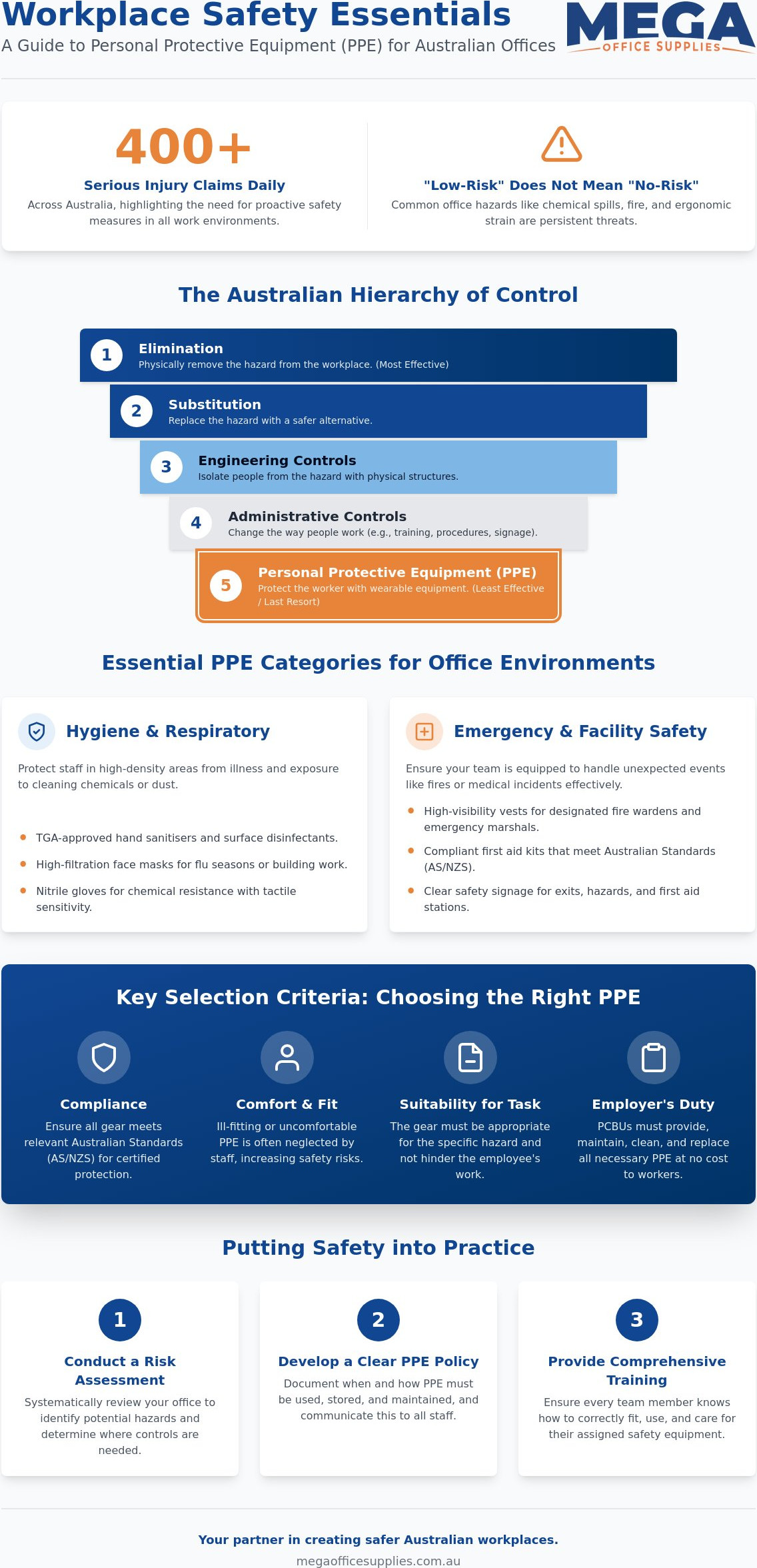
With over 400 serious injury claims occurring every single day across Australia, the assumption that a corporate office is a zero-risk environment is a dangerous oversight. Selecting the right PPE for office staff is no longer just about high-visibility vests for the warehouse; it now involves a sophisticated mix of ergonomic tools, respiratory protection, and hygiene solutions. You likely feel the pressure of distinguishing between mandatory requirements and recommended extras, all while trying to keep staff comfortable and the budget intact.
With over 20 years of combined industry experience, Mega Office Supplies understands that procurement officers value stability and regional expertise. This guide will help you master the essentials of workplace safety with a comprehensive look at choosing compliant, effective PPE for Australian office environments. We'll preview the 2026 regulatory shifts in workplace exposure limits and psychosocial hazards, providing a practical shopping list that ensures your organisation meets its WHS duties while boosting team morale.
Key Takeaways
- Understand where personal protective equipment fits within the Australian 'Hierarchy of Control' to ensure it serves as an effective final line of defence against workplace hazards.
- Gain confidence in selecting the right PPE for office staff by prioritising professional-grade sanitisation and emergency response gear that meets 2026 WHS standards.
- Discover why comfort and material choice are critical for compliance, as ill-fitting gear often leads to staff neglect and increased safety risks.
- Learn how to develop a clear workplace PPE policy and training program to ensure every team member knows how to correctly use and store their safety equipment.
- Optimise your budget through bulk procurement strategies that standardise safety gear across multiple locations, simplifying maintenance and training for national fit-outs.
Understanding PPE Requirements for Australian Offices
Safety in a professional environment often feels invisible until something goes wrong. In a corporate setting, Personal Protective Equipment (PPE) refers to any clothing or equipment worn to minimise risk to health and safety. While a warehouse manager thinks of steel-capped boots, an office manager must consider items like nitrile gloves for cleaning, high-visibility vests for emergency marshals, or respiratory masks for high-traffic reception areas. Under the Australian 'Hierarchy of Control', PPE is positioned as the final layer of protection. It's only used when a hazard cannot be eliminated or substituted. This makes selecting the right PPE for office staff a critical task, as it serves as the last barrier between an employee and a potential injury.
To better understand how to integrate these safety layers into your workplace, watch this helpful video:
Identifying these hazards requires a formal risk assessment. You can't simply guess what your team needs. A Person Conducting a Business or Undertaking (PCBU) must systematically review the office environment to find where administrative controls might fail. For example, if a staff member is required to handle bulk printer toners or industrial-strength cleaning chemicals, the risk of skin irritation or inhalation must be mitigated through specific protective gear. Proper assessment ensures you aren't over-purchasing unnecessary items while leaving critical gaps in your safety plan.
The Legal Framework: WHS Duties in 2026
Australian law is clear: employers must provide necessary PPE to workers at no cost. This obligation extends beyond the initial purchase to include contractors and casual staff. The PCBU is legally responsible for ensuring that all safety gear is maintained, cleaned, and replaced whenever it becomes damaged or ineffective. When browsing for supplies, always verify that products meet relevant Australian Standards (AS/NZS). These certifications provide the peace of mind that a first aid kit or a pair of safety glasses will perform reliably during a crisis.
Why "Low-Risk" Does Not Mean "No-Risk"
Many administrators fall into the trap of viewing the office as a completely safe zone. However, common hazards like chemical spills in the staff kitchen, fire emergencies, and even ergonomic strain are persistent threats. Implementing the right facility supplies and PPE is a proactive way to reduce workers' compensation claims and minimise absenteeism. By selecting the right PPE for office staff, you protect your people and your organisation's bottom line from the high costs of workplace incidents.
Essential PPE Categories for Modern Workplaces
Selecting the right PPE for office staff involves categorising gear into functional groups that address specific environmental risks. While corporate spaces are generally low-risk, they aren't hazard-free. A professional safety strategy must look beyond standard office stationery and consider the equipment required for hygiene, emergency response, and manual handling. Effective procurement focuses on professional-grade solutions that offer durability and compliance without hindering staff productivity.
Hygiene and Respiratory Protection
Modern office environments require more than basic hand soap. High-density workspaces benefit from TGA-approved hand sanitisers and surface disinfectants that provide a verified level of antimicrobial protection. When respiratory risks increase, such as during flu seasons or building renovations, providing high-filtration face masks is a prudent step for illness prevention. According to Safe Work Australia guidelines, the equipment must be suitable for the user and the task. For office tasks requiring manual precision, such as handling mail or operating machinery, choose nitrile gloves that offer both chemical resistance and high tactile sensitivity.
Emergency and Facility Safety Gear
Don't overlook the importance of specialised office first aid kits. These kits function as a form of collective PPE, providing the necessary medical supplies to treat injuries on-site. Ensure your kits meet the specific size requirements for your staff headcount, as a small kit suitable for five people won't suffice for a floor of fifty. For more detailed insights on maintaining a safe environment, consult our office first aid kits guide which covers essential safety gear and workplace maintenance.
Protective apparel also extends to the staff kitchen and mailroom. Staff handling bulk deliveries or cleaning chemicals should have access to durable aprons and heavy-duty gloves to prevent skin contact with irritants. If you're looking to update your facility's safety equipment, you can browse our range of WHS-compliant supplies to find the right fit for your organisation.
Selection Criteria: Choosing the Right Gear for Your Team
Procuring safety equipment requires a shift in perspective. You aren't just buying hardware; you're investing in a system that staff must use daily. If a piece of equipment is heavy, itchy, or poorly sized, it will likely end up in a desk drawer rather than being used during a hazard. Selecting the right PPE for office staff involves a rigorous evaluation of how a product feels after eight hours of wear, not just how it looks on a spec sheet.
Material choice is a primary consideration for long-term compliance. In an Australian climate, breathable fabrics are essential to prevent heat stress and skin irritation. Look for hypoallergenic materials, especially for items that have direct skin contact like nitrile gloves or face mask linings. Durability also plays a role in value for money. Professional-grade fabrics resist tearing and maintain their protective qualities after multiple washes, which is vital for high-visibility vests and reusable protective aprons.
Compatibility is often the most overlooked factor in safety procurement. Items of PPE must work in harmony. For instance, a face mask should not interfere with the seal of safety glasses, which often leads to fogging and reduced visibility. When selecting the right PPE for office staff, test how different components interact. Look for low-profile masks and eyewear with anti-fog coatings to ensure staff remain comfortable and safe simultaneously.
The "Comfort First" Framework
A successful safety rollout prioritises the user's physical experience. Weight and breathability are the two most significant factors in whether a staff member will keep their gear on. For ergonomic interventions, look for adjustability features. Just as high-quality office chairs offer lumbar and height adjustments to suit different body types, safety apparel should feature adjustable straps or elasticised borders. This ensures size inclusivity, allowing the gear to fit the diverse body types within a modern Australian workforce.
Australian Standards and Quality Assurance
Compliance is non-negotiable. Every item you purchase should carry the AS/NZS tick of approval, signifying it meets rigorous Australian and New Zealand safety standards. Avoiding 'grey market' imports is essential; these products often bypass local testing and may fail when needed most. Consult the Safe Work Australia PPE guidelines to understand the specific benchmarks required for your industry. Because human anatomy varies significantly across any team, the concept of 'one size fits all' is a dangerous myth in professional PPE procurement.
Implementation and Legal Compliance for PCBUs
Implementation is where safety theory meets workplace reality. For a PCBU, the legal duty doesn't end at the point of purchase. You must ensure the gear is used correctly and maintained in a state that provides the intended level of protection. A clear, written PPE policy is the foundation of this process. It should outline exactly when gear is required, how it should be fitted, and the procedure for reporting damaged items. By keeping the language direct and utilitarian, you ensure the policy is a functional tool rather than a forgotten document.
Training is a critical compliance step. Simply providing a mask or a pair of gloves isn't enough; staff need to understand the 'why' and 'how'. Demonstrate correct fitting techniques and, just as importantly, the safe removal of contaminated items to prevent cross-contamination. Signage in high-risk zones, like staff kitchens or chemical storage areas, acts as a constant visual reminder of these duties. These visual anchors help embed safety into the daily rhythm of the office, reducing the likelihood of accidental exposure.
Training and Staff Engagement
Engagement shouldn't be a one-way street. Consult with your team to gather feedback on the performance of the equipment. If staff find a specific brand of mask uncomfortable or a certain type of glove too bulky for mailroom tasks, they're less likely to comply with safety protocols. This feedback loop is essential when selecting the right PPE for office staff in the future, as it ensures your procurement strategy is grounded in real-world usage. A worker who feels heard is a worker who is more likely to prioritise their own safety and that of their colleagues.
Storage and Inventory Management
Proper storage extends the lifespan of your safety assets and ensures they're ready for immediate use. Organising supplies in central, accessible locations like filing cabinets or dedicated storage bins prevents damage from sunlight, moisture, or dust. This is particularly important for first aid consumables and sanitisers, which have finite shelf lives and specific storage requirements to maintain their efficacy.
Establish a robust inventory management system to track expiry dates and stock levels. A simple re-order trigger prevents the risk of stockouts during a crisis. Periodic reviews of your risk profile are also necessary. As Australia transitions to legally enforceable Workplace Exposure Limits (WELs) in late 2026, your safety requirements will likely change. Consistent monitoring ensures your safety programme remains effective and compliant with these evolving standards. If you need assistance standardising your safety gear across multiple locations, contact our specialist team for a comprehensive facility assessment.
Procurement Strategies for Bulk Office PPE
Managing safety requirements across multiple branches or a national office fit-out demands a centralised procurement strategy. Bulk purchasing offers more than just immediate volume discounts; it provides the logistical stability needed to maintain a high standard of care across every site. When selecting the right PPE for office staff, standardising your gear ensures that a staff member in Sydney uses the same high-visibility vest or sanitisation station as their colleague in Perth. This uniformity simplifies training, as a single instructional video or signage set can be deployed across the entire organisation, reducing the risk of confusion during an emergency.
Selecting a Reliable Australian Supplier
Reliability in safety equipment is non-negotiable. Partnering with a domestic provider like Mega Office Supplies ensures that your safety-critical items are backed by local support and efficient domestic shipping. Vendor fragmentation is a common headache for procurement officers; choosing a supplier with a broad catalogue allows you to consolidate your facility and safety needs into a single account. Our team offers over 20 years of combined industry experience, providing the technical depth required to help you navigate complex WHS requirements. This regional expertise is vital when ensuring that every item, from a first aid kit to a fire warden's helmet, meets the necessary Australian Standards discussed in previous sections.
Maximising Value in Your Safety Budget
A professional safety budget should prioritise long-term durability over the lowest initial price. While budget-grade gear might seem attractive on a spreadsheet, the 'cost per use' is often higher due to frequent replacements and staff non-compliance caused by poor comfort. Professional-grade PPE maintains its structural integrity through repeated cleaning and daily wear, offering better value over its lifespan. Integrating your safety procurement with your regular stationery orders can further reduce logistical overhead, as consolidated deliveries minimise shipping fees and administrative processing time.
For departments managing public funds, streamlining the acquisition process is essential. We facilitate this by ensuring government purchase orders are accepted, allowing for a frictionless transaction that respects your internal auditing requirements. Selecting the right PPE for office staff doesn't have to be a fragmented, time-consuming task. By centralising your orders and choosing a high-capacity partner, you gain the peace of mind that your organisation is compliant, protected, and efficient. Contact our team for a bulk PPE quote today to discuss your specific workplace requirements.
Building a Compliant and Protected Workplace for 2026
Maintaining a safe corporate environment requires a shift from reactive purchasing to proactive risk management. By prioritising AS/NZS-compliant gear and focusing on the comfort-first framework, you ensure that safety equipment is actually used rather than stored away. Selecting the right PPE for office staff is about more than meeting legal duties; it's about fostering a culture where staff feel protected and valued in their daily roles.
As an Australian family-owned and operated business with over 20 years of combined industry experience, Mega Office Supplies is your dependable partner for workplace maintenance. We understand the logistical demands of national organisations and offer reliable national delivery to keep your facility running without friction. From hygiene solutions to emergency response apparel, our catalogue is built for durability and professional-grade performance.
Take the next step in your WHS journey and secure your workplace with professional PPE from Mega Office Supplies. Investing in high-quality safety solutions today creates a more resilient and productive office for the years ahead.
Frequently Asked Questions
Is it mandatory to provide PPE in a standard Australian office?
Yes, providing personal protective equipment is mandatory if a risk assessment identifies hazards that cannot be eliminated through other means. While offices are generally lower risk than construction sites, PCBUs must still provide gear for specific tasks, such as fire warden duties, first aid response, or the handling of bulk cleaning chemicals. Under the model WHS Act, you have a primary duty of care to ensure the health and safety of all workers.
Can I charge my employees for the PPE I provide?
No, Australian WHS law strictly prohibits employers from charging workers for any equipment required for workplace safety. You must provide all necessary PPE at no cost to the employee, and this obligation includes the costs associated with its maintenance, repair, and eventual replacement. You cannot deduct these expenses from a worker's wages or require them to pay a deposit for their safety gear.
What are the most common PPE items needed for fire wardens?
Fire wardens typically require high-visibility vests, identifying headgear such as caps or helmets, and high-powered torches for low-visibility evacuations. Standardisation is key here; yellow vests are usually reserved for wardens while white is used for floor marshals. These items ensure that leaders are easily identifiable to both staff and emergency services during a crisis, facilitating a faster and more organised building clearance.
How often should office first aid kits be checked and replenished?
You should inspect your office first aid kits at least every 6 to 12 months, or immediately after any item is used during an incident. Regular checks are essential for identifying expired sterile items, such as saline pods or antiseptic wipes, which must be replaced to remain effective. A designated safety officer should maintain a replenishment log to ensure stock levels always match the staff headcount requirements.
Does PPE for office staff need to meet specific Australian Standards?
Yes, all safety equipment should comply with the relevant AS/NZS standards to ensure it meets rigorous local safety benchmarks. When selecting the right PPE for office staff, always look for the official 'tick' of approval on the packaging or product. Using uncertified 'grey market' imports can leave your organisation legally vulnerable if the equipment fails to protect a staff member during a workplace accident.
What should I do if a staff member refuses to wear their assigned PPE?
Start by investigating the reason for the refusal, as it is frequently caused by poor fit or physical discomfort. If the gear is itchy, too heavy, or ill-fitting, providing an alternative material or a better-sized option often solves the issue. If a staff member continues to refuse without a valid medical reason, you must follow your organisation's formal WHS disciplinary procedures to ensure workplace compliance.
How do I determine the correct size of PPE for a diverse team?
The most effective method is to consult with your staff and provide a range of sizes for them to trial before placing a bulk order. Human anatomy varies significantly, so a 'one size fits all' approach is rarely successful for items like gloves or high-visibility vests. Selecting the right PPE for office staff requires an inclusive procurement process that accounts for all body types to ensure maximum comfort and compliance.
Are there specific PPE requirements for staff using cleaning chemicals?
Yes, anyone handling cleaning chemicals must use the protective gear specified in the product's Safety Data Sheet (SDS). This typically includes nitrile gloves to prevent skin irritation and protective aprons to guard against splashes. You should keep a printed copy of the SDS in the storage area so staff can quickly identify which items are mandatory for the specific chemicals they are using.
Article by
Mega Office Supplies Team
The Mega Office Supplies Team provides practical guidance for Australian businesses, schools, government organisations, healthcare providers, hospitality venues, warehouses and home offices. Based in Tweed Heads South, Mega Office Supplies is a family-owned and operated Australian business offering office stationery, workplace furniture, technology products, labels, printers, cleaning and janitorial supplies, safety products, art materials, education resources and everyday business essentials from trusted brands.
General Information
This article is provided as general information only to help customers compare and choose office, workplace, school, cleaning, technology, furniture, safety and business supplies. Product details, specifications, compatibility, availability, pricing and suitability may vary. Always check the individual product page, manufacturer information, workplace requirements and relevant safety guidance before purchasing or using a product.


